Category: 2000
-

In the Mood for Love runs under a hundred minutes. Its present action is somewhat indeterminate, but less than a year total and a few weeks for the longest continuous sequence. As for the length of that continuous sequence, I’m not sure. There’s such a smoothness to William Chang’s editing. It’s calm and measured. It’s…
-

So much of The Poor and Hungry is so good, one wants to forgive writer-director Brewer his excesses. First off, he shot the film on some kind of consumer video. He’s completely aware of the medium’s limitations, but he still gets ambitious with the camera work and especially the editing. Brewer’s editing on Hungry is…
-

If it had been made earlier–even with the same flawed script–Mission to Mars would probably have been more successful. Many of its failings relate to the CG special effects. Stephen H. Burum is incompetent at lighting them, but they also bring an artificiality to the film’s tensest sequences. So, while Ennio Morricone might have a…
-

Red Planet is an awful film. It’s got decent performances from Val Kilmer and Tom Sizemore, awful ones from Carrie-Anne Moss, Terence Stamp and Benjamin Bratt and a mediocre one from Simon Baker. The script fails Baker, who actually has what should be the film’s most interesting character arc, so it’s not entirely his fault.…
-
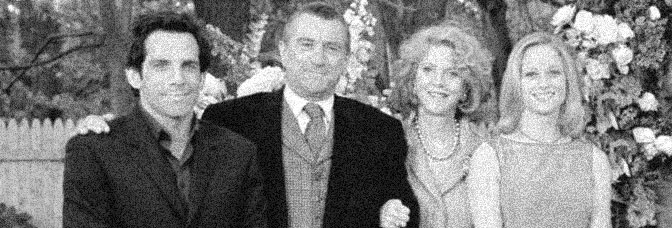
Meet the Parents requires an extraordinary suspension of disbelief. It’s an absurdist comedy, but the presence of Robert De Niro and–maybe even more so–Blythe Danner imply Parents is based in some kind of reality. So the simplest thing–believing Teri Polo could be a well-adjusted adult after growing up with De Niro as a father–becomes Parents’s…
-

If only someone involved in Battlefield Earth realized they should be making fun of the story instead of being earnest, it might have some camp value. Instead, between Barry Pepper’s humorless protagonist and John Travolta’s ludicrous villain, Earth is an exasperating affair. No one noticed Forest Whitaker looks like the Cowardly Lion? Really? He looks…
-

Is Hollow Man the last of the “for CGs’ sake” blockbuster attempts? In the nineties, post-Jurassic Park Hollywood assumed doing genre standards over with CG would get big grosses. Hollow Man feels like one of those. There’s nothing nice to say about the film, except one has a lot to mock. Incompetent screenwriter Andrew W.…
-

Something unfortunate happens during the last third of State and Main… Mamet realizes he needs a story. He goes so long without traditional narrative elements—the film has, at best, a roaming protagonist and Mamet doesn’t do much establish the ground situation as hint at one for smiles. Mamet doesn’t go for belly laughs in the…
-

Neve Campbell wanted a reduced presence in Scream 3—she doesn’t really show up in the film’s plot until an hour in—but by not participating, she’s in a worse film. Her performance is fine. Ehren Kruger’s script is so lame, she can’t do much with the role—especially since she’s got to be suspecting everyone. Except Courtney…
-

The issue ends with the good guys (at least, it seems like they’re the good guys) setting sail for Troy. I can’t say “finally,” because Shanower never really gave a timeline for when the war was to start. This issue is the first where the long lapses in time seem to affect the characters. It…
-

Shanower needs to include two things. First are maps. He moves all over the place; each issue should end with a map. Second is a cast list. He’s got this one character returning after being gone three issues. It’d help if a cast list reminded the reader of characters and their histories. Otherwise, it’s a…
-

Shanower fast forwards approximately nine months and opens with the birth of Achilles’s son. No one knows about Achilles and the girl, everyone still thinking he’s a girl too. It’s somewhat extraordinary and doesn’t work in Shanower’s realistic retelling. Achilles is such a jerk, it’s also unlikely sometime in the nine months he wouldn’t have…
-

Well, certainly by Republican standards, Achilles is not a rapist. The issue ends with him, dressed as a female, forcing himself on a girl. They’re presumably about thirteen. Between him and Paris, Shanower seems to be implying men’s errors tend to be due to desire for women (in Paris’s case, Helen). I imagine it’s in…
-

Ennis brings Rifle Brigade safely home for its delightful conclusion. It’s a somewhat busier issue than usual, as it opens with the boys still in the SS prison. They get out quickly, sabotage some German laboratory and head off for their escape. Actually, most of the issue is action–they’re escaping in a stolen plane and…
-

The lunacy continues. And maybe amplifies a little. While the boys in the Rifle Brigade are being questioned by a busty SS woman, the regular army guy who caught them is bickering with the SS commander. Basically, Ennis just uses the structure to get in as many Nazi jokes as possible. There’s a beauty to…
-
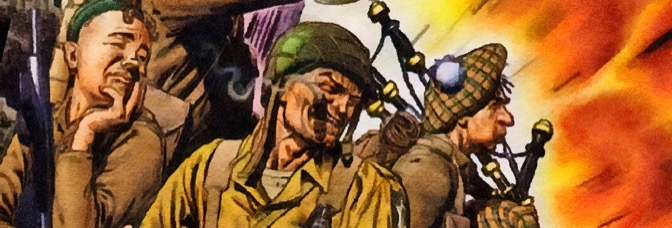
Rifle Brigade might be Ennis at his funniest (this first series anyway). He mixes absurdly graphic violence with constant humor here. There’s nothing going on but his attempt to get a laugh out of situations. He even takes the time to set up jokes, like the gay soldier trying to get a dying kiss out…
-

Moore finishes the story with an unexpected conclusion, one he hadn’t hinted at earlier and should have. Tom Strong’s birthday was coming up. It ends at his birthday party (and the Millennium City Y2K party). It’s a great scene, but it’s sort of tacked on. This issue is significant for one major reason. Moore talks…
-

It’s appropriate Gibbons draws the flashback story here, given the villain–Saveen–reminds a great deal of the villains in Watchmen. Moore doesn’t suggest a lot of superheroes in Tom Strong, it’s all a lot more science-based. The issue is, for a large part, a walk through Tom Strong’s past. Saveen’s set up a little museum to…
-
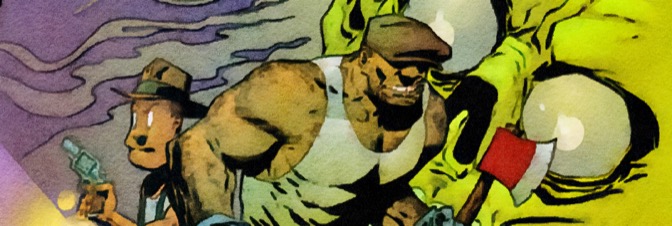
The final issue of Dark Horse Presents doesn’t even note it on the cover. On either cover actually. If it weren’t for The Goon, one might say the series just trailed off. Luckily, it does have The Goon. That statement is not to suggest The Goon is fantastic. It might be only my second ever…
-

Well, Gray inking Sook on Witch’s Son—at least at this stage of Sook’s career—produces a far better result than Sook inking himself. It still looks very Mignola, but there’s a lot more fluidity to the characters. As for Allie’s script? It’s competent in terms of dialogue, but the content is fairly weak. Witches, demons, yada…
-

Another fine issue. The pleasant surprise is the Angel story finally approaches good. Golden and Sniegoski introduce a lot of humor into this installment (completing the story) and it helps a lot. Also, Horton and Lee are mostly drawing supernatural beings and they do it well. The end’s a bit weak, but it’s something to…
-

It’s the “all female” issue… without a single female creator working on the book. The best is in the Buffy story, when they turn rape prevention into a pun. The Buffy story is the worst–Fassbender and Pascoe’s writing is, tasteless jokes aside, awful. Their dialogue is weak as is their plotting. Richards and Pimentel’s art…
-

Finally… a solidly mediocre issue. Iron Reich 3000 isn’t bad. Land writes it like an infantry comic set in the future (one has to wonder about Starship Troopers influences) and Saiz and Blanco do a good job with the art. Saiz’s abilities are clear here… but he does draw all his characters like male models. It’s…
-

I think some of these Presents licensed properties stories might be ideal examples of why properties should never be licensed across mediums. This issue’s Angel—and Golden and Sniegoski’s script isn’t even bad—is too short and too slight, even for the concept (one of the Angel cast makes a Blair Witch movie for demons). Horton and Lee’s art could be…
-

Von Shelly has another fumetti this issue. While I suppose it’s a bit of an achievement to mix all the photos together, it’s godawful. Von Shelly’s writing is real bad. It’s clear he thinks his work is maybe the greatest thing ever; only a similarly minded (i.e. illiterate) reader would enjoy it. Full Throttle is…
-

Mignola’s Hellboy is inexplicably pointless. Hellboy’s sort of the main character, but it’s really this secret group of people out to… kill him? Study him? Mignola never specifies and it makes the ending flop. The first part is decent—it is nice how Mignola works out a three-act structure even in eight pages or whatever—but it quickly…
-

The issue opens with Petrie, Richards and Pimentel on Buffy. Petrie’s writing is awful (Buffy explains the story to herself through expositional dialogue) and the art is fairly weak. Even the resolution is lame. Chadwick’s Concrete is bad, but in interesting ways. Chadwick avoids the usual humanity of his stories (good or bad) and concentrates on the…
-
Jeter runs out of space here a little. He’s got an exciting conclusion, but then he’s also got a big special effects conclusion (Cypress is disastrous as rendering it, unfortunately) and some more talking heads stuff. Also–and here’s why I was confused last issue. He’s got the station commander–Major Kira (you can’t refer to “Deep…
-

This issue is the all action issue. Or close to it. I think N-Vector is most useful–not to discount its success as an episode of “Star Trek: Deep Space Nine,” it’s a fine episode of that television program–as an example of how television pacing can be adapted to comic books. The problem, of course, is…
-

Did Wildstorm not get the likenesses in their “Star Trek” license or something? At first I thought it was just Cypress’s style, bringing a scratchy indie feel to a completely mainstream release, but now I’m wondering if it’s just because he couldn’t draw the actors. His artwork is a little static at times, especially for…
 The Stop Button