Superboy (1949) #222

Cary Bates, Jim Shooter (script)

Mike Grell, Michael Netzer (pencils)

Bob Wiacek, Bob Layton (inks)

Jack C. Harris (assistant editor)


Murray Boltinoff (editor)

Mike Grell gets an inker for his pencils on the feature, but Bob Wiacek doesn’t bring anything to improve on them. In fact, the figures might be worse. Some of the close-ups, from certain angles, are better than usual for Grell. Not so the rest.

Cary Bates contributes the script, which has Tyroc rampaging around Metropolis, angry the Legion doesn’t want to move its headquarters to his island. Even without the later clarifying details, it’s an incredibly thin setup. We get the science police complaining to the Legion, the Legion revealing Tyroc’s having a tantrum, and then the Legion going after him. They catch up to him at a park, where they capture him.

Not the end of the story by a long shot because then the Legionnaires show up at the jail with another suspect and a whole story about how Tyroc has been framed. If only it weren’t a way for Bates to kill two pages before wiping the stakes and loosing Tyroc back onto the unsuspecting populace. What could be causing the Legion’s latest member to break so badly? Just hang on for two more narrative feints, and Bates will explain everything!

The remainder of the story is then Bates backfilling on the reasoning for a bunch of other details throughout. The whole thing’s set up to have the reader, the public, and some of the Legionnaires convinced Tyroc isn’t Legion material (seriously, he was the first Black guy on the team, and they gave him this story). It’s unremarkably bad, except in the historical sense. And to see how an inker can somehow make Grell’s figures worse. Superboy goes from having a bulky torso and skinny legs to a skinny torso with skinny legs.

Jim Shooter, Mike Nasser, and Bob Layton contribute the backup. Superboy, Timber Wolf, and Lightning Lass are going to a faraway planet for some celebration. The president of Earth couldn’t be bothered to attend. On the way, they watch their favorite superhero movies starring Questar, who will also be at the ceremony.

I assume Shooter didn’t know he’d be following up a feature with a multiple narrative switchbacks, so when he does two of his own… well, it rounds out the issue overall, I guess.

The art’s not as good as the feature, which isn’t a particularly high bar, but either Nasser or Layton doesn’t understand how fingers look. There are other things they don’t understand, but not knowing how fingers look….

It’s a particularly bad finish for Superboy, too. He comes off like a callous prick.

The feature’s tedious and unrewarding. The backup’s more of the same.

Legion of Super-Heroes (1980) #268

Lsh268I’ve always had a soft spot for Steve Ditko’s art. Even thirty-ish years ago, when I was starting to recognize creators in Silver Age books—hunting down older comics to read—Ditko was already a reclusive, right-wing crank. No doubt complaining about wokeness since 1985. History’s just proven his being quiet about it was the only difference between him and many other comic creators.

Except, of course, the talent. Ditko’s art has an energy about it, even here in a Legion of Super-Heroes fill-in. Bob Wiacek inks, doing what he can in the medium and long shots, but there’s this bewildering mix of static and kinetic in the Karate Kid fight scenes. The figures seem stiff, but they move fluidly. And then there’s something weird about the close-ups; not sure if it’s too much Wiacek or not enough.

The outer space stuff is fantastic. Full stop. Steve Ditko’s 2001.

The story—by J.M. DeMatteis—is ambitious but not successful. DeMatteis introduces a wild villain—named Doctor Mayavale—who kidnaps some of the Legionnaires, saying they’ve got a history together from previous lifetimes. The issue plays out like a spec script for a “Star Trek” episode—hey, maybe a “Star Trek: Phase Two” episode—only with the three Legionnaires kind of having something to do with the story. Only not really, just for action scenes.

It’s an incredibly padded story, starting with a reference to current events in the series, then a bookend with Lightning Lad and Saturn Girl (I think; I’ve been reading these for months, and I’m still not sure on most of the names—though Cosmic Boy’s the one dressed like a male stripper). Speaking of Cosmic Boy, he then narrates the flashback–so much padding. Then the mind-boggling cosmic space-time odyssey fit into an “each hero in separate trouble” comic book template.

There’s some really iffy Native American cultural appropriation, which DeMatteis ratchets up throughout the story, and the resolution’s very pat—even for a Legion fill-in—but the issue’s got some charm. It’s silly to see some guy talk about the secrets of the universe when Steve Ditko’s drawing him as a General Custer wannabe. It’s like they knew the absurdism would actually help, so they amped it up.

The wrap-up bookend kills the momentum, but it’s a much better read than it ought to be.

Superboy and the Legion of Super-Heroes (1977) #240

Slsh240

So Howard Chaykin doing layouts of a teen superhero book without being pervy. All the dudes look about forty-five. It’s hilarious. It’s not good, but it’s hilarious. There’s only one female Legionnaire in the story—Phantom Girl—who’s not as scantily clad as Cosmic Boy, so not the salacious Chaykin one might expect. Also, he’s just doing layouts (over Alan Kupperberg’s layouts, according to Kupperberg), with Bob Wiacek finishing. And maybe Al Milgrom, who’s got editor credit, doing more inks (according to Milgrom, not the credits).

Not good art. Like. There are some cool ideas for visuals—Colossal Boy holding up a bridge and various future stuff—but it’s a patriarchal decorum story set in a cool-looking sci-fi future. The patriarchal decorum thing is the subtext; the main plot is about a bad guy named “Grimbor the Chainsman” hunting down the Legion because they locked up his lady love, Charma (whose power was to charm men), and she died in prison. Because they put her in a lady jail and ladies hate Charma; the power she had over men worked in reverse over ladies. Everyone’s really boringly straight in the future.

Including Cosmic Boy, who’s bummed out because he misses the Legionnaires who just got married and left. He’ll never get married and leave, though, he assures Superboy, who’s all up in his business; Legion over ladies.

Superboy and Phantom Girl have that patriarchal decorum thing going; he wants to make sure Cosmic Boy’s not lollygagging over missed friends and failed romances. If you’re going to be a Legionnaire, your head’s got to be in the game. Meanwhile, Phantom Girl’s made at Colossal Boy about something he did last issue, and her subplot is about not being allowed to have feelings if they go against the boys.

Cool.

Jack C. Harris scripts from Paul Levitz’s plot. The plot’s better than the script, though only slightly. After spending the issue setting up a second part, they wrap it up in a few pages anyway, so there’s at least a wasted page forecasting a future adventure. They’ve also got the problem the bad guy’s got a real motive–shame it was too early for them to call the story The Wrath of Grimbor. The “chainsman” stuff is weird, though maybe it’s all a metaphor for a bunch of vanilla straights bullying bondage enthusiasts.

And the story comments on how Legionnaires are cast based on how their powers will combine to resolve plot points, which is a little on the nose.

The backup, however, is a visual delight. James Sherman on pencils, Bob McLeod on inks, it’s absolutely gorgeous. The art sustains for the whole story, all twelve pages, with some standouts even on the last page. It’s great-looking superhero art, just phenomenal.

The story’s about how Dawnstar’s a stuck-up b-word who needs to learn to play well with others. She’s one of those uppity Native American descendants gone to space who became navigational mercenaries, and she’s only in the Legion because she gets paid. She’s not some nerd who wants to be a superhero.

She and three other trainees need to go on a real mission, only she’s pissed everyone off, and no one wants to work with her. Will she survive on her own? Will she learn a valuable lesson about teamwork?

What’s funny is how the setup for Dawnstar being the focus is team leader and trainee trainer Wildfire asking her out on a date. Mind you, he’s a complete asshole in addition to not having a physical form outside his super-suit. So there’s a considerable power dynamic thing going on, but, obviously, the comic will not acknowledge it. Please.

Again, truly great art, so it doesn’t matter. Levitz plots, Paul Kupperberg scripts. The dialogue’s much better than the feature. Not great—it’s also not a great dramatic arc—but much better.

That Sherman and McLeod art, however, is divine.

The Sensational She-Hulk 1 (May 1989)

The Sensational She-Hulk #1John Byrne finds a nice approach for Sensational She-Hulk–it’s a gag. He doesn’t just go for humor, he finds the right balance between humor for the characters and the reader. It’s entertaining, which is the point, but very expertly executed in how he delivers that entertainment.
He never lets She-Hulk be a joke or her comics history–in fact, some of Byrne’s handling of crowd (this issue mostly takes place at a circus) reminds of Silver Age Marvel. But there’s also the Byrne art. He gives himself a cast of peculiar characters to illustrate and does well with them. The final reveal takes it a little far, but the whole circus setting is fantastic.

It’s not a deep comic and there’s not much character development, but it’s a lot of fun and the art’s good. Byrne’s attitudes–both to his narrative and to his protagonist–are strong.

B 

CREDITS

Second Chance; writer and penciller, John Byrne; inker, Bob Wiacek; colorist, Glynis Oliver; letterer, John Workman; editor, Bobbi Chase; publisher, Marvel Comics.

The Flash 298 (July 1981)

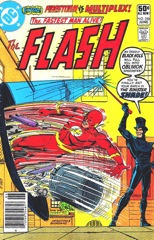
The Flash #298I’m not sure how to phrase it exactly, because Bates hasn’t exactly dumbed down The Flash for Infantino’s return to the book, but he’s definitely dulled the characters down. It’s like he’s changing the audience, aiming younger. There’s no character development anymore and the character details are lame. One colleague of Barry’s wonders if he’s always running off because the guy has bad breath.
Yawn.

There’s also not as much emphasis on the science of The Flash’s powers. Bates just lets Infantino run wild with the art and fills in with endless exposition. It makes for a strange read, because whether Infantino is trying hard or not, the art’s excellent. But Bates is no longer trying. It’s too bad.

The Firestorm backup still has Cowan on the art and thankfully no high school scenes. There’s a lot of action packed into a few pages and it all works well enough.

C+ 

CREDITS

A Deadly Shade of Peril; writer, Cary Bates; penciller, Carmine Infantino; inker, Bob Smith; colorist, Gene D’Angelo. Firestorm, The Multiplex Complex; writer, Gerry Conway; penciller, Denys Cowan; inker, Bob Wiacek; colorist, Jerry Serpe. Letterer, Ben Oda; editor, Len Wein; publisher, DC Comics.

The Flash 297 (May 1981)

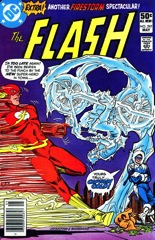
The Flash #297There’s something a little off about this issue. While Infantino is (hopefully) the new regular artist and he definitely has some good work in the issue–he can turn the smallest panel into the fullest one with all the movement and action–Bates is a little tone deaf.

The problem might be the two-fold nature of the plotting. Captain Cold is out on parole and has turned himself into a hero, but Barry’s mom is also in a coma following a traffic accident. Bates dismisses any struggle about being a superhero while being a supportive son–Barry decides being the Flash is more important, no question.

The Cold plot has a terrible resolution. Bates introduces a good story for him, then rushes through it.

Good thing the art’s nice.

Denys Cowan pencils the Firestorm backup’s high school students like thirty-somethings. Conway tries to do some character work, but there aren’t enough pages.

C+ 

CREDITS

Capt. Cold’s Cold, Cold Flame; writer, Cary Bates; penciller, Carmine Infantino; inker, Bob Smith; colorist, Gene D’Angelo; letterer, Todd Klein. Firestorm, Multiplex Means Multiple Choice… Death!; writer, Gerry Conway; penciller, Denys Cowan; inker, Bob Wiacek; colorist, Phil Rachelson; letterer, Milton Snapinn. Editor, Len Wein; publisher, DC Comics.

The Flash 296 (April 1981)

The Flash #296What’s strange about the feature is how much better Bates writes Elongated Man and Sue Dibney than he does Barry and the Flash. There’s a lot of charm to his characterizations of the Dibneys and it breathes a lot of life into the story.

Of course, the story also has Carmine Infantino artwork and every page has one or two phenomenal panels; Infantino is able to turn anything the Flash does into a moment of comic gold, whether it’s a fight scene or just a costume change. It’s not just how much movement Infantino implies, it’s how he composes each panel to have a narrative flow to it.

It also doesn’t hurt the story’s a genuine surprise with a great reveal.

The Firestorm backup has Conway trying too hard to make the protagonist likable, but some ambitious artwork from Starlin. Rather unfortunately, the detail doesn’t live up to the composition.

B 

CREDITS

The Man Who Was Cursed to the Bone!; writer, Cary Bates; penciller, Carmine Infantino; inker, Bob Smith; colorist, Gene D’Angelo. Firestorm, Rain, Rain, Go Away… Come to Kill Us Another Day!; writer, Gerry Conway; penciller, Jim Starlin; inker, Bob Wiacek; colorist, Jerry Serpe. Letterer, John Costanza; editor, Len Wein; publisher, DC Comics.

The Flash 295 (March 1981)

The Flash #295Heck gets lazy on the strangest stuff for the feature in this issue. It’s not the super gorillas or all the different locations in Bates’s script… no, it’s the people. Whenever Heck is drawing a person, it just doesn’t work out. It’s like he spent all his time on everything else and rushed through the faces.

The feature story has an odd structure too and it never quite recovers from it. Bates relies on deceiving the reader to get create drama at the end, but he also weighs down the front of the story. There are a couple lengthy action scenes as Grodd is brainwashing Flash and the good super gorilla; these scenes are quick and pointless and Bates gives them too much time.

He just moves too fast through the story, which is too slight anyway.

The Firestorm back-up has Conway suffering pacing problems too. And the art’s mediocre.

C 

CREDITS

In Grodd We Trust; writer, Cary Bates; artist, Don Heck; colorist, Gene D’Angelo. Firestorm, By the Sea, By the Sea, By the Dangerous Sea; writer, Gerry Conway; penciller, Jim Starlin; inker, Bob Wiacek; colorist, Jerry Serpe. Letterer, Ben Oda; editor, Len Wein; publisher, DC Comics.

The Flash 294 (February 1981)

The Flash #294The super gorillas. I forgot about the super gorillas. If Bates likes writing anything more than strange applications of Flash’s powers, it’s got to be these super gorillas.

But the super gorillas aren’t interesting to talk about, because it’s just the overdone dialogue and the gorillas talking about their intelligence. The Flash’s powers and their applications? At least in those scenes Bates is trying something. It’s a decidedly not visual way to express the powers. Artist Heck doesn’t do anything special with these scenes either. The feature story’s visually unimaginative.

Luckily, Bates has a good plot. It’s multi-layered, it’s got a lot of neat plotting tricks. It works out well, even though Bates probably shouldn’t have started foreshadowing the cliffhanger so early in the book. Not so obviously.

The Firestorm backup has terrible art from Jim Starlin and Bob Wiacek. It’s impossible to ignore it and the story suffers.

B 

CREDITS

Fiend the World Forgot; writer, Cary Bates; artist, Don Heck; colorist, Gene D’Angelo. Firestorm, The Typhoon Is a Storm of the Soul; writer, Gerry Conway; penciller, Jim Starlin; inker, Bob Wiacek; colorist, Jerry Serpe. Letterer, John Costanza; editor, Len Wein; publisher, DC Comics.

The Further Adventures of Indiana Jones (1983) #21

The Further Adventures of Indiana Jones  21

There are a bunch of inkers on this issue. They stay consistent until the finish, when it’s very obvious the inker has changed. The final inker changes Steve Ditko’s pencils so much, it barely looks like the same comic.

Ditko doesn’t do a great job on Jones, but it’s really cool to see his old standard panel arrangements used again. And the eyes. Love the eyes. It’s a shame Priest didn’t write the issue as a retro thing to match Ditko, but given the number of inkers, I’m sure no one at Marvel had any idea who was drawing it when Priest was writing it.

The story itself is lame. It’s a lot of action and some silly villains. Priest continues to flush the romance between Indy and Marion… Not to mention playing up Marcus Brody being tough.

Priest is also really bad with the setting. He writes too modern.