Detective Comics (1937) #470

Dc470

There’s a lot to be said about this issue, but the “highlight” has got to be when writer Steve Englehart describes Batman as the “pensive prince of shadows.” This line comes just before Batman goes to the Batcave and yells, “I’m the goddamn Batman,” to himself as a positive self-reinforcement.

I’m only slightly exaggerating; Englehart writes Detective Comics with a boisterous, entirely unwarranted enthusiasm. Unfortunately, he’s incredibly thoughtless too. The first big swing is Batman stops a jewel heist and, while beating up the crook, tells the villain he’s just defending his municipality of residence and, as a citizen, it’s his right to be a vigilante.

Just then, a process server shows up and hands Batman a subpoena for a grand jury. Gotham’s regular folks have had enough of Batman. The issue implies there’s something shady about these elected officials out for Batman, which makes sense—they’re shitty rich white guys just like… oh, wait, just like Bruce Wayne.

And even if Batman thinks they’re corrupt, shouldn’t he have proved it at some point instead of going rogue? Or letting them operate for decades. So no, “your feast is nearly over” here. But he’s now been duly, lawfully told he needs to knock off the vigilante shit, and his response is exactly what you’d expect from a mega-rich white guy.

Englehart writes Batman as an asshole fascist in Detective, but, you know, for kids. Except when Silver St. Cloud shows up, Bruce forgets about his “I’m Bat-Man, and I don’t like girls” monologue. Then Bruce turns on the sultry seventies predatory charm.

Amid all the nonsense, Batman fights Dr. Phosphorus. The story’s title is The Master Plan of Dr. Phosphorus! but he literally just gases people at a stadium. There’s not much master planning to it. Otherwise, he’s waiting around for Batman to show up and kick his ass. Englehart’s Batman’s a killer too.

Seriously, the whole thing reads like a potentially better Val Kilmer and Joel Schumacher Batman movie. It feels like a pseudo-gritty riff on “Batman: The TV Show.”

Either I’m acclimated to Al Milgrom inking Walt Simonson, or the art’s a little better. Simonson and Milgrom’s costumed Batman art is very, very silly—which the exposition sometimes exaggerates, like when Batman “stands motionless” for seven minutes after being served his subpoena. On the other hand, there’s a little more regular people talking this issue; they’re fine with the Bruce and Silver stuff. Not great, but fine.

The Dr. Phosphorus fight’s weak sauce, though, both writing and art.

What a weird, bad comic.

Detective Comics (1937) #469

D469

Why does Steve Englehart’s writing sound like he’s doing a spec script for “Batman: The TV Show” cliffhanger narration? I can’t decide if it’d be better if he’s serious and thinks it’s good writing to treat your readers as infantile or if he’s doing it because he’s being condescending to the material. Either way… lousy start.

Especially since I only started reading this era of Detective for an Englehart run.

Yikes.

From the first page, it’s a lot. There’s the narration, but there’s also Englehart doing a flashback on the second page to right before the first page. Alfred passed out when bringing Batman his morning snack. It appears sensational at first, then, you know, medically concerning. Maybe Alfred hit his head.

Batman can’t get an ambulance because there’s an epidemic all of a sudden. People collapsing all over Gotham, so he rushes Alfred to the hospital as Bruce Wayne because Bruce Wayne “pays his way.” But, again, is Englehart being silly, or did he just finish reading some Atlas Shrugged for inspiration?

A new villain is poisoning the city—Mr. Phosphorous—no, wait, Dr. Phosphorous—and he’s not going to stop. So Batman goes home (his Bruce Wayne caring for Alfred thing does not warrant a scene of concerned Bruce, it’s nonce) and investigates what poisoned Alfred. It takes Batman longer than it should. Like, it’s one of those Bob Rozakis “you-solve-its” only Batman had to cheat on the last page and turn the comic upside down.

He’s able to go confront Doctor Phosphorous, who’s got a hilarious way of poisoning the people, and they have a big fight. Only Doctor Phosphorus is really hot, and it hurts to fight him, which leads to Batman wrapping his non-heat or flame-resistant gloves in his cape. The cape is heat and flame-resistant. It’s a poorly designed outfit or something, doesn’t matter. Neither does Batman’s next way to compensate.

The scene ends with Doctor Phosphorous running off while Batman whines at him to stay and fight; Doctor Phosphorous says you have to come back next issue, silly, it’s a two-parter.

The backup is Doctor Phosphorous’s origin, which unexpectedly ties into the main story. Phosphorous knows the city council guy who’s giving Gordon shit about Batman being a deputized vigilante—a different city council guy than a few issues ago; apparently, each Detective writer has to introduce their own similarly smarmy white guy whine. The city council’s corrupt and caused Doctor Phosphorous to become Doctor Phosphorus (sort of, he’s the one who thought he’d inspect a nuclear power plant on his own). So to pay him back for ruining his life, the city council has to set up Batman.

It’s a complicated, petty politics story arc, with narration written for a very bored narrator to read. At times it feels like Englehart must’ve tested the lines aloud and liked the terrible way they sound.

Big sigh.

Al Milgrom inks Walt Simonson pencils. It doesn’t go well for Batman or the people, but Doctor Phosphorous is all right. The art stylizes the people strangely—some guy’s got Norman Osborn hair—and Batman’s awkwardly bulky. Phosphorous is a glowing skeleton. They do best with him.

It’s a bad comic. Like, even for this era of Detective… it’s a bad comic. What have I gotten myself into?

Bullwhip (2017) #1

Bullwhip 1

Is Josh Bayer the right person to write Bullwhip? It’s about a seventies female superhero who fights bad guys named “The Misogynist” and time traveling space vampires who are also misogynists. There are enough misogyny “jokes,” one might even think Frank Miller wrote this thing. So, no, he’s not the right person. He goes overboard with the joke and lacks any humanism in his portrayal of Bullwhip. She’s the butt of various jokes and action setpieces, but she’s hardly the lead in the comic. It also has time traveling vampires, which is fine, though it’s all ripped off from popular media (save the vampire aspect). At least Ben Marra and Al Milgrom’s art is all right.

Bullwhip 1 (April 2017)

Bullwhip #1Is Josh Bayer the right person to write Bullwhip? It’s about a seventies female superhero who fights bad guys named “The Misogynist” and time traveling space vampires who are also misogynists. There are enough misogyny “jokes,” one might even think Frank Miller wrote this thing. So, no, he’s not the right person. He goes overboard with the joke and lacks any humanism in his portrayal of Bullwhip. She’s the butt of various jokes and action setpieces, but she’s hardly the lead in the comic. It also has time traveling vampires, which is fine, though it’s all ripped off from popular media (save the vampire aspect). At least Ben Marra and Al Milgrom’s art is all right.

CREDITS

Web of Oblivion!; writers, Benjamin Marra Josh Bayer; penciller, Marra; inker, Al Milgrom; colorist, Matt Rota; letterer, Rick Parker; publisher, Fantagraphics Books.

Howard the Duck 31 (May 1979)

Howard the Duck #31What a bad comic. Whether it’s Mantlo’s rhyming of adjectives and nouns, the lamebrain fight scene, Bev’s silly way of resolving her situation–it’s all bad. It’s all bewilderingly disconnected, not just from the series, but from the other elements of the comic. It’s like Mantlo can’t even figure out how to move these characters in relation to one another.

And I want to be positive about it. Like anyone would be in trouble trying to followup Gerber but Mantlo does a bad job. Independent of not being Steve Gerber, he does a bad job. Howard acting like a snarky sitcom character isn’t Howard. He and Bev get together again it’s not even a scene. Regardless of having Colan on the pencils (though Milgrom’s inks weaken quickly), it doesn’t feel right.

Howard’s big adventure ends and it’s not even Howard anymore. It’s a clueless imitation. Marvel Nurse Ratchet’d him.

CREDITS

The Final Bong!; writer, Bill Mantlo; penciller, Gene Colan; inker, Al Milgrom; colorist, George Roussos; letterer, Irving Watanabe; editor, Jim Shooter; publisher, Marvel Comics.

Howard the Duck 30 (March 1979)

Howard the Duck #30Al Milgrom inking Gene Colan. And it’s not bad. It looks like Milgrom does a lot of work on Howard’s face–his lines are smoother than everything else–but otherwise, it’s not a bad job inking at all.

Milgrom’s not the only change. Steve Gerber’s gone and Bill Mantlo’s scripting. He changes some details about Howard’s current predicament, immediately removing the complications for Howard and Beverly, and gets going with the adventure.

Howard gets a suit of Iron Man armor to fight Dr. Bong. It’s really dumb and it’s hard to believe it won’t some day end up in a Marvel movie with Robert Downey Jr. doing a $100 million five minute cameo.

At one point in the issue–which is terribly written–Mantlo gives Howard a line about how death is preferable to humiliation. Howard might survive without Gerber, but Mantlo’s humiliating the poor Duck, page after painful page.

CREDITS

If This Be Bongsday!; writer, Bill Mantlo; penciller, Gene Colan; inker, Al Milgrom; colorist, Michele Wolfman; letterer, Elaine Heinl; editors, Mark Gruenwald and Jim Shooter; publisher, Marvel Comics.

Firestorm, The Nuclear Man 5 (October-November 1978)

Firestorm, The Nuclear Man #5It’s a pointlessly double-sized issue. The extra pages give Conway time to get in fight scenes between Firestorm and both villains–and the art on the fight with the Hyena does have a great double page spread–without having to sacrifice the character development.
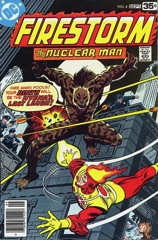
Ronnie and the girlfriend, Doreen, go on an actual date. There are big problems with the date, both in them walking into a supervillain fight and in now Conway forces too much ominous foreshadowing, but it’s at least a scene between two people where they exhibit personalities.

There’s some really good stuff with Professor Stein too. Conway roams a lot as far as protagonists for a scene. It’s too omniscient to let the comic have a personality, but it’s definitely effective for engaging storytelling.

The problem is there’s just too much in the issue and it ends without having accomplished anything. It’s inflated but empty.

C 

CREDITS

Again: Multiplex!; writer, Gerry Conway; penciller, Al Milgrom; inker, Bob McLeod; colorist, Jerry Serpe; letterer, Clem Robins; editor, Jack C. Harris; publisher, DC Comics.

Firestorm, The Nuclear Man 4 (August-September 1978)

Firestorm, The Nuclear Man #4The issue opens with a lengthy recap of the previous one’s events and Conway’s found a great way to do exposition in the series. Ronnie and Professor Stein just talk about it naturally.

There’s a certain appeal to this issue of Firestorm, even though Conway tries through hard throughout. About the only time he isn’t overextending himself is with Professor Stein. Those scenes are perfectly measured.

The stuff with Ronnie–who has problems with his dad, problems with the kids at school–goes too far. Conway has a couple really nice moves in his scenes, but it’s way too obvious he’s going for melodrama and not letting the character build naturally. From scene to scene, there’s no sense of the previous scene having any effect on the character, just being a display for the reader.

Also problematic this issue is the villain–the Hyena. The Hyena talks a lot and it’s really goofy.

B- 

CREDITS

When Laughs the Hyena!; writer, Gerry Conway; penciller, Al Milgrom; inker, Jack Abel; colorist, Gene D’Angelo; letterer, Clem Robins; editor, Jack C. Harris; publisher, DC Comics.

Firestorm, The Nuclear Man 3 (May 1978)

Firestorm, The Nuclear Man #3I don’t know how best to make the remark without it sounding like a slight but McLeod inks the heck out of Milgrom’s pencils this issue. There are maybe two questionable panels, otherwise the art is first-rate.

And it’s first-rate art on an excellent comic. Conway doesn’t do a direct sequel to the previous issue, he jumps ahead a bit and starts with Firestorm being juvenile. There’s a lot in the issue about the dynamic between Ronnie and the Professor when it comes to being Firestorm and the maturity required for it (Conway wants to say the great power line and does come close).

There’s also quite a bit with Professor Stein on his own, which is cool. And the villain introduced is Killer Frost. I should have punned.

No, I shouldn’t have.

The issue’s very strong thanks to the emphasis on Stein and the villain. Very strong.

B+ 

CREDITS

Kiss Not The Lips of Killer Frost; writer, Gerry Conway; penciller, Al Milgrom; inker, Bob McLeod; colorist, Mario Sen; letterer, Ben Oda; editor, Jack C. Harris; publisher, DC Comics.

Firestorm, The Nuclear Man 2 (April 1978)

Firestorm, The Nuclear Man #2I don’t want to spend time griping about Milgrom’s pencils. If his composition were better, I might even let it pass, but the composition–and how he handles the costumed stuff–is a real problem. Conway gets in a lot of scenes and Milgrom handles the transitions awkwardly. His figures in superhero motion are really awkward, especially the flying. Superman guest stars too so lots of flying.

This issue picks up the day after the previous issue with more superhero stunts from Firestorm. He gets a villain–Multiplex–and Conway works a little bit on the character stuff too. Conway succeeds at making teenage Ronnie Raymond simultaneously a star athlete and a kid with low self-esteem. Right now, it’s all in broad strokes. Conway’s hinting there’s more depth.

As for Professor Stein, the other half of Firestorm, Conway doesn’t give him much space.

The issue’s likable, but very problematic.

B- 

CREDITS

Danger Doubled Is Death; writer, Gerry Conway; penciller, Al Milgrom; inker, Bob McLeod; colorist, Adrienne Roy; letterer, Ben Oda; editor, Jack C. Harris; publisher, DC Comics.