

The strangest thing about the first five stories in Omnibus Volume 1 isn’t how writer Gardner Fox uses Barbara Gordon’s position at the Gotham Public Library to explain how she somehow targets criminals. She violates professional privacy standards—if not laws (it was the late sixties, who knows)—to figure out where the bad guys are going to strike so she can go out and beat them up before Batman and Robin get there.
I’m going to assume Fox just didn’t know anything about the library profession (were there Ph.D.s in library science in the late sixties or is Barbara’s doctorate just there to be something else for her father not to be impressed with) and not it being some kind of statement on how we should all be a little more fascist when it comes to enabling women (and men) dressed as bats.
The strangest thing is how it takes Fox until the last story to explore how Barbara’s inherent femininity as expressed with concern for her appearance, her deference to men, and her propensity to scream at inopportune times is going to be a problem for crime-fighting. The collection opens with a foreword from Gail Simone talking about how the character—as created—didn’t have much to offer the female readership but reading Fox’s stories?
It’d be worse if he thought there were a female readership. Sure, he’s telling little boys how to be both misogynist and ignorant, but at least he’s not telling little girls their value is only as sex objects for boys? Probably? Like, Fox’s Batgirl isn’t really cheesecake though artists Carmine Infantino and Sid Greene do employ some cheesecake, but there’s this definite undercurrent with Robin lusting after her. But in late sixties Code comics so it’s simultaneously subtle and grossly overdone.
Anyway, why Fox waited until the last story to remind everyone girls are better to look at than anything else—it’s also an about face from earlier stories where Batman tells Robin they have to respect Batgirl even though she’s, you know, a girl–is the strangest thing about his stories. They go out on a low; already brought down by a two-part Catwoman story (Frank Springer pencils the second half; it misses Infantino) where Catwoman is jealous of Batgirl and wants to force Batman to put a ring on it ASAP.
The most amusing part of that story is Fox finding an honest moment with Barbara, who’s surprised and perplexed why Catwoman is all of a sudden pissed off at her.
Aside—it seems like Selina Kyle is publicly infamous costumed criminal Catwoman? Or at least Bruce Wayne knows about it? Even acknowledging these comics require a profound willful suspension of disbelief, but at some point, Fox is responsible for things not making logical sense. And they can’t be too steeped in continuity because this Bat-era is when they were introducing characters from the TV show to try to get TV viewers to read the comics.
Then again, Barbara very obviously should’ve figured out Bruce’s secret identity in one of the stories and there’s even a hint about it, but it goes nowhere. Because Fox’s stories get worse as they go along, as Batgirl is more and more the guest star. At least in the origin story she’s something of a protagonist.
Though she’s the protagonist in the story about her worrying about her hair too much to stop bad guys from trying to kill her.
I thought about writing this post with abundant alliterations but decided against it. Outside keeping a dictionary (or thesaurus, really) handy, there’s not really anything to talk about regarding Fox’s use of alliteration and adjective. I mean, other than to track if it was ripped off from Marvel at this point. Similarly, the frequent sports metaphors in Batgirl’s thought balloons had me expecting her to talk about loving jazz at any point.
But leaving these first five stories—the character’s foundation (Barbara was a new character at this point, right?)—there hasn’t been much in character development or even establishment. Fox avoids Commissioner Gordon conversations with his daughter other than to chastise her for not being more like Batgirl; otherwise, Gordon just speaks in transitional exposition to his daughter. Fox does firmly establish Batgirl’s got no romantic interest in Batman and vice verse (despite Infantino pencilling otherwise at one point), which ended up just making me remember that terrible Killing Joke movie.
It’s not the worst thing it could be. At least until the last story and then, really, the Catwoman ones foreshadow it, but even then it’s not like Batgirl quits being she’s too sexy by far. No, she’s going to keep crime-fighting and use that sexy, just like Batman says.
Ew.
There’s a little of Robin being the sexist teen and Batman having to tell him not to be—within limits—but then there’s also the Robin as Batgirl’s partner thing. It’s a complex web of mediocre comics writing (see how I qualified that one), misogyny, patriarchy, and lots more. Lots of good Infantino art, with Gil Kane pencilling the last story in a way almost indistinguishable from Infantino. The Springer you can tell, but the Kane seems just like more Infantino.
Though it is just cheesecake when Barbara is hanging out in the library after work in her Batgirl costume, which definitely seems like someone—Infantino or Fox—really wants to fetishize it.
So much of these comics should’ve gotten a “No” even in the sixties but—I just realized—they’re objectively a lot less misogynist than DC output from forty years later. It’s a definite flex to present these stories without contextualizing the rampant misogyny because outside the art, any reading of them has to be either subjectively, nostalgically influence or you just have a terrible taste in comics and bad critical thinking skills.
That statement made… obviously I’m going to keep going. Even on sale the book wasn’t cheap.


 Carmine Infantino on Howard the Duck. It works out rather well. He’s got Frank Giacoia on inks. They have fun. It helps the story is fun too–these people who run into Howard go to the same psychiatrist, which wraps the flashbacks. Howard’s story has him breaking in to an army base. The army is experimenting on the populace.
 It’s a better issue than the recent norm, but Gerber still doesn’t have Howard on much of a path. At one point, Howard all of a sudden seemed like the perfect cultural relic from the Carter presidency, but it’s not.
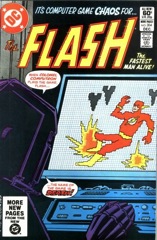 I think Bates must have just learned the word “erg” before writing this issue because he uses it ostentatiously.
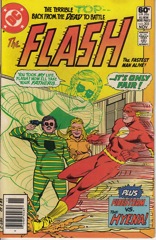 It’s a good issue for Bates and Infantino. Bates comes up with a lot of set pieces, but doesn’t hurry them. Infantino actually has time to make them visually interesting.
 I was hoping Bates would keep Flash running smoothly after the previous issue, but this one doesn’t bode well for the series keeping up. Even more than usual, Barry–and the Flash–are less characters in the comic than they are movable pieces for Bates’s plot. There’s not even the attempt at showing the Flash’s fantastic powers. Instead, Bates shows him doing what equates to a grade school science project without the traditional verbose, fantastic explanation.
 Bates seems a lot more comfortable and assured this issue–maybe assured isn’t the right word. He’s ambitious again, both in plotting the feature story and how he gets through it. The only weak part is when the Flash has to beg for Barry Allen’s job back. It reveals how little work Bates does on either character.
 About eighty-five percent of the issue is spent on flashbacks. Apparently Barry is in a mental institution, covered in bandages, and he’s been imagining the Flash side of his life for years. As he remembers things to keep himself sane, Bates and Infantino visualize them. These little stories tend to be short, sometimes just a few panels.
 It’s too bad, but not even the Infantino art can make this issue particularly worthwhile. There’s a real lack of personality to all of it; Bates is just building towards the big event with Barry’s evil father (I wonder if he’s secretly Reverse Flash, could he be) in the next issue. Not even a scene with Barry’s dad holding a gun to his head (while Barry is sleeping) has any weight.