Zombie (1979, Lucio Fulci)

They filmed a lot of Zombie on location—New York City, the Dominican Republic, the ocean floor. For over half the movie, the location filming is the most important thing—if we’re going by what director Fulci showcases the most. Not even the gore gets a bigger showcase until the third act, though there are some rather gruesome exceptions. But the static (or just panning) long shots of palm trees once the action gets to the Caribbean island where Richard Johnson is playing Dr. Moreau only with zombies are the rule. It’s very pretty, even if it’s desolate as something has happened—an unseen voodoo witch doctor has decided the dead must rise so everyone’s a flesh-eating zombie. The film can’t decide on what happened. Johnson says things went bad three months ago, non-acting action hero and world traveller Al Cliver says the island’s been cursed at least a year. It’s also unclear how long Johnson’s been on the island. And why. Despite the almost endless exposition in Zombie, usually from actors poorly delivering it, the exposition just doesn’t matter. Because Zombie is going to be all about the gross stuff Fulci and his crew get his fake shemps to endure.

For instance, I don’t think there are any shemps covered in maggots—their faces, the zombie makeup is entirely on their faces—but lots of them have live worms wriggling around the makeup. I think one zombie has a mouthful of live worms, no doubt worms not protected by the American Humane Association. The zombie makeup itself isn’t great. There are a lot of attempts at showing bone in the makeup, incorporating masks, which just makes the zombie look bulky like their skulls are retaining water or something. So the live worms and such do a good job distracting from such deficiencies. Zombie has a lot of gore in the second half, a little in the third, with Fulci saving the grossest zombies for the finale. They’re coming out of their graves too at one point, so he’s able to get a lot of mileage out of his long (timing wise) practical effects shots. Sergio Salvati’s photography and especially Giorgio Cascio and Fabio Frizzi’s music help for those shots too. They’re really good tests of one’s stomach; the last big gross-out scene the gore is so extreme it’s actually unbelievable at least one of the characters doesn’t puke. Though then we’d have to see one of the leads trying to essay puking, which they probably couldn’t do.

See, Zombie’s an Italian production shot without a synchronous audio track, which is called motor only sync (MOS). I didn’t know the jargon until today, even though pretty much every Italian production from the twentieth century seems to use this method. Thanks Wikipedia. But what the lack of synchronous sound means is the actors, who might be speaking different languages, never get any actual rapport. Fulci tries to compensate with reaction shots. It doesn’t work.

The worst case is when ostensible lead Ian McCulloch is watching Auretta Gay undress for scuba diving. She does it topless and in a string bikini bottom. McCulloch just stares, occasionally making sure top-billed Tisa Farrow’s still watching him watching. You’re worried the male gaze compounding on itself is going to cause a cosmic singularity before the sequence ends. Though McCulloch’s exceptionally unconvincing comb-over is enough to cause a singularity on its own. Farrow doesn’t mind the comb-over by the way, in fact she’s very hot to trot for McCulloch. At one point during the long opening of the third act, “escape the zombies on foot” sequence, Farrow even gives McCulloch the “I don’t want to die without sex” speech, so they get it on in a graveyard. Too bad the now zombified corpses are waking up below.

But not really because even though Farrow’s not good, she’s not a shit heel like McCulloch. It’s hard to be a such a big shit heel when you’re dubbed but McCulloch abides.

The best performances appear to be Johnson and his assistants—Stefania D'Amario and Dakar—worst are Johnson’s wife, Olga Karlatos, Gay, Cliver, McCulloch. Farrow gets a pass from that list because she’s so irrelevant once they get to the island. She mustn’t have been willing to take her clothes off. Karlatos, who the film manages to portray negatively for not wanting to be on the zombie island of undying death, also gets a gratuitous nude scene. Unlike Gay, however, it’s not prelude to something awesome. Gay’s scuba diving sequence leads into the zombie versus shark scene, Zombie’s claim to fame. It’s an impressive underwater stunt sequence. But much like the rest of the film’s impressive moments, it’s nowhere near enough to justify it. With a better budget, Fulci and his crew probably could’ve done something revolting and realistic, instead of revolting and effective. Zombie’s set pieces are gross instead of scary, but its default—with Fulci’s often good composition, Salvati’s photography, Vincenzo Tomassi’s editing, and that score from Cascio and Frizzi—is disquieting. Maybe it’d help if the third act of the script didn’t sink it.

It also doesn’t help the best sequence—an empty sailboat showing in New York Harbor, Dracula-style—is the first one in the picture.

Zone Troopers (1985, Danny Bilson)

The saddest thing about Zone Troopers is Biff Manard gives a fantastic performance and there’s no reason to see it. Nothing Manard could do would make Troopers worthwhile; it’s got so many problems—cast, direction, photography, editing, music, budget (though some of the effects are outstanding)—the thing is a wreck. With a few good ideas, a great performance, and a lot of derivative nonsense.

I got ahead of myself. I was being positive—the second saddest thing about Zone Troopers. When it has those good ideas, it can’t figure out how to execute them. You watch it, getting hopeful, then it fails and you don’t just get disappointed, you feel bad for the movie; you can tell what director Bilson (who co-wrote with producer Paul De Meo) and he just couldn’t figure out how to do it. Zone Troopers, visually, needs a lot of things—it needs cinematographer Mac Ahlberg to light sets better, it needs Bilson to figure out how to shoot his actors, and they need a crane. They really, really, really need a crane. The movie takes place in an Italian forest during WWII and there’s not a single good establishing shot in it. Not even when a crane would have helped. Bilson just can’t do it. He’s got maybe three creative shots and they’re not so much good or even better than the standard bland composition, but they’re creative. Someone thought about them. No one thinks about much in Zone Troopers.

If anyone did, Timothy Van Patten wouldn’t happen. Van Patten is the young guy in the movie. He’s the private, Art LaFleur is the corporal, “top-billed but should’ve had an the ‘and’ credit” Tim Thomerson is the sergeant, an atrocious John Leamer is the inept greenhorn lieutenant, and Manard is the wartime correspondent. LaFleur and Manard are definitely in the forties, Thomerson looks a little too old too, so for the battle scenes before the aliens show up, Zone Troopers basically looks like WWII reenactment with middle-aged men. Bilson’s direction doesn’t help with that feeling either.

Anyway, Van Patten is the young Italian kid who reads sci-fi magazines and talks all the time, especially in dangerous situations, and ignores Thomerson’s orders and almost gets everyone killed over and over again. Until the movie evens out a bit in the second act, the only thing Troopers has to keep one occupied is the hope Thomerson will just shoot Van Patten in the head for insubordination.

And Van Patten is objectively terrible. No one could watch what he was doing and think it was a good idea, not even in a movie where the script has commercial breaks in the second half, like Bilson and DeMeo were plotting a three or four-part cartoon… though it’d be a lot better as a three or four-part cartoon. Van Patten wouldn’t be in it.

The effects work is bad when it comes to the lasers and the humanoid aliens are silly, but the bug-monkey alien is at least a good suit and the script handles that character surprisingly well. Again, Bilson and DeMeo have some decent ideas, they’re just in the muck of bad performances and lifts from E.T., The Thing, Star Wars, Raiders of the Lost Ark, and… something else no doubt. They don’t have any lifts from Empire Strikes Back, which is weird because composer Richard Band rips off its score mercilessly. It and Raiders. Clearly likes his John Williams.

And if it’s not going to be a four-part cartoon pilot, Zone Troopers does seem much more like a Spielberg movie. Just an amateur one. A poorly directed and acted amateur one. With WWII re-enactors.

Prophet 28 (August 2012)

875791.jpg
Graham and company keep up the crazy and camaraderie, but continue to tone down the grossness. Prophet and his living tree sidekick are now traveling the galaxy (or at least the solar system) to find pieces of their other friend. For most of the issue, the other friend is a hodgepodge of parts. It makes for a very interesting supporting cast member.

Towards the end, Humpty Dumpty does get put back together again; Milonogiannis has a good time illustrating it. The character, Diehard, seems like it should look slick (and lame) but Milonogiannis makes the organic android lumpy and awkward.

Most of the issue takes place on a moon. Shattered pieces of planets hang in the atmosphere. Milonogiannis takes no time to beautify, instead suggests enough with his lines the reader fills in the majesty.

The Zooniverse backup is a cool discussion between Graham and Fil Barlow about Barlow’s technique.

CREDITS

Prophet; writers, Brandon Graham, Giannis Milonogiannis and Simon Roy; artist, Milonogiannis; colorist, Joseph Bergin III; letterer, Ed Brisson. Zooniverse; writers, Graham and Fil Barlow; artist and colorist, Barlow. Editor, Eric Stephenson; publisher, Image Comics.

Dark Horse Presents 67 (November 1992)

dhp67.jpg
The issue opens with an idiotic story about an annoying character called Zoo-Lou. Hedden and McWeeney usually do great work. The art here’s excellent, but the writing is an absolute nightmare. Dark Horse really loves poking fun at themselves… and usually it comes out awful, like Zoo-Lou.

An Accidental Death comes to its conclusion here. No one does this kind of angst and suffering like Brubaker. Everything he does these days is a waste compared to what he could be doing. Brilliant work from Shanower too.

Duffy and Sakamoto have an awful story called Nestrobber. It’s just atrocious.

The Predator story is weird–it’s based on an Andrew Vachss story. Not bad, just too soon to tell.

Campbell’s got a funny Alec, then Russell closes with an Oscar Wilde adaptation. It’s a brilliant piece of work, but it really needs color to make the fairy tale element work.

CREDITS

Zoo-Lou vs. Editor; story, art and lettering by Rich Heddon and Tom McWeeney. An Accidental Death, Part Three; story by Ed Brubaker; art and lettering by Eric Shanower. Nestrobber, Money for Nothing; story by Jo Duffy; art and lettering by Maya Sakamoto. Predator, Race War, Part One; story by Andrew Vachss; adapted by Randy Stradley; pencils by Jordan Raskin; inks by John Beatty; lettering by Clem Robins. Alec, A Pub Far Away; pencils, inks and lettering by Eddie Campbell. The Selfish Giant; story by Oscar Wilde; adaptation, art and lettering by P. Craig Russell. Edited by Randy Stradley.

Dark Horse Presents 34 (November 1989)

dhp34.jpg
Race of Scorpions gets even more amazing this issue… Duranona tells the reader what happens to the story’s protagonists in a little text paragraph at the end of the story. The actual story was spent on some supporting cast members. It’s sort of amazing how poorly plotted this story gets. Dark Horse really just didn’t care what they printed. Lots of perspective failures here. Just a dreadful read.

Zone is getting more dramatic–this issue the reporter gets hurt near a fire and Zone saves him, so all the threads are coming together. Unfortunately, Kraiger’s art, which was no great shakes to begin with, is weakening. His faces are poor here and there’s a lot of them because of the talking about the fire. But it’s not terrible.

Stradley and Norwood’s Aliens story is just a conversation over Norwood’s awesome artwork. It’s probably shouldn’t be effective, but it works well.

CREDITS

Aliens; story by Randy Stradley; pencils by Phill Norwood; inks by Karl Story; lettering by Pat Brosseau. Zone; story, art and lettering by Michael Kraiger. Race of Scorpions, By Water and Stone; story and art by Leopoldo Durañona; lettering by Laura Davis. Edited by Randy Stradley.

Dark Horse Presents 33 (September 1989)

dhp33.jpg
What can one say when the best story in the issue is the Mr. Monster… it just seems wrong.

Pollock’s Mike & Viv has a lame plot, a couple funny lines and decent art. A bickering couple gets stuck in the Cretaceous period. Dark Horse was picking from the bottom of the stack here.

Race of Scorpions is confusing, weakly written and Duranona isn’t pretending to use shadows. In other words, it’s the norm for the series. It has a incomprehensible cliffhanger this time too.

Zone‘s okay, with Kraiger tying together the previous story threads to imply something significant. However, he ends the issue with some kind of slapstick routine, ignoring all the social commentary he was doing in the rest of the pages.

Buniak, not Gilbert, does the majority of the Mr. Monster story. He’s funny and his artwork’s fantastic.

Kesel’s Nick ‘n’ Nora is weak, but the art’s competent.

C- 

CREDITS

Mike & Liv, Mike & Liv Go To Las Vegas; story, pencils and lettering by Jack Pollock; inks by Jorge Pacheco. Race of Scorpions, Eaten by the Earth; story and art by Leopoldo Durañona; lettering by Laura Davis. Zone; story, art and lettering by Michael Kraiger. Mr. Monster, The Movie; story by Michael T. Gilbert and Brian Buniak; art by Gilbert, Buniak and Donnie Marquez; lettering by Mike McCarthy and Ken Bruzenak. Nick ‘n’ Nora; story, art and lettering by Karl Kesel. Edited by Randy Stradley.

Dark Horse Presents 32 (August 1989)

35843.jpg
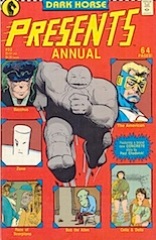
Ugh, another “annual.” Sixty-four pages of Dark Horse Presents tends to be a little much.

The American is a little long here–it’s very passive and not at all dramatic. On the other hand, Peterson shows he used to be a lot more interesting of an artist.

The Wacky Squirrel strip from publisher Richardson is dumb.

Davis’s Delia & Celia is a complete bore, big shock. He manages to make a pterodactyl boring.

The longer than usual Bob the Alien just shows with more space Rice does an even better story. It’s funny and touching

The Concrete story is better than usual–Concrete’s jealous over girls–and Chadwick puts in three unanswered questions. Two are crime related, one personal. It works.

Bacchus is great. Campbell gets more into his eight pages than anyone ever has in one of these issues.

As usual, Zone is passable, Race of Scorpions is lame.

CREDITS

The American, My Dinner with the American; story by Mark Verheiden; pencils by Brandon Peterson; inks by Randy Emberlin; lettering by David Jackson. Wacky Squirrel; story by Mike Richardson; art by Jim Bradrick; lettering by David Jackson. Delia & Celia, Down, Down and Down; story, art and lettering by Gary Davis. Bob the Alien, Bob, the alien, Steppin’ Out; story, art and lettering by Rich Rice. Concrete, Visible Breath; story and art by Paul Chadwick; lettering by Bill Spicer. Bacchus, A God and His Dog; story, art and lettering by Eddie Campbell. Zone; story, art and lettering by Michael Kraiger. Race of Scorpions, The Rusty Soldier; story and art by Leopoldo Durañona; lettering by Laura Davis. Edited by Randy Stradley.

Dark Horse Presents 31 (July 1989)

35842.jpg
It’s a banner installment of Race of Scorpions. Two things I never thought would occur do this issue… first, Duranona uses shadows to give the reader some sense of depth. Well, only for half the story, but still. Second, he comes up with an interesting detail! In this miserable future, cookbooks are bibles. I’m stunned by these developments.

The Zone story is on the low side of okay. Kraiger spends too much time on the boring Zone character (before he douses some guy in toxic waste or something, which is funny). But the art’s good and the plotting is decent. Kraiger has some sense of what he’s doing here.

Rice’s Bob the Alien story is awesome, as usual. Here Bob encounters deception, but still manages to come out ahead. Lots of laughs, great progression of narrative.

The Duckman story is only a page long and I don’t really understand it.

CREDITS

Race of Scorpions, The Alley Where Sorrows End; story and art by Leopoldo Durañona; lettering by Laura Davis. Zone; story, art and lettering by Michael Kraiger. Bob the Alien, Bob, the alien, is Swindled; story, art and lettering by Rich Rice. Duckman, Duckman’s in a Snit Today; story, art and lettering by Everett Peck. Edited by Randy Stradley.

Dark Horse Presents 28 (March 1989)

35839.jpg
The Concrete story goes on forever. It has some of Chadwick’s better art in a while, but also some Liefeldian body mechanics. It’s metaphysical nonsense about the environment. These Concrete stories are best as time capsules–things haven’t gotten any better in the last twenty years.

Zone debuts this issue; Kraiger’s illustrating is fine. The story’s harmless and uninteresting. It seems like it’s going to follow in Concrete‘s footsteps in terms of passivity.

Hedden and McWeeney do a wordless Roachmill. Great art, mildly amusing story. The art’s what’s important here.

Gilbert and Beatty do a Mr. Monster story all about EC Comics and censorship. It’s incredibly well-intentioned but boring and poorly illustrated. The inks on these Mr. Monster stories are hideous.

Then there’s the Homicide. Arcudi… it’s… I don’t know where to start so it’s probably not worth talking about.

Oh, and lame Black Cross pages litter the issue.

CREDITS

Black Cross; story and art by Chris Warner. Concrete, Stay Tuned for Pearl Harbor; story and art by Paul Chadwick; lettering by Bill Spicer. Zone, Of a Feather; story, art and lettering by Michael Kraiger. Roachmill, The Terror of Canal St.; story, art and lettering by Rich Hedden and Tom McWeeney. Mr. Monster, Inklings; story and art by Michael T. Gilbert and Terry Beatty; lettering by Ken Bruzenak. Homicide; story by John Arcudi; art by Doug Mahnke; lettering by Pat Brosseau. Edited by Randy Stradley.

Zorro (1993) #2

Z2

I tried, I really did. However, I’m not sure how anyone could tolerate Zorro. It’s beyond awful, beyond boring. I can’t figure out how the thing sold enough issues to get up to ten, or however long the series ran. I mean, it was the 1990s and all, but come on… no one would like this tripe.

The problem is wholly McGregor. I mean, Mayhew’s art is cookie cutter mainstream lame, but it’s fine enough. McGregor, though, he just can’t shut up. He seems to think the reader needs to know every characters thoughts all the time. He also tries to fetishize hacienda living… but by showing only the negatives. Even basic human kindness is alien in McGregor’s setting.

Again, a big problem is Zorro not being a real character. It’s also odd how the series seems to be based on the old Disney television series. Down to the likenesses.