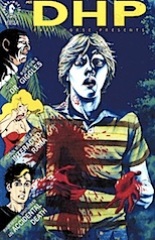
Dark Horse Presents (1986) #144

Dhp144

If it weren’t for Hedden and McPhillips, this one would be a complete stinker.

Okay, Vortex, from Kennedy, Larson and Moncuse, isn’t atrocious. It’s a dumb superhero story about a guy from another dimension who comes to Earth and does stuff, blah blah blah. What’s crazy is Kennedy does it all in summary, so the story’s present action is maybe a hundred years. The art’s not terrible.

Burglar Girls suggests Dark Horse really wanted to sell American manga… it’s an idiotic little story about three obnoxious thieves in training who go out to a nightclub. There, they meet boys, get in fights, et cetera. It’s awful. Barberi and Velasco’s art is bad, but it’s nothing compared to Amara’s dreadful writing.

Then there’s Galactic Jack (from Hedden and McPhillips). It’s light, sci-fi action comedy stuff. Lots of lasers and slime. It’s a lot of fun. They’ve still got the touch.

Dark Horse Presents (1986) #139

Dhp139

It’s a strange Roachmill because it’s very confined—Hedden and McWeeney set it at a public school where Roachmill’s after the school bully. So it’s sort of an all-action story. Dark Horse seems to have included both parts in this issue (there’s a very clear break, with cliffhanger), which is nice. McWeeney’s art is still good though it lacks the vivacious enthusiasm of the early days. The story’s also less about the inappropriate laughs. Maybe because it’s set at a school. Still, it’s a nice piece of work and it’s good to have some more Hedden and McWeeney.

As for Chichester and Barberi’s Saint Slayer? Umm… I don’t get it. Dark Horse had the Buffy license, so why did they print this kung fu Buffy knock-off. It’s an unpleasant read—Chichester’s writing is awful and Barberi’s art isn’t much better. It’s all action… but it plods along. Ick.

Dark Horse Presents (1986) #126

Dhp126

It’s another big issue of Presents and a decent one.

Brereton’s The Nocturnals looks real nice and reads well. He introduces a bunch of characters, but the protagonist’s plot is compelling. It’s often very funny.

Schutz has a one page thing (art by Mireault and Bottenberg); it’s okay, if not special.

Hedden and McPhillips have an excellent story with Snipe, about a monster hunter on a talk show. Great art, great script.

Watson’s Skeleton Key is… fine. It’s a page.

On the other hand, Weissman’s Phineas Page is only a page too; it could have been a feature story. Awesome little strip.

Reprinted from Europe, Manoukian and Roucher’s Metalfer starts. Superb art, confusing, kind of dumb story. It might get better.

Strnad and Edwards cover Starship Troopers. Nice art, competent writing for filler.

DeMos and Gillis close with a story a guy obsessed with holes (the shape). It’s quite good.

Dark Horse Presents (1986) #100-5

Dhp100 5

Only in Dark Horse Presents can you open with Art Adams and close with Paul Pope.

The Adams Monkeyman and O’Brien story appears to be some kind of homage to Plan 9 from Outer Space. So maybe Adams’s terrible dialogue is in line with that approach. Regardless, it’s fairly awful.

Then Hernandez has an utterly fantastic story about a bunch of carnies reunited. It opens with one thing, moves somewhere else. It’s just great. Second story in and they’ve already made up for Adams and set the issue apart in terms of quality.

Hedden’s Frankenstein, P.I. is well-drawn and mildly amusing.

Oh, then there’s a Milk and Cheese from Dorkin mocking alcoholism. If these strips were only a page, they might be a little less putrid.

Pope (with Smith) closes with a THB. It’s beautiful looking, but even more–Pope finds a profound moment in his action. Just great.

Dark Horse Presents 100 5 (August 1995)

35916.jpg
Only in Dark Horse Presents can you open with Art Adams and close with Paul Pope.

The Adams Monkeyman and O’Brien story appears to be some kind of homage to Plan 9 from Outer Space. So maybe Adams’s terrible dialogue is in line with that approach. Regardless, it’s fairly awful.

Then Hernandez has an utterly fantastic story about a bunch of carnies reunited. It opens with one thing, moves somewhere else. It’s just great. Second story in and they’ve already made up for Adams and set the issue apart in terms of quality.

Hedden’s Frankenstein, P.I. is well-drawn and mildly amusing.

Oh, then there’s a Milk and Cheese from Dorkin mocking alcoholism. If these strips were only a page, they might be a little less putrid.

Pope (with Smith) closes with a THB. It’s beautiful looking, but even more–Pope finds a profound moment in his action. Just great.

CREDITS

Monkeyman & O’Brien, I Was the Alien; story and art by Art Adams; lettering by Lois Buhalis. Los Malcriados; story and art by Mario Hernandez. Frankenstein, P.I., Butcher’s Night Out!; story by Rich Hedden; art by Hedden and Mike McPhillips. Milk and Cheese, Alcoholics Unanimous!; story and art by Evan Dorkin. Panfried Girl; story and art by Paul Pope and Jeff Smith; lettering by Lorie Witte. Edited by Bob Schreck and Scott Allie.

Dark Horse Presents (1986) #67

Dhp67

The issue opens with an idiotic story about an annoying character called Zoo-Lou. Hedden and McWeeney usually do great work. The art here’s excellent, but the writing is an absolute nightmare. Dark Horse really loves poking fun at themselves… and usually it comes out awful, like Zoo-Lou.

An Accidental Death comes to its conclusion here. No one does this kind of angst and suffering like Brubaker. Everything he does these days is a waste compared to what he could be doing. Brilliant work from Shanower too.

Duffy and Sakamoto have an awful story called Nestrobber. It’s just atrocious.

The Predator story is weird–it’s based on an Andrew Vachss story. Not bad, just too soon to tell.

Campbell’s got a funny Alec, then Russell closes with an Oscar Wilde adaptation. It’s a brilliant piece of work, but it really needs color to make the fairy tale element work.

Dark Horse Presents 67 (November 1992)

dhp67.jpg
The issue opens with an idiotic story about an annoying character called Zoo-Lou. Hedden and McWeeney usually do great work. The art here’s excellent, but the writing is an absolute nightmare. Dark Horse really loves poking fun at themselves… and usually it comes out awful, like Zoo-Lou.

An Accidental Death comes to its conclusion here. No one does this kind of angst and suffering like Brubaker. Everything he does these days is a waste compared to what he could be doing. Brilliant work from Shanower too.

Duffy and Sakamoto have an awful story called Nestrobber. It’s just atrocious.

The Predator story is weird–it’s based on an Andrew Vachss story. Not bad, just too soon to tell.

Campbell’s got a funny Alec, then Russell closes with an Oscar Wilde adaptation. It’s a brilliant piece of work, but it really needs color to make the fairy tale element work.

CREDITS

Zoo-Lou vs. Editor; story, art and lettering by Rich Heddon and Tom McWeeney. An Accidental Death, Part Three; story by Ed Brubaker; art and lettering by Eric Shanower. Nestrobber, Money for Nothing; story by Jo Duffy; art and lettering by Maya Sakamoto. Predator, Race War, Part One; story by Andrew Vachss; adapted by Randy Stradley; pencils by Jordan Raskin; inks by John Beatty; lettering by Clem Robins. Alec, A Pub Far Away; pencils, inks and lettering by Eddie Campbell. The Selfish Giant; story by Oscar Wilde; adaptation, art and lettering by P. Craig Russell. Edited by Randy Stradley.

Dark Horse Presents 65 (August 1992)

dhp65.jpg
An Accidental Death opens this issue. It’s been a while since I’ve read it. The most immediate thing is Shanower’s art. It’s finished and precise; I’m sure Dark Horse Presents has had artwork as good, I just can’t think of any example. But then there’s Brubaker’s writing–and the way he presents the moral ambiguity of being a teenager. He’s able to make the naive behavior create sympathy… then the danger arises. It’s great work.

The Dr. Giggles story has awful writing from Coto. He didn’t get any better between issues. Burrows has some really gross visuals here and they work. It’s just sad Dark Horse used Presents to hawk their crappy movie tie-in. Unfortunately, it’s not even the worst thing they published to this point.

Hedden and McSweeney contribute a story without dialogue or narration. The reader gets to cut and paste. The art’s fantastic, but it’s pointless.

CREDITS

An Accidental Death, Part One; story by Ed Brubaker; art and lettering by Eric Shanower. Dr. Giggles, Part Two; story by Manny Coto; art by Alan J. Burrows; lettering by Bill Spicer. Interact-O-Rama; pencils by Rich Hedden; inks by Tom McWeeney. Edited by Randy Stradley.

Dark Horse Presents (1986) #65

Dhp65

An Accidental Death opens this issue. It’s been a while since I’ve read it. The most immediate thing is Shanower’s art. It’s finished and precise; I’m sure Dark Horse Presents has had artwork as good, I just can’t think of any example. But then there’s Brubaker’s writing–and the way he presents the moral ambiguity of being a teenager. He’s able to make the naive behavior create sympathy… then the danger arises. It’s great work.

The Dr. Giggles story has awful writing from Coto. He didn’t get any better between issues. Burrows has some really gross visuals here and they work. It’s just sad Dark Horse used Presents to hawk their crappy movie tie-in. Unfortunately, it’s not even the worst thing they published to this point.

Hedden and McSweeney contribute a story without dialogue or narration. The reader gets to cut and paste. The art’s fantastic, but it’s pointless.

Dark Horse Presents (1986) #50

Dhp50

Heartbreakers is a little better this issue. Bennett and Guinan still don’t have a good sense of what makes a story interesting. This one implies it had potential to be interesting on the second to last page.

Hughes and Story do a few pages, riffing on the idea of pin-up pages. The writing’s far from perfect, but it’s Hughes doing regular comics. It’s technically outstanding, though some of the jokes require a lot of close attention.

Csutoras and Gaudiano continue Harlequin. Some of this installment features Gaudiano’s best art so far. The story continues to be somewhat indescribable and very odd. I love how they get humanity of it when it should be difficult.

Brubaker–in his first work?–has a little childhood reminiscence (art by Christian and Ranjo). It’s short and nice. I miss the cynical, jaded Brubaker.

Hedden and McWeeney do a one page thing. It’s fine.