Predator 1 (June 1989)

252433Cops, gangs and a Predator… sounds like a movie. Oh, wait, it was a movie. Only Mark Verheiden’s Predator came before Predator 2, probably when they thought Schwarzenegger would play his own brother.

But Verheiden sets the story in New York, narrated by a tired detective with a crazy huge partner (the brother of Schwarzenegger’s character from the first movie). They investigate this weird gang war, which has the general from the movie hanging around (oddly unnamed so far), and get into it with their boss.

It feels a little like Robocop in terms of urban dystopia, but Verheiden does do a fair approximation of a decent cop show. The narrator is extremely likable and there are some great lines. Verheiden has his scene pacing down.

Chris Warner’s composition is better than the actual art. There are some interesting transitions between panels and some effective angles.

It’s totally fine stuff.

CREDITS

The Heat; writer, Mark Verheiden; penciller, Chris Warner; inkers, Sam de la Rosa and Randy Emberlin; colorist, Chris Chalenor; letterer, David Jackson; editor, Randy Stradley; publisher, Dark Horse Comics.

Star Wars: Crimson Empire II: Council of Blood 6 (April 1999)

273126.jpg
The series ends with some undeniable problems–the Romeo and Juliet aspect is idiotic–but Richardson and Stradley manage to reign in their big conspiracy storyline.

They don’t resolve some of their threads, which is both a good and bad decision. It’s good because there’s not enough room for the resolution, but bad because they sort of promised it for the first half of the series.

There’s a lot of content to this issue–it’s not just a wrap-up. The wrap-up is saved for the last three pages or so… and it isn’t enough. This issue’s problems with pacing sort of reveal the series’s problems with it in general.

Gulacy is rushed here. He can’t make it all fit. It’s the least impressive art on the entire series, though there are some good space battles at the open.

The series nearly succeeds, overcoming a few major story problems.

Star Wars: Crimson Empire II: Council of Blood 5 (March 1999)

273125.jpg
It’s a romance now? Seriously? Wow.

After a solid first half, Richardson and Stradley are running off the rails. They set up a convoluted set of schemes and subterfuges and are now rapidly resolving them. And what solves them all? Sworn enemies kissing.

But the issue has a bunch of great Gulacy sci-fi action so it’s impossible not to enjoy it. There’s spaceship battles, there’s blaster fights, it goes on and on. Even the talking heads stuff is great; Gulacy’s got lots of Star Wars technology around to draw.

But the writing has just gone off the deep end. The writers introduce a major new character this issue (more important than any other new character in Council of Blood actually) and reveal he’s been working behind the scenes the whole series.

It’s a complete mess. It’s like Richardson and Stradley changed their minds about the series’s plot halfway through.

Star Wars: Crimson Empire II: Council of Blood 4 (February 1999)

273124.jpg
I’m not sure it’s possible this issue could have a softer cliffhanger. Soft as it may be, it does signal a change in Council of Blood… it’s finally a sequel to Crimson Empire.

Until this issue, Richardson and Stradley have been avoiding what they promised at the finish of the first series. While the previous issues touched on it, they more concentrated on the overall Dark Horse Star Wars universe. This issue brings Sinn (I finally remember her dumb name) and the Imperial Guard together.

And it does so on a strange planet with stranger aliens and Gulacy has a great time with all of it. There’s a lot of action this issue; Gulacy has to condense approximately twelve action panels to one page.

It’s a packed issue.

Sadly, bringing back the first series’s character relationship, the writers start to stumble. It’s an okay comic, but the characters are nonsensical.

Star Wars: Crimson Empire II: Council of Blood 3 (January 1999)

273123.jpg
Interesting. The series is now half done and Richardson and Stradley haven’t shown much of their hand yet, as far as future events go. Instead, they’re still raveling the narrative. The reader gets to be a little ahead of the characters, but since there’s still no protagonist, it doesn’t hurt the comic.

This issue spends most of its time going over the business practices of the Hutt character. They’re sensational, which makes them engaging, and the writers hint just enough at how everything connects to make it intriguing.

There’s also some more business with the Imperials, with the writers identifying the villains among the villains.

It’s effective. It even makes one (stupidly) consider reading more Star Wars comics.

Nice art from Gulacy and Emberlin. Gulacy’s got some great page compositions to mix action and dramatics. He also takes the time to indulge his humorous side.

It’s a very strong issue.

Star Wars: Crimson Empire II: Council of Blood 2 (December 1998)

273122.jpg
Once again, there’s the item you can tell Gulacy just went gloriously overboard with. This time, it’s one of the squid faced aliens–but as a Hutt dancing girl. Emberlin inks are especially good; there are some great alien worlds panels in the first few pages.

Richardson and Stradley are slowly developing the overall story. The dialogue is good, the characters are all good. The issue passes without many hiccups, but it also passes without a real character. Crimson Empire II is apparently a licensed Star Wars comic first and a narrative second.

In fact, this issue is still setup for whatever’s going to come, big and small. The previous issue introduced two general story lines. This one expands it out to three or more. The writers are enthusiastic about whatever they have planned and it helps.

It’s still too soon to decide on the series, but the issue’s good.

Star Wars: Crimson Empire II: Council of Blood 1 (November 1998)

273121.jpg
Once again, Mike Richardson and Randy Stradley are deliberate in their setup. Council of Blood has some fight scenes–well, some violent acts without real bloodshed (just the threat of it)–and some space stuff, but it’s all about the politics.

Just from this issue, it’s clear the dialogue’s better than the first series, at least for the politicians. While the comic obviously owes a lot to Star Wars–specifically Jedi–it’s hard not to see some Dune comparisons too.

I’m not sure how it reads to regular Dark Horse Star Wars readers, but it’s incomprehensible without reading the first series. Sadly, the Western flavor to the story isn’t back–there’s way too much planet-trotting–but Richardson and Stradley have a good tone.

Paul Gulacy (inked by Randy Emberlin) does fairly well. Emberlin’s a little thick for Gulacy. Gulacy’s best work is in the little details.

Blood starts fine.

Dark Horse Presents (1986) #153

Dhp153

I think some of these Presents licensed properties stories might be ideal examples of why properties should never be licensed across mediums. This issue’s Angel—and Golden and Sniegoski’s script isn’t even bad—is too short and too slight, even for the concept (one of the Angel cast makes a Blair Witch movie for demons). Horton and Lee’s art could be a lot better too.

The surprise of the issue is The Mask. Gilroy’s script is engaging and entertaining—even though the Mask (as illustrated by Marangon and Emberlin) is the laughing version, Gilroy’s approach is one of terror and foreboding. The two tones don’t match well, but it’s the best story the issue… and in the last few Presents issues, in fact.

Just when I think Armstrong’s art might be getting better on Doc Thunder, he loses his ability to draw the human body proportionately. Once again, it’s awful.

Dark Horse Presents (1986) #32

Dhp32

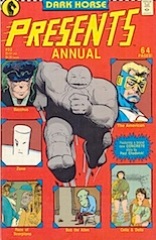
Ugh, another “annual.” Sixty-four pages of Dark Horse Presents tends to be a little much.

The American is a little long here–it’s very passive and not at all dramatic. On the other hand, Peterson shows he used to be a lot more interesting of an artist.

The Wacky Squirrel strip from publisher Richardson is dumb.

Davis’s Delia & Celia is a complete bore, big shock. He manages to make a pterodactyl boring.

The longer than usual Bob the Alien just shows with more space Rice does an even better story. It’s funny and touching

The Concrete story is better than usual–Concrete’s jealous over girls–and Chadwick puts in three unanswered questions. Two are crime related, one personal. It works.

Bacchus is great. Campbell gets more into his eight pages than anyone ever has in one of these issues.

As usual, Zone is passable, Race of Scorpions is lame.

Dark Horse Presents 32 (August 1989)

35843.jpg
Ugh, another “annual.” Sixty-four pages of Dark Horse Presents tends to be a little much.

The American is a little long here–it’s very passive and not at all dramatic. On the other hand, Peterson shows he used to be a lot more interesting of an artist.

The Wacky Squirrel strip from publisher Richardson is dumb.

Davis’s Delia & Celia is a complete bore, big shock. He manages to make a pterodactyl boring.

The longer than usual Bob the Alien just shows with more space Rice does an even better story. It’s funny and touching

The Concrete story is better than usual–Concrete’s jealous over girls–and Chadwick puts in three unanswered questions. Two are crime related, one personal. It works.

Bacchus is great. Campbell gets more into his eight pages than anyone ever has in one of these issues.

As usual, Zone is passable, Race of Scorpions is lame.

CREDITS

The American, My Dinner with the American; story by Mark Verheiden; pencils by Brandon Peterson; inks by Randy Emberlin; lettering by David Jackson. Wacky Squirrel; story by Mike Richardson; art by Jim Bradrick; lettering by David Jackson. Delia & Celia, Down, Down and Down; story, art and lettering by Gary Davis. Bob the Alien, Bob, the alien, Steppin’ Out; story, art and lettering by Rich Rice. Concrete, Visible Breath; story and art by Paul Chadwick; lettering by Bill Spicer. Bacchus, A God and His Dog; story, art and lettering by Eddie Campbell. Zone; story, art and lettering by Michael Kraiger. Race of Scorpions, The Rusty Soldier; story and art by Leopoldo Durañona; lettering by Laura Davis. Edited by Randy Stradley.