
 This comic is difficult to believe. Not the content of the issue, where Gerber just goes wild with a look at American presidential candidacy, but its very existence. Marvel Comics published a comic about the American public rabidly anticipating the assassination of political candidates. They let Gerber get away with it, they even paid Gene Colan to draw it. It’s amazing in its existence.
As a comic, it’s pretty good. Gerber’s plotting is strange. The issue really just is a series of assassination attempts on Howard’s life. There’s barely any character development. Gerber is just moving Howard and Bev from one setup to another. It’s efficiently done too, which is cool. It feels like a race.
The art, from Colan and inker Steve Leialoha, is awesome as usual. But this issue gives Colan and Leialoha a lot of thriller sequences they also have to make somewhat amusing. They confidently succeed.
CREDITS
Open Season!; writers, David Anthony Kraft, Don McGregor and Steve Gerber; penciller, Gene Colan; inker, Steve Leialoha; colorist, Janice Cohen; letterer, Irving Watanabe; editor, Archie Goodwin; publisher, Marvel Comics.

 Ragamuffins is a very strange comic. It’s unfortunate it’s strange, because in addition to being strange, it’s a lovely effort from Don McGregor and Gene Colan.
 Well, Dusk’s personal story arc for this series sure doesn’t go anywhere expected. Maybe it’s because McGregor didn’t set him up for enough development or maybe it’s because almost a fourth of the double-sized issue is wasted on a poorly paced resolution to last issue’s cliffhanger.
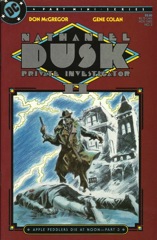 McGregor gets to a lot of revelations this issue. Well, more like two. But they’re big ones. One involves the case, one involves Dusk’s involvement with his dead girlfriend’s kids. The case one is particularly interesting because McGregor does it without much emotion. McGregor isn’t unenthusiastic, he’s just measured–both for the comic (it’s not the big reveal) and for the character. This type of thing isn’t something to get Dusk emotional. He’s disconnected from it.
 The second issue has a lot of action. The issues are double-sized and McGregor plots them quite well. There are three, maybe four, big action sequences in this one, along with a bunch of scenes involving the case itself, but there’s still time for the character work. McGregor always makes sure to work some of it into the investigation-related scenes too.
 For Nathaniel Dusk II, Gene Colan’s pencils go without inks. However, they go with Tom Ziuko’s colors. Ziuko’s a familiar name as a colorist but I was still a little surprised with his work here. He takes Colan’s pencils and turns them into a painted comic. The colors are muted, but still lush. There are some fabulous skies in this one and Colan probably only contributed the cloud outlines.
 The fight scene is painful. It goes on for three or four pages–at least, two, anyway–and is impossible to comprehend thanks to Colan only doing pencils. It’s like a sketch of a fight scene, not an actual realized sequence.
 I feel like A Terror of Dying Dreams should be a little better. Gene Colan does the art–just pencils, no inks; it’s good art but Don McGregor’s script doesn’t just play to Colan’s strengths, it plays to his standards. Inexplicably enormous scary mansion in the New York area? Check. Urban blight? Check. Even the one fight scene looks like every Colan fight scene.
 Dusk is a good comic and all and McGregor does good with it and all but I’m shocked he could pull this issue off.