Star Wars: Crimson Empire 3 (February 1998)

36237.jpg
From the second panel, it’s clear something off with the art. Either Gulacy hurried through faces and let Russell finish or Russell got eager and got rid of all Gulacy’s rounded lines. The former would just be unfortunate… the latter would just piss me off. This issue doesn’t feel like Gulacy until about halfway, which is too long.

Even though very little happens–there’s a battle scene, some talking among good guys, a flashback, bad guys talking–it’s probably the best issue of Crimson Empire so far. Richardson and Stradley aren’t being coy about their protagonist anymore and, in fact, reveal him to be a rather complex character.

Hopefully some of these complexities will have room to play out. There’s also a lot with the Imperials infighting and politicking, which is amusing enough (but probably the worst scenes as they look so silly).

Art problems aside, it’s getting rather entertaining.

Star Wars: Crimson Empire 2 (January 1998)

36236.jpg
For some of this issue, the Gulacy sci-fi art makes one forget it’s a Star Wars comic and imagine it’s just a Gulacy (with Doug Moench) comic. Then Richardson and Stradley have some awful dialogue from the big villain and the illusion comes crashing down.

It’s like the comic can get away with bad dialogue because Star Wars got away with it. But there’s a lot more of it here, as the bad guys bicker with each other.

Still, the story’s compelling enough the dialogue doesn’t matter. Oddly, the good guys’ dialogue is fine. It’s just the insidious declarative statements.

By the end, when the bad guys attack, Gulacy nicely gives the art a cinematic pace.

The story’s somewhat predictable, save a couple details, but with the action scenes sold it’d be hard to not be enjoying it. It’s a Western set in Star Wars land. Lots of fun.

Star Wars: Crimson Empire 1 (December 1997)

36235.jpg
Crimson Empire answers the burning question… what’s with the guys in red from Return of the Jedi. The ones who had fabric capes on the action figures.

Of course, it’s mostly just backdrop for the story of a fugitive. It probably could fit a Civil War story too. A stranger comes to town, kicks butt, has to hide with possibly duplicitous newfound friends. Meanwhile there’s a big villain out to get him, along with all the little ones.

But the real attraction so far is Paul Gulacy’s art. Mike Richardson and Randy Stradley’s script is fine, it’s just not compelling on its own. But Gulacy always does interesting sci-fi, even when he’s working from existing designs, and Crimson is no different.

The action scenes are a little too static, but the vistas are great. P. Craig Russell inks Gulacy well.

It’s a decent comic, with a lot of possibilities.

Dark Horse Presents (1986) #64

Dhp64

Seriously, they thought this issue was good enough?

The opening is a terrible bit of corporate synergy–a prologue to the Dr. Giggles movie from screenwriter Coto, who’s just as awful writing comics as he is writing movies. It’s a mean, gory eight pages of crap. Though Burrows’s art isn’t bad.

Then there’s a Boris the Bear, which is funny if you like Richardson making fun of Dark Horse. It’s weak, except for Smith’s artwork, which brings a certain amount of charm.

The Creep ends on a very depressing note. It’s one of the finest things Dark Horse Presents has published in the last twenty or so issues… just amazing work from Arcudi and Eaglesham.

The closing story is this writing workshop collaboration. Though Rubio’s art looks like a Disney movie, it’s all an obnoxious blind guy who’s mean to his dog. Definitely problematic, but it has a great finish.

Dark Horse Presents 64 (July 1992)

35875.jpg
Seriously, they thought this issue was good enough?

The opening is a terrible bit of corporate synergy–a prologue to the Dr. Giggles movie from screenwriter Coto, who’s just as awful writing comics as he is writing movies. It’s a mean, gory eight pages of crap. Though Burrows’s art isn’t bad.

Then there’s a Boris the Bear, which is funny if you like Richardson making fun of Dark Horse. It’s weak, except for Smith’s artwork, which brings a certain amount of charm.

The Creep ends on a very depressing note. It’s one of the finest things Dark Horse Presents has published in the last twenty or so issues… just amazing work from Arcudi and Eaglesham.

The closing story is this writing workshop collaboration. Though Rubio’s art looks like a Disney movie, it’s all an obnoxious blind guy who’s mean to his dog. Definitely problematic, but it has a great finish.

CREDITS

Dr. Giggles, Part One; story by Manny Coto; art by Alan J. Burrows; lettering by Bill Spicer. Boris the Bear; story by Mike Richardson; art and lettering by James Dean Smith. The Creep; story by John Arcudi; art by Dale Eaglesham; lettering by Pat Brosseau. Scraps; story by William C. Herrel, Douglas Miers, Eric Dinehart, LaDonne Lynn, Matt Hammond, Doselle Young, Jeff Camp, John Clapp, Jason A. Turner, Steve Kaiser, Mike Kerr and Janine Goldfarb; pencils by Bobby Rubio; inks by Jorge Pacheco; lettering by Karen Casey-Smith. Edited by Randy Stradley.

Dark Horse Presents (1986) #40

Dhp40

You know, I think Matt Wagner’s Aerialist is homophobic. Every man is forced to be gay. Anyway, it’s not at all impressive, a Rollerball knockoff. When his characters aren’t in costume, Wagner’s art is rather weak. I guess the hot air balloons look good.

Bob the Alien is absolutely amazing as a) Bob moves to a black neighborhood in Brooklyn and b) discovers God. It might be the funniest installment so far. I can’t believe this comic isn’t more appreciated.

The Argosy is a really wordy retelling of Jason and the Argonauts. It’s fantasy, introduces about forty character names in eight pages. It’s a waste of time.

Randall continues his good art on this Trekker installment. Still bad writing–some really silly developments here.

The Wacky Squirrel story’s a waste of pages, but I guess Bradrick’s art is good.

Campbell’s Bacchus features the (presumably true) story of Dom Pérignon. Fantastic.

Dark Horse Presents 40 (May 1990)

35851.jpg
You know, I think Matt Wagner’s Aerialist is homophobic. Every man is forced to be gay. Anyway, it’s not at all impressive, a Rollerball knockoff. When his characters aren’t in costume, Wagner’s art is rather weak. I guess the hot air balloons look good.

Bob the Alien is absolutely amazing as a) Bob moves to a black neighborhood in Brooklyn and b) discovers God. It might be the funniest installment so far. I can’t believe this comic isn’t more appreciated.

The Argosy is a really wordy retelling of Jason and the Argonauts. It’s fantasy, introduces about forty character names in eight pages. It’s a waste of time.

Randall continues his good art on this Trekker installment. Still bad writing–some really silly developments here.

The Wacky Squirrel story’s a waste of pages, but I guess Bradrick’s art is good.

Campbell’s Bacchus features the (presumably true) store of Dom Pérignon. Fantastic.

CREDITS

Trekker; story and art by Ron Randall; lettering by David Jackson. The Aerialist, Part One; story and art by Matt Wagner; lettering by Kevin Cunningham. Bob the Alien, Bob, the alien, Learns About God; story, art and lettering by Rich Rice. The Argosy; story and art by Bruce Zick; lettering by Karen Casey-Smith. Wacky Squirrel, Diet Riot; story by Mike Richardson and Jim Bradrick; art by Bradrick; lettering by Jack Pollock. Bacchus, Gods, Monks, & Corkscrews; story and art by Eddie Campbell. Edited by Randy Stradley and Diana Schutz.

Dark Horse Presents (1986) #32

Dhp32

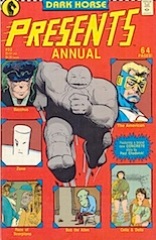
Ugh, another “annual.” Sixty-four pages of Dark Horse Presents tends to be a little much.

The American is a little long here–it’s very passive and not at all dramatic. On the other hand, Peterson shows he used to be a lot more interesting of an artist.

The Wacky Squirrel strip from publisher Richardson is dumb.

Davis’s Delia & Celia is a complete bore, big shock. He manages to make a pterodactyl boring.

The longer than usual Bob the Alien just shows with more space Rice does an even better story. It’s funny and touching

The Concrete story is better than usual–Concrete’s jealous over girls–and Chadwick puts in three unanswered questions. Two are crime related, one personal. It works.

Bacchus is great. Campbell gets more into his eight pages than anyone ever has in one of these issues.

As usual, Zone is passable, Race of Scorpions is lame.

Dark Horse Presents 32 (August 1989)

35843.jpg
Ugh, another “annual.” Sixty-four pages of Dark Horse Presents tends to be a little much.

The American is a little long here–it’s very passive and not at all dramatic. On the other hand, Peterson shows he used to be a lot more interesting of an artist.

The Wacky Squirrel strip from publisher Richardson is dumb.

Davis’s Delia & Celia is a complete bore, big shock. He manages to make a pterodactyl boring.

The longer than usual Bob the Alien just shows with more space Rice does an even better story. It’s funny and touching

The Concrete story is better than usual–Concrete’s jealous over girls–and Chadwick puts in three unanswered questions. Two are crime related, one personal. It works.

Bacchus is great. Campbell gets more into his eight pages than anyone ever has in one of these issues.

As usual, Zone is passable, Race of Scorpions is lame.

CREDITS

The American, My Dinner with the American; story by Mark Verheiden; pencils by Brandon Peterson; inks by Randy Emberlin; lettering by David Jackson. Wacky Squirrel; story by Mike Richardson; art by Jim Bradrick; lettering by David Jackson. Delia & Celia, Down, Down and Down; story, art and lettering by Gary Davis. Bob the Alien, Bob, the alien, Steppin’ Out; story, art and lettering by Rich Rice. Concrete, Visible Breath; story and art by Paul Chadwick; lettering by Bill Spicer. Bacchus, A God and His Dog; story, art and lettering by Eddie Campbell. Zone; story, art and lettering by Michael Kraiger. Race of Scorpions, The Rusty Soldier; story and art by Leopoldo Durañona; lettering by Laura Davis. Edited by Randy Stradley.

Dark Horse Presents (1986) #14

Dhp14

Reading Mr. Monster, I thought a lot about how much I love Will Eisner’s Spirit in black and white. Not because Gilbert’s art in any way reminds of Eisner, but because it doesn’t. Because instead of publishing wonderful black and white comics, Dark Horse Presents is publishing Gilbert’s Mr. Monster and it looks like pencils run through the photocopier to darken it. Art aside, it’s still atrocious.

The Concrete story is completely depressing. While visiting his parents’ grave, Concrete contemplates his future. It’s bleak. Chadwick’s art isn’t particularly special here (why is Concrete the one thing he doesn’t draw well), but it’s one heck of a lovely downer.

Badger’s Mask story is just a filler, maybe announcing Badger’s leaving or maybe not. It’s hard to tell.

Nelson has a one page Dinosaur Tales, which is more design than anything else, but still nice.

That Mr. Monster story was really awful.