Category: 2009
-

This issue is probably the most straightforward, action-packed thriller issue of the series so far. And, wow, does Dysart really ruin any visceral thrill. He manages to remove all the excitement from it, turning every success into failure, making every mistake a fated inevitability–Moses’s weaknesses doom him to those mistakes… and the issue ends with…
-

Eleven issues in and Dysart’s back to basics a little–it’s strange to refer to the return of the first six issue’s principal characters as “back to basics,” but I suppose it’s only natural in the era of story arcs and trade-waiting. Moses, Sera, Jack and Margaret Wells are all back this issue, all of them…
-

In this issue’s conclusion, Dysart juxtaposes the bickering of adults–sure, it’s dramatic and violent, but they’re arguing over ideas–with children making friends with each other. It’s a profound little moment, creation versus destruction. It might be the most profound moment in Unknown Soldier so far. There’s a lot Dysart can go wrong with this issue,…
-

Dysart gives ex-CIA guy almost the entire issue. His name’s Jack, which I can’t believe I forgot. This issue is both prequel and sequel to the previous one, following Jack instead of Moses. What’s neat–I may have made this observation before–is how Jack is less easy for the reader to identify with than Moses. At…
-

Hmm. I wonder if anyone’s told Angelina Jolie about Unknown Soldier, specifically the idea she’s help Africa a lot more by being murdered…. Jolie’s Unknown Solider stand-in shows up for a minute this issue, but the plot to kill her is introduced a little later. Moses has hooked up with some pan-African freedom fighters and…
-

This issue is something of a texture piece. While it does further the story (Moses gets a radio and a translator by the end while starting the issue with neither), it’s really about someone else. The issue’s protagonist is a college student who returns home, only he’s returning home to a war zone. He makes…
-

Since I already knew I’d like the Greg Tocchini artwork–I hope the future issues have some more color; this issue is mostly set in dark streets and the brighter stuff is just so lush, I want more of it–The Last Days of American Crime otherwise mostly just showcased the benefits to the sixty-four page format.…
-

Langridge takes the show on the road–I wonder how many times someone’s made that statement about this issue. The Muppet Show, as a comic book, has a limited number of possibilities–I think I’ve already suggested Boom! have a guest star (i.e. a comic book guest star) for each issue–so Langridge’s solution is to make the…
-
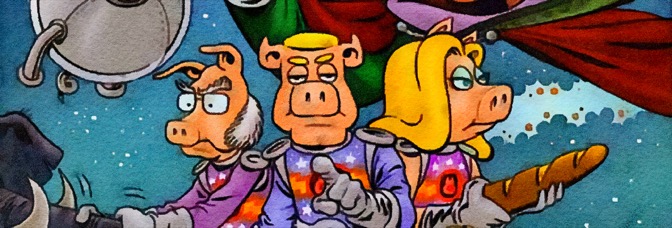
I’m not sure why Boom! did a zero issue of The Muppet Show. Maybe to show off a different artist could illustrate Langridge’s scripts to good effect? Paroline does a good job faking Langridge’s style, so much I didn’t even realize it wasn’t him until the second or third page. I just assumed he was…
-

This issue starts off terrible. Fraction uses three narrators–Ben Urich, Tony Stark and Peter Parker–and it’s a rough fit. Well, maybe not with Tony and Peter, that transition is actually, pretty smooth. But the Ben Urich narration? With Fraction capitalizing every proper noun to show EMPHASIS? It’s horrific. But the story isn’t bad. There’s a…
-

Here Ennis plays with having two protagonists, the expectations that arrangement has on the reader. Play might be the wrong word because play suggests it might be fun. Ennis doesn’t do it for fun, he does it to get a surprising ending. See, the series has always had the two protagonists juxtaposed, but it’s only…
-

Tarantino will probably never make a film as good as the good parts of Inglorious Basterds again. Possibly because the good parts of the film–even with the Sam Jackson narration–seem so unlike Tarantino, it’s impossible to imagine him making them. It’s like, all of a sudden, an adult magically appeared and took his place. Unfortunately,…
-

The conclusion to the first arc is beyond depressing. It’s not just depressing because it showcases the futility of Moses’s quest (before the quest even starts), but because everything is revealed, in the end, to be futile. The good Moses has done is all for nought. And the character accepts it and moves forward because…
-

Now I’m confused. Not because I don’t remember this issue from the last time I read it, but because Dysart’s finally revealing little glimpses at the secret behind the “voice.” Something happened to the good doctor, letting him become the killing machine… and the Unknown Soldier has something to do with it. Not the Unknown…
-

Dysart starts tying his two narratives (between the CIA operative and his protagonist) together here. He opens with the CIA guy, set before the end of the previous issue and continues, again, from before the last issue ended, showing a different point of view of the situation (it’s the bad guys’ perspective–bad guys being the…
-

Dysart deals with it–and has been since the first issue–but really… Unknown Soldier‘s going to have limited appeal. It doesn’t matter if it’s more action packed than Rambo, it’s a story where the hero does good by killing children (soldiers, but still children). There aren’t going to be any movie adaptations here… no summer event…
-

The second issue is a little more traditional. Dysart uses a roaming third person narrator, jumping into his protagonist’s head when he’s with him, staying out of the supporting cast members’ heads when he’s with them. Now, the meat of the story arc is developing. Dysart introduces the old CIA guy, which sort of shows…
-

And, boom, there goes the series. Smith opens the issue reasonably well with a big fight scene between the Joker, the new supervillain and Batman, but then he decides to do a Killing Joke rip-off instead. I think he even opens the conversation between Batman and the Joker like Moore does in The Killing Joke.…
-
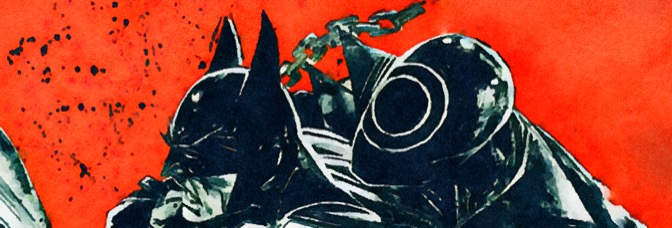
There’s some really problematic art this issue. I feel kind of bad pointing it out (it happens regularly throughout the issue) since this issue is even better than the first. Smith opens it with narration. I can’t remember the last time I read a Batman comic with so much opening narration. It’s wonderful. There’s a…
-

Who knew? Kevin Smith can write one heck of a Batman comic. And his buddy, Walt Flanagan (who spent many years as a punchline in Smith’s films), can draw well enough. I’ve certainly seen far less professional looking Batman comics than Cacophony. I haven’t read a Smith comic in ten plus years–since Daredevil. He does…
-

As Command Performance‘s end credits began to roll, I turned to my wife and instructed her to always say “No” if I ever suggest watching a Dolph Lundgren movie again. And it’d be hard to find a Dolph-ier Lundgren movie than Command Performance. He stars, he directs, he cowrote the screenplay. He also gives himself…
-

Given Korean film sort of resurrected the melodrama as a viable genre (I can’t believe I’m arguing for melodrama, but I guess if you like cinema, you sort of have to accept it–and I mean melodrama in a neutral sense… not as a guaranteed pejorative), I was curious to see how they’d do a disaster…
-

The Marvels Project, Epting or no Epting, all of a sudden seems like a bad choice for Brubaker. Why not get Jeff Parker, who loves doing revisionist stories of old characters. I suppose I made that suggestion thinking Parker would have more creative control, but even if he didn’t–did anyone think Brubaker was just clamoring…
-

Does anything happen this issue? I will definitely say it doesn’t tread over Marvels territory at all and does introduce one or two interesting things–the image of the Human Torch working on controlling his flames in a hayloft–but otherwise, nothing happens. The narrator–this issue revealed to be a costumed adventurer himself, the Angel–talks a bit…
-

I really need a cast of characters page. It’s neat how Brubaker uses the Two-Gun Kid to open (though I can’t remember how he got to the future in the Slott She-Hulk series); it gives the story something of a context in the modern Marvel Universe, since it really is just another retcon. Just one…
-
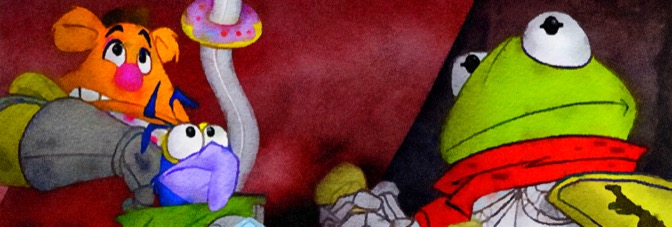
Muppet King Arthur has one rather big problem. It doesn’t really have any other problems, actually, as the writing is great–it’s funny as a Muppet comic–there’s plenty of the self-aware anachronisms the genre (the Muppet retelling) has always had, both in film and comic mediums. It’s also smart like a Muppet comic (or film) should…
-

It ends very cute. Nauseatingly cute because of the pseudo-manga face Lopez gives Hawkeye. It looks like a Twilight comic or something. McCann has a speedy read here but he gets a lot done. He has the big villain reveal, which is silly–I don’t care If McCann’s Mockingbird is a female character far better than…
-

Ah ha, so while she was on Planet Skrull–next planet over from Planet Hulk–Mockingbird (I’m sorry, I don’t know if I’ll ever be able to call her Bobbi) had a Skrull stalker who impersonated Hawkeye. Not just impersonated him, but filled her in on the details of his life. It’s somewhat interesting backstory but the…
-

It’s a soap opera, but not as a pejorative. I mean, I could be nicer and say it’s a character drama, but it’s really not because the characters are solely defined by events, nothing deeper. So it’s a soap opera. And a damned good one. Wait, wait, I do need to complain for a moment…
-

How clean can Lopez’s artwork get? I mean, he draws Clint like he’s some kind of Backstreet Boy. Mockingbird comes off a lot better–Lopez has a similar problem with Bucky Captain America, he looks about twelve. When he and Clint bicker–a decent scene too–it’s like the Little Rascals fighting over a gumdrop. Still, it’s a…
 The Stop Button