Judge Dredd 26 (December 1985)

Judge Dredd #26There’s a lot of imaginative Ron Smith art this issue. He does an excellent job mixing action with setting detail, especially since all of Wagner’s stories have something to do with Mega-City One, whether with the block architecture or with the people.

Unfortunately, Wagner’s stories of Dredd and the general public, even when they’re good, are too much of Wagner trying to play up Dredd’s ideals. The first story has a minor crime turn into a major, the second has Dredd showing compassion (while appearing not to show compassion), the third and fourth are Walter stories.

The final story, from Alan Grant and Kelvin Gosnell, is this way too conceptually big, but way too small in terms of pages–and Smith’s scale–story of a runaway mobile traffic thing.

These Mega-City One details, even with good art, are really hard to take one after another. There’s no story.

B- 

CREDITS

Writers, John Wagner, Alan Grant and Kelvin Gosnell; artist, Ron Smith; colorist, John Burns; letterers, Peter Knight and Tom Frame; editor, Nick Landau; publisher, Eagle Comics.

Judge Dredd 13 (November 1984)

Judge Dredd #13Wagner finishes the Chief Judge Cal storyline. There are a couple surprises before the end, with Wagner in something of a hurry. Smith doesn’t get much space on the art, which is unfortunate, but he uses the space he gets really well at times. It’s a satisfactory conclusion, but the denouement is way too abrupt.

The next story has Dredd contending with a block where people are reverting back to apes. Wagner gets a lot of good jokes in, especially with how he writes the misadventures of the affected residents. But he’s just as sympathetic when things go really bad. It’s an excellent story, with wonderful art from McMahon. He does well with the ape people in action.

The last story, with Alan Grant and Kelvin Gosnell writing, is a little obvious. Dredd is suspicious of an amusement center where people act out their violent urges.

Overall, it’s fine stuff.

B 

CREDITS

Writers, John Wagner, Alan Grant and Kelvin Gosnell; artists, Ron Smith and Mike McMahon; colorist, John Burns; letterer, Tom Frame; editor, Nick Landau; publisher, Eagle Comics.

2000 AD 17 (18 June 1977)

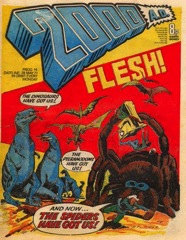
144907This issue has some strange turns. Mostly when Flesh all of a sudden become about dinosaurs teleporting to the future and having Fly-like effects with the guys’ heads ending on a dinosaur. It’s the cliffhanger and it’s dumb, but Gosnell writes a decent enough story before it.

Invasion is a little weird too. Finley-Day plots the opening somewhat backwards, leading to a confusing story.

Gibbons has some good panels and some really bad ones on Harlem Heroes. The bad ones outweigh the good, unfortunately.

And Moore doesn’t have much going on with Dan Dare. It’s basically a bridging story–but all action. It’s not good. And Belardinelli can’t decide on Dare’s hair.

Allen and Redondo do an almost incomprehensible skiing M.A.C.H. 1. The art’s good, but confusing.

Wager and Gibson play Dredd mostly for laughs. There’s a big fight, where Gibson fails; luckily, he does the comedy well.

CREDITS

Invasion, Slaves; writer, Gerry Finley-Day; artist, Mike Dorey; letterer, John Aldrich. Flesh, Book One, Part Seventeen; writer, Kelvin Gosnell; artist, Felix Carrion; letterer, Tony Jacob. Harlem Heroes, Part Seventeen; writer, Tom Tully; artist and letterer, Dave Gibbons. Dan Dare, Hollow World, Part Six; writer, Steve Moore; artist, Massimo Belardinelli; letterer, Peter Knight. M.A.C.H. 1, Spotbox; writer, Nick Allen; artist, Jesus Redondo; letterer, Knight. Judge Dredd, Robot Wars, Part Eight; writer, John Wagner; artist, Ian Gibson; letterer, Knight. Editor, Gosnell; publisher, IPC.

2000 AD 16 (11 June 1977)

144906All in all, not a bad issue.

There’s actually danger in Dan Dare, for example, and a couple good pages in M.A.C.H. 1. A little makes a big difference with 2000 AD, apparently.

Invasion isn’t terrible. It’s mostly action, with Pino doing decent work on a shootout between the protagonist and a bounty hunter. Very busy pages, but competently done.

Flesh comes to what seems to be a shocking conclusion. Absolutely phenomenal art from Sola on a rampaging dinosaur, more than making up for the lame, big-headed human villain.

Even Harlem Heroes is okay (for it). There’s a team of ugly cyborgs the Heroes have to play. Not terrible.

Like I said, Dare has something new–Moore gives it an actually suspenseful cliffhanger. Plus recaps Dare’s origin.

Wagner writes both Dredd and M.A.C.H. 1, which probably explains why the latter’s so much better than usual. Dredd’s okay enough too.

CREDITS

Invasion, Bounty; writer, Gerry Finley-Day; artist, Carlos Pino; letterers, Peter Knight and J. Swain. Flesh, Book One, Part Sixteen; writer, Kelvin Gosnell; artist, Ramon Sola; letterer, Bill Nuttall. Harlem Heroes, Part Sixteen; writer, Tom Tully; artist and letterer, Dave Gibbons. Dan Dare, Hollow World, Part Five; writer, Steve Moore; artist, Massimo Belardinelli; letterers, Knight and John Aldrich. M.A.C.H. 1, Capitol; writer, John Wagner; artist, P. Martinez Henares; letterer, Aldrich. Judge Dredd, Robot Wars, Part Seven; writer, Wagner; artist, Ron Turner; letterer, Tony Jacob. Editor, Pat Mills; publisher, IPC.

2000 AD 15 (4 June 1977)

144905It’s another weak issue.

Mike Dorey’s art is real lame on Invasion, but the writing’s worse. Finley-Day actually relies on a huge truck of acid to solve the problem.

Flesh is weak too; Sola’s art is distressingly underwhelming. It might just be too rushed–all the art this issue is rushed in some way or another–dinosaurs driving cars should be funny.

More Harlem Heroes. Tully explores the way ties are resolved in the game. It’s getter even harder to care about the fake sport.

Moore’s Dan Dare is really contrived. He does indicate, however, there might be an origin recap, which would be nice.

M.A.C.H. 1 has awful art from Marzal Canos. Peter Harris’s goofy story involves bloodthirsty yeti and a dope-dealing Dalai Lama.

Dredd, as usual, is the winner. Wagner’s got some funny stuff amid the robot rebellion. Sadly, McMahon is light on the robots’ details.

CREDITS

Invasion, The Doomsdale Scenario, Part Three; writer, Gerry Finley-Day; artist, Mike Dorey; letterer, Jack Aldrich. Flesh, Book One, Part Fifteen; writer, Kelvin Gosnell; artist, Ramon Sola; letterer, Bennsberg. Harlem Heroes, Part Fifteen; writer, Tom Tully; artist and letterer, Dave Gibbons. Dan Dare, Hollow World, Part Four; writer, Steve Moore; artist, Massimo Belardinelli; letterer, Peter Knight. M.A.C.H. 1, Yeti; writer, Peter Harris; artist, Marzal Canos; letterer, Tony Jacob. Judge Dredd, Robot Wars, Part Six; writer, John Wagner; artist, Mike McMahon; letterer, Jack Potter. Editor, Pat Mills; publisher, IPC.

2000 AD (1977) #14

2000 AD  14

Good grief it’s a bad one.

The only good story is the Dredd one. Wagner packs way too much action into its pages; even though Ian Gibson tries hard, he’s too rushed. But it’s still a solid story.

The Invasion story isn’t terrible, but it’s got a frantic pace too. And it’s dumb–the peaceful nuclear research planet is called Doomsdale. Not sure what, if anything, Finley-Day could have been thinking.

Flesh is awful. Boix’s art isn’t bad, but Gosnell’s writing is the pits.

For Harlem Heroes, Tully concentrates on the team turning around a game. It’s a combination of inane–comics aren’t the best medium for a sporting event–and incomprehensible. I guess Gibbons does okay.

Awful Dan Dare. Moore’s writing isn’t good anymore.

And M.A.C.H. 1… wow. Between Finley-Day’s racist characterizations of Chinese people and Kato’s ugly, busy artwork, it’s an ugly time.

Very bad issue.

2000 AD 14 (29 May 1977)

144904Good grief it’s a bad one.

The only good story is the Dredd one. Wagner packs way too much action into its pages; even though Ian Gibson tries hard, he’s too rushed. But it’s still a solid story.

The Invasion story isn’t terrible, but it’s got a frantic pace too. And it’s dumb–the peaceful nuclear research planet is called Doomsdale. Not sure what, if anything, Finley-Day could have been thinking.

Flesh is awful. Boix’s art isn’t bad, but Gosnell’s writing is the pits.

For Harlem Heroes, Tully concentrates on the team turning around a game. It’s a combination of inane–comics aren’t the best medium for a sporting event–and incomprehensible. I guess Gibbons does okay.

Awful Dan Dare. Moore’s writing isn’t good anymore.

And M.A.C.H. 1… wow. Between Finley-Day’s racist characterizations of Chinese people and Kato’s ugly, busy artwork, it’s an ugly time.

Very bad issue.

CREDITS

Invasion, The Doomsdale Scenario, Part Two; writer, Gerry Finley-Day; artist, Carlos Pino; letterer, Jack Potter. Flesh, Book One, Part Fourteen; writer, Kelvin Gosnell; artist, Boix; letterer, John Aldrich. Harlem Heroes, Part Fourteen; writer, Tom Tully; artist and letterer, Dave Gibbons. Dan Dare, Hollow World, Part Three; writer, Steve Moore; artist, Massimo Belardinelli; letterers, Peter Knight and J. Swain. M.A.C.H. 1, Chinese Formula; writer, Finley-Day; artist, Kato; letterer, Aldrich. Judge Dredd, Robot Wars, Part Five; writer, John Wagner; artist, Ian Gibson; letterer, Potter. Editor, Pat Mills; publisher, IPC.

2000 AD 12 (14 May 1977)

144902Carlos Pino does the art on Invasion. He does pretty well, though Finley-Day’s script has all these analogues to the Nazis. It seems inappropriate and somewhat insensitive.

Flesh has good Sola art and a lame script, as usual, from Gosnell. They should’ve just done it without dialogue. Gosnell even manages to butcher pop culture references.

Harlem Heroes covers the origin of the sport–it’s Scottish. The script’s probably the most imaginative in many progs; it’s still not good.

Steve Moore takes over writing Dan Dare. It’s much better. Dare goes to the future London (a floating theme park) and meets a wolf man. Easily the best Dare so far.

M.A.C.H. 1–from Charles Herring and Mike Dorey–is similarly not terrible. It’s anti-American bluster and very silly, but okay.

Dredd has some goofy dialogue from Wagner, but McMahon illustrates a robot rebellion well. The giant robots are awesome.

CREDITS

Invasion, Death Line; writer, Gerry Finley-Day; artist, Carlos Pino; letterer, Jack Potter. Flesh, Book One, Part Twelve; writer, Kelvin Gosnell; artist, Ramon Sola; letterer, Potter. Harlem Heroes, Part Twelve; writer, Tom Tully; artist and letterer, Dave Gibbons. Dan Dare, Hollow World, Part One; writer, Steve Moore; artist, Massimo Belardinelli; letterer, Peter Knight. M.A.C.H. 1, The Laser Hound; writer, Charles Herring; artist, Mike Dorey; letterer, J. Swain. Judge Dredd, Robot Wars, Part Three; writer, John Wagner; artist, Mike McMahon; letterer, Jack Potter. Editor, Pat Mills; publisher, IPC.

2000 AD 11 (7 May 1977)

144901It’s another less than impressive outing.

Ramon Sola does the art for both Invasion and Flesh, so those strips look good. Invasion’s really boring; I suppose Flesh would be too, except writer Kelvin Gosnell tasks Sola with drawing hundreds of dinosaurs. They make up for it.

Wagner’s Judge Dredd story isn’t bad (it’s the issue’s best), but Ron Turner’s art is a little weak. It’s not a hard story to tell–the robots go nuts and attack humans–but Turner is weak on the details. It’s never interesting looking.

Dan Dare finishes up its first storyline and threatens a second. It’s probably the best strip so far, but only because it promises to be over (then takes that promise away, unfortunately).

M.A.C.H. 1 is dumb, involving a fast car trip. Barry Mitchell’s art isn’t bad, but there are continuity gaffs throughout.

Terrible Harlem Heroes. Tully’s scripts are getting worse.

CREDITS

Invasion, Dartmoor, Part Two; writer, Kelvin Gosnell; artist, Ramon Sola; letterer, Peter Knight. Flesh, Book One, Part Eleven; writer, Gosnell; artist, Sola; letterer, Knight. Judge Dredd, Robot Wars, Part Two; writer, John Wagner; artist, Ron Turner; letterer, Bill Nuttall. Dan Dare, Part Eleven; writer, Gosnell; artist, Massimo Belardinelli; letterer, Knight. M.A.C.H. 1, Operation Death-Drive!; writer, Roy Preston; artist, Barry Mitchell; letterer, Jack Potter. Harlem Heroes, Part Eleven; writer, Tom Tully; artist and letterer, Dave Gibbons. Editor, Pat Mills; publisher, IPC.

2000 AD 10 (30 April 1977)

144900Overall, it’s not a terrible issue. Nothing really stands out as good or bad. The first half of the Dan Dare is okay even–Belardinelli really does do a lot better with space battles than anything else.

The Invasion entry has decent art from Eric Bradbury and a nice reveal at the end. Finley-Day’s dialogue’s moronic, but it’s always moronic.

Studio Giolitti does a little better on the Flesh writing. Boix continues to draw dinosaurs rampaging well. The Harlem Heroes has a great panel or two from Gibbons. Again, dumb but not terrible–the story’s plotted okay.

M.A.C.H. 1 rips off some Bond moments as the protagonist hunts a fugitive. Mills does better with the action than the quiet epilogue.

And then there’s Dredd. Good art from Ezquerra helps things a lot. Wagner writes weak dialogue and the end’s way too heavy handed. Otherwise, nearly okay.

CREDITS

Invasion, Dartmoor, Part One; writer, Gerry Finley-Day; artist, Eric Bradbury; letterer, John Aldrich. Flesh, Book One, Part Ten; writer, Studio Giolitti; artist, Boix; letterer, Aldrich. Harlem Heroes, Part Ten; writer, Tom Tully; artist and letterer, Dave Gibbons. Dan Dare, Part Ten; writer, Kelvin Gosnell; artist, Massimo Belardinelli; letterers, Jack Potter and Peter Knight. M.A.C.H. 1, On the Roof of the World; writer, Pat Mills; artist, Enio; letterer, Tony Jacob. Judge Dredd, Robot Wars, Part One; writer, John Wagner; artist, Carlos Ezquerra; letterer, Aldrich. Publisher, IPC.