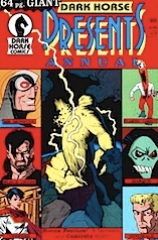
Dark Horse Presents (1986) #20

Dhp20

This issue is a sixty-four page giant–only most of the extra is filler. They could have gotten away with a lot less pages.

The Mr. Monster story is real short (and lame). Gary Davis has a short space alien story showing he’s read some Arthur C. Clarke (it’s long, wordless filler).

Rick Geary’s got a nice two page story, which is filler but really excellent filler.

Then there’s the start of a Trekker serial. It’s incomprehensible if you haven’t read the Trekker series and probably even if you have.

Doug Potter has an excellent story about homelessness.

Oh, I missed Bob Burden’s Mystery Men and Flaming Carrot two page filler.

Then a real Mask story, which seems to be wrapping up. The narrative’s a little pat dramatically, but I’m not sure Badger cared.

Bob the Alien and Mindwalk have stories. Bob‘s hilarious, Mindwalk‘s weak.

Finally, even more filler.

Dark Horse Presents 20 (August 1988)

35831.jpg
This issue is a sixty-four page giant–only most of the extra is filler. They could have gotten away with a lot less pages.

The Mr. Monster story is real short (and lame). Gary Davis has a short space alien story showing he’s read some Arthur C. Clarke (it’s long, wordless filler).

Rick Geary’s got a nice two page story, which is filler but really excellent filler.

Then there’s the start of a Trekker serial. It’s incomprehensible if you haven’t read the Trekker series and probably even if you have.

Doug Potter has an excellent story about homelessness.

Oh, I missed Bob Burden’s Mystery Men and Flaming Carrot two page filler.

Then a real Mask story, which seems to be wrapping up. The narrative’s a little pat dramatically, but I’m not sure Badger cared.

Bob the Alien and Mindwalk have stories. Bob‘s hilarious, Mindwalk‘s weak.

Finally, even more filler.

CREDITS

<

p style=”font-size:11px;”>Mr. Monster, The Thing in Stiff Alley!; story by Chuck Gamble and Michael T. Gilbert; pencils by Gamble, Gilbert and Chuck Wacome; inks by Gilbert; lettering by Ken Bruzenak. Anomaly; story, art and lettering by Gary Davis. A Mother’s Tragedy; story, art and lettering by Rick Geary. Trekker, Vincent’s Share; story and art by Ron Randall; lettering by Ken Bruzenak. The Mystery Men!; story and art by Bob Burden; lettering by Roxanne Starr. The Visit; story, art and lettering by Douglas C. Potter. The Mask; story and art by Mark Badger; lettering by David Jackson. Concrete, Watching a Sunset; story and art by Paul Chadwick; lettering by Bill Spicer. Bob the Alien, Bob, the alien, Goes Birddogging; story, art and lettering by Rich Rice. Mindwalk; story by Randy Stradley; art by Randy Emberlin; lettering by Willie Schubert. Wacky Squirrel, Mixed Results; story, art and lettering by Jim Bradrick. Black Cross; story and art by Chris Warner. Edited by Randy Stradley.

Dark Horse Presents (1986) #4

Dhp04

It’s a real toss-up this issue for worst writing.

Randall’s script for Trekker is laughably bad, but there’s something almost confrontational about Stradley’s Mindwalk script. It’s like he’s punishing the reader for taking the time to read the story, as though he or she isn’t being punished enough by Emberlin’s artwork.

Randall’s Trekker art, on the other hand, isn’t terrible. He’s got some issues with proportions and perspective, but his enthusiasm and persistence are clear. He worked hard illustrating his derivative, atrocious sci-fi story.

The rest of the issue is similarly unimpressive. Sure, Chadwick’s Concrete artwork is amazing, but the story is another one where Concrete spends eight pages doing something then decides to reverse and not tell anyone. So why does the reader have to put up with it, to sympathize for the character? Why should we?

Once again, a moderately cute Boris strip closes the issue.

Dark Horse Presents (1986) #3

Dhp3

Yay, Warner’s back with Black Cross–featuring a bunch of expository dialogue recapping the first story. With all that useless exposition, one might think Warner would explain the ground situation to the reader. But he doesn’t. It’s confusing and a lot of work thinking about something so dumb sounding.

Stradley and Emberlin’s Mindwalk has its weakest entry so far, with Stradley inexplicably using two narrators here. A mediocre first person narrator is one thing, but then he brings in a female narrator who sounds like a six-year-old. Emberlin’s art is similarly problematic, though he draws Kirby-esque monsters well.

The Concrete story is charming. It’s the adventures of the female scientist (still not clear on Concrete’s origin, which seems to be intentional) trying to move his unconscious body. Chadwick’s art is gorgeous.

The Boris Chronicles strip is cute, with Smith basically converting a newspaper strip to four pages.

Dark Horse Presents 4 (January 1987)

35815.jpg
It’s a real toss-up this issue for worst writing.

Randall’s script for Trekker is laughably bad, but there’s something almost confrontational about Stradley’s Mindwalk script. It’s like he’s punishing the reader for taking the time to read the story, as though he or she isn’t being punished enough by Emberlin’s artwork.

Randall’s Trekker art, on the other hand, isn’t terrible. He’s got some issues with proportions and perspective, but his enthusiasm and persistence are clear. He worked hard illustrating his derivative, atrocious sci-fi story.

The rest of the issue is similarly unimpressive. Sure, Chadwick’s Concrete artwork is amazing, but the story is another one where Concrete spends eight pages doing something then decides to reverse and not tell anyone. So why does the reader have to put up with it, to sympathize for the character? Why should we?

Once again, a moderately cute Boris strip closes the issue.

CREDITS

Trekker; writer and artist, Ron Randall; letterer, David Jackson. Concrete, The Gray Embrace; writer and artist, Paul Chadwick; letterer, Bill Spicer. Mindwalk, Mindwar!, Part Two; story and script, Randy Stradley; story and art, Randy Emberlin; letterer, David Jackson. Boris the Bear, The Boris Chronicles; story and art, James Dean Smith; script, Randy Stradley; letterer, David Jackson. Editor, Randy Stradley; publisher, Dark Horse Comics.

Dark Horse Presents 3 (November 1986)

35814.jpg
Yay, Warner’s back with Black Cross–featuring a bunch of expository dialogue recapping the first story. With all that useless exposition, one might think Warner would explain the ground situation to the reader. But he doesn’t. It’s confusing and a lot of work thinking about something so dumb sounding.

Stradley and Emberlin’s Mindwalk has its weakest entry so far, with Stradley inexplicably using two narrators here. A mediocre first person narrator is one thing, but then he brings in a female narrator who sounds like a six-year-old. Emberlin’s art is similarly problematic, though he draws Kirby-esque monsters well.

The Concrete story is charming. It’s the adventures of the female scientist (still not clear on Concrete’s origin, which seems to be intentional) trying to move his unconscious body. Chadwick’s art is gorgeous.

The Boris Chronicles strip is cute, with Smith basically converting a newspaper strip to four pages.

CREDITS

Mindwalk, Mindwar!, Part One; writer, Randy Stradley; artist, Randy Emberlin; letterer, David Jackson. Concrete, The Four-Wheeled Sleeping Pill; writer and artist, Paul Chadwick; letterer, Bill Spicer. Black Cross; writer and artist, Chris Warner; letterer, David Jackson. Boris the Bear, The Boris Chronicles; story and art, James Dean Smith; script, Randy Stradley; letterer, David Jackson. Editor, Randy Stradley; publisher, Dark Horse Comics.

Dark Horse Presents (1986) #2

Dhp2

Wow, does Chadwick ever try hard to be cute. His Concrete story this issue is a completely useless, inconsequential diversion… Maybe I’m missing the point. Maybe it’s supposed to be charming, but it just seems like he wastes a lot of energy. The art’s okay, Concrete being a really boring looking character but the desert setting is fine.

I certainly wish Chadwick was on Mindwalk, just because Emberlin is so weak. He’s got the occasionally well-designed panel, but the art tends to be broad or ugly. The broad stuff is fine, it just doesn’t look like he put in work. The ugly stuff… well, he put in work to no good effect. The script’s goofy in an annoying way.

Thankfully, DeMatteis and Badger’s Hellwalk, Inc. is fantastic. It’s this romantically involved detective couple who handle occult cases. DeMatteis grounds it in depressing and hopeful reality. A very nice closer.

Dark Horse Presents (1986) #1

Dhp1

You know, I really didn’t expect Dark Horse Presents to open its first issue with a male overcompensation piece like Black Cross. Warner’s art’s amateurish and I guess it shows movie optioning is a comic book tradition (the character looks like Sylvester Stallone). It’s a dismal story.

Chadwick’s two contributions are all right. The Concrete one is charming and at least hints at some kind of social consciousness for the comic (which Black Cross feigns). More impressive, as far as the art goes, is Brighter!, a Vertigo ready story about some young woman who can produce optical illusions. So she’s a mutant (lots of superpowers this issue). But the art’s gorgeous and makes up for the lukewarm writing.

Stradley’s Mindwalk is about another mutant (one with a kind of telepathy). It’s nearly okay, though Emberlin’s art isn’t quite there. Features Nazis and gangsters though.

I wasn’t expecting so many mutants.

Dark Horse Presents 2 (September 1986)

35813.jpg
Wow, does Chadwick ever try hard to be cute. His Concrete story this issue is a completely useless, inconsequential diversion… Maybe I’m missing the point. Maybe it’s supposed to be charming, but it just seems like he wastes a lot of energy. The art’s okay, Concrete being a really boring looking character but the desert setting is fine.

I certainly wish Chadwick was on Mindwalk, just because Emberlin is so weak. He’s got the occasionally well-designed panel, but the art tends to be broad or ugly. The broad stuff is fine, it just doesn’t look like he put in work. The ugly stuff… well, he put in work to no good effect. The script’s goofy in an annoying way.

Thankfully, DeMatteis and Badger’s Hellwalk, Inc. is fantastic. It’s this romantically involved detective couple who handle occult cases. DeMatteis grounds it in depressing and hopeful reality. A very nice closer.

CREDITS

Concrete, Under the Desert Stars; writer and artist, Paul Chadwick; letterer, Bill Spicer. Mindwalk, Crystal Vision; writer, Randy Stradley; art by Randy Emberlin; letterer, John Workman. Hellwalk, Inc., Cortege; writer, J.M. DeMatteis; artist and letterer, Mark Badger. Editor, Randy Stradley; publisher, Dark Horse Comics.

Dark Horse Presents 1 (July 1986)

35812.jpg
You know, I really didn’t expect Dark Horse Presents to open its first issue with a male overcompensation piece like Black Cross. Warner’s art’s amateurish and I guess it shows movie optioning is a comic book tradition (the character looks like Sylvester Stallone). It’s a dismal story.

Chadwick’s two contributions are all right. The Concrete one is charming and at least hints at some kind of social consciousness for the comic (which Black Cross feigns). More impressive, as far as the art goes, is Brighter!, a Vertigo ready story about some young woman who can produce optical illusions. So she’s a mutant (lots of superpowers this issue). But the art’s gorgeous and makes up for the lukewarm writing.

Stradley’s Mindwalk is about another mutant (one with a kind of telepathy). It’s nearly okay, though Emberlin’s art isn’t quite there. Features Nazis and gangsters though.

I wasn’t expecting so many mutants.

CREDITS

Black Cross; writer and artist, Chris Warner; letterer, John Workman. Concrete, Lifestyles of the Rich and Famous; writer and artist, Paul Chadwick; letterer, Bill Spicer. Mindwalk; writer, Randy Stradley; artist, Randy Emberlin; letterer, John Workman. Brighter!; writer and artist, Paul Chadwick; letterer, Bill Spicer. Editor, Randy Stradley; publisher, Dark Horse Comics.