Dracula Lives (1973) #9

Dl9

Until the last story, which might be the least impressive entry in an issue of unimpressive entries… I think the most successful art, overall, in the issue is Ernie Chan’s one-pager. It opens the issue, with a Tony Isabella script, all about the various ways of killing vampires. It’s amusing and practical; statements it’s difficult to make about the rest of the issue.

The first story’s the most disappointing, just because it continues Doug Moench’s okay “Dracula vs. the NYPD” story from the previous issue. This time Frank Robbins is penciling with Frank Springer inking. It’s a cartoony style, with disappointing character work. Not sure if it’s Robbins or Springer, but the people look lousy. Neither good nor bad is Dracula, who’s more inhuman. The story involves Dracula tracking down the guy who looted his castle and having to figure out how to get his wares back.

Meanwhile, the cop whose wife Dracula killed last issue is out to get him. His fellow cops believe his story of a vampire forcing the guy to kill his own wife, which tracks. Imagine what police accountability was like in the seventies.

Interestingly, Dracula’s still a somewhat mythic figure, with the lady who buys his stuff at auction (seriously, hasn’t another Tomb story used this bit) wishing he were real. Well, she finds out.

For a panel, it seems like the Franks are at least enthusiastic about good girl art but then not really.

The disappointing art sets the tone for the rest of the issue, with the most personally disappointing coming up next. It’s another Moench story (there are four features, one movie review, and a letters page, yet another change of regular content), with art by twenty-one-year-old Paul Gulacy and inks by Mike Esposito. It’s about Dracula versus some other vampire; this other vampire’s terrorizing a European village, which pisses Dracula off because it means no easy feeding there.

I’d love to say baby Paul Gulacy has the chops.

He does not. He’s got better panels and worse panels, and you can see proto-Gulacy at work (even the almond eyes), but you can’t really see how good he’ll get from this one.

The story’s got a strange finish, kind of jokey. What’s more bizarre is the other two stories have the same kind of finish.

They have a different writer, though—Gerry Conway.

His first story has Alfredo Alcala art. Alcala’s a better inker than penciller and inker. His faces are flat in the wrong places, and his figures are strange. His backgrounds are fantastic. The story’s about a young couple; the evil girl convinces the boy to rob a jewelry store for her.

Meanwhile, Dracula’s around. Their paths cross. Unlike the Moench story, this one begins and ends with light humor. It’s a weird tone, especially with the art. The whole issue just feels off.

The last story—the only one where the art’s more successful than that Chan one-pager—is about a mysterious figure in a top hat hunting Dracula. Sonny Trinidad does the art. The art’s good. The story’s terrible. Conway takes a big swing with it and completely misses. So again, the issue feels off, especially with usually sturdy (on Lives anyway) Conway fumbling both his stories. Moench’s got more art problems, so it’s hard to say. But Conway’s stories go wrong because of the writing.

The movie review—by Gerry Boudreau—covers the Hammer Dracula film, The Scars of Dracula. Boudreau hates it, though with less personality than Moench or Isabella had in their previous reviews.

No Bram Stoker’s Dracula adaptation here.

Unfortunately—and unexpectedly—I’m back to wondering if Lives is worth it again.

The Rook 1 (October 2015)

The Rook #1Seventies and eighties comic book sci-fi is some solid stuff. The Rook tries to tap into the genre to get some nostalgia points and it isn’t hard–artist Paul Gulacy drew a lot of good seventies and eighties sci-fi. The classics, if you would. And I’ll bet Steven Grant even wrote some of them.

Not sure if ROM counts.

Sci-fi in comics has gotten a whole lot more mainstream–especially in indie books–so what do returning giants Grant and Gulacy bring to the genre? It’s nearly camp. It nearly feels like a sci-fi comic from the early nineties because of all the references (“Quantum Leap,” “Back to the Future,” Time Machine actually playing a part of the plot), only the style is from a different era.

But then, The Rook is set in 2015, so Grant’s doing this nineties look at college life. You expect someone to call another kid a square for not drinking the spiked punch. And it doesn’t feel like camp in those moments, because Grant’s just not caring about his cast. They’re not as important as the gimmick. Only the gimmick’s not particularly good.

The Gulacy art carries it all, even after Gulacy starts rushing (somewhere in the second half of the issue). Gulacy has the chops to make the characters likable and sympathetic, even if their dialogue doesn’t give them any personality.

The plot’s amusing, the dialogue’s weak, the art’s good. The Rook isn’t the project Gulacy deserves, but he excels with what he’s got.

CREDITS

Writer, Steven Grant; artist, Paul Gulacy; colorist, Jesus Aburto; letterer, Nate Piekos; editors, Ian Tucker and Daniel Chabon; publisher, Dark Horse Comics.

Batman 394 (April 1986)

2856The Gulacy art continues, albeit in a far less interesting environment. Batman, the KGB agent and Robin have to stop the villain from poisoning the city. It seems a much simpler story–if it weren’t a Soviet assassin as the villain, it could be the Joker. And some boring looking Soviet guy isn’t the best use of Gulacy.
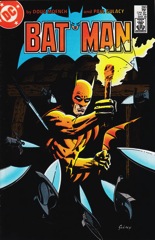
Moench tries really hard to show the common links between Americans and Russians; it’s warm and fuzzy eighties peace-nik stuff. It’s okay, mostly thanks to Gulacy’s art, but without it I can’t imagine the book being very entertaining.

Where Moench is interesting is Robin. Jason Todd has changed completely at this point, just a background object as opposed to Bruce’s would-be adoptive son. He even calls Bruce “boss” at one point. Moench’s really pulled the plug on the adopting business.

It’s a fantastic looking comic book with a serviceable script.

B+ 

CREDITS

At the Heart of Stone; writer, Doug Moench; artist, Paul Gulacy; colorist, Adrienne Roy; letterer, John Costanza; editor, Len Wein; publisher, DC Comics.

Batman 393 (March 1986)

774351Some lucky person out there, hopefully, has the original pages to this issue. Paul Gulacy guests and he does amazing work. There’s a lot of design influences, but all of them work. Well, sort of. They’re great, but they lead to the dialogue filling most of them. Moench writes a wordy script this issue and there’s not the right space for the words.

Batman is doing a mission for the CIA–again no Jason appearance–and he basically plays James Bond. He even hooks up with a female KGB agent. They have some good banter, but there’s way too much exposition. Even without Gulacy’s grand composition, Moench’s script has enough story for two issues.

The story is regularly silly, but the art makes everything a wonder; Gulacy delivers a gorgeous comic book.

The issue is also the first in Moench’s run so far not to continue over in Detective Comics.

B+ 

CREDITS

The Dark Rider; writer, Doug Moench; artist, Paul Gulacy; colorist, Adrienne Roy; letterer, John Costanza; editor, Len Wein; publisher, DC Comics.

Star Wars: Crimson Empire II: Council of Blood 6 (April 1999)

273126.jpg
The series ends with some undeniable problems–the Romeo and Juliet aspect is idiotic–but Richardson and Stradley manage to reign in their big conspiracy storyline.

They don’t resolve some of their threads, which is both a good and bad decision. It’s good because there’s not enough room for the resolution, but bad because they sort of promised it for the first half of the series.

There’s a lot of content to this issue–it’s not just a wrap-up. The wrap-up is saved for the last three pages or so… and it isn’t enough. This issue’s problems with pacing sort of reveal the series’s problems with it in general.

Gulacy is rushed here. He can’t make it all fit. It’s the least impressive art on the entire series, though there are some good space battles at the open.

The series nearly succeeds, overcoming a few major story problems.

Star Wars: Crimson Empire II: Council of Blood 5 (March 1999)

273125.jpg
It’s a romance now? Seriously? Wow.

After a solid first half, Richardson and Stradley are running off the rails. They set up a convoluted set of schemes and subterfuges and are now rapidly resolving them. And what solves them all? Sworn enemies kissing.

But the issue has a bunch of great Gulacy sci-fi action so it’s impossible not to enjoy it. There’s spaceship battles, there’s blaster fights, it goes on and on. Even the talking heads stuff is great; Gulacy’s got lots of Star Wars technology around to draw.

But the writing has just gone off the deep end. The writers introduce a major new character this issue (more important than any other new character in Council of Blood actually) and reveal he’s been working behind the scenes the whole series.

It’s a complete mess. It’s like Richardson and Stradley changed their minds about the series’s plot halfway through.

Star Wars: Crimson Empire II: Council of Blood 4 (February 1999)

273124.jpg
I’m not sure it’s possible this issue could have a softer cliffhanger. Soft as it may be, it does signal a change in Council of Blood… it’s finally a sequel to Crimson Empire.

Until this issue, Richardson and Stradley have been avoiding what they promised at the finish of the first series. While the previous issues touched on it, they more concentrated on the overall Dark Horse Star Wars universe. This issue brings Sinn (I finally remember her dumb name) and the Imperial Guard together.

And it does so on a strange planet with stranger aliens and Gulacy has a great time with all of it. There’s a lot of action this issue; Gulacy has to condense approximately twelve action panels to one page.

It’s a packed issue.

Sadly, bringing back the first series’s character relationship, the writers start to stumble. It’s an okay comic, but the characters are nonsensical.

Star Wars: Crimson Empire II: Council of Blood 3 (January 1999)

273123.jpg
Interesting. The series is now half done and Richardson and Stradley haven’t shown much of their hand yet, as far as future events go. Instead, they’re still raveling the narrative. The reader gets to be a little ahead of the characters, but since there’s still no protagonist, it doesn’t hurt the comic.

This issue spends most of its time going over the business practices of the Hutt character. They’re sensational, which makes them engaging, and the writers hint just enough at how everything connects to make it intriguing.

There’s also some more business with the Imperials, with the writers identifying the villains among the villains.

It’s effective. It even makes one (stupidly) consider reading more Star Wars comics.

Nice art from Gulacy and Emberlin. Gulacy’s got some great page compositions to mix action and dramatics. He also takes the time to indulge his humorous side.

It’s a very strong issue.

Star Wars: Crimson Empire II: Council of Blood 2 (December 1998)

273122.jpg
Once again, there’s the item you can tell Gulacy just went gloriously overboard with. This time, it’s one of the squid faced aliens–but as a Hutt dancing girl. Emberlin inks are especially good; there are some great alien worlds panels in the first few pages.

Richardson and Stradley are slowly developing the overall story. The dialogue is good, the characters are all good. The issue passes without many hiccups, but it also passes without a real character. Crimson Empire II is apparently a licensed Star Wars comic first and a narrative second.

In fact, this issue is still setup for whatever’s going to come, big and small. The previous issue introduced two general story lines. This one expands it out to three or more. The writers are enthusiastic about whatever they have planned and it helps.

It’s still too soon to decide on the series, but the issue’s good.

Star Wars: Crimson Empire II: Council of Blood 1 (November 1998)

273121.jpg
Once again, Mike Richardson and Randy Stradley are deliberate in their setup. Council of Blood has some fight scenes–well, some violent acts without real bloodshed (just the threat of it)–and some space stuff, but it’s all about the politics.

Just from this issue, it’s clear the dialogue’s better than the first series, at least for the politicians. While the comic obviously owes a lot to Star Wars–specifically Jedi–it’s hard not to see some Dune comparisons too.

I’m not sure how it reads to regular Dark Horse Star Wars readers, but it’s incomprehensible without reading the first series. Sadly, the Western flavor to the story isn’t back–there’s way too much planet-trotting–but Richardson and Stradley have a good tone.

Paul Gulacy (inked by Randy Emberlin) does fairly well. Emberlin’s a little thick for Gulacy. Gulacy’s best work is in the little details.

Blood starts fine.