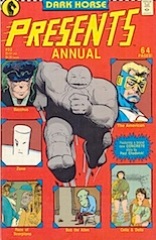
Dark Horse Presents 66 (September 1992)

dhp66.jpg
Obviously, the major attraction is the second chapter of An Accidental Death. The pace changes throughout; it opens with the body being hidden, then Brubaker moves to summary, then to scene again. The final scene–the discovery–comes after the two boys (the protagonist and the murderer) start to discover where they really live. Reality, in more ways than one, rushes in on them. But Brubaker’s writing is nuanced, never obvious. It’s just lovely.

Then Dr. Giggles, hopefully, finishes up. I don’t think I’ve mentioned how inept Coto is at plotting this narrative. The plot developments get stupider and stupider. At least it’s over.

The Concrete story is a little overwritten… lots of narration, but it’s amusing and Chadwick and Hotchkiss do a great job with the art.

The issue ends with two one page Alec comics from Campbell. Both are quiet, wonderful and somewhat profound. It’s such good work.

CREDITS

Concrete, Byrdland’s Secret; story and art by Paul Chadwick; lettering by Bill Spicer. Dr. Giggles, Part Three; story by Manny Coto; art by Alan J. Burrows; lettering by Willie Schubert. An Accidental Death, Part Two; story by Ed Brubaker; art and lettering by Eric Shanower. Alec, Genetic Defects and Overheard While I Was Supposed to be Working; story, art and lettering by Eddie Campbell. Edited by Randy Stradley.

Dark Horse Presents Fifth Anniversary Special (1991)

Dhp5th

This special is far from an accurate representation of Dark Horse Presents. Everything looks very professional.

The Aerialist and Heartbreakers installments are both long needed establishments of the series’ ground situation.

I even liked the Heartbreakers one (Bennett’s writing is far stronger from the clones’ perspective, versus their creator).

There’s also lots of disposable stuff–Concrete, The American and Black Cross are all weak, though Warner’s art is better on Cross than I’ve ever seen it. Chadwick and Verheiden use their stories to blather about American culture.

Of the two Miller’s–Give Me Liberty and Sin City–I almost prefer Sin City. Liberty‘s a little overbearing, though the Gibbons art is nice.

Prosser and Janson do a great adaptation of an Andrew Vachss. The Roachmill, Aliens and Aliens vs. Predator entries are all fantastic.

I’m a little peeved Bob the Alien is on the cover but not in the issue.

Dark Horse Presents Fifth Anniversary Special (April 1991)

35927.jpg
This special is far from an accurate representation of Dark Horse Presents. Everything looks very professional.

The Aerialist and Heartbreakers installments are both long needed establishments of the series’ ground situation.

I even liked the Heartbreakers one (Bennett’s writing is far stronger from the clones’ perspective, versus their creator).

There’s also lots of disposable stuff–Concrete, The American and Black Cross are all weak, though Warner’s art is better on Cross than I’ve ever seen it. Chadwick and Verheiden use their stories to blather about American culture.

Of the two Miller’s–Give Me Liberty and Sin City–I almost prefer Sin City. Liberty‘s a little overbearing, though the Gibbons art is nice.

Prosser and Janson do a great adaptation of an Andrew Vachss. The Roachmill, Aliens and Aliens vs. Predator entries are all fantastic.

I’m a little peeved Bob the Alien is on the cover but not in the issue.

CREDITS

Give Me Liberty, Martha Washington’s War Diary: April 16, 2012; story by Frank Miller; art by Dave Gibbons. Concrete, Objects of Value; story and art by Paul Chadwick; lettering by Bill Spicer. Aliens; story by John Arcudi; art by Simon Bisley. The American; story by Mark Verheiden; pencils by Dougie Braithwaite; inks by Robert Campanella; lettering by Pat Brosseau. Roachmill; story and art by Rich Hedden and Tom McWeeney. Placebo; script by Jerry Prosser, based on a story by Andrew Vachss; art by Klaus Janson; lettering by Michael Heisler. Black Cross; story and art by Chris Warner; lettering by Jim Massara. The Aerialist, Part Three; story and art by Matt Wagner; lettering by Kurt Hathaway. Heartbreakers, The Prologue; story by Anina Bennet; art by Paul Guinan; lettering by Willie Schubert. Aliens vs. Predator; story by Randy Stradley; art by Phill Norwood; lettering by Brosseau. Sin City, Episode One; story and art by Frank Miller. Edited by Stradley.

Dark Horse Presents (1986) #38

Dhp38

Chadwick’s Concrete isn’t so interesting this issue for what he does say, but for what he doesn’t. Concrete’s sidekicks get lost in the ghetto and a bunch of Black guys attack the car–presumably to beat the guy and “gang rape,” Chadwick’s words, the woman. When Concrete and the guy are sitting around calmly discussing it later, Concrete basically says it’s just how men act and isn’t it awful and shouldn’t women run things. But Chadwick made it pretty clear earlier these men are, specifically, Black men. I think it’s supposed to be well-intentioned, but….

Prosser and Pollock contribute the Mary: The Elephant prose story (Pollock illustrates). It’s awful; I can’t believe anyone would want it in their book. Maybe Dark Horse didn’t pay Prosser for something else on the condition they printed this idiocy. Some nice art though.

Delia & Celia is better than usual, but still exceptionally bad.

Dark Horse Presents 38 (April 1990)

35849.jpg
Chadwick’s Concrete isn’t so interesting this issue for what he does say, but for what he doesn’t. Concrete’s sidekicks get lost in the ghetto and a bunch of black guys attack the car–presumably to beat the guy and “gang rape,” Chadwick’s words, the woman. When Concrete and the guy are sitting around calmly discussing it later, Concrete basically says it’s just how men act and isn’t it awful and shouldn’t women run things. But Chadwick made it pretty clear earlier these men are, specifically, black men. I think it’s supposed to be well-intentioned, but….

Prosser and Pollock contribute the Mary: The Elephant prose story (Pollock illustrates). It’s awful; I can’t believe anyone would want it in their book. Maybe Dark Horse didn’t pay Prosser for something else on the condition they printed this idiocy. Some nice art though.

Delia & Celia is better than usual, but still exceptionally bad.

CREDITS

Concrete, Fire at Twilight; story and art by Paul Chadwick; lettering by Bill Spicer. Mary: The Elephant They Could Not Hang (At First)!; story by Jerry Prosser; art by Jack Pollock. Delia & Celia, A Pyre for Ethrod; story, art and lettering by Gary Davis. Edited by Randy Stradley.

Dark Horse Presents (1986) #32

Dhp32

Ugh, another “annual.” Sixty-four pages of Dark Horse Presents tends to be a little much.

The American is a little long here–it’s very passive and not at all dramatic. On the other hand, Peterson shows he used to be a lot more interesting of an artist.

The Wacky Squirrel strip from publisher Richardson is dumb.

Davis’s Delia & Celia is a complete bore, big shock. He manages to make a pterodactyl boring.

The longer than usual Bob the Alien just shows with more space Rice does an even better story. It’s funny and touching

The Concrete story is better than usual–Concrete’s jealous over girls–and Chadwick puts in three unanswered questions. Two are crime related, one personal. It works.

Bacchus is great. Campbell gets more into his eight pages than anyone ever has in one of these issues.

As usual, Zone is passable, Race of Scorpions is lame.

Dark Horse Presents 32 (August 1989)

35843.jpg
Ugh, another “annual.” Sixty-four pages of Dark Horse Presents tends to be a little much.

The American is a little long here–it’s very passive and not at all dramatic. On the other hand, Peterson shows he used to be a lot more interesting of an artist.

The Wacky Squirrel strip from publisher Richardson is dumb.

Davis’s Delia & Celia is a complete bore, big shock. He manages to make a pterodactyl boring.

The longer than usual Bob the Alien just shows with more space Rice does an even better story. It’s funny and touching

The Concrete story is better than usual–Concrete’s jealous over girls–and Chadwick puts in three unanswered questions. Two are crime related, one personal. It works.

Bacchus is great. Campbell gets more into his eight pages than anyone ever has in one of these issues.

As usual, Zone is passable, Race of Scorpions is lame.

CREDITS

The American, My Dinner with the American; story by Mark Verheiden; pencils by Brandon Peterson; inks by Randy Emberlin; lettering by David Jackson. Wacky Squirrel; story by Mike Richardson; art by Jim Bradrick; lettering by David Jackson. Delia & Celia, Down, Down and Down; story, art and lettering by Gary Davis. Bob the Alien, Bob, the alien, Steppin’ Out; story, art and lettering by Rich Rice. Concrete, Visible Breath; story and art by Paul Chadwick; lettering by Bill Spicer. Bacchus, A God and His Dog; story, art and lettering by Eddie Campbell. Zone; story, art and lettering by Michael Kraiger. Race of Scorpions, The Rusty Soldier; story and art by Leopoldo Durañona; lettering by Laura Davis. Edited by Randy Stradley.

Dark Horse Presents (1986) #28

Dhp28

The Concrete story goes on forever. It has some of Chadwick’s better art in a while, but also some Liefeldian body mechanics. It’s metaphysical nonsense about the environment. These Concrete stories are best as time capsules–things haven’t gotten any better in the last twenty years.

Zone debuts this issue; Kraiger’s illustrating is fine. The story’s harmless and uninteresting. It seems like it’s going to follow in Concrete‘s footsteps in terms of passivity.

Hedden and McWeeney do a wordless Roachmill. Great art, mildly amusing story. The art’s what’s important here.

Gilbert and Beatty do a Mr. Monster story all about EC Comics and censorship. It’s incredibly well-intentioned but boring and poorly illustrated. The inks on these Mr. Monster stories are hideous.

Then there’s the Homicide. Arcudi… it’s… I don’t know where to start so it’s probably not worth talking about.

Oh, and lame Black Cross pages litter the issue.

Dark Horse Presents 28 (March 1989)

35839.jpg
The Concrete story goes on forever. It has some of Chadwick’s better art in a while, but also some Liefeldian body mechanics. It’s metaphysical nonsense about the environment. These Concrete stories are best as time capsules–things haven’t gotten any better in the last twenty years.

Zone debuts this issue; Kraiger’s illustrating is fine. The story’s harmless and uninteresting. It seems like it’s going to follow in Concrete‘s footsteps in terms of passivity.

Hedden and McWeeney do a wordless Roachmill. Great art, mildly amusing story. The art’s what’s important here.

Gilbert and Beatty do a Mr. Monster story all about EC Comics and censorship. It’s incredibly well-intentioned but boring and poorly illustrated. The inks on these Mr. Monster stories are hideous.

Then there’s the Homicide. Arcudi… it’s… I don’t know where to start so it’s probably not worth talking about.

Oh, and lame Black Cross pages litter the issue.

CREDITS

Black Cross; story and art by Chris Warner. Concrete, Stay Tuned for Pearl Harbor; story and art by Paul Chadwick; lettering by Bill Spicer. Zone, Of a Feather; story, art and lettering by Michael Kraiger. Roachmill, The Terror of Canal St.; story, art and lettering by Rich Hedden and Tom McWeeney. Mr. Monster, Inklings; story and art by Michael T. Gilbert and Terry Beatty; lettering by Ken Bruzenak. Homicide; story by John Arcudi; art by Doug Mahnke; lettering by Pat Brosseau. Edited by Randy Stradley.

Dark Horse Presents (1986) #22

Dhp22

Seriously, a short story? I guess Andrew Murphy provides his own illustrations, but his story is a prose future story about cloning. Not a very logical one either (how do the clones age, for example). I guess it’s not the worst prose story I’ve ever read in a comic, but am I making a compliment? No.

Concrete is a thoughtful story of a young village kid in Asia getting ready for Concrete’s walking tour. Chadwick has probably never written a better story. Too bad the illustration is mediocre. He’s barely got any detail to his faces and I can’t remember a single stunning panel.

Rick Geary’s Police Beat, presumably short true police cases, is great. One page.

Trekker has Dave Dorman inks, which makes the whole thing look completely different. It’s not an entirely successful art experiment, but it’s the first Trekker I’ve sort of liked.

And Duckman is funny.