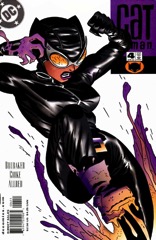
Catwoman (2002) #4

Catwoman  4

And here’s how you do a comic book. I was wondering when Catwoman was going to click and level up, and it’s this issue. It’s not just Darwyn Cooke’s pencils, though he’s got dozens of great panels in the issue. Pretty much everything except Selina fighting Clayface Y2K’s muck is great. The muck stuff is fine, but it’s gross, and it’s just muck. Worse, it’s pink flesh muck. Icky bad.

The issue starts with Selina confronting the killer and hearing some of his origin story. U.S. soldier, battlefield injury, weird experiment, dumped as a monster on the streets of Gotham by the U.S. Army. Tracks. She thinks she can talk him down and get him some help from that dickhead Batman (who does end up cameoing and is a complete piece of shit, gloriously rendered in a forties nod from Cooke and inker Mike Allred). She’s not entirely wrong, but she’s not right enough not to have a big supervillain fight. Except she’s Catwoman, and she’s not ready to fight fleshy muck monsters.

Writer Ed Brubaker does an exceptional job writing the fight scene. It’s a character development micro-arc for Selina as she realizes the new responsibilities she’s taking on; there’s doubt, regret, turmoil, all in rapid-fire as the fight progresses. Brubaker captures these snapshots into Selina’s experience through the text, tied to the visuals, and it’s phenomenal stuff. I knew Catwoman was going to get good, but I didn’t think it would get this good this fast.

Especially when the epilogue involves setting up the series proper, with Holly becoming a Kyle Investigations operative and Leslie Tompkins firmly established in the supporting cast. Except Brubaker writes it as a contrast to dickhead Batman, who doesn’t care about sex workers getting murdered and thinks writing Leslie a check fixes all the problems with the poors.

Only then Cooke (and Allred and colorist Matt Hollingsworth) turn the final splash page into this Batman visual homage deep cut. It’s so good.

This opening arc has got to be a killer trade.

Catwoman (2002) #3

Catwoman  3

There’s a lot of great Darwyn Cooke “good girl” art in this issue as Selina goes undercover to find the john who’s been killing all the girls, which I suppose could kick off an interesting discussion of how male gaze works in a non-realistic styles like Cooke’s. But it doesn’t make for a great issue. There’s a terrific opening with Selina visiting Leslie Thompkins, but after a dream sequence for Leslie.

Like three pages. Beautiful art, with Cooke doing a Will Eisner Spirit nod. It has absolutely nothing to do with the comic itself. It’s just padding. Selina’s visiting Leslie to get Oracle’s digits; Batman doesn’t give Selina his white friends’ phone numbers. It’d be something if they wrote Batman—or even could imagine writing him—as more thoughtful than a sixteen-year-old rich kid.

Oracle comes through—off-page—and Selina and Holly go undercover to interrogate the used car dealer who sold the killer his car. Selina gets to wear the costume; Holly gets to walk the Cooke “good girl” runway. Again, great art. But not a particularly good mystery development. It’s a fun, mischievous scene but has to basically hold up the comic because afterward, it’s just a chase scene.

The bad guy gets past Selina, and to pass the level in the video game, she has to search three different warehouses before he kills again. Writer Ed Brubaker intercuts Selina’s mission with the killer and his date flirting and being sweet when really we know he’s going to disintegrate the girl.

The art’s neat, and some of the dialogue’s excellent; plus, Leslie and Selina are cool pals, but it’s like half an issue with clutter to make up the rest. It’s Darwyn Cooke art, so the issue’s definitely worthwhile; it’s just not a great installment in the arc. Brubaker doesn’t have much narration from Selina this issue either. The whole thing’s a little off.

But very pretty.

Catwoman (2002) #2

Cw2

Darwyn Cooke owns this issue. It begins with an action sequence: Catwoman breaking into Gotham PD to get a look at the autopsies on the dead streetwalkers. Cooke breaks each page into a dozen or two panels, sometimes splitting a horizontal frame, more often zooming in on one particular aspect of the action. All in his “cartoony” style. There’s never better movement in comic art than the first act of Catwoman #2. It’s a masterpiece.

And he doesn’t let up the rest of the issue ambition-wise. There’s Selina and Holly’s girl talk, done in art deco—to contrast the noir—and then the finale reveal. While Selina (and the reader) have heard about what the killer’s doing to the women and then read the reports, the finale shows the immediate aftermath, complete with the cops robbing the corpse.

Cooke’s superhero noir is a genre itself. Absolutely beautiful, superior work.

Ed Brubaker’s script is mostly successful. The Selina narration’s solid (and appropriately sparse at times), but he runs into a couple hiccups. First, obviously, Selina’s characterization of Batman in her narration is one of a dick—he’d care the women were dying, but they chose that life, didn’t they? Second, when Selina does decide she’ll be the one to stop the killings, it appears to only be after the finale and seeing the latest victim. The narration comes too late in the visuals.

Otherwise, the writing’s excellent. The issue has the lengthy action open, which slows down once Selina’s broken into the morgue, then the flashback to her and Holly’s conversation after last issue, then back to the present and the latest killing. Based on the initial pacing, they could’ve gotten away without having Selina arrive at the crime scene in time. The issue’d earned its two dollars and four bits by then, but Cooke and Brubaker somehow find time (and pages) to continue.

Though had they not paced it so well, that final narration fumble might’ve been avoided. But Catwoman’s inordinately rare faults being side effects of its great successes seems on par for the book.

It’s just too good for its own good.

Catwoman (2002) #1

Catwoman  1

I’ve meant to go back and reread Brubaker’s Catwoman for literal decades now. The last time I tried, I started the post about Catwoman #1 pointing out it proves Ebert’s “no masks in noir” rule from his Batman Returns review wrong.

I’ll never be able to top that one, though it’s impossible not to think of Catwoman in those terms. With Darwyn Cooke and Mike Allred’s brisk, expressive art, Matt Hollingsworth’s lush but dark palette, Catwoman’s a visual feast. Especially once Selina gets back in “the outfit” and goes for an evening constitutional, hanging out on giant heads from a Schumacher Batman only fit to the Gothic city. It’s dark but not depressed; there are moments of such sincere joy in the comic. Not just for the reader but for Selina. She’s been struggling to get her groove back, and she’s finally got the right idea.

The comic’s got full narration from Selina, with Brubaker toggling between first and second person. When Selina’s feeling good about herself, it’s first person. When she’s tearing herself down, it’s second person. Batman ethics and morals have aged terribly, even in the last twenty years—I didn’t even realize I’m starting Catwoman again on its twentieth anniversary—so Selina feeling bad for thinking her friends—poor people, marginalized people—are actually worth it no matter what Batman says… yikes. Batman does show up, and Brubaker (and Cooke) give him the swashbuckler, Zorro feel, not the fascist Frank Miller one, which is good.

But still. Yikes. Find a better role model, Selina.

And she sort of does. She’s been seeing Leslie Thompkins for talk therapy. However, Selina’s been hiding her Catwoman side even though Batman already told Leslie, so she’s known the whole time, which seems professionally questionable. Be careful, Dr. Thompkins; it’s a slippery slope ending it faking the death of the first female Robin or whatever.

The opening has a hook—someone’s killing sex workers and terrifying them before doing so—and the soft cliffhanger gets Selina into the know. She’s been hiding out in the Narrows or whatever it’s called, most people thinking she’s dead, fallen from high society, and not wanting to return to the Jim Balent days of Catwoman. It’s an earnest, speedy character development issue. Not too much backlog, but some panels showing off Cooke’s ability to mix Catwomen of all vintages and costumes; Selina’s trying to move forward and do some good.

It’s such a great first issue. It’s nice. It’s never not tough, never not potentially rough, but it’s also so damn nice.

Justice League: The New Frontier Special (2008) #1

Justice League The New Frontier Special 2008 1 1

It would be wrong to describe Justice League: The New Frontier Special as hack work. Darywn Cooke’s art on the feature, even his plotting of it, is not hacky. Neither is the Robin and Kid Flash story’s art, courtesy Dave Bullock and Michael Cho. Even the Wonder Woman and Black Canary go to a Playboy Club art by J. Bone isn’t… hack work. Bone’s cartoonish style does what it’s supposed to do.

Now, the writing on that last story might be hack work. Cooke opens with a gentle jab at political correctness, confirms Bruce Wayne is a pig in his off time, and then has Wonder Woman slut shame. It’s not quite cringe because it’s six pages, but it’s definitely eye-roll.

And the Robin and Kid Flash story is more just annoying. Between Robin’s hep cat narration and the proto-groovy dialogue (and the “commie” villains?), it’s tiresome. But gorgeous art. Arguably better looking than Cooke’s feature, which is… something.

The feature tells the untold tale from the original New Frontier (this not at all special Special tied into the release of the lousy New Frontier animated movie)—Batman v Superman: Dawn of the Greater Good. Besides getting some insight into how Cooke would write Batman, Superman, and Wonder Woman if he’d written them more in the original comic (good thing he didn’t), it also has more of dickhead Dwight D. Eisenhower, who sends Supes after Bats. I remember reading something about (Canadian) Cooke thinking we needed Eisenhower back—when asked about his politics during Iraq War II, where there was only one right answer—which adds a layer to the comic.

If Cooke liked Ike… it’s hard to imagine how he’d have written him if he didn’t like him. Killing a puppy maybe?

The feature’s twenty-four interminable pages, with Cooke clearly not spending a lot of time on the art. The Batman and Superman fight itself is pretty good, rather drawn out, but with a goony resolution. It’s also one hell of a retcon of the original series.

Overall the most successful thing in the comic is the one page prologue with Rip Hunter telling everyone not to take it seriously.

All of a sudden, I’m real glad I don’t have one of the New Frontier collected editions with the Special included. If I’d read it on publication, I forgot about it. I hope I can forget about it again.

DC: The New Frontier (2004)

DC The New Frontier 2004 1

Darwin Cooke’s most impressive achievement with The New Frontier isn’t the art, which is a mix of sublime, grandiose, muted, and bombastic, or keeping track of all the characters (there have to be hundreds), but the voice he finds for characters. He starts big, with Losers member Johnny Cloud narrating the team’s adventures on Dinosaur Island. New Frontier is heavier with the science heroes and war heroes than with the superheroes. The Losers, Task Force X (the Suicide Squad), the Blackhawks show up, there’s a bunch with the Challengers of the Unknown—all of the mask-free, government sanctioned hero types, they play the biggest part in the New Frontier’s main plot, figuring into both Hal Jordan and John Jones’s plot lines and then consuming them. Though everyone’s plot is consumed by the finale.

Cloud’s memoir sets up the comic both in terms of Cooke’s approach—it’s going to be fantastical comic book action, but with a lot of heart in its heroes (New Frontier doesn’t have much in the way of human villains, as it turns out, just heroes who aren’t being heroic yet and then the politicians… they’re all bad), so awesome art and simple, sincere narration—as well as the main plot. Dinosaur Island’s going to figure in a lot.

After Cloud, Cooke cycles through the same main “leads”—Green Lantern-to-be Jordan and not yet Martian Manhunter Jones. There are tangents, but it’s their story for most of the comic. The big three—Batman, Wonder Woman, Superman—figure in a little. Wonder Woman and Superman more because they become government stooges and head off to Southeast Asia when tasked, which has long lasting ramifications and figures into their (scant) character development arcs. Cooke’s not telling a Wonder Woman or Superman story—despite showing up every issue, Superman’s basic ground situation still comes as a bit of a surprise at the end. Batman’s just there to support other characters, whether Superman or Martian Manhunter (without knowing he’s a Martian).

There’s also a possible plot hole with Wonder Woman knowing Eisenhower from the war but it’s unclear in what capacity because the superheroes weren’t involved in World War II (because “Spear of Destiny,” which means B.J. Blazkowicz failed his mission in New Frontier-verse). Cooke is cagey with the ground situation, which is fine when it works and he’s able to have a surprise reveal or little plot twist, but he’s intentionally manipulating. So when it doesn’t work, it’s real obvious.

As present as Wonder Woman and Superman is Lois Lane. She comes in early and stays to the end, often getting onto a soapbox to rant about the government wanting to control all the superheroes. See, the Red Scare goes to them too, not for being communists but for wearing the masks. Cooke does a fantastic job with the science heroes and how they exist in the world, but there’s nothing about how the regular folk regard the superheroes anymore. Tying them into McCarthyism when they would’ve been fresh in the public’s mind for do-gooding (presumably). It’s weird.

Of course, there’s not a lot of opportunity for Cooke to expound recent history because—outside the various narrations—the only expository device he’s got is the occasional article from some in-world reporter, Lois, Vicki Vale, Iris West, and they wouldn’t be appropriate for too much historical exposition.

The big fight at the end—will the United States’s earnest heroes be able to get over their fears and band together to stop an unimaginable threat, leveraging their individual abilities and the latest in Silver Age technology? Of course, it’s a superhero. It’s rather well executed, even if some of the details—Cooke’s design of the final boss seems like the physiology-free sketches of a child (in the Fifties, natch) and, well, something out of Max Shea’s imagination (obligatory Watchmen mention)… because New Frontier very much feels like Watchmen only with the DC Universe heroes. The Wonder Woman and Superman stuff… it does not exist in a vacuum. Cooke is showing off the potential for the regular stock of DC characters but does it too well.

The Flash, who gets less than stars Hal Jordan and John Jones but definitely more than Superman or Wonder Woman, fits really well in the 1960s context. Ditto Hal Jordan. In proving the characters relevance to their original historical context, Cooke makes everything else seem, well, second best. Again, with the caveat he’s very much gearing their characterizations—as expressed in their narrations—to fit his story. But you don’t get done with New Frontier and want to hunt down the latest Flash or Green Lantern issue. It’s interesting see these guys—and the comic definitely leans almost all male (it passes Bechdel because Wonder Woman chastises another Amazon’s fighting ability and a woman compliments another on her blouse)—as they struggle with their internalized jingoism and so forth. Cooke’s subplots often are just texture to promote this internal turmoil, like Hooded Justice—sorry, sorry, John Henry—who fights to KKK in Tennessee to national acclaim but is a local criminal. Cooke talks around the vigilantism stuff; he doesn’t have a character who can really get into it. John Jones does a little because he’s a cop in Gotham City, but supervillains aren’t really a thing yet.

Cooke takes huge bites and thoughtful chews.

The epilogue, set to John F. Kennedy’s “New Frontier” speech (get it, get it), is clearly a labor of love for Cooke but also unnecessary if not wholly unsuccessful. Kennedy and speechwriter Ted Sorensen were not writing for DC Comics and Cooke’s juxtaposition of text about social injustices with the corresponding comic book images… it comes off a combination of callous, opportunistic, and forced. New Frontier reaches, which is just right, it ought to reach, but Cooke reaches a little too far in the end. He ends up derivative instead of innovatory, which is exactly what the comic shouldn’t do.

But it’s still a masterpiece of superhero comics, setting an insurmountable bar because—even with plot holes and pitfalls and rushed subplots and epilogue problems—Cooke’s four or five hundred pages of art aren’t ever going to be surpassed. It’s a gorgeous, affecting tribute, homage, and eulogy to the Silver Age of DC Comics.

Catwoman (2002) #4

Catwoman  4

How does noir work when the villain is a Clayface rip-off. I say rip-off because Catwoman is a Batman spin-off and Clayface is a Batman villain. Brubaker knew the similarity. It also gives Cooke something fantastic to draw. Selina in this gross pink muck–the leftover transformative flesh of the villain? Great stuff. Lots of movement in the art.

The villain does have something of a noir origin though. G.I. injured, army docs turn him into a monster, it’s like a film noir with shades of fifties sci-fi. It’s really cool.

But Brubaker relies on it almost too much. The script tries to showcase the art, which is fine and dandy and marvelous. Only it makes for some rushed scenes. One less page of the fight and one more page with Selina and Leslie would have been awesome.

The issue starts fast and rushes. The last few pages seem so short because of the action sequence pacing. Those last few pages are exceptional. Brubaker and Cooke figure out how to give noir a superhero. It’s great comic book storytelling.

Even if the fight goes long.

Catwoman 4 (April 2002)

Catwoman #4How does noir work when the villain is a Clayface rip-off. I say rip-off because Catwoman is a Batman spin-off and Clayface is a Batman villain. Brubaker knew the similarity. It also gives Cooke something fantastic to draw. Selina in this gross pink muck–the leftover transformative flesh of the villain? Great stuff. Lots of movement in the art.

The villain does have something of a noir origin though. G.I. injured, army docs turn him into a monster, it’s like a film noir with shades of fifties sci-fi. It’s really cool.

But Brubaker relies on it almost too much. The script tries to showcase the art, which is fine and dandy and marvelous. Only it makes for some rushed scenes. One less page of the fight and one more page with Selina and Leslie would have been awesome.

The issue starts fast and rushes. The last few pages seem so short because of the action sequence pacing. Those last few pages are exceptional. Brubaker and Cooke figure out how to give noir a superhero. It’s great comic book storytelling.

Even if the fight goes long.

CREDITS

Anodyne, Conclusion; writer, Ed Brubaker; penciller, Darwyn Cooke; inker, Mike Allred; colorist, Matt Hollingsworth; letterer, Sean Konot; editors, Nachie Castro and Matt Idelson; publisher, DC Comics.

Catwoman 3 (March 2002)

Catwoman #3It’s a strange issue. It’s a good issue–though it’s certainly the least ambitious so far–but it’s also a strange issue. Selina doesn’t have as much narration as she had before and now she’s doing much different things. She’s the star of a Bronze Age Batman comic, where Batman dresses up as Matches Malone and investigates on the wharf.

It’s a successful issue. Cooke’s in on the Bronze Age vibe of the issue and the art feels very seventies. The content Cooke’s illustrating, anyway. There’s even a sixties thing with a used car dealer. A lot of thought went into the visual presentation of the book. I just wish Brubaker hadn’t been so quiet.

So far, this series has been about Selina evolving into a do-gooder. This issue continues that evolution, but with the exception of the narration in the first few pages, Selina’s experience is absent from the comic. Even when Brubaker brings back the narration later, it’s to establish that Matches Malone sequence.

Like I said, strange. Expertly, enthusiastically done, but with too much confidence in the narrative effect of the comic to worry about the narrative itself. It’s showy.

CREDITS

Anodyne, Part Three of Four; writer, Ed Brubaker; penciller, Darwyn Cooke; inker, Mike Allred; colorist, Matt Hollingsworth; letterer, Sean Konot; editors, Nachie Castro and Matt Idelson; publisher, DC Comics.

Catwoman 2 (February 2002)

Catwoman #2Cooke mixes a lot of styles in this issue. Selina lives her non-costumed life in a more angular city, one with more art deco designs than when she’s got the costume on at night. But Cooke also finds this mixed style for Selina herself. She’s got the modern look, but he also goes for Silver Ago influences to make her more sympathetic.

And then there’s what Brubaker’s narration does for her character. This series of Catwoman integrates whatever history the character had since Batman: Year One, so the Jim Balent stuff and whatever else, with a continuation of the character from Year One. Or at least something closer to that characterization. Including the history of prostitution.

The prostitution angle–with Holly, Selina’s sidekick from her Year One days–figures into the story, with Gotham’s dirty cops ignoring a serial killer preying on girls on the street. Selina ends up investigating it. There’s no humor in the comic. Not a moment. Not even when Cooke and Brubaker take the time and care to show Selina’s pure joy in running around the rooftops. It’s serious stuff; Brubaker’s very deliberate in how he works through Selina’s thoughts in the narration too.

Again, it’s noir. It’s a noir comic masquerading as a superhero comic (masquerading as a noir comic). Brubaker juggles the mainstream and more artistically ambitious beautifully. What Cooke does is just as important, but it only works because of how well Brubaker does his bit.

CREDITS

Anodyne, Part Two of Four; writer, Ed Brubaker; penciller, Darwyn Cooke; inker, Mike Allred; colorist, Matt Hollingsworth; letterer, Sean Konot; editor, Nachie Castro and Matt Idelson; publisher, DC Comics.