 In his ★★ review of Batman Returns, Roger Ebert said, “no matter how hard you try, superheroes and film noir don’t go together; the very essence of noir is that there are no more heroes.” I disagree about the film, but not all of the quote. I agree with the first part, not so much the second. Because it’s a closed vision of heroes.
It oddly doesn’t seem to occur to Ebert how the “junkies and masochists and hookers and those who have squandered everything… [can be] the ring of brightest angels around heaven.” Because a review of a single comic book from 2002 needs this long of a preamble. One with the only time I’ll agree with Ebert this year and a great Rick Moody quote.
But Ed Brubaker and Darwyn Cooke’s Catwoman requires a significant preamble. Because Brubaker and Cooke crack Ebert’s problem. How do film noir and superheroes go together? Well, the superhero can’t be the hero. Batman shows up in this first issue of Catwoman for two reasons.
First, regardless of how progressive DC was being with a non-objectified characterization of Catwoman, they weren’t being so progressive they didn’t want to sell the comic. There’s an exceptionally tasteful, but sexy, suiting up sequence. Cooke can do that kind of thing, thanks to Brubaker selling Selina’s excitement. It’s believable.
That scene is so well-executed, one might just skip over it as a commercialist detail. But Batman is all commercial. You launch a spin-off of a Batman comic, Batman better guest star, especially in the early aughts, especially going from Chuck Dixon and Jim Balent to Ed Brubaker and Darwyn Cooke. You need Batman. And this issue delivers. A full-on Batman action sequence–it’s hard to remember when Brubaker’s mainstream writing was a DC staple, not how he brought the same thing to Marvel to better sales–then Batman shows up for character stuff.
And that character stuff is the second reason Batman shows up. He’s essential to Brubaker’s characterization of Selina. Selina has an informed but seemingly simplistic view of Batman; he’s her dark blue boy scout. It gives Selina better possession over the shared setting, she belongs.
Brubaker and Cooke visualize that setting as a noir. They start with the already noir-ish David Mazzuchelli Year One visuals then develop it, creating a Technicolor film noir. Brubaker’s script follows Selina–the comic’s narrator as well as protagonist–through her last few days of sabbatical. She doesn’t know it, but she’s going to get suited up again.
There’s a lot of noir framing in the flashbacks and so on. The narrative construction is special stuff. It’s meticulous. Meticulously written, then meticulously illustrated.
By the time the most noir element comes into the comic–in its last pages–Brubaker and Cooke have already delivered an awesome read. The way the last two pages and the soft cliffhanger? It’s the chocolate sprinkles on the frosting.
CREDITS
Anodyne, Part One of Four; writer, Ed Brubaker; penciller, Darwyn Cooke; inker, Mike Allred; colorist, Matt Hollingsworth; letterer, Sean Konot; editor, Nachie Castro and Matt Idelson; publisher, DC Comics.
 Looks like Conner rushed a bit with the art. The issue opens fine and closes okay, but there are some definite rough patches.
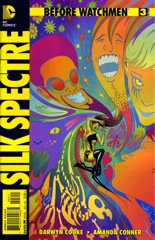 The mystery of the smiley face button is solved! Finally, now everyone can sleep at night. The addition of said button does make one wonder if Cooke’s flipping off Moore a little (as the button is what started Moore’s disputes with DC).
 Cooke and Conner set up Laurie as a hippie superhero; it’s kind of cool and definitely a decent look at sixties San Francisco. What’s interesting–and something I don’t think the original series ever established–is Laurie goes the “with great power” route. She turns into Silk Spectre because she can help people if she does. It deepens the character quite a bit.
 For Silk Spectre, Darwyn Cooke and Amanda Conner go the romance comic route. Or at least closer to it than I was expecting, but it makes sense given Laurie’s age during the high adventuring days of Watchmen.
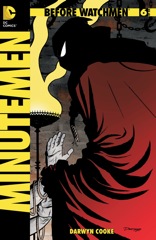 Cooke plays both Hollis and the reader. We all find out at the same time–maybe Cooke’s trying to show Hollis made the same negative assumptions the reader does, but I don’t think so. Cooke’s been intentionally fooling the reader for at least three issues and in ways he doesn’t fool Hollis.
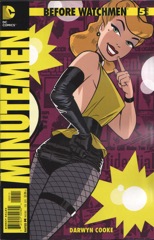 Yeah, Cooke goes exactly where I expected him to go. I suppose one could say there’s a balance to how he treats gays, but there’s not. He turns one group into martyrs and demonizes the other. It’d probably make Alan Moore ralph; one’s got to wonder if it’s there as a middle finger to Moore, actually.
 On one hand, this issue is the most how I’d expect a Watchmen prequel from Cooke to read (if it weren’t four issues in). There’s back story on the Minutemen after the war, including when Sally and the Comedian reunite. Cooke humanizes him quite a bit… even if he does rip off Full Metal Jacket and a handful of other war movies to do so.
 Poor Hollis, in love with a girl who doesn’t know he exists. Strangely, Cooke doesn’t narrate the book well when Hollis–in the sixties–is commenting directly on his younger self’s actions. The narration does work otherwise though.
 And now I’m not sure with where Cooke takes things. He turns Minutemen, in its conclusion this issue, into a really tough, uncomfortable book. It’s like I can’t decide if it’s homophobic, if Cooke’s just using the material or if he’s just being straightforward about it. There’s probably no comfortable way to handle it.