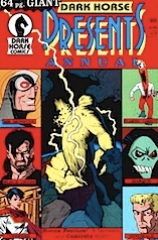
Dark Horse Presents 47 (January 1991)

35858.jpg
If it weren’t for a one page Rich Rice cartoon of an apologetic Godzilla, this issue would be really scraping bottom.

Okay, not exactly true. Buniak’s got a beautifully illustrated jungle adventure featuring Tarzan and Kong stand ins. Lovely ink washes. The story’s not strong, but the art’s the point.

Otherwise, it’s a weak one. The art from the Trumans is pretty good. While the plot has a solid finish, their writing is disastrous. The first person narration is… Ugh.

Wolfer and Warner have some future story about an earth invaded by alien dinosaurs and the Japanese building humans battle armor. It’s lame and derivative, with some occasionally okay art. I don’t think Wolfer has a single original idea.

As for Mielcarek’s story, is Dark Horse publishing mediocre eighth grade illustrators? The writing’s moronic, but the art is simply hideous. Maybe the worst art I’ve ever seen in this series.

CREDITS

Jungle of the Giants; story and art by Timothy Truman and Benjamin Truman. Burn Out; story and pencils by Mike Wolfer; inks by Chris Warner; lettering by Pat Brosseau. Desperate; story and art by Brian Buniak. Monster Island; story and art by Vince Mielcarek; lettering by Jade Moede. Edited by Randy Stradley.

Dark Horse Presents (1986) #28

Dhp28

The Concrete story goes on forever. It has some of Chadwick’s better art in a while, but also some Liefeldian body mechanics. It’s metaphysical nonsense about the environment. These Concrete stories are best as time capsules–things haven’t gotten any better in the last twenty years.

Zone debuts this issue; Kraiger’s illustrating is fine. The story’s harmless and uninteresting. It seems like it’s going to follow in Concrete‘s footsteps in terms of passivity.

Hedden and McWeeney do a wordless Roachmill. Great art, mildly amusing story. The art’s what’s important here.

Gilbert and Beatty do a Mr. Monster story all about EC Comics and censorship. It’s incredibly well-intentioned but boring and poorly illustrated. The inks on these Mr. Monster stories are hideous.

Then there’s the Homicide. Arcudi… it’s… I don’t know where to start so it’s probably not worth talking about.

Oh, and lame Black Cross pages litter the issue.

Dark Horse Presents 28 (March 1989)

35839.jpg
The Concrete story goes on forever. It has some of Chadwick’s better art in a while, but also some Liefeldian body mechanics. It’s metaphysical nonsense about the environment. These Concrete stories are best as time capsules–things haven’t gotten any better in the last twenty years.

Zone debuts this issue; Kraiger’s illustrating is fine. The story’s harmless and uninteresting. It seems like it’s going to follow in Concrete‘s footsteps in terms of passivity.

Hedden and McWeeney do a wordless Roachmill. Great art, mildly amusing story. The art’s what’s important here.

Gilbert and Beatty do a Mr. Monster story all about EC Comics and censorship. It’s incredibly well-intentioned but boring and poorly illustrated. The inks on these Mr. Monster stories are hideous.

Then there’s the Homicide. Arcudi… it’s… I don’t know where to start so it’s probably not worth talking about.

Oh, and lame Black Cross pages litter the issue.

CREDITS

Black Cross; story and art by Chris Warner. Concrete, Stay Tuned for Pearl Harbor; story and art by Paul Chadwick; lettering by Bill Spicer. Zone, Of a Feather; story, art and lettering by Michael Kraiger. Roachmill, The Terror of Canal St.; story, art and lettering by Rich Hedden and Tom McWeeney. Mr. Monster, Inklings; story and art by Michael T. Gilbert and Terry Beatty; lettering by Ken Bruzenak. Homicide; story by John Arcudi; art by Doug Mahnke; lettering by Pat Brosseau. Edited by Randy Stradley.

Dark Horse Presents (1986) #20

Dhp20

This issue is a sixty-four page giant–only most of the extra is filler. They could have gotten away with a lot less pages.

The Mr. Monster story is real short (and lame). Gary Davis has a short space alien story showing he’s read some Arthur C. Clarke (it’s long, wordless filler).

Rick Geary’s got a nice two page story, which is filler but really excellent filler.

Then there’s the start of a Trekker serial. It’s incomprehensible if you haven’t read the Trekker series and probably even if you have.

Doug Potter has an excellent story about homelessness.

Oh, I missed Bob Burden’s Mystery Men and Flaming Carrot two page filler.

Then a real Mask story, which seems to be wrapping up. The narrative’s a little pat dramatically, but I’m not sure Badger cared.

Bob the Alien and Mindwalk have stories. Bob‘s hilarious, Mindwalk‘s weak.

Finally, even more filler.

Dark Horse Presents 20 (August 1988)

35831.jpg
This issue is a sixty-four page giant–only most of the extra is filler. They could have gotten away with a lot less pages.

The Mr. Monster story is real short (and lame). Gary Davis has a short space alien story showing he’s read some Arthur C. Clarke (it’s long, wordless filler).

Rick Geary’s got a nice two page story, which is filler but really excellent filler.

Then there’s the start of a Trekker serial. It’s incomprehensible if you haven’t read the Trekker series and probably even if you have.

Doug Potter has an excellent story about homelessness.

Oh, I missed Bob Burden’s Mystery Men and Flaming Carrot two page filler.

Then a real Mask story, which seems to be wrapping up. The narrative’s a little pat dramatically, but I’m not sure Badger cared.

Bob the Alien and Mindwalk have stories. Bob‘s hilarious, Mindwalk‘s weak.

Finally, even more filler.

CREDITS

<

p style=”font-size:11px;”>Mr. Monster, The Thing in Stiff Alley!; story by Chuck Gamble and Michael T. Gilbert; pencils by Gamble, Gilbert and Chuck Wacome; inks by Gilbert; lettering by Ken Bruzenak. Anomaly; story, art and lettering by Gary Davis. A Mother’s Tragedy; story, art and lettering by Rick Geary. Trekker, Vincent’s Share; story and art by Ron Randall; lettering by Ken Bruzenak. The Mystery Men!; story and art by Bob Burden; lettering by Roxanne Starr. The Visit; story, art and lettering by Douglas C. Potter. The Mask; story and art by Mark Badger; lettering by David Jackson. Concrete, Watching a Sunset; story and art by Paul Chadwick; lettering by Bill Spicer. Bob the Alien, Bob, the alien, Goes Birddogging; story, art and lettering by Rich Rice. Mindwalk; story by Randy Stradley; art by Randy Emberlin; lettering by Willie Schubert. Wacky Squirrel, Mixed Results; story, art and lettering by Jim Bradrick. Black Cross; story and art by Chris Warner. Edited by Randy Stradley.

Dark Horse Presents (1986) #3

Dhp3

Yay, Warner’s back with Black Cross–featuring a bunch of expository dialogue recapping the first story. With all that useless exposition, one might think Warner would explain the ground situation to the reader. But he doesn’t. It’s confusing and a lot of work thinking about something so dumb sounding.

Stradley and Emberlin’s Mindwalk has its weakest entry so far, with Stradley inexplicably using two narrators here. A mediocre first person narrator is one thing, but then he brings in a female narrator who sounds like a six-year-old. Emberlin’s art is similarly problematic, though he draws Kirby-esque monsters well.

The Concrete story is charming. It’s the adventures of the female scientist (still not clear on Concrete’s origin, which seems to be intentional) trying to move his unconscious body. Chadwick’s art is gorgeous.

The Boris Chronicles strip is cute, with Smith basically converting a newspaper strip to four pages.

Dark Horse Presents 3 (November 1986)

35814.jpg
Yay, Warner’s back with Black Cross–featuring a bunch of expository dialogue recapping the first story. With all that useless exposition, one might think Warner would explain the ground situation to the reader. But he doesn’t. It’s confusing and a lot of work thinking about something so dumb sounding.

Stradley and Emberlin’s Mindwalk has its weakest entry so far, with Stradley inexplicably using two narrators here. A mediocre first person narrator is one thing, but then he brings in a female narrator who sounds like a six-year-old. Emberlin’s art is similarly problematic, though he draws Kirby-esque monsters well.

The Concrete story is charming. It’s the adventures of the female scientist (still not clear on Concrete’s origin, which seems to be intentional) trying to move his unconscious body. Chadwick’s art is gorgeous.

The Boris Chronicles strip is cute, with Smith basically converting a newspaper strip to four pages.

CREDITS

Mindwalk, Mindwar!, Part One; writer, Randy Stradley; artist, Randy Emberlin; letterer, David Jackson. Concrete, The Four-Wheeled Sleeping Pill; writer and artist, Paul Chadwick; letterer, Bill Spicer. Black Cross; writer and artist, Chris Warner; letterer, David Jackson. Boris the Bear, The Boris Chronicles; story and art, James Dean Smith; script, Randy Stradley; letterer, David Jackson. Editor, Randy Stradley; publisher, Dark Horse Comics.

Dark Horse Presents (1986) #1

Dhp1

You know, I really didn’t expect Dark Horse Presents to open its first issue with a male overcompensation piece like Black Cross. Warner’s art’s amateurish and I guess it shows movie optioning is a comic book tradition (the character looks like Sylvester Stallone). It’s a dismal story.

Chadwick’s two contributions are all right. The Concrete one is charming and at least hints at some kind of social consciousness for the comic (which Black Cross feigns). More impressive, as far as the art goes, is Brighter!, a Vertigo ready story about some young woman who can produce optical illusions. So she’s a mutant (lots of superpowers this issue). But the art’s gorgeous and makes up for the lukewarm writing.

Stradley’s Mindwalk is about another mutant (one with a kind of telepathy). It’s nearly okay, though Emberlin’s art isn’t quite there. Features Nazis and gangsters though.

I wasn’t expecting so many mutants.

Dark Horse Presents 1 (July 1986)

35812.jpg
You know, I really didn’t expect Dark Horse Presents to open its first issue with a male overcompensation piece like Black Cross. Warner’s art’s amateurish and I guess it shows movie optioning is a comic book tradition (the character looks like Sylvester Stallone). It’s a dismal story.

Chadwick’s two contributions are all right. The Concrete one is charming and at least hints at some kind of social consciousness for the comic (which Black Cross feigns). More impressive, as far as the art goes, is Brighter!, a Vertigo ready story about some young woman who can produce optical illusions. So she’s a mutant (lots of superpowers this issue). But the art’s gorgeous and makes up for the lukewarm writing.

Stradley’s Mindwalk is about another mutant (one with a kind of telepathy). It’s nearly okay, though Emberlin’s art isn’t quite there. Features Nazis and gangsters though.

I wasn’t expecting so many mutants.

CREDITS

Black Cross; writer and artist, Chris Warner; letterer, John Workman. Concrete, Lifestyles of the Rich and Famous; writer and artist, Paul Chadwick; letterer, Bill Spicer. Mindwalk; writer, Randy Stradley; artist, Randy Emberlin; letterer, John Workman. Brighter!; writer and artist, Paul Chadwick; letterer, Bill Spicer. Editor, Randy Stradley; publisher, Dark Horse Comics.

Aliens vs. Predator (1990) #4

Avp4

It’s a weak close, partially because Stradley probably needed another issue to fully develop the relationship between the protagonist and the friendly Predator (he also needed space to give it a proper ending), but mostly because Chris Warner is no replacement for Norwood.

Warner kills that beautiful design sense Norwood brings to the book. Instead of the panels being so well-composed it can distract from the narrative, they’re rote. Aliens vs. Predator, between Warner and Campanella, becomes a boring movie tie-in. Norwood made it special.

Even with the action pacing and the lack of narration, Stradley’s able to keep his protagonist strong. Sadly, one of her strongest moments is inferred instead of shown.

Stradley can only do so much. He’s a good writer, he clearly has a decent plot. But he doesn’t have the time to tell the story. He also doesn’t adjust the writing for Warner’s pencils.