• Ms. Marvel 2 (May 2014)

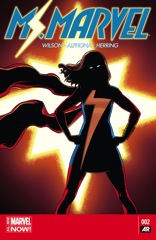
    Ms. Marvel #2I remember worrying about whether or not Wilson would be able to maintain the first issue’s level of quality as Ms. Marvel went on. Apparently I didn’t need to concern myself, because not only is the second issue just as good, Wilson starts to show her hand.

    First up, the superhero alter ego is going to be more important to the protagonist than to anyone else. I can’t imagine how Wilson will deal with a crossover. Second, the family and friends aspect is going to continue to be where Wilson gets the majority of the drama. In some ways, it’s not a very Marvel comic, but in others… it’s very much one.

    There’s some excellent art from Alphona too. The setting has to be mysterious, familiar and contained all at once. Then the second half is (good) family comedy. Alphona handles both styles equally well.

    Wilson and Alphona have Marvel covered.

    A 

    CREDITS

    All Mankind; writer, G. Willow Wilson; artist, Adrian Alphona; colorist, Ian Henning; letterer, Joe Caramagna; editors, Devin Lewis and Sana Amanat; publisher, Marvel Comics.

  • The Incredible Hulk 59 (October 2003)

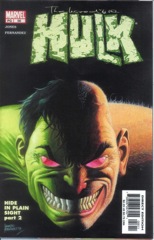
    The Incredible Hulk #59I don’t tend to go on at length about bad art. Well, maybe I do sometimes. But not often.

    This issue features the Hulk versus the Absorbing Man. Fernandez might draw the Hulk bad, but the Absorbing Man? Oh, he’s a disaster. From the panel Creel gets out–maybe even a few panels earlier where an establishing shot or two gets missed–the issue is a disaster. Fernandez is clearly trying, there’s lots of detail, it’s just inept visual storytelling.

    There’s also a lack of commitment from Jones. The arc’s plot threads don’t great resolved; he sends Bruce off into the sunrise, Bill Bixby-style, ready for his next episode. There’s an orphaned kid and the super-woman female lead of the arc not getting any resolution. Worse, there’s even an ominous epilogue.

    Jones also loses the too smart supervillain vibe this issue. It’s bad stuff, disjointed and rather dispassionate.

    C- 

    CREDITS

    Hide in Plain Sight, Part Five; writer, Bruce Jones; artist, Leandro Fernandez; colorist, Steve Buccellato; letterer, Cory Petit; editors, Warren Simons, John Miesegaes and Axel Alonso; publisher, Marvel Comics.

  • Ghosted 8 (March 2014)

    Ghosted #8Gianfelice’s art stands out this issue. Maybe it’s because everything Williamson does–Jackson is being held hostage–needs to be a surprise. There’s the villains taunting him so their taunts need to be visually rendered, there’s the allies doing a surprise attack, the surprise needs to be rendered. Even though there aren’t any huge set piece fights (I think they average three or four panels), the art’s essential.

    Also essential is giving Jackson someone to talk with. Williamson can run him through the Bond henchmen and Bond villain–a comparison the comic itself raises–but giving him a chance to connect with a “regular” character is necessary to jump start the arc. Ghosted has been doing fine, but once Williamson unveils the damsel in distress’s secret, it improves.

    While the flashback stuff is calculatedly compelling, Williamson hasn’t introduced complicated intrigue in the arc until now. It seems worth the wait.

    CREDITS

    Writer, Joshua Williamson; artist, Davide Gianfelice; colorist, Miroslav Mrva; letterer, Rus Wooton; editor, Sean Mackiewicz; publisher, Image Comics.

  • Ghosted 7 (February 2014)

    Ghosted #7Trick is okay. I’m a little surprised, since he sort of ominously disappeared for a bit last issue. He’s in sidekick role, self-proclaimed dirty old man to Jackson’s more sympathetic narrator.

    Williamson gives the issue a speedy pace. It’s maybe three or four different sequences set in the same night. But there’s something too speedy about it. Williamson forecasts the cliffhanger too early. Not the exact details of it, but how he’s going to use it. Hard cliffhanger, just after Jackson has discovered a big detail in the story arc.

    It’s too bad the comic gets predictable for the last few pages, because, otherwise, Williamson’s pacing is good–pulp, ghosts and action all play a part. There’s even a flashback to some mystery woman. I’d forgotten Williamson might want to develop Jackson a bit more; even though the character narrates, he’s distant.

    The issue meanders, which is a shame.

    CREDITS

    Writer, Joshua Williamson; artist, Davide Gianfelice; colorist, Miroslav Mrva; letterer, Rus Wooton; editor, Sean Mackiewicz; publisher, Image Comics.

  • The Terminator: Enemy of My Enemy 2 (March 2014)

    The Terminator: Enemy of My Enemy #2Okay, the structure confuses me. I think the issue opens and then goes back to an early time and stays there but it also seems like maybe it continues the time from the open. I don’t know.

    The confusion aside, it’s a fairly decent comic for a Terminator comic. Igle’s pencils are good–he’s got a fantastic sense of action and how to break out those scenes. And enough nostalgia for the eighties to make tone engaging.

    Jolley writes more of a movie script than a comic book one. You can just hear the Brad Fiedel Terminator music at times and it’d make a great scene in a movie. In a comic, it makes an okay one.

    The problem with the comic is mostly the pacing. Not enough happens in it; Jolley raises some neat questions about the franchise, but there still needs to be some narrative content… Doesn’t there?

    B- 

    CREDITS

    Writer, Dan Jolley; penciller, Jamal Igle; inkers, Ray Snyder and Robin Riggs; colorist, Wes Dzioba; letterer, Nate Piekos; editors, Ian Tucker and Brendan Wright; publisher, Dark Horse Comics.

  • Home (2013, Jono Oliver)

    Home is never inspiring or sentimental. Writer-director Oliver lets sentimentality graze the film graze once–and it’s a film about sympathetic mental patients reintegrating so it’s amazing he was able to get away with a sidewalk picnic without sentimentality–but the realities of the characters quickly reign in any loose tender particles.

    The film concerns Gbenga Akinnagbe and his last two week and a half weeks in a New York mental hospital. He’s trying to get an apartment so he can be discharged (hence the title). Even though Akinnagbe has a goal and a set time frame, Oliver takes Home a lot of different places. The script takes its time fully realizing Akinnagbe’s character; the subplots almost seem independent of the narrative’s time limit. They move on deeper layers.

    The film’s supporting performances are all stellar. Oliver makes sure all of his cast takes the time to listen–or, at the right time, interrupt–but also to think. Exceptional supporting work from Victor Williams, Frank Harts, Danny Hoch and Judah Bellamy.

    Of course, while Oliver’s direction is phenomenal (the composition is quietly stunning and precise) and the film has excellent photography from Sung Rae Cho–Ulysses Guidotti’s editing is singular–none of it would work without Akinnagbe. Home starts with a narrative disruption; Oliver takes a long time to establish the ground situation, which is disorienting. The film relies on Akinnagbe’s character to navigate, even after it reveals Akinnagbe isn’t necessarily the most reliable navigator.

    Home’s a striking success.

    3.5/4★★★½

    CREDITS

    Written and directed by Jono Oliver; director of photography, Sung Rae Cho; edited by Ulysses Guidotti; music by Gingger Shankar; production designer, Eric Oliver; produced by Daniela Barbosa and Ged Dickersin; released by Entertainment One.

    Starring Gbenga Akinnagbe (Jack Hall), Danny Hoch (Dundee), Joe Morton (Donald Hall), K.K. Moggie (Denise), Tawny Cypress (Laura), Victor Williams (Hamilton), Isiah Whitlock Jr. (Samuel), Tonya Pinkins (Esmin), Elena Hurst (Melissa), Frank Harts (Smitty), Adrian Martinez (Hector), Eddie R. Brown III (Travis), Alexander Flores (Thomas), Nick Choksi (Max), Deborah Offner (Sondra), Theo Stockman (Charles), Marilyn Torres (Viveca), Venida Evans (Ginnie), Ananias Dixon (Leo), Judah Bellamy (John) and James McDaniel (Dr. Parker).


    RELATED

  • The Incredible Hulk 58 (September 2003)

    The Incredible Hulk #58There’s no nice way to phrase this observation so I’m going to just go ahead–Jones gives his female characters, in particular the New York paralegal or whatever she is, way too much credit. Unless he reveals her to be a trained law enforcement officer (like most of his strong female members), it’s just absurd. She can track Banner on the run, she carries night vision binoculars, she’s cool when confronted with Creel possessing a little kid… she’s practically Rambo.

    It’s too much. It’s not even clear why she needs to be here, other than Jones likes her. Her scenes with Bruce are good too. It’s the other ones where there are problems.

    Almost nothing happens this issue. It’s not a bridging issue, it’s a train ride issue. Bruce and Creel take the train to the final action. Fernandez’s Hulk scene is awful.

    Besides decent plot details, this issue’s plodding.

    C 

    CREDITS

    Hide in Plain Sight, Part Four: Brain Dead; writer, Bruce Jones; artist, Leandro Fernandez; colorist, Steve Buccellato; letterer, Cory Petit; editors, Warren Simons, John Miesegaes and Axel Alonso; publisher, Marvel Comics.

  • Clockwork Angels 1 (March 2014)

    Clockwork Angels #1Ah, a young man, unhappy with the life predetermined for him, sets out on his own to find adventure but instead makes discovers to shake the foundation of his understanding. Never been done before.

    Oh, wait, it has been done before. And it seems like Kevin J. Anderson knows it’s been done before and instead of trying to seem original, tries for charm with Clockwork Angels. On that level, he succeeds.

    The art, from Nick Robles, is painted. Robles is decent with figures–most of the dialogue is in dark settings, so painted doesn’t hurt too much–but he does really well with the scenery. Angels takes place in a mechanized steampunk-type reality, only without the grim. It’s idyllic.

    This first issue establishes the protagonist, establishes the antagonist, but it’s clearly from the protagonist’s point of view. Except Anderson also gets in a third, nearly omniscient presence.

    It’s fine; unoriginal but fine.

    B 

    CREDITS

    Writers, Neil Peart and Kevin J. Anderson; artist, Nick Robles; letterer, Ed Dukeshire; editors, Jasmine Amiri and Ian Brill; publisher, Boom! Studios.

  • Ghosted 6 (January 2014)

    293780 20140205005126 largeOh, good, Davide Gianfelice is a new artist on Ghosted. I was a little confused as the style is so different from the first arc. I thought it could be the same guy, just because Williamson’s doing such different things right off with this issue.

    He’s not trying to device the reader in the same way. The unanswered questions are for the protagonist too this time. Presumably there will be some kind of subterfuge; the series is going to need surprises again at some point. And there are a couple little ones. Returning cast members, the way the lead, Jackson, travels from the tropics to Las Vegas. But Williamson is clearly trying a different approach.

    Jackson has a case, adventure, undertaking, whatever. Even with his baggage, he’s in control differently. It’s like a soft reboot–Williamson has the pilot arc out of the way.

    It’s not earth shattering, but good.

    CREDITS

    Writer, Joshua Williamson; artist, Davide Gianfelice; colorist, Miroslav Mrva; letterer, Rus Wooton; editor, Sean Mackiewicz; publisher, Image Comics.

  • Minimum Wage 3 (March 2014)

    Mw3I didn't really think Minimum Wage could ever be as good as this issue turns out. Fingerman has a single adventure for alter ego Rob. He gets dumped and fills in on a public access television puppet show and meets his childhood crush, the fetching ranger woman.

    It goes places. It goes very odd places.

    Fingerman spends a little time with Rob's living situation (with his mother) and quite a bit with a couple friends… not to mention the hilarious cab ride sequence where poor Rob gets to listen to the cabbie's bigoted ranting. Fingerman just gets in a lot of funny scenes and doesn't spend any time trying to develop the character.

    Wage works like an extended comic strip, its characters too. They can't change too much or fast. They're funnier when they aren't developing as quickly as they would normally.

    I've raised my hopes for Fingerman and Wage

    CREDITS

    Writer and artist, Bob Fingerman; publisher, Image Comics.

  • The Incredible Hulk 57 (September 2003)

    200828Here's Jones's problem, at least with this arc–he can't tell this story with the Hulk. So far it has little or nothing to do with the bigger conspiracy story, it's just about Bruce Banner getting involved with the Absorbing Man's ingenious plan to free himself and kill a bunch of innocent people in the process.

    But Jones hasn't really established why Crusher Creel (the Absorbing Man) is fixated on the Hulk. They've fought before, but Jones gives them a Batman versus the Joker thing this issue and I realized… Jones is writing a DC story. He's not writing for the Hulk and its constraints, he's trying to fit it to match this story more suited for a DC comic.

    No wonder it isn't working.

    As for the art, Fernandez does okay. It's no longer visually compelling, just because the action is out of New York, but it's okay enough.

    C 

    CREDITS

    Hide in Plain Sight, Part Three: A Mind of His Own; writer, Bruce Jones; artist, Leandro Fernandez; colorist, Steve Buccellato; letterer, Cory Petit; editors, Warren Simons, John Miesegaes and Axel Alonso; publisher, Marvel Comics.

  • Star Trek 31 (March 2014)

    298192 20140312073644 largeThis issue feels very much like a Star Wars approach to Trek. Not storytelling, but franchise stuff. Apparently there's a new character in the Into Darkness movie who has no memorable lines and isn't a familiar actor, but he's got an amazing story and the comic gets to reveal it.

    It feels like when you only knew a Return of the Jedi character's story because of the fan club and action figure exclusives.

    This new character is a living computer, which will undoubtedly some day make the Abrams continuity Data feel very not special. The issue opens with Johnson writing from his perspective, then moves into a flashback to explain things.

    The flashback stuff isn't bad until it becomes clear where the story's going. For about five pages, the comic just feels like a decent "Star Trek" episode.

    And I think Fajar's art has improved a little. A little helps.

    C 

    CREDITS

    I, Enterprise, Part One; writer, Mike Johnson; artist, Erfan Fajar; colorists, Ifansyah Noor and Sakti Yuwono; letterer, Robbie Robbins; editor, Sarah Gaydos; publisher, IDW Publishing.

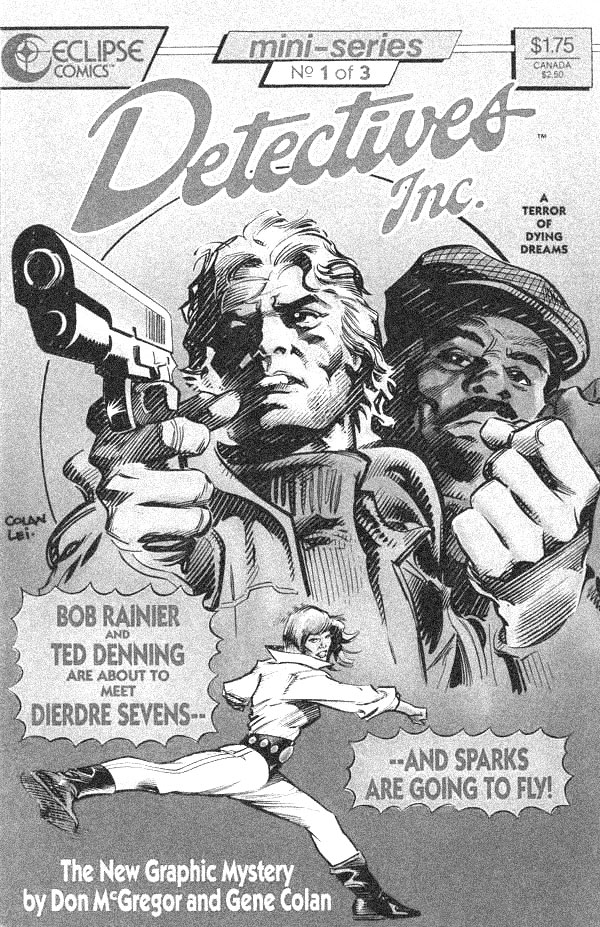
  • 11059Well, Dusk’s personal story arc for this series sure doesn’t go anywhere expected. Maybe it’s because McGregor didn’t set him up for enough development or maybe it’s because almost a fourth of the double-sized issue is wasted on a poorly paced resolution to last issue’s cliffhanger.

    The issue has good art, even during that lengthy opening, but it’s just a bunch of action scenes strung together. The final one, involving Dusk playing Indiana Jones doesn’t even feel like the same comic. McGregor’s rushing to get in all his period detail and not worried enough about the story itself.

    There are no supporting characters in this final issue. No one who’s appeared before makes any impression, not on the plot, not on the protagonist. If it weren’t for McGregor’s competence and the still good art from Colan, things would have been a lot worse.

    It’s a shame Dusk’s finale disappoints.

    B- 

    CREDITS

    Apple Peddlers Die at Noon, Part Four; writer and editor, Don McGregor; artist, Gene Colan; colorist, Tom Zuiko; letterer, John Costanza; publisher, DC Comics.

  • Hawkeye 17 (May 2014)

    298224 20140312115138 largeWhat do you do if your comic is so late not just your primary artist is behind but apparently your backup artist is behind too?

    You do a "winter holiday special," in which the main character–as in titular superhero Hawkeye–falls asleep in front of the television during a holiday special. And the rest of the comic is the holiday special (courtesy Chris Eliopoulos).

    There are definite analogues between Eliopoulos's cute little cartoon thing and the series itself. The hero is a powerless superhero who's determined, even though he can't do things right. Kind of like Clint Barton. Very deep stuff here.

    Taken on its own, Eliopoulos is quote good at what he does so the comic's not bad. It's about as good as Fraction's regular Clint issues, actually.

    However, the apologetic bookends don't endear the issue. Don't apologize for chooching your readers out of a real issue, just do it.

    B 

    CREDITS

    Writers, Matt Fraction and Chris Eliopoulos; artists, Eliopoulos and David Aja; colorist, Jordie Bellaire; letterer, Eliopoulos; editors, Devin Lewis and Sana Amanat; publisher, Marvel Comics.

  • The Incredible Hulk 56 (August 2003)

    200827Much as I enjoy Fernandez's art with setting and people, he's not a good Hulk artist. The Hulk has very, very awkward proportions. Pudgy almost. Muscularly pudgy.

    But since it's a Bruce Jones Hulk there's not much Hulk action. Instead, he splits the comic between Bruce (Banner) and his new lady friend recovering from an Absorbing Man possession and then the things going on back at the Absorbing Man's cell.

    Jones is trying hard to give Bruce something more to do than smash, he's just trying to hard to use existing ideas. Absorbing Man is okay, but the powers are more important than the character, so Jones has to spread himself thin rationalizing the Absorbing Man cameo.

    There are some weird moments at the end. They're more interesting than anything else. The narrative is pretty set once Jones opens the comic.

    Still, the issue is fair enough, if decidedly undercooked.

    C+ 

    CREDITS

    Hide in Plain Sight, Part Two: Inside Out; writer, Bruce Jones; artist, Leandro Fernandez; colorist, Steve Buccellato; letterer, Dave Sharpe; editors, Warren Simons, John Miesegaes and Axel Alonso; publisher, Marvel Comics.

  • Stray Bullets: Killers 1 (March 2014)

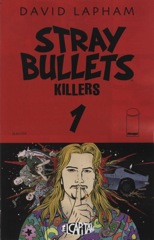
    298209 20140312105955 largeWith this first issue of Stray Bullets: The Killers, David Lapham reminds everyone why they should feel bad about themselves for not missing Stray Bullets more. It's a new story, but it hits all the best beats the series used to hit and nothing else has hit since.

    It opens with a stunning sequence with preteen boys talking about women. Fantastic dialogue, fantastic balancing of dark and not. Then Lapham gets into the protagonist's screwed up home life–deadbeat salesman dad who heads to the strip club while the mom works. The protagonist tags along, hidden in the back of the station wagon.

    At the strip club, the kid forms a bond with one of the bouncers. Lapham gets in small town suffocation, the father's levels of guilt, the bouncer's personal morality, the kid's inability to understand any of it.

    It's a phenomenal issue. I should've been missing Bullets daily.

    A 

    CREDITS

    No Take-Backs; writer, artist and letterer, David Lapham; editors, Karen Hoyt and Maria Lapham; publisher, Image Comics.

  • 11058McGregor gets to a lot of revelations this issue. Well, more like two. But they’re big ones. One involves the case, one involves Dusk’s involvement with his dead girlfriend’s kids. The case one is particularly interesting because McGregor does it without much emotion. McGregor isn’t unenthusiastic, he’s just measured–both for the comic (it’s not the big reveal) and for the character. This type of thing isn’t something to get Dusk emotional. He’s disconnected from it.

    However, there’s one plot point full of emotion for Dusk and McGregor does explore that point much more thoroughly. McGregor gets a lot of mileage out of the hard boiled private investigator thing. He never throws too many contrary details in, just enough to make the character compelling.

    This issue, very gently, even brings attention to New York density versus something like L.A. openness.

    It’s a fantastic issue. McGregor and Colan do great work.

    A

    CREDITS

    Apple Peddlers Die at Noon, Part Three; writer and editor, Don McGregor; artist, Gene Colan; colorist, Tom Zuiko; letterer, John Costanza; publisher, DC Comics.

  • The Bigamist (1953, Ida Lupino)

    With a sensational title like The Bigamist, one might expect something lurid and exploitative from the film. Definitely from the titular lead, Edmond O’Brien. But, no, poor O’Brien is just a married traveling salesman with a barren, work-oriented wife (Joan Fontaine) so who can blame him for stepping out. And he only did it once; he’s not a bad guy, he’s tragic hero.

    Nearly all of O’Brien’s story comes out in a flashback–screenwriter Collier Young’s use of layered narrative is the film’s biggest problem–when he reveals all to kindly Edmund Gwenn, who has just discovered him.

    The flashback portions are exceptionally insensitive to both Fontaine and Ida Lupino (which is surprising, as she directed the film after all) but the present action scenes with them are better. The film does cheat Lupino out of any great emotive moments, while Fontaine gets a couple.

    As the lead–but fourth-billed–O’Brien has trouble with the impossible role. After spending fifteen minutes making him a suspect, Young’s script spends the rest turning him into a hero. Except O’Brien can’t seem to get behind playing the role heroic, which causes a bit of a disconnect… not to mention a general disinterest in how the story turns out. I had been hoping they went for the cheap, obvious ending, which would have resulted in less melodrama (but robbed Kenneth Tobey of a great scene).

    Lupino’s direction is somewhat stilted at times, but generally okay. Except the Los Angeles exteriors; they’re way too lifeless.

    Just like the movie.

    1/4

    CREDITS

    Directed by Ida Lupino; screenplay by Collier Young, based on a story by Lawrence B. Marcus and Lou Schor; director of photography, George E. Diskant; edited by Stanford Tischler; music by Leith Stevens; produced by Young; released by Filmmakers Releasing Organization.

    Starring Edmond O’Brien (Harry Graham), Joan Fontaine (Eve Graham), Ida Lupino (Phyllis Martin), Edmund Gwenn (Mr. Jordan), Kenneth Tobey (Tom Morgan), Jane Darwell (Mrs. Connelley), Peggy Maley (Phone Operator), Lillian Fontaine (Miss Higgins), Matt Dennis (Singer) and John Maxwell (Judge).


    RELATED

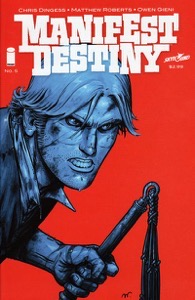
  • Manifest Destiny (2013) #5

    Manifest Destiny  5

    It's a decent enough issue but the opening scene resolving the previous cliffhanger goes on way too long. There's also no science–though there's the hint of it–and the science stuff in Manifest Destiny is always cool.

    Instead, Dingess very awkwardly paces the issue. There's no time spent getting the explorers through the forest full of monsters, lots of time spent on the boat preparing to go back out, then a seemingly pointless encounter with Sacajawea. That last scene almost just seems like a reminder she's in the comic, because Dingess hasn't used her yet. The men are still running things.

    Though, after this issue's cliffhanger gets resolved, maybe not.

    In many ways, the issue feels like the first half of a two-part one. The whole back to the boat then on an assault mission thing feels like a setup, not a plot point.

    But it's still good.

  • The Star Wars 6 (March 2014)

    298235 20140312103045 largeAfter some unimaginative issues, The Star Wars definitely feels a lot more on track this time around. Even with some way too static art from Mayhew. He has lots of problems with Princess Leia react shots. She looks completely nonplussed by the chaos around here; it's not a one time thing, it's every time she's in a panel.

    But this issue gives writer Rinzler the chance to utilize that fantastic Star Wars device–divide the cast into separate story lines before bringing them back together. Annikin gets separated from Starkiller and Han Solo as they both run across the Wookie tribes on this jungle planet. Lots of interesting, unexplored threads from the original films, which is something this series apparently needs (and initially promised).

    Before I forget–having an older lead in Starkiller, not a guest star, really helps.

    It's definitely one of the better issues. The second half's fantastic.

    B 

    CREDITS

    Writer, J.W. Rinzler; artist, Mike Mayhew; colorist, Rain Beredo; letterer, Michael Heisler; editors, Freddye Lins and Randy Stradley; publisher, Dark Horse Comics.

  • The Incredible Hulk 55 (August 2003)

    128327Leandro Fernandez to the rescue! Not just regular Leandro Fernandez either, but doing a walking and talking scene through Central Park at twilight. It’s a gorgeous issue.

    And Fernandez alone isn’t responsible for rescuing Jones and Hulk (it’s just one issue after all). Jones opens from scratch. Banner on the run. He’s in New York, he meets a girl. Turns out she works at the special prison holding the Absorbing Man. There are cuts to the story going on in that prison with her coworkers (and Creel). Jones has lots to do, lots of characters and subplots to establish and he gets them done.

    But his Banner story is just this walk with the good doctor and a girl. There’s a plotting reason she’s the girl he’s chatting with, but it’s still a nice sequence with fabulous art. Jones is indulging himself a little and it’s nice to see again.

    B 

    CREDITS

    Hide in Plain Sight, Part One; writer, Bruce Jones; artist, Leandro Fernandez; colorist, Studio F; letterer, Dave Sharpe; editors, Warren Simons, John Miesegaes and Axel Alonso; publisher, Marvel Comics.

  • 298301 20140312134058 largeIt's a decent enough issue but the opening scene resolving the previous cliffhanger goes on way too long. There's also no science–though there's the hint of it–and the science stuff in Manifest Destiny is always cool.

    Instead, Dingess very awkwardly paces the issue. There's no time spent getting the explorers through the forest full of monsters, lots of time spent on the boat preparing to go back out, then a seemingly pointless encounter with Sacajawea. That last scene almost just seems like a reminder she's in the comic, because Dingess hasn't used her yet. The men are still running things.

    Though, after this issue's cliffhanger gets resolved, maybe not.

    In many ways, the issue feels like the first half of a two-part one. The whole back to the boat then on an assault mission thing feels like a setup, not a plot point.

    But it's still good.

    CREDITS

    Writer, Chris Dingess; artist, Matthew Roberts; colorist, Owen Gieni; letterer, Pat Brosseau; editor, Sean Mackiewicz; publisher, Image Comics.

  • Afterlife with Archie (2013) #4

    Afterlife with Archie  4

    Good grief, what a depressing issue. Aguirre-Sacasa definitely knows how to construct an effective story. He even mini-apes the dog issue of Hawkeye, only he does it here to greater success. Archie might be where he can have zombie attacks and make very adult observations about Archie Comics, but it’s also got an air of sincerity. Aguirre-Sacasa uses the Archie trappings as a tap into the readers’ nostalgia and familiarity to make the issue all the more devastating.

    This issue Aguirre-Sacasa utilizes flashbacks rather well. Francavilla draws them bittersweet, like a too wise for its years comic strip. The flashbacks are pretty awesome technically and always drawn out just enough they never seem cheap in the context of the modern events.

    The modern events are zombie attacks, human and not, and how to deal with them.

    The creators have turned a gimmick title into great comics.

  • 11057 1The second issue has a lot of action. The issues are double-sized and McGregor plots them quite well. There are three, maybe four, big action sequences in this one, along with a bunch of scenes involving the case itself, but there’s still time for the character work. McGregor always makes sure to work some of it into the investigation-related scenes too.

    Even with all the character work, McGregor hasn’t hinted how the Dusk character is going to progress during this story. It’s set in the same year as the previous series, something I hadn’t realized until it came up in dialogue, so measured changes are fine. But there ought to be some change… and the only place I can guess is the easiest place.

    I’ll have to wait and see.

    The art’s stunning once again, those Zuiko skies are gorgeous.

    McGregor and Colan are making good comics here.

    B+ 

    CREDITS

    Apple Peddlers Die at Noon, Part Two; writer and editor, Don McGregor; artist, Gene Colan; colorist, Tom Zuiko; letterer, John Costanza; publisher, DC Comics.

  • 297697 20140305154903 largeGood grief, what a depressing issue. Aguirre-Sacasa definitely knows how to construct an effective story. He even mini-apes the dog issue of Hawkeye, only he does it here to greater success. Archie might be where he can have zombie attacks and make very adult observations about Archie Comics, but it’s also got an air of sincerity. Aguirre-Sacasa uses the Archie trappings as a tap into the readers’ nostalgia and familiarity to make the issue all the more devastating.

    This issue Aguirre-Sacasa utilizes flashbacks rather well. Francavilla draws them bittersweet, like a too wise for its years comic strip. The flashbacks are pretty awesome technically and always drawn out just enough they never seem cheap in the context of the modern events.

    The modern events are zombie attacks, human and not, and how to deal with them.

    The creators have turned a gimmick title into great comics.

    A 

    CREDITS

    Escape from Riverdale, Chapter Four: Archibald Rex; writer, Roberto Aguirre-Sacasa; artist and colorist, Francesco Francavilla; letterer, Jack Morelli; editors, Victor Gorelick, Jamie Lee Rotante and Paul Kaminski; publisher, Archie Comics.

  • The Incredible Hulk 54 (August 2003)

    774294And here’s that double-issue long Hulk fight Jones has never done before and now it’s clear why… Because he’s no good at it. Jones and Deodato have a rhythm to the fight. There’s the fight, there’s the side action (sometimes the Abomination’s wife, sometimes the bad guys in a helicopter). Those are usually six panel pages. So you get little panels for big fight moments. Or there’s the half double-page spread device, which Deodato uses a lot.

    Here’s the thing about Deodato’s art. He knows how to compose the frame. With the half double-page spreads, action starts on the left page, moves to the right. It’s wholly competent and incredibly boring. The fight’s just Hulk and Abomination saying nasty stuff to each other between punches, at least it could look engaging.

    Jones sort of resets the ground situation at the end, which is good, Hulk needs it.

    C 

    CREDITS

    Dark Mind, Dark Hearts, Part Five: Welcome to Entropy; writer, Bruce Jones; artist, Mike Deodato Jr.; colorist, Studio F; letterers, Richard Starkings and Wes Abbott; editors, Warren Simons, John Miesegaes and Axel Alonso; publisher, Marvel Comics.

  • SOA 07 CoverEd Brisson takes over Sons of Anarchy with a good pulpy story about a guy investigating the death of a friend's junkie son. I assume the guy and the friend are on the show, but since I haven't seen the show, it's just a guy and his friend.

    The issue's paced rather well, with a couple good surprises in it. There's a deliberateness to how Brisson shows the investigation. Since the protagonist solves the case relatively early Brisson has to extend the resolution. Instead of seeming forced, it plays organically. It's a very well put together comic, even if it doesn't need the licensing brand. The story's solid on its own.

    The art, from Jesús Hervás is okay, but on the lower end of it. It's definitely moody and expressive with the figures and settings but it's a little too rough. The inking doesn't compliment the pencils maybe.

    Still, good.

    B 

    CREDITS

    Writer, Ed Brisson; artist, Jesús Hervás; colorist, Stephen Downer; letterer, Ed Dukeshire; editor, Dafna Pleban; publisher, Boom! Studios.

  • Veronica Mars (2014, Rob Thomas)

    Rob Thomas loves the "Veronica Mars" television show fans. He must. He pretty much wastes the first act of the feature film (also titled Veronica Mars) thanking them for funding the film's production through Kickstarter. It's worse for star Kristen Bell than the film–both recover, but the film first–as the script's moving her around like a marionette. She doesn't get to do anything for way too long. Instead, she's an entirely passive, narrating protagonist.

    Luckily, a lot of Thomas's fan service is amusing. So it allows Mars to coast–something Thomas's direction unfortunately can't do (he's mediocre until the second half)–and the acting is mostly strong. Even when the characters are just there to take up running time.

    But coasting isn't enough; Thomas seems to know it because he brings erstwhile leading man (and don in distress) Jason Dohring. The script gives Dohring all the drama and all the layers it doesn't give Bell. Dohring excels. It's in his scenes where Bell starts getting better.

    And then, all of a sudden, Mars sheds the dead leaves and starts growing organically. The film still calls back to elements from the show, but Thomas and co-writer Diane Ruggiero give Bell a role to act. They finally let her engage with the story instead of just visiting old friends. Problem solved.

    Fine supporting turns from Enrico Colantoni, Ryan Hanson and Gaby Hoffmann. Tina Majorino looks completely lost.

    Mars succeeds–almost everything with Bell opposite Dohring or Colantoni is spectacular stuff. It's just rough going at the start.

    2.5/4★★½

    CREDITS

    Directed by Rob Thomas; screenplay by Thomas and Diane Ruggiero, based on a story by Thomas; director of photography, Ben Kutchins; edited by Daniel Gabbe; music by Josh Kramon; production designer, Jeff Schoen; produced by Thomas, Danielle Stokdyk and Dan Etheridge; released by Warner Bros.

    Starring Kristen Bell (Veronica Mars), Jason Dohring (Logan Echolls), Krysten Ritter (Gia Goodman), Ryan Hansen (Dick Casablancas), Francis Capra (Eli ‘Weevil’ Navarro), Percy Daggs III (Wallace Fennel), Gaby Hoffmann (Ruby Jetson), Chris Lowell (Stosh ‘Piz’ Piznarski), Tina Majorino (Cindy ‘Mac’ Mackenzie), Jerry O’Connell (Sheriff Dan Lamb), Martin Starr (Lou ‘Cobb’ Cobbler), Ken Marino (Vinnie Van Lowe), Max Greenfield (Leo D’Amato), Eddie Jemison (JC Borden), Jamie Lee Curtis (Gayle Buckley) and Enrico Colantoni (Keith Mars).


    RELATED

  • Nd21For Nathaniel Dusk II, Gene Colan’s pencils go without inks. However, they go with Tom Ziuko’s colors. Ziuko’s a familiar name as a colorist but I was still a little surprised with his work here. He takes Colan’s pencils and turns them into a painted comic. The colors are muted, but still lush. There are some fabulous skies in this one and Colan probably only contributed the cloud outlines.

    Don McGregor’s script is excellent. He starts out with the finish of one of titular private investigator Dusk’s cases, then gradually introduces not just the series’s case, but also plays catchup. Not so much has happened since the last series, just enough. McGregor carefully makes the issue accessible for new readers while still rewarding returning ones.

    The attention to detail–1934 Manhattan–is fabulous.

    McGregor occasionally gets a little too enthusiastic with that detail, but the art picks up any slack.

    A- 

    CREDITS

    Apple Peddlers Die at Noon, Part One; writer and editor, Don McGregor; artist, Gene Colan; colorist, Tom Zuiko; letterer, John Costanza; publisher, DC Comics.

  • Tales of Honor 1 (March 2014)

    F20cd20f 3dfe 4193 ad92 a4609e0a0fe4I have one quibble with Tales of Honor is how Jung-Geun Yoon draws the wildlife. Yoon’s sequential art is very stylized, digital painting, which works great for space battles and not too bad for the people. The conversations are mostly in medium shots so no too static faces delivering dialogue. But the protagonist has a pet cat (it’s not just a pet, it’s a soul-bonded thing but who cares) and Yoon can’t draw that cat. It looks like an Egyptian statue.

    Writer Matt Hawkins has quite a bit of material to build on–the series is based on a science fiction novel series–and everything is well-executed. The protagonist is sympathetic but not exactly likable. Hawkins doesn’t give the reader to opportunity to get to know any supporting cast; arguably he hasn’t established one yet.

    Tales of Honor’s off to a strong, confident start. It’s good stuff.

    B 

    CREDITS

    On Basilisk Station, Part One; writer, Matt Hawkins; artists, Jung-Geun Yoon and Linda Sejic; colorist, Yoon; letterer, Troy Peteri; editor, Besty Gonia; publisher, Top Cow Productions.