
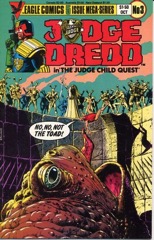
 A lot of the issue is rough going. Wagner tries out a few things on the second two planets–Dredd and company go to three–and has some success. But the adventure on the first planet, which has a bunch of different alien species at war, but as televised entertainment, is tedious.
Still, Wagner somehow distracts from Dredd not getting any clues about the location of the Judge Child. It’s just a trip through the galaxy, really.
The second story is more horror-influenced, which leads to some silly elements (like a giant monster in outer space grabbing Dredd’s spaceship), but the stuff in the scary castle is good. McMahon’s art on this section is utterly fantastic; he revels in the creepiness.
The last planet is prehistoric cavemen, with Wagner narrating from a storyteller’s song. It’s a cool little digression. Nice art from McMahon too.
That first story hurts though.
B-
CREDITS
Writer, John Wagner; artists, Mike McMahon and Ron Smith; colorist, Ian Stead; letterer, Tom Frame; editor, Nick Landau; publisher, Eagle Comics.


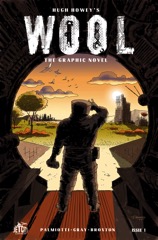 Wool opens with one protagonist, then moves on to another, then promises a third. It’s a novel adaptation, which might have handled the transitions smoother, but writers Justin Gray and Jimmy Palmiotti are a tad abrupt. They do well establishing the setting–a post-apocalyptic future where everyone lives in a huge silo underground and can’t go outside–but the characters and their relationships are confusing.
 Wagner takes Dredd and company–though the company is rather indistinct–on an intergalactic quest. They’re in pursuit of the Angel family, who have kidnapped the Judge Child. There’s not a lot on the pursuit, but rather a series of imaginative sci-fi encounters.
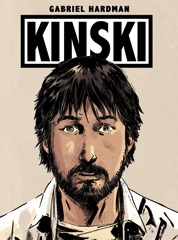 Hardman brings the story to a satisfactory, if somewhat unreasonable conclusion. He jumps through time a lot–a year total–and skips over the more interesting parts of his protagonist’s experiences. He also stops with the character study aspect of Kinski and treats the whole issue as an epilogue.
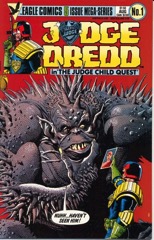 Judge Dredd heads into the Cursed Earth looking for a mutant child who’s going to have to save Mega-City One, or so one of the pre-cogs says. Writer John Wagner comes up with some decent encounters for Dredd–this issue’s primary villain is a “garbage god” who has thousands of slaves mining antiques from pre-apocalypse Memphis for him. There’s an ancient Egypt thing too; it doesn’t make much sense, but the Brian Bolland and Ron Smith are is excellent so it doesn’t need to make any.
 Hardman finds a better mix of the character work and the action, with his protagonist sharing a car ride with the dog’s owner and finding out a little more about her life. There’s nothing more about the protagonist (except his willingness to talk himself into bad situations). Instead, Hardman expands the supporting cast through the protagonist’s journey.
 Wagner finishes the Chief Judge Cal storyline. There are a couple surprises before the end, with Wagner in something of a hurry. Smith doesn’t get much space on the art, which is unfortunate, but he uses the space he gets really well at times. It’s a satisfactory conclusion, but the denouement is way too abrupt.
 So now the action moves to the RV park, or RV gathering–it’s unclear how it’s working but the RVs aren’t parked in any sort of sensible way. Not to harp on it, it’s just strange. And the sidekick even says he needs to leave to get back to real life.
 It’s a surprisingly awesome issue, with Wagner giving Dredd a big dumb sidekick, but one with a lot of character and comic relief value. They have to get back to the surface (Dredd and company escaped underground), so there’s a decent action sequence when Wagner brings them up against some other judges.
 It’s the equivalent of an action issue for Kinski. Hardman resolves the previous issue’s cliffhanger, putting the protagonist and his friend back on the road. There’s some slight character drama–and a way too obvious plea for exposition from the friend–before Hardman gets to the rest stop.
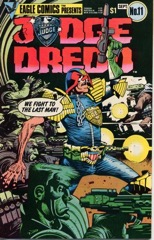 Somehow, even though Bolland and McMahon alternate the chapters in this issue–so it’s always very clear when moving from one to the next–the story flows a lot smoother. Maybe because Wagner has gotten into the middle of the story, he’s established the lunatic rule of Chief Judge Cal. He’s moving through instead of building up.
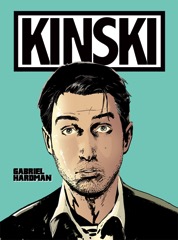 The strangeness of Kinski continues. Hardman sort of wraps the narrative around itself, with the protagonist going back to the same motel from the previous issue, having another encounter with one of the dog’s actual owners. But these similar situations play fresh, thanks to all the character work Hardman does on his protagonist.
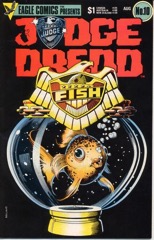 This issue reads a lot smoother, with Dredd again a fugitive, leading the revolt against the crazy new chief judge. Unfortunately, Wagner goes for absurdity at every turn–the new chief judge is so crazy he appoints a fish as his deputy–and it’s never believable the other judges would follow the new leader with such blindness. It’s almost like Wagner saw he couldn’t make the story work straightforwardly, so he introduced the lunacy to at least make it funny.
 After one issue, all Drifter has done is establish itself as another sci-fi Western. It’s not a new genre. Nic Klein clearly works at the art, so while the design work reminds of other sci-fi movies, TV shows and comic books going back forty years, at least he’s visibly committed.
 It’s something of a lackluster issue.
 It’s another solid issue, with Babs stumbling onto a crime on campus. Stewart and Fletcher also introduce a few more supporting cast members–the issue ends with a sitcom-like tag with all of them, sans Dinah, who’s clearly a guest star. It gives Batgirl a nice feel, though the more impressive stuff comes just before.
 The resolution to the Las Vegas cliffhanger is a little lame. Dredd just happens to get there in time to challenge the sitting judge and there just happens to be a good resistance movement in place to help out. The whole subplot–the mob being the corrupt judges of Vegas–is weak anyway.
 There’s quite a bit of talking in this comic. Not just the lead characters, who talk a whole bunch, but also the government guys out to catch the lead characters. There’s also a revelation scene, which Millar doesn’t do particularly well. It’s a talking heads issue and Millar is just dumping exposition to set up for the finish.
 It’s Dredd versus a dinosaur. Not just any dinosaur, but the offspring of the dinosaur from the early issues of 2000 AD. Mills spends more time writing from the dinosaur’s perspective than he does from Dredd’s, which makes for a vaguely annoying, while still engaging enough outing.
 And Big Trouble is back. Powell is setting up a new storyline, but he’s also back with his core cast–or maybe just developing his core cast. It feels less like a direct sequel to the movie and more like a real one.
 It’s an excellent issue. Mills sends Dredd on something of a self-discovery; he encounters all different types in the Cursed Earth, with the villainous gangs being the only bad guys. It comes as a surprise to Dredd, but not the reader. Mills has a way of trying to surprise the reader with Dredd’s humanity. He’ll give Dredd a choice and one of them seems obvious if Dredd is just a caricature, then Dredd’ll choose the other option and Mills will gently explain.
 Gianfelice has some great expressions this issue. Wonderful moments with the characters mid-thought. These moments occasionally make Ghosted seem to light while also making it more accessible. Williamson goes for a lot of exposition this issue. There’s so much talking, the word balloons obscure important visual details (the pacing of the big action scene is all off because of them). It’s too much to digest, especially since most of it’s fluff.
 Mike McMahon does the art for the first three quarters of the issue, with Dredd getting ready to go on a mission through the Cursed Earth. Writer Pat Mills does a decent job setting up the back story, though once it moves on to preparations for the mission, he and McMahon get wrapped up in showing off the goofy hardware Dredd’s going to have. It’s relatively short sequence–the initial double-page spread of a militarized RV–but it stops the story cold.
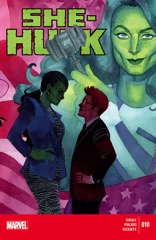 Soule wraps up the Captain America story rather nicely. The story doesn’t really belong in a She-Hulk comic, just because it doesn’t have anything to do with Jen (not the explanation of the past nor the current lawsuit, which is just a red herring) but it’s a good Marvel universe story. Soule manages to correct the story arc’s trajectory; it helps he’s sincere.
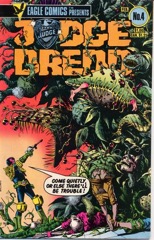 The feature story, with Mega-City One under attack from mutants from the Cursed Earth, is fairly strong. Wagner foreshadows throughout the story, but gently enough it just looks like he’s doing a lot of texture. He’s enthusiastic about describing the various settings; even when connections seem obvious later, when he’s introducing them, Wagner never draws too much attention.
 Brubaker switches protagonists for the issue–with the normal, screenwriter protagonist basically getting a cameo–and moves over to the actress replacing the dead actress in the movie.
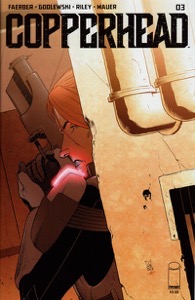

 From the first page, there’s something off about this issue of Copperhead. Godlewski goes with a full page spread but of a really bland situation–actually, it’s supposed to be a tense situation but the full page spread makes it bland. Then the scene itself is bland, with Faerber eschewing logic and character.
 Once again, McGovern manages not to do anything special–or even particularly good–with his script for the issue and still it all turns out fine. Leandri’s art is so strong, his ability to mix in all the action and the mood–this issue has the good guys creeping through a varied landscape–just makes Nightworld work.
 The Stop Button