• Lazarus #16For the first time in ten issues or so, Lazarus doesn’t sit well.

    Oh, it’s fine–the script’s certainly stronger than the first arc of the series, but Rucka’s got a problem. He’s got an artist without time for the comic so what’s he going to do? A fill-in issue. But Lark does most of the art, just nothing exciting. Instead of exciting, there are these graphic design fill-in pages by Owen Freeman and Eric Trautmann. Diagrams, journal entries, all sorts of malarky.

    And it is malarky. Rucka’s got his story–this secret agent nun trying to do something–and he tells it so Lark never has to get too involved with the art. Lots of night scenes, lots of black. Long shots with narration. No one actually talking for most of the comic.

    Fill-in issues, done-in-one issues, they’re a necessary evil to modern comics.

    CREDITS

    Mercy; writer, Greg Rucka; artists, Michael Lark, Tyler Boss, Owen Freeman and Eric Trautmann; colorist, Santiago Arcas; letterer, Jodi Wynne; editor, David Brothers; publisher, Image Comics.

  • Velvet (2013) #10

    Velvet  10

    It’s a bridging issue. But, since it’s Brubaker, he feels the need to do it to bridge his arcs together. To give that trade paperback an extended cliffhanger, not just each issue in the trade.

    It lacks texture, it lacks tone. Brubaker actually does have this significant new character (Sean Connery) running around Velvet, but he doesn’t make his presence felt, just talked about. It’s unfortunate, but it’s still, you know, generally okay. Brubaker’s narration is good, Epting’s art is good, it just doesn’t go anywhere.

    And it’s not clear Velvet really does need to go anywhere. It’s a spy thriller; the gimmick of having a forty year-old female protagonist in a “James Bond was framed” story isn’t even giving it any mileage anymore. It’s an okay comic book, with its creators a little jaded and commercial but still having fun.

    I enjoy reading Velvet, even if it’s shallow.

  • House Specialty (1978, Sophie Tatischeff)

    House Specialty chronicles the last few minutes of a day at a pastry shop in a small French town. The short’s credits are incomplete, but it appears the lead–the clerk–is played by Dominique Lavanant. She’s an attractive young woman surrounded either by old men or almost old men. The difference is the almost old men talk about working and the old men just play games at the shop. The similarity is all the men scarf down the tartlets.

    Director Tatischeff is very straightforward with her direction, letting the conversations mesh together in the confined space. Characters come and go–with the only female customers being disgusted at the tarlets, which sell out immediately after coming out of the oven.

    As the film winds down and Lavanant and her employer send the men home, Tatischeff reveals the further importance of the pastry shop in the town.

    It’s sublime stuff.

    3/3Highly Recommended

    CREDITS

    Written and directed by Sophie Tatischeff; director of photography, Pierre Dupouey; edited by Joëlle Hache; production designer, Denis-Martin Sisteron.

    Starring Dominique Lavanant (the clerk), Dédé (a customer) and Gilberte Géniat (the boss).


    RELATED

  • Curb Stomp 3 (April 2015)

    Curb Stomp #3The first issue of Curb Stomp had a lot of promise, the second issue implied maybe it didn’t… the third shows Ferrier and Neogi are going to do even better than that initial promise. It’s an outstanding comic book with a masterful control of the plotting. And some of Neogi’s best art–there are a lot of rituals in this issue (as the gangs negotiate) and Neogi has a visual theme for each different kind of ritual. It’s awesome.

    Ferrier’s script is almost in real time but lots of things happen. It’s not a talking heads comic, it’s an action comic, just one with occasional talking. Each conversation is a confrontation, which works entirely differently. It’s not about exposition or explanation, it’s about action.

    Not to say there isn’t general action–whether it’s suspense or just all out fight scenes–but Ferrier and Neogi do a great job maintaining tone.

    CREDITS

    Writer, Ryan Ferrier; artist, Devaki Neogi; colorist, Jeremy Lawson; letterer, Colin Bell; editors, Jasmine Amiri and Eric Harburn; publisher, Boom! Studios.

  • Velvet #10It’s a bridging issue. But, since it’s Brubaker, he feels the need to do it to bridge his arcs together. To give that trade paperback an extended cliffhanger, not just each issue in the trade.

    It lacks texture, it lacks tone. Brubaker actually does have this significant new character (Sean Connery) running around Velvet, but he doesn’t make his presence felt, just talked about. It’s unfortunate, but it’s still, you know, generally okay. Brubaker’s narration is good, Epting’s art is good, it just doesn’t go anywhere.

    And it’s not clear Velvet really does need to go anywhere. It’s a spy thriller; the gimmick of having a forty year-old female protagonist in a “James Bond was framed” story isn’t even giving it any mileage anymore. It’s an okay comic book, with its creators a little jaded and commercial but still having fun.

    I enjoy reading Velvet, even if it’s shallow.

    CREDITS

    The Secret Lives of Dead Men, Part Five; writer, Ed Brubaker; artist, Steve Epting; colorist, Elizabeth Breitweiser; letterer, Chris Eliopoulos; editor; Eric Stephenson; publisher, Image Comics.

  • Chrononauts 1 (March 2015)

    Chrononauts #1I like how Mark Millar has gotten to the point I don’t even bother forming an opinion on his first issue. Take Chrononauts. Good–but surprisingly not great–art from Sean Murphy. Of course, Millar often works with good artists.

    The story? Time travel in the near future. Millar comes up with something rather interesting, the idea of a time traveling satellite going back in time, transmitting video of an event, crashing down in a different time period. It’s cool. Then he gets to the guys who are going to go back in time. Both are rock star scientists–because Millar has to write rock star something or others–one has an ex-wife, one is a lothario. Millar’s not stretching here. He’s got his characters, he recycles them.

    But the time travel stuff with the guys? Boring. Feels like a Stargate comic.

    But, it’s Millar; I’ll delay critical thinking.

    CREDITS

    Writer, Mark Millar; artist, Sean Murphy; colorist, Matt Hollingsworth; letterer, Chris Eliopoulos; editor, Nicole Boose; publisher, Image Comics.

  • Ghosted 19 (April 2015)

    Ghosted #19Okay, Laci’s art isn’t working out for Ghosted, especially not this issue. It’s talking heads–with one important bit of unexpected actions and one hinted one; so it’s mostly talking. And Laci can’t do it. His art works on a macro creepy level, but he doesn’t get into expressions enough for the characters to “perform” their fear and discomfort.

    Williamson has quite a bit of fun with the script. He starts off with something entirely unexpected, then sort of avoids it. The issue takes place over twenty minutes at the most, following two and then three sets of characters. If the issue didn’t have such a surprising (though maybe it shouldn’t have been) development, it would have been fine with five or six pages.

    And being able to make something a big deal is one of Williamson’s strengths. He does the character work to make his big plot developments succeed.

    CREDITS

    Writer, Joshua Williamson; artist, Vladimir Krstic Laci; colorist, Miroslav Mrva; letterer, Rus Wooten; editors, Michael Williamson and Sean Mackiewicz; publisher, Image Comics.

  • Good Character
  • Video | Good Character
  • Ace in the Hole (1951, Billy Wilder)

    Ace in the Hole moves while the script–from director Wilder, Lesser Samuels and Walter Newman–never races. In fact, it’s deliberate and methodical, maybe even redundant at times (especially in the first act). The redundant moments aren’t actually a problem since Kirk Douglas is in almost every scene of the film and, even when he doesn’t have the best scene, his performance is fantastic.

    Douglas plays disgraced newspaperman trying to make it in a world of journalism students and publishers who believe in ethics and so on. Douglas believes in selling the most newspapers and getting paid for it. Most of the first act has Douglas spreading the gospel, which makes for great scenes.

    The story then has Douglas happening across a tragic situation and exploiting it. All he has to do is convince a handful of people to do the wrong thing. And here’s where Hole’s eventual problems start showing up. Douglas has this perverted relationship with Jan Sterling; she’s married to Richard Benedict, who’s stuck in a hole and Douglas is turning it into a big story. Wilder and the other writers never really explore Douglas’s motivations (alcohol provides a fast answer) in that situation. Instead, Douglas gets a more traditional, epical arc. An overcooked one.

    But that overcooked character arc is in a gorgeously made film. Wilder has excellent composition, whether for dialogue scenes or the big vista shots of New Mexico.

    Douglas and Wilder, somewhat separately, make Hole worthwhile. It’s just got its problems.

  • Stop Button Favorites – 1×3 – Man Of Steel

    Episode 3 | Man of Steel Stop Button Favorites

    An audio commentary of Zach Snyder's 2013 film, "Man of Steel," produced by Christopher Nolan, Charles Roven, Deborah Snyder and Emma Thomas for Warner Bros. Synced to the 2013 Warner Home Video DVD release.

    WHERE TO LISTEN

    Apple Podcasts
    Breaker
    Google Podcasts
    Overcast
    Pocket Casts
    Radio Public
    Spotify
    RSS
  • Big Man Plans 1 (March 2015)

    Big Man Plans #1The cynic in me hopes they do the Big Man Plans TV show well. I’m also hopeful for it, because if it gets a TV show, it’ll probably get another series. This series is only four issues and I can already tell I’m going to want more.

    Big Man Plans is about an unnamed Vietnam vet in the late seventies and his experiences going back to his hometown. Of course, he’s an expertly trained killer little person; bullied and ostracized in the States, he excelled as a tunnel “cleaner” in Vietnam. It’s the standard tough guy comes home to clean house but it’s with a little person.

    Eric Powell’s art is great–he heavily details people, lightly details scenery but just enough to make it feel seventies–and he and Tim Wiesch’s writing is pretty darn good too. There’s a humanity to the pulpy narration.

    And it’s really, really funny.

    CREDITS

    Writers, Eric Powell and Tim Wiesch; artist and letterer, Powell; publisher, Image Comics.

  • Perihelion (2015, József Gallai)

    Perihelion is a gorgeous film. Director Gallai composes the widescreen masterfully; he’s shooting digital, but uses Panavision aspect ratio to great success. The only times there’s any problem with the short’s visuals are when he and photographer (and editor and composer) Gergö Elekes hurry a shot.

    The film’s a rumination on sadness and loss, with protagonist Bálint Egri leading a solitary existence. Gallai and Elekes do these fantastic transitions into flashback, bringing a desolate shot to life (Perihelion really shows off what one can do with digital on a restricted budget).

    Unfortunately, there’s also almost omnipresent narration. Gallai adapted Perihelion from Beke Tamás Tarsoly’s poems and Gábor Varga narrates with them. Even though Egri never speaks, it’s obvious he doesn’t sound like Varga. There’s a disconnect. Varga’s rough voice against the beautiful film and Egri’s gentle performance.

    Perihelion is still successful–Gallai’s a fantastic filmmaker–but it could’ve been sublime

    2/3Recommended

    CREDITS

    Directed by József Gallai; screenplay by Gallai, based on poems by Beke Tamás Tarsoly; director of photography, Gergö Elekes; edited by Elekes; music by Elekes; production designer, Elekes; produced by Gallai and Elekes.

    Starring Bálint Egri (Poet), Petra Zsófia Rékai (Wife) and Kata Tábori (Girl); narrated by Gábor Varga.

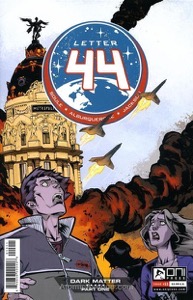
  • Letter 44 (2013) #15

    Letter 44  15

    Well. Soule jumps three months ahead in Letter 44 and entirely skips anything with the regular President. The former President (you know, Bush) is running the war against America from Europe, which is kind of funny. Wonder if he eats Freedom Fries. It’s kind of bad, kind of not. Soule is using up all his stockpiled good will, especially since Alburquerque’s art has somehow gotten worse.

    There’s some flashback to the discovery of the aliens and it’s boring. I think it’s basically the trailer from Contact. Or maybe The Arrival. And when Soule gets back to outer space, it reminds of Arthur C. Clarke and so on. The astronauts are now in an alien zoo.

    The space stuff is definitely more interesting than the Earth stuff, but it’s still stretching thin. Hopefully Soule will figure out something to do with the comic, because Letter 44 seems aimless at this point.

  • Letter 44 #15Well. Soule jumps three months ahead in Letter 44 and entirely skips anything with the regular President. The former President (you know, Bush) is running the war against America from Europe, which is kind of funny. Wonder if he eats Freedom Fries. It’s kind of bad, kind of not. Soule is using up all his stockpiled good will, especially since Alburquerque’s art has somehow gotten worse.

    There’s some flashback to the discovery of the aliens and it’s boring. I think it’s basically the trailer from Contact. Or maybe The Arrival. And when Soule gets back to outer space, it reminds of Arthur C. Clarke and so on. The astronauts are now in an alien zoo.

    The space stuff is definitely more interesting than the Earth stuff, but it’s still stretching thin. Hopefully Soule will figure out something to do with the comic, because Letter 44 seems aimless at this point.

    CREDITS

    Dark Matter, Part One; writer, Charles Soule; artist, Alberto Jiménez Alburquerque; colorist, Dan Jackson; letterer, Crank!; editor, Robin Herrera; publisher, Oni Press.

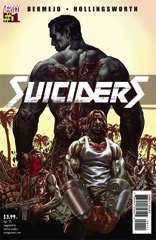
  • Suiciders 1 (April 2015)

    Suiciders #1Because no one remembers Escape From L.A., it’s time for Suiciders. But people do remember Mad Max Beyond Thunderdome–or at least the Thunderdome. Writer and artist Lee Bermejo rips off one of those movies, or just any other movie where post-apocalyptic guys fight in an arena to do the death for the enjoyment of the masses. Wasn’t it in a Zorro too?

    There’s nothing original about Suiciders, except maybe bringing illegal immigration into it except it’s probably something Judge Dredd did thirty years ago.

    But the comic’s extremely readable. Bermejo’s not a good writer, but his dialogue’s passable (maybe editorial actually did some work on the comic) and it’s a gorgeous looking comic book. Suiciders gets away with everything because it looks gorgeous.

    When will the stupidity outweigh the gorgeous art? Depends on how much cool stuff Bermejo gets to draw.

    It’s a desperate attempt from Vertigo though.

    CREDITS

    The Brutality Malady; writer and artist, Lee Bermejo; colorist, Matt Hollingsworth; letterer, Jared K. Fletcher; editors, Gregory Lockard and Will Dennis; publisher, Vertigo.

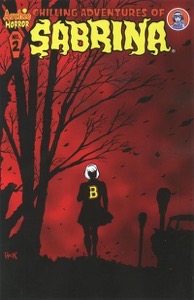
  • Chilling Adventures of Sabrina (2014) #2

    Cas02

    The protagonist of the second issue of Sabrina–Aguirre-Sacasa doesn’t actually go with Sabrina, but her new (unknown to her) nemesis–is so disturbing, once the story does get back to Sabrina and company, as creepy as they are, they’re welcoming.

    The issue’s protagonist is Madam Satan. Who has a proper name, but I can’t remember it (it comes up only once in a flashback). She used to date Sabrina’s father and he dumped her for a human (Sabrina’s mother). So Madam Satan let a bunch of lions eat her, which sent her to the part of Hell for suicides, but she’s back.

    I can’t explain it all. Aguirre-Sacasa and Hack have a lovely way of filling in the exposition; the fluidity of Hack’s artwork as it flows between past and present, imagined and real, is phenomenal.

    Who knew Sabrina the Teenage Witch could be so dang good?

  • Chilling Adventures of Sabrina #2The protagonist of the second issue of Sabrina–Aguirre-Sacasa doesn’t actually go with Sabrina, but her new (unknown to her) nemesis–is so disturbing, once the story does get back to Sabrina and company, as creepy as they are, they’re welcoming.

    The issue’s protagonist is Madam Satan. Who has a proper name, but I can’t remember it (it comes up only once in a flashback). She used to date Sabrina’s father and he dumped her for a human (Sabrina’s mother). So Madam Satan let a bunch of lions eat her, which sent her to the part of Hell for suicides, but she’s back.

    I can’t explain it all. Aguirre-Sacasa and Hack have a lovely way of filling in the exposition; the fluidity of Hack’s artwork as it flows between past and present, imagined and real, is phenomenal.

    Who knew Sabrina the Teenage Witch could be so dang good?

    CREDITS

    The Crucible, Chapter Two; The Secret History of Madam Satan; writer, Roberto Aguirre-Sacasa; artist, Robert Hack; letterer, Jack Morelli; editor, Jamie Lee Rotante; publisher, Archie Comics.

  • Quiz Show (1994, Robert Redford)

    Quiz Show is a story about pride and envy. The film’s main plot is about the quiz show scandals in the fifties–big media taking the American public for a ride–and I suppose it could be seen as a loss of innocence thing. But it isn’t.

    It’s about pride and envy.

    John Turturro’s working class Jewish guy doesn’t have much pride (though he’s gloriously proud of it) and he’s got lots of envy. But not so much for the WASPs, but for more successful Jewish guys. So Rob Morrow’s middle class Jewish guy. Morrow’s character has pride and envy; in this case, it’s envy for the WASPs. Like Ralph Fiennes, who’s got not so much pride but envy. In his case, it’s for his dad–Paul Scofield in a wonderful performance.

    There’s a lot about class, there’s a lot about masculinity (the women get what’s going on and try to get their husbands to recognize it to disappointment), there’s a lot about the time period. And screenwriter Paul Attanasio brings it all together beautifully. Quiz Show has an incredibly complex structure, something director Redford and editor Stu Linder fully embrace. Even in its stillest moments, the film is always in motion.

    Gorgeous Michael Ballhaus photography too.

    The leads–Turturro, Morrow and Fiennes–are all excellent. Nice support from David Paymer, Hank Azaria and Allan Rich. Ditto Johann Carlo and Mira Sorvino. Redford’s use of prominent actors and filmmakers in cameo roles works great.

    Quiz Show is a phenomenal film.

    4/4★★★★

    CREDITS

    Directed by Robert Redford; screenplay by Paul Attanasio, based on a book by Richard N. Goodwin; director of photography, Michael Ballhaus; edited by Stu Linder; music by Mark Isham; production designer, Jon Hutman; produced by Michael Jacobs, Julian Krainin, Michael Nozik and Redford; released by Hollywood Pictures.

    Starring John Turturro (Herbie Stempel), Rob Morrow (Dick Goodwin), Ralph Fiennes (Charles Van Doren), David Paymer (Dan Enright), Christopher McDonald (Jack Barry), Elizabeth Wilson (Dorothy Van Doren), Paul Scofield (Mark Van Doren), Hank Azaria (Albert Freedman), Mira Sorvino (Sandra Goodwin), Johann Carlo (Toby Stempel) and Allan Rich (Robert Kintner).


    RELATED

  • D4VE 1 (February 2015)

    D4VE #1D4VE is the traditional American story of the disaffected middle aged office worker, the one whose wife doesn’t find him attractive anymore, the one who has a terrible relationship with his kid.
    Only D4VE is a robot. Man made robot, robot killed man, robots inherit the Earth. Only Ferrier takes it to the nth degree and the robots actually went out and killed every living thing they could find. Actually, it’s kind of like the Borg. Only Valentin Ramon doesn’t draw D4VE and the other robots grody. They’re really slick futuristic robots, like Boris Vallejo robots.

    Does D4VE work out in the end? Pretty much. Nothing happens (except aliens invading, possibly giving former war-bot D4VE a chance to shine again). D4VE fights with his wife, his boss, goes to a strip club. Ferrier isn’t doing anything new, he’s just found a new way of doing it.

    And it works.

    CREDITS

    Writer and letterer, Ryan Ferrier; artist, Valentin Ramon; editor, David Hedgecock; publisher, IDW Comics.

  • Sons of Anarchy (2013) #20

    Sob20

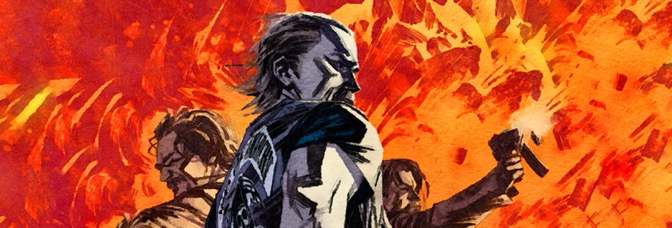
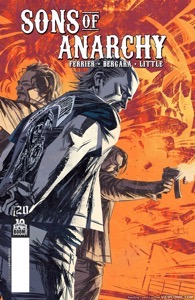
    Ferrier’s second issue as writer is better than his first, but it’s still got a lot of problems. He gives the SAMCRO club a nemesis in this dopey little punk, who Bergara draws like an Archie character. It’s weird.

    The insider turned villain thing isn’t new, not even with the setup Ferrier’s using; it’s been in Avengers, it’s been in Justice League. It’s a team book comic trope. So Ferrier’s turned Sons of Anarchy into a team book. Swell. Maybe if Boom! embraced it they could do their heads in the top left corner of the cover.

    (I’d actually love to see that).

    It’s okay on those terms. As a licensed property, one questionably comic-ready, it’s fine to turn Sons of Anarchy into a team comic book. With slightly cartoon-y art from Bergara.

    And Ferrier’s subplots are good. But they’re just dressing on the bland, familiar main plot.

  • Sons of Anarchy #20Ferrier’s second issue as writer is better than his first, but it’s still got a lot of problems. He gives the SAMCRO club a nemesis in this dopey little punk, who Bergara draws like an Archie character. It’s weird.

    The insider turned villain thing isn’t new, not even with the setup Ferrier’s using; it’s been in Avengers, it’s been in Justice League. It’s a team book comic trope. So Ferrier’s turned Sons of Anarchy into a team book. Swell. Maybe if Boom! embraced it they could do their heads in the top left corner of the cover.

    (I’d actually love to see that).

    It’s okay on those terms. As a licensed property, one questionably comic-ready, it’s fine to turn Sons of Anarchy into a team comic book. With slightly cartoon-y art from Bergara.

    And Ferrier’s subplots are good. But they’re just dressing on the bland, familiar main plot.

    CREDITS

    Writer, Ryan Ferrier; artist, Matías Bergara; colorist, Paul Little; letterer, Ed Dukeshire; editors, Mary Gumport and Dafna Pleban; publisher, Boom! Studios.

  • Dekalog (1989) s01e04 – Four

    With Four, Kieslowski engages with the television format of “Dekalog” more than he has done before. No pun intended.

    Four has a young woman discovering her father might not be her father, a fact he isn’t aware of either. Kieslowski and co-writer Piesiewicz don’t go so much for thought-provoking as discussion-provoking. Each moment in the episode is begging to be discussed, not analyzed.

    Why not analyzed? Because Kieslowski and Piesiewicz create a closed system; they quarantine the sensational plot developments.

    Playing the daughter, Adrianna Biedrzynska is okay. Kieslowski and editor Ewa Smal make sure to leave the viewer hints at where things are going. It’s more roadside billboards than ominous foreshadowing, particularly because the script’s structure is so soggy. Four stops and goes, stops and goes.

    As a filmed play, it’s nearly successful (thanks to Biedrzynska and understated Janusz Gajos as the father).

  • Descender 2 (April 2015)

    Descender #2Lemire sure does know his sci-fi–this issue of Descender continues the A.I. vibe while throwing in some Outland. He also knows how to go straight for the heartstrings, which he does with a bunch of flashbacks to Tim–21 (he’s the android protagonist) in happier days.

    And Lemire does a good job with it. He can get away with almost anything with Nguyen’s art. Descender will always be worth looking at. Nguyen’s color washes give each page a distinct separate feel, even when the action continues between them. It’s a lovely comic.

    This issue doesn’t do much to develop the world of the comic, just Tim–21. Lemire’s careful not to give the robot too many emotional observations (again, A.I.) and it’s unclear if he can get legs out of story with a purely sympathetic lead character.

    But he’s off to an okay start. It’s gloriously manipulative stuff.

    CREDITS

    Tin Stars, Part Two; writer, Jeff Lemire; artist, Dustin Nguyen; letterer, Steve Wands; publisher, Image Comics.

  • Friday the 13th Part III (1982, Steve Miner)

    Friday the 13th Part III is shockingly inept. Director Miner has a number of bad habits, some related to the film being done in 3-D, some just with how he composes the widescreen frame. Miner favors either action in the center of the frame or on the left. The right is unused. Miner’s shooting for pan and scan. But he also has enough interest to do a quick Psycho homage and a more elaborate one to the first Friday the 13th. So there was some ambition. At least twice.

    But even if Miner were a better director, there’s still cinematographer Gerald Feil. Feil does an atrocious job. Sometimes, during the terribly lighted night scenes, it’s impossible to tell whether a shot is interior or exterior. The light doesn’t create anything. It barely even illuminates relevant action.

    All of the acting is bad. Some of it is worse. Lead Dana Kimmell is real bad. Not as bad as Paul Kratka as her boyfriend, but still real bad. The rest of the cast isn’t much better. Catherine Parks and Tracie Savage probably give the best performances.

    It takes the movie over a half hour to really get going and Miner never matches the care he gives the first suspense sequence (the first after the previous installment’s recap). Maybe most surprising is the lousy score from Harry Manfredini. He opens with a disco thing, then abandons it for a tired rehash score.

    Beside that one opening suspense sequence, Part III’s total turkey.

  • The Maltese Falcon (1941, John Huston)

    Even though almost every moment of The Maltese Falcon is spent with Humphrey Bogart’s protagonist, director Huston keeps the audience at arms’ length. Most of the film’s more exciting sounding set pieces occur off-screen, but so does Bogart’s thinking. The audience gets to see him manipulating, often without context.

    His most honest scenes are with the women in his life–secretary Lee Patrick, damsel in distress Mary Astor, ill-chosen love interest Gladys George. Of course, Huston’s script doesn’t even make it clear (right off) Bogart’s going to be honest in those scenes. Huston reveals it a few minutes later, which is important as Falcon is an intentionally convoluted mystery but only on the surface. It’s more an epical character study of Bogart, something Huston doesn’t feel the need to reveal until the last seven or eight minutes.

    Huston’s approach leads to a briskly moving film with a bunch of fantastic scenes. Bogart (and the viewer) see the result of the villains’ machinations, but Bogart saves all the conclusions. He doesn’t share, not with Patrick, not with Astor, not with the viewer. Huston’s exceptionally controlled with the narrative structure. It’s brilliant; he’s able to set up a fantastic conclusion for the mystery, but also for the character study, all because of that structure.

    And the acting. Bogart’s phenomenal, so’s Astor, so are Peter Lorre, Sydney Greenstreet and Elisha Cook Jr. Greenstreet almost gets as good of material as Bogart.

    Wonderfully playful score from Adolph Deutsch.

    It’s a magnificent film.

    4/4★★★★

    CREDITS

    Directed by John Huston; screenplay by Huston, based on the novel by Dashiell Hammett; director of photography, Arthur Edeson; edited by Thomas Richards; music by Adolph Deutsch; released by Warner Bros.

    Starring Humphrey Bogart (Samuel Spade), Mary Astor (Brigid O’Shaughnessy), Peter Lorre (Joel Cairo), Sydney Greenstreet (Kasper Gutman), Ward Bond (Detective Tom Polhaus), Barton MacLane (Lt. of Detectives Dundy), Lee Patrick (Effie Perine), Elisha Cook Jr. (Wilmer Cook), Gladys George (Iva Archer) and Jerome Cowan (Miles Archer).


    Banner

    THIS POST IS PART OF THE GREAT VILLAIN BLOGATHON 2015 HOSTED BY KRISTINA OF SPEAKEASY, KAREN OF SHADOWS & SATIN, and RUTH OF SILVER SCREENINGS.


    RELATED

  • Criminal: The Special Edition (February 2015)

    Criminal: The Special Edition (One Shot)Criminal’s back for a one-shot and, wow, it certainly does do a good job reminding of when Ed Brubaker and Sean Phillips are hitting the high notes on the comic.

    The special brings back a character, but Brubaker spends more time establishing this Conan knockoff than anything he does with the issue’s protagonist. Having black and white interludes to the Conan knockoff’s magazine (it takes place in the seventies) wouldn’t work without Phillips’s art. He has this beautiful way of being detailed but not too detailed. You can buy the interludes as hurried late seventies fantasy comic art, but there’s still the Phillips quality to it.

    The individual scenes in the comic–whether it’s the protagonist in a jailhouse fight or yelling at his son at one point–work better than the whole. Brubaker doesn’t have time for a big twist. He’s got time for scenic awesomeness though.

    CREDITS

    By This Sword I Live!; writer, Ed Brubaker; artist, Sean Phillips; colorist, Elizabeth Breitweiser; publisher, Image Comics.

  • Kaijumax (2015) #1

    Kaijumax  1 crop

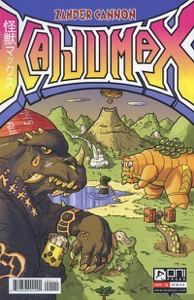
    My friend summed up Kaijumax for me before I read it. Monster Island is a maximum security prison. Ultraman is the guard. He neglected to tell me there was bickering between classes of monster, silly cameos from an Aliens alien and a whole bunch of Mecha-Godzillas. Because Zander Cannon loves this stuff. It’s clear. He loves it.

    Kaijumax is perfect for a certain audience, one with nostalgia for afternoons spent in the seventies and eighties watching Godzilla movies on TV. Of course, Cannon makes Kaijumax tougher–it’s a prison after all (and one of the only real problems is how much he wants to make it “Oz”). It doesn’t cause a disconnect between story and art, it just makes it hard to know how to take the comic.

    Should any effort be spent trying to see all the sense in it?

    Who knows. Maybe I’ll find out next issue.

  • Kaijumax #1My friend summed up Kaijumax for me before I read it. Monster Island is a maximum security prison. Ultraman is the guard. He neglected to tell me there was bickering between classes of monster, silly cameos from an Aliens alien and a whole bunch of Mecha-Godzillas. Because Zander Cannon loves this stuff. It’s clear. He loves it.

    Kaijumax is perfect for a certain audience, one with nostalgia for afternoons spent in the seventies and eighties watching Godzilla movies on TV. Of course, Cannon makes Kaijumax tougher–it’s a prison after all (and one of the only real problems is how much he wants to make it “Oz”). It doesn’t cause a disconnect between story and art, it just makes it hard to know how to take the comic.

    Should any effort be spent trying to see all the sense in it?

    Who knows. Maybe I’ll find out next issue.

    CREDITS

    Error & Respect; writer, artist and letterer, Zander Cannon; editor, Charlie Chu; publisher, Oni Press.

  • Ei8ht 1 (February 2015)

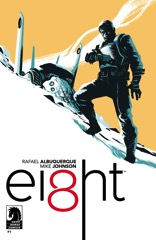
    Ei8ht #1What is Ei8ht?

    Well, first off, it’s gorgeous. Rafael Albuquerque does a great job. Nothing’s exactly original–Planet of the Apes meets Twelve Monkeys meets Waterworld meets The Road Warrior–but it all looks really good. Albuquerque immediately brings personality to the characters. He and co-writer Mike Johnson even choose just the right names for certain connotations.

    Wait, wait, wait. Albuquerque’s great except the last page. I need to bring it up for a second. It’s the “money shot” of the issue, it’s what sets it the last page being some kind of cliffhanger, and Albuquerque fumbles. He’s not thoughtful about the illustration and it shows. Maybe he’s busy, but maybe the editors need to do more.

    There’s a lot of time travel and so on in Ei8ht. Space travel, time travel. Albuquerque and Johnson do it well. Not original, but thoughtfully constructed from other elements.

    It’s definitely okay.

    CREDITS

    Writers, Rafael Albuquerque and Mike Johnson; artist, Albuquerque; letterer, Nate Piekos; editors, Spencer Cushing and Sierra Hahn; publisher, Dark Horse Comics.