The One-Trick Rip-Off (1993-96)

OnetrickripoffThe One Trick Rip-Off isn’t a failed heist story. Paul Pope plays a lot with that genre, updating it to Los Angeles street gangs. Pope’s Los Angeles setting is an entirely different subject, one I’ll get out of the way. One Trick’s setting is lush–both in Pope’s lines and the colors–always urban, but still somehow organic. Pope’s use of the stars and the city skyline are both great ways to make it breath, especially the stars. The first star scene has the protagonists talking about constellations. They obviously aren’t visible, but Pope convinces the reader to look anyway.

All right, setting out of the way. Back to the genre. One Trick was originally serialized; some of the chapters are more obvious than others, but it also shows how Pope’s unveiling events. It opens with a classic heist planning scene and then Pope does whatever he can do make that scene impossible in the narrative. He later brings it back, which is something of a genre standard. But then Pope breaks One Trick out of the genre with the finish. It’s like he acknowledges what the genre’s limits and bypasses it.

Pope deftly prepares the protagonists for the transition. He spends a lot of time on his characters; the protagonists are actually the least jazzy. They’ve got a good story, especially with the genre shift, but Pope saves the flash for the supporting cast.

As for the art? It’s concurrently sublime and frantic.

It’s a great book.

CREDITS

Writer and artist, Paul Pope; colorists, Jamie Grant and Dominic Regan; letterer, Michael Neno; editor, Bob Schreck; publisher, Image Comics.

Dark Horse Presents 112 (August 1996)

194822.jpgOne Trick Rip-Off finishes here, the first story in the issue too. It’s pretty clear Pope was thinking, especially here—it has a multi-page wordless sequence for dramatic effect—of a single sitting read, not a one-year one. Some very nice art; some weak sentiment. The finish might read better as a single piece.

Actually, it’s an issue of finale installments—French has Ninth Gland’s strange close next and it’s… creepy and disturbing but not at all horrifying. In fact, if one were to synopsize the series, it would sound strange but not scary.

And then there’s Egg. Lovece writes this installment from the perspective of the egg creature. It’s an alien of some sort. I think Lovece is trying to do something about the cycle of abuse (inferring the kid beat the ugly alien for misbehaving with a crowbar). Well-intentioned or not, the writing’s idiotic.

CREDITS

The One Trick Rip-Off, Part Twelve; story and art by Paul Pope; lettering by Michael Neno. The Ninth Gland, Part Seven; story and art by Renée French. Egg, Part Three; story by Frank Lovece; art by Christopher Schenck; lettering by Sean Konot. Edited by Bob Schreck and Jamie S. Rich.

Dark Horse Presents 111 (July 1996)

194821.jpgI was expecting The Ninth Gland to be creepier this issue, but I guess French has to save something for the finish. While it’s disturbing, it’s just disturbing imagery. The story itself is rather tame—though I imagine the payoff next issue will be something awful.
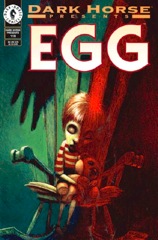
Speaking of awful… Egg, Lovece and Schenck after-school special about a father beating his son and the son bringing home a giant monster. This issue is from the father’s perspective and Lovece writes him even worse than he wrote the son. It’s interesting how, in both installments, the whole world is actually out to get the father and son.

Pope’s penultimate One Trick Rip-Off is gorgeous—lots of great panels this time, fantastic movement between them. It’s an action story; a great looking action story.

Too Much Coffee Man is incredibly bland this issue. Wheeler’s observations are straight out of “Dear Abby.”

CREDITS

The Ninth Gland, Part Six; story and art by Renée French. Egg, Part Two; story by Frank Lovece; art by Christopher Schenck; lettering by Sean Konot. The One Trick Rip-Off, Part Eleven; story and art by Paul Pope; lettering by Michael Neno. Too Much Coffee Man; story and art by Shannon Wheeler. Edited by Bob Schreck and Jamie S. Rich.

Dark Horse Presents 110 (June 1996)

35926.jpgThe issue opens with Egg, which is a well-intentioned look at child abuse. The narrator’s father is beating him and the school officials aren’t doing anything to help, even though some are well-intentioned. Lovece’s writing is better in dialogue. Dealing with the narrator’s Stockholm Syndrome, he fails. Also, introducing a giant creature into the situation seems a little cheap. Schenck’s art is fine.

Pope’s One Trick is an action installment. He seems to be ramping up for the conclusion. The art’s great but it’s gone on too long, especially if Pope’s going to load up the ending with action versus story.

The Ninth Gland is getting even freakier—one of the girls is now hallucinating some very disturbing things. Let’s not forget these two girls are hanging around in a hospital basement with the janitor either….

Then Wheeler’s got a page of Coffee Man, who I didn’t miss.

CREDITS

Egg, Part One; story by Frank Lovece; art by Christopher Schenck; lettering by Sean Konot. The One Trick Rip-Off, Part Ten; story and art by Paul Pope; lettering by Michael Neno. The Ninth Gland, Part Five; story and art by Renée French. Too Much Coffee Man; story and art by Shannon Wheeler. Edited by Bob Schreck and Jamie S. Rich.

Dark Horse Presents 109 (May 1996)

35925.jpgI can’t believe I’m about to make this statement—I liked Milgrom’s story the best. It’s some charming little thing about a guy treating his roaches as pets (after all other attempts at pet owning in New York fail). Milgrom’s style is more comic strip than I’ve seen and it works. Even if the protagonist does look like Peter Parker with a receding hairline.

Pope’s One Trick opens the issue and I remembered all the characters in this installment. One of them was mentioned briefly in the first installment. One Trick doesn’t seem to be meant for a lengthy, interrupted read. Pope’s pacing suggests it should be read in a sitting (I know Dark Horse traded it eventually).

Devil Chef ends this issue… it’s a slightly less annoying read knowing Pollock won’t be back with it next time.

And French’s Ninth Gland? Still no real story, just incredibly, uncomfortably weird.

CREDITS

The One Trick Rip-Off, Part Nine; story and art by Paul Pope; lettering by Michael Neno. Devil Chef, Part Three; story and art by Jack Pollock. The Ninth Gland, Part Four; story and art by Renée French. New York Pets; story and art by Al Milgrom. Edited by Bob Schreck and Jamie S. Rich.

Dark Horse Presents 108 (April 1996)

35924.jpgNinth Gland is fairly gross this issue, though French still hasn’t done anything to tell the reader what the story’s about. There’s something growing in the alien horse and the two girls who brought it to the hospital maintenance man will be affected somehow. It’s creepy.

Pollock’s Devil Chef installment is somewhat less annoying than usual for most of the pages, then it has a moronic ending. The concept—the FDA approving food with a parasite in it to force consumers to eat only that foodstuff—is interesting, actually. Too bad Pollock’s writing is awful.

Then Pope’s got problems with One Trick. It’s impossible to keep his characters straight here (I swear he’s changed one character’s hair color from blond to brown). Also, it feels a little padded. Nice last page though.

DeMos and Gillis have an anti-suicide story. Gillis’s art is fine. DeMos wrote two lines of dialogue.

CREDITS

The Ninth Gland, Part Three; story and art by Renée French. Devil Chef, Part Two; story and art by Jack Pollock. The One Trick Rip-Off, Part Eight; story and art by Paul Pope; lettering by Michael Neno. The Perfect Tree; story by Jeff DeMos; art by Scott Gillis. Edited by Bob Schreck and Jamie S. Rich.

Dark Horse Presents 107 (March 1996)

35923.jpg
I’ll start with the worst—Devil Chef. Pollock threatens a second installment. He can draw, this story shows, he just choses not to. It’s an unfunny strip with a lot of details and zero charm.

On the other hand, Purcell and Mignola’s Rusty Razorciam is quite a bit of fun. Mignola’s not a good fit for sci-fi (it’s hard to tell what he’s trying to convey, action-wise, at times), but Purcell’s got an amusing set of characters. The protagonist narrates an incomplete adventure. It’s really rather nice, even with the art problems.

French’s Ninth Gland is weird and ominous. Not much happens this issue (the emphasis is on making the reader uncomfortable), but French’s art is fine; the story works.

Pope’s at a bridging point in One Trick. It’s a Paul Pope talking heads story, actually. It’s a good installment, very cinematically paced.

Geary does another inconsequential page.

CREDITS

Rusty Razorclam; story by Steve Purcell; art by Mike Mignola; lettering by Lois Buhalis. The Ninth Gland, Part Two; story and art by Renée French. The One Trick Rip-Off, Part Seven; story and art by Paul Pope; lettering by Michael Neno. Devil Chef, Part One; story and art by Jack Pollock. Humiliation and Debasement; story and art by Rick Geary. Edited by Bob Schreck and Scott Allie.

Dark Horse Presents 106 (February 1996)

35922.jpg
Okay, so Wray did have something to do with “Ren & Stimpy.” Otherwise, it’d be a little too coincidental. He does the art on Big Blown Baby (Fleming scripts). Great art, very detailed, very fluid. Too bad Fleming’s script is just a mediocre absurdist comedy thing. It’s amazing how many of these poorly written, obscenity-laden strips Dark Horse felt the need to publish.

Very nice One Trick installment, with Pope stranding protagonist Tubby in the middle of nowhere. The story’s a neo-noir, maybe the most inventive ever. Pope paces the installment slowly, more cinematically than the rest of it. I sometimes forget how good Pope is with narrative structure. He really works hard at it.

Then it’s Ed Brubaker writing a Godzilla. More, it’s Brubaker writing a comedic Godzilla strip. Cooper’s art is fun, the story’s inventive. It’s amazing how much better it is than Baby. See, writing helps.

CREDITS

Big Blown Baby; story by Robert Loren Fleming; art by Bill Wray; lettering by John Costanza. The One Trick Rip-Off, Part Six; story and art by Paul Pope; lettering by Michael Neno. Godzilla, Godzilla’s Day; story by Ed Brubaker; art by Dave Cooper. Edited by Bob Schreck and Scott Allie.

Dark Horse Presents 105 (January 1996)

35921.jpg
Dark Horse had a misprint this issue. A couple pages were out of sequence on Niles’s Cal McDonald. Well, that misprint in addition to continuing Shaw’s Alan Brand and Musgrove and Chamberlin’s Pink Tornado.

What’s funniest about Shaw this issue is how lazy he gets. Lots and lots of white space here. Alan Brand started out interesting and then got idiotic very quickly. As it did, Shaw’s art got lazier and lazier.

As for Pink Tornado, the art’s a bit better this issue. Musgrove and Chamberlin have problems with eyes. They also, again, write poorly. It’s amazing someone at Dark Horse thought this material constituted quality. Given the subject matter (a fetus as a superhero), maybe they were just trying to get press.

Niles’s story ends. It’s bad, but fine.

This installment of One Trick finds Pope plotting a very European twist. The cliffhanger’s sort of confusing, but excellent overall.

CREDITS

Cal McDonald, Hairball, Part Four; story by Steve Niles; pencils by Casey Jones; inks by Bruce Patterson; lettering by Sean Konot. Alan Bland, That’s Mr. Painter to You, Part Four; script and art by Stan Shaw. The One Trick Rip-Off, Part Five; story and art by Paul Pope; lettering by Michael Neno. The Pink Tornado, Part Three; story and art by Scott Musgrove and Darick Chamberlin; lettering by Konot. Edited by Bob Schreck and Scott Allie.

Dark Horse Presents 104 (December 1995)

35920.jpg
Musgove and Chamberlin have a Helen Keller joke in this installment of The Pink Tornado, presumably because they thought it makes them edgy. They’re really just incredibly stupid and rather terrible writers. Their dialogue’s endless and their art’s bad.

As for Niles’s Cal McDonald, it’s fine. I mean, it’s bad, but it’s Jones’s fault. Niles writes an action story and Jones isn’t capable of illustrating an action sequence. It’s maybe the best thing I’ve ever read with Niles’s name on it, as he doesn’t profusely narrate the action sequence.

Shaw’s Alan Bland is, again, weak.

But then there’s Pope and The One Trick Rip-Off. Pope injects magical realism into his urban gang story here. While Pope’s art does lend itself towards the fantastic, his story is set–until this installment–in reality. It’s an odd development, one he handles beautifully.

Oh, and another harmless Pekar and Sacco one pager.

CREDITS

The Pink Tornado, Part Two; story and art by Scott Musgrove and Darick Chamberlin; lettering by Sean Konot. Cal McDonald, Hairball, Part Three; story by Steve Niles; pencils by Casey Jones; inks by Bruce Patterson; lettering by Konot. Alan Bland, That’s Mr. Painter to You, Part Three; script and art by Stan Shaw. The One Trick Rip-Off, Part Four; story and art by Paul Pope; lettering by Michael Neno. Felipe Alfau; story by Harvey Pekar; art by Joe Sacco. Edited by Bob Schreck and Scott Allie.