 I asked for Templesmith Spectre and Templesmith Spectre I got. I shouldn’t have asked for so much. Giant Spectre deciding whether or not to judge Gotham City. It seems like it should be okay, but it’s not. Maybe because the giant monster is just a blob of ghosts or something. Maybe because Batman figures into it and Templesmith can’t bring the cinematic scale to a Batwing attack and it just doesn’t work.
Or maybe because the drama of the issue is whether or not the boss of the unit is going to shoot Corrigan in the head to stop the Spectre. Worse, Fawkes feels the need to go with a shock soft cliffhanger. There isn’t much personality to the issue either.
It’s a disaster issue by a couple guys who don’t seem to know how to scale one out.
The art’s nice, the writing’s okay enough; it just doesn’t connect.
CREDITS
Judgment on Gotham; writer, Ray Fawkes; artist, Ben Templesmith; letterer, Saida Temofonte; editors, Dave Wielgosz and Rachel Gluckstern; publisher, DC Comics.
 Well, Templesmith gets to draw the Spectre and it mostly works out. He gets to draw big giant Spectre even, which I wasn’t expecting. And big giant Spectre is like a big giant monster, fighting another big giant monster. Gotham by Midnight is definitely distinct. Even if Templesmith’s Batwing looks like a Batarang. And his panel arrangement doesn’t change to accommodate a giant-size character.
 On second thought, maybe seeing Templesmith fully realize the Spectre isn’t a good idea for Gotham by Midnight. He has to handle big supernatural action this issue and it doesn’t come off. It’s too constrained and his style is no good for discerning the action without narration.
 For a good fifth of this issue, which Templesmith paces out well, it seems like the Spectre might show up. He does, but Templesmith doesn’t show him. But for a while, it seems like Templesmith is going to show the Spectre. It’s really cool.
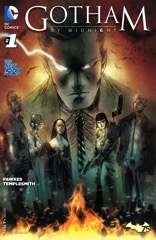 Thanks to Ben Templesmith’s art, Gotham by Midnight works a lot better than it should. A lot of Ray Fawkes’s dialogue is generic cop show stuff, but Templesmith has a way of visually rushing some of the conversations through how he positions the characters. In other words, he makes the problem spots shorter than they’d otherwise be… and it helps immensely.
 Thanks to the Internet, unofficial, fan-made productions can get a lot of exposure. Why people haven’t been doing more unofficial superhero comics is beyond me. It makes great senses but you don’t hear about many.
 The headline on the cover promises an "off-beat" story from Harlan Ellison. Off-beat can't have been an intentional euphemism for bad… Ellison writes Batman as an insensitive, ill-mannered, narcissist.
 I hate this comic. I hate how DC used it, I hate how Moench writes it, even if it was an editorial decision.
 I wish they had done a recap issue back when Colan was at the top of his game. This issue sets up the big anniversary special over in Batman, with he and Robin going over the villain files in the Batcave. Gordon got an ominous note.
 It’s a depressing issue, but Moench’s ambitious in that depression. He plays some of the thriller scenes like a melodrama–a guy storming over to have it out with the murderer of his girlfriend–while having Batman moon over Catwoman.