The Legion of Monsters (1975) #1

Legion of Monsters  1

Legion of Monsters opens with a defensive letter from editor Tony Isabella, responding to the Marvel faithful who were mad at the inglorious cancellation of the other black and white magazines. Isabella explains the books weren’t ever losing money; it’s just not in Marvel’s best interest not to make money. If readers really want black-and-white monster magazines, they better buy Legion.

They did not.

Although there’s a subscription form in the issue, Monsters only had this one issue.

And kind of for good reason.

There are four features. One Monster of Frankenstein, one continuation from Dracula Lives, and two original horror stories. All of them are uneven, starting with Doug Moench, Val Mayerik, Pablo Marcos, and Dan Adkins’s Frankenstein story. It’s after the Monster has woken up in the modern age, and he’s wandering around. He sees a princess, and even though he knows it always ends with villagers and pitchforks, he follows her.

Now, if it were just about the Monster following some girl, it’d be tired fast. But the Monster finds himself amid intrigue; it’s a costume party, and the jester tells him someone’s out to kill the princess, will the Monster help? Of course, he will. But will it be helpful help or disastrous?

The art’s sometimes excellent. Mayerik inking himself, Marcos inking Mayerik, it works out. The Adkins inks are wanting. And the story’s really dang long.

But at least it’s not the Secret Origin of Manphibian, the following story. Tony Isabella scripts from a Marv Wolfman plot. Dave Cockrum pencils, Sam Grainger inks. It’s about a Creature from the Black Lagoon type coming up through an oil well and getting in a fight with another monster from the same species, as well as some husband out to kill his wealthy wife. Or something.

It’s tedious. Maybe if the art were more distinct.

Ditto the next story, about kids picking on a former circus “freak” whose only friends are flies. It bleeds empathy, but the story’s way too long, and the art lacks Paul Kitchener pencils, Ralph Reese inks. They also share story credit with scripter Gerry Conway.

Maybe if Marvel wanted more people to be excited about Legion, they should’ve gotten together a better first issue.

The next chapter in Roy Thomas and Dick Giordano’s adaptation of Bram Stoker’s Dracula wraps up the issue. After a lengthy (and welcome) recap of events to date, this installment covers Mina going off to marry Jonathan in Europe while Lucy’s condition worsens in England. There are multiple diary and journal keepers: Mina, Steward, and eventually Lucy.

It sure seems like Lucy has no idea she’s been Dracula’s steady blood bag for months, and, to this point, Mina hasn’t read Jonathan’s diary, even though he wants her to do so. But what Thomas doesn’t fix—and Giordano doesn’t help with—is Dr. Van Helsing, who arrives this issue to commit medical malpractice.

With the timeline visually broken out so nicely, it’s even more apparent than usual Van Helsing messes up with Lucy’s initial diagnosis and then waits too long to tell everyone what they’re dealing with.

Giordano draws Van Helsing like a combination of Santa Claus and a leprechaun.

Otherwise, lots of good art, but Lucy’s the only sympathetic character, with Seward whining almost nonstop about her marrying someone else and Van Helsing blandly kind and incompetent.

There’s one page of single-panel strips from Stuart Schwartzberg. They’re a highlight and shouldn’t be. There’s also another text article recapping monsters in other media, like it’s a real magazine again. Too little, too late.

Is it a bummer Legion didn’t continue? Sure?

But it makes sense why it didn’t.

Dracula Lives (1973) #5

Dl5

This issue starts with the Roy Thomas and Dick Giordano adaptation of Bram Stoker’s Dracula, which I read in reprint. I’m not going to check the original novel, but I’m not sure Stoker had Jonathan Harker be a shitty racist about China (complaining about how their trains ran in 1897). Harker writes in his diary about how after he and Mina get married, they can get screwing… well, maybe Stoker implied it. Never heard a lot of good about Stoker.

Anyway.

The adaptation covers Harker’s arrival in Transylvania up to Dracula opening the door. He goes from train to village to carriage to Dracula’s carriage; for those familiar with the novel (or faithful adaptations), there are good looks at the carriage driver, who’ll turn out to be Drac in disguise. I’m waiting to see if Giordano has visual consistency.

Harker’s far from a sympathetic protagonist as he Karens his way through Eastern Europe, but the goings-on are mysterious (Dracula’s marking the buried treasure blue flames, though Harker doesn’t know it yet), and the art is absolutely gorgeous. Giordano works his whole ass off on the art. It’s magnificent.

And the writing’s fine. Thomas does Harker’s narration well, does his snooty, British superiority well; so far, there’s nothing else.

Though it’s a relatively quick read, sort of half an act.

While that feature is pretty impressive, the rest of the issue is a less exciting Dracula Lives. And not just because of the text pieces. They apparently ran out of old Atlas strips to run and instead have more original text ones, including Gerry Conway doing a full story. Doug Moench’s Transylvania “travelogue” and Dracula: Prince of Darkness reviews are far more successful. Chris Claremont also contributes a book review (Raymond Rudorff’s The Dracula Archives) and there’s a new feature: “Coffin Chronicles,” upcoming Dracula in other media.

The second original story is also written by Conway, who again does much better in these Lives stories than he did in Tomb, though Frank Springer’s got some odd designs. He does full Bela Lugosi Count Dracula (albeit with an angular, gaunt face), but it’s set before the French Revolution. Dracula goes to France, where he tangles with magician Cagliostro for the first time.

The Cagliostro stories have been running in Lives for a while, only in the present. Dracula’s convinced his old foe’s still kicking and is trying to take him out. This story provides the backstory of their rivalry. Or at least the very beginnings of it.

After surviving an assassination attempt, Dracula bribes his way onto Louis XVI’s court. Cagliostro’s already there and already trying to do away with the Count.

It’s an okay but somewhat awkward story. It’s too short because it’s got a part two coming, and while Springer’s art is often good, his designs are not.

The one reprint is a reasonably solid effort with art by Sid Greene. A reporter goes to a village where they feed their local vampire farm animals, and the vampire’s nice to everyone. Unfortunately, some loudmouth in the village convinces everyone they need to get rid of the vampire, which has terrible repercussions. It’s five pages; maybe it could’ve been four, but okay.

The third original story is a disappointment. Not in terms of art. Gene Colan with Pablo Marcos inking. The art’s remarkable. The story not so much.

Tony Isabella writes based on a Marv Wolfman story. It’s Dracula on a plane. Some incel is going to blow the plane up to watch everyone die, only Dracula’s got to get back to the Big Apple and his waiting coffin. It’s a follow-up to his Hollywood adventure last issue.

While no one else on the plane can handle the terrorist (white guy), Dracula’s sure he can handle it. But apparently, Drac doesn’t understand explosives. He also doesn’t think to mist his way behind the guy. It’s not very well-thought-out by Dracula or Isabella.

But the art’s fabulous. The final gag is neat, though it breaks a bunch of vampire rules continuity, both within the story and elsewhere in the issue. But I was expecting a lot more from it. I wonder if Wolfman had the whole story idea or just the setup. Or maybe just the good punchline.

Then there’s a one-page “The Boyhood of Dracula” strip to close the issue; Isabella writing, Val Mayerik on art. It’s about when the Turks imprisoned young Vlad Tepes and tortured him. It’s a fairly tepid account and seems like filler. I was expecting more from it as well.

Still, the novel adaptation makes it more than worth the read, plus Conway’s writing is good on the too-short France story, and Marcos inking Colan is sublime.

Howard the Duck 23 (April 1978)

Howard the Duck #23Leave it to Steve Gerber to do the impossible here. Wow. He takes this peculiar story arc (which ties back to Howard’s first appearance and ignores everything else in the series so far) and throws in these (intentionally) painfully obvious Star Wars references and then goes loose with it all.

The result is a good Spaceballs. The result is the perfect mix of subversive material, mainstream gags and storytelling intelligence. The comic’s called Howard the Duck and the duck’s been paddling around in a circle. Why’s Gerber do it? To make the return to him here work. It’s a strange thing–this issue is so tied to the previous one, it might have worked better as a single issue. Maybe double-size.

Because this comic–with gorgeous Mayerik art (wonderful depth)–is amazing. It’s “space humor” done better than anyone’s done it since or before. Even Dark Star.

It’s magnificent.

CREDITS

Star Waaugh; writer and editor, Steve Gerber; artist, Val Mayerik; colorist, Janice Cohen; letterer, Irving Watanabe; publisher, Marvel Comics.

Howard the Duck 22 (March 1978)

Howard the Duck #22I’m not sure Howard is back on track so much as Gerber has found someplace to take it. The existing narrative of the series is on hold; this issue continues Howard’s first appearance (and death) over in Man-Thing. Now he’s back with Man-Thing, Jennifer Kale (Man-Thing’s blondie girlfriend), a blond Conan and an old wizard. His mission, save the universe.

In a very Star Wars fashion. It’s a little weird to see Gerber so obviously–and appreciatively–aping Star Wars at the same comic book company printing a monthly Star Wars comic book. Maybe Howard would have had legs as a zeitgeist parody, but it’s only because Gerber brings such personality to the homage.

Val Mayerik is back on pencils, which is cool, especially given the integral Man-Thing guest appearance, which works so well because it’s got Gerber writing it.

It’s a solid issue. Real solid.

CREDITS

May the Farce Be with You!; writer and editor, Steve Gerber; penciller, Val Mayerik; inker, Bill Wray; colorist, Janice Cohen; letterer, John Costanza; publisher, Marvel Comics.

Howard the Duck Annual 1 (June 1977)

Howard the Duck Annual #1The Howard the Duck Annual is a fantastic comic. Writers Mary Skrenes and Steve Gerber wisely go for an extended story as opposed to some special, annual-like one. Unless there’s something to Howard being in Arabia. Did Donald Duck ever have an Arabian adventure?

With Howard–especially with Val Mayerik on the art–there’s frequently a strange moment where the panel seems extremely iconic… only Howard’s not the iconic one. Between the visuals and the script, the comic often requires a moment of reflection from the reader. Crazy hijinks are going on, but Gerber handles them all so well, for a moment they don’t seem too crazy.

Gerber gets in quite a few good jokes here too. Some great situational punchlines. The issue also has Winda and Paul tagging along with Bev and Howard. It’s a very strange team comic or something.

I wish Howard was always annual-length.

CREDITS

Thief of Bagmom!; writers, Mary Skrenes and Steve Gerber; artist, Val Mayerik; colorist, Janice Cohen; letterer, Joe Rosen; editor, Gerber; publisher, Marvel Comics.

The Man-Thing 4 (April 1974)

The Man-Thing #4Abel inks Mayerik even better this issue; occasionally there’s an almost Eisner-like roundness to the figures and the faces. The hair too–the hair’s not Eisner-like, but there’s often a lot of phenomenal hair.
Gerber continues with the Foolkiller, recounting his origin. It’s a tad much, actually. There’s some anti-religion, anti-military propaganda in Gerber’s story for the character and it’s not effective. It might have been a big deal at the time, but it’s really just a shortcut to not having to do much character work.

The art and the rest of the comic smooth out those bumps. The outlandish humor aspect–down to the Foolkiller having a van and car setup from “Knight Rider” (but before the television show; wonder if Marvel got a check for it)–and the way Gerber doesn’t try to do anything with Man-Thing except as the lumbering deus ex machina… it all works out.

Works out well.

B 

CREDITS

The Making of a Madman!; writer, Steve Gerber; penciller, Val Mayerik; inker, Jack Abel; colorist, Linda Lessmann; letterer, Dave Hunt; editor, Roy Thomas; publisher, Marvel Comics.

The Man-Thing 3 (March 1974)

The Man-Thing #3I almost want to cut this issue slack for the art; Jack Abel inking Val Mayerik is an interesting thing. Abel adds not just a lot of detail–to Man-Thing in particular–but comic expressions for most of the characters. Man-Thing all of a sudden seems to recognize its humor.

And a good deal of the issue has Gerber dealing with his human civilian cast. While they aren’t the most engaging people ever, Gerber’s coming up with new situations for them and plotting these situations well. It’s like he can’t ever screw up too much because his storytelling instincts are strong.

But then there’s Foolkiller, who makes his first appearance this issue. Gerber runs him through the issue, tying together all the subplots, but it’s all too obvious. The character feels way too artificial.

The worst part of the issue might be the cliffhanger–because Gerber doesn’t make it a rewarding one.

C 

CREDITS

Day of the Killer, Night of the Fool!; writer, Steve Gerber; penciller, Val Mayerik; inker, Jack Abel; colorist, Linda Lessmann; letterer, Jean Simek; editor, Roy Thomas; publisher, Marvel Comics.

The Man-Thing 2 (February 1974)

The Man Thing #2One problem I can see Gerber having with Man-Thing is what to do on the regular issues, the ones where he has a somewhat ambitious narrative structure, but isn't doing anything fantastical. Gerber excels at the fantastical. This issue is not fantastical.

The structure's kind of neat. Man-Thing saves a guy who runs into a girl in trouble while Schist is plotting against Man-Thing (though Gerber tries too hard on the humor of the big scheming scene) and then Man-Thing runs into the trouble the girl's running from (a biker gang). It all comes together at the end.

Maybe if the guy, the protagonist for a lot of the issue, were a better character, it would work. Instead, he's a comical doofus; Gerber goes for jokes for his backstory without thinking them through.

It's a dense issue, however, and Gerber's plotting is a success. Mayerik and Trapani keep it moving.

B 

CREDITS

Nowhere to Go But Down!; writer, Steve Gerber; penciller, Val Mayerik; inker, Sal Trapani; colorist, Petra Goldberg; letterer, Jean Izzo; editor, Roy Thomas; publisher, Marvel Comics.

The Man-Thing 1 (January 1974)

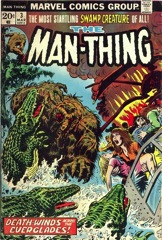
The Man-Thing #1At one point during the issue, the editor–or writer Steve Gerber–apologizes for the visual madness in Gerber’s script. This apology is for the reader. But given all the insanity Gerber throws together, which ranges from superheroes, Howard the Duck, wizards, barbarians, politicians in big cars and then army guys–not to mention castles, swamps and cosmic walkways–one has to wonder how artist Val Mayerik felt about it.

Ostensibly–and from the title, Man-Thing–this comic is about Man-Thing. But not really. Especially not since Gerber does a slight retcon on the character and removes its ability for maintaining thought. So, while the comic’s great and Gerber uses Man-Thing to good effect, it’s hard to say where he can take the comic.

But it certainly seems like it’ll be somewhere great. Part of Gerber’s charm is his unexpectedness.

It’s a brilliantly written comic book with these fantastic little moments. Gerber and Mayerik are awesome.

A 

CREDITS

Battle for the Palace of the Gods!; writer, Steve Gerber; penciller, Val Mayerik; inker, Sal Trapani; colorist, Dave Hunt; letterer, John Costanza; editor, Roy Thomas; publisher, Marvel Comics.

Adventure Into Fear 19 (December 1973)

Fear #19Apparently Mayerik and Trapani are keeping this new style, which is Trapani doing bad faces most of the time. Very unfortunate.

The issue is a mess of alternate realities, barbarians, ducks, GIs and something else. Magicians. Gerber is writing about the walls of reality collapsing and somehow he’s just got to get Man-Thing involved. But he doesn’t until towards the end of the issue and not well.

The story’s imaginative but there’s just no point to it. Man-Thing isn’t a full character in the comic, not with Gerber constantly trying to pull away from him–which is fine, so long as you don’t pretend otherwise. And the Jennifer girl is a problematic protagonist too. She’s the one who’s having the great adventure, yet Gerber can’t stick with her.

So he sticks with the guest stars, then brings in Man-Thing. It’s an okay hodgepodge. Except the weak art.

B 

CREDITS

The Enchanter’s Apprentice!; writer, Steve Gerber; penciller, Val Mayerik; inker, Sal Trapani; colorist, Stan Goldberg; letterer, Artie Simek; editor, Roy Thomas; publisher, Marvel Comics.