

What a lousy comic. I mean, I didn’t even care about Steve Dillon’s artwork. His lines get thick during action sequences and lose all fluidity. Dillon’s precise line work always implies movement, entropy, never static. He looks like he’s doing pin-ups this issue. Punisher pin-ups. Is it 1993 or something?
I can’t figure out who Marvel is targeting with this Punisher variation. Let’s go through all the pieces of the pie. First, Steve Dillon’s back. He hasn’t been on the book for a while, right? And he was on the book during multiple good new (or post-Angelic) Punisher titles. So Dillon alone might be a sale. Except now you need a writer–Marvel should’ve just gotten Dillon a ghostwriter for the book, it couldn’t have been any worse and probably would’ve been better–but it’s 2016 and Marvel has a diversity problem. So get Becky Cloonan to write the book. Name female creator. It’s almost an event comic.
Only bad Punisher comics aren’t events, they’re the standard. Cloonan and Dillon turn in a lame issue. Cloonan writes Frank with less personality than a slasher movie villain, only Dillon draws him very superhero, very compensation Frank. Cloonan’s got these moron DEA agents who would have been lousy cop characters in the early eighties, much less now. Her dialogue’s thoughtfully written but it meanders in exposition land. Or she just has terrible editors.
Finally, this Punisher is the first series since regular people started caring about the Punisher, thanks to the “Daredevil” TV show. Shock of shocks, a “Punisher” show got announced just a few days before this issue came out. It’s buzzy. It’s Disney (and if Disney just means nostalgia-based brand synergy, so be it). Anyway, buzzy says it needs to be accessible as well as notable. Cloonan’s there for her buzz cred, not because she has some great Punisher story to tell.
Or maybe she does and it really is just another Lethal Weapon riff with war buddies selling dope and one of them having to stop it. But I’m giving her the benefit of the doubt.
Marvel apparently thinks they need it to have mass appeal, which is admirable but impossible. The Punisher is pulp, it’s exploitation. For it to succeed, it’s got to have an edge–it can’t be bland. And this book couldn’t be blander.
 What a lousy comic. I mean, I didn’t even care about Steve Dillon’s artwork. His lines get thick during action sequences and lose all fluidity. Dillon’s precise line work always implies movement, entropy, never static. He looks like he’s doing pin-ups this issue. Punisher pin-ups. Is it 1993 or something?
 Wagner and Grant amp up the block war storyline, but turn it into a long investigation. Dredd is trying to track down the person responsible for the block war mania. It’s strange, once the suspect is identified, he also refers to the condition as block mania. It’s a small thing, but it does show where Wagner and Grant aren’t paying attention.
 Good grief–Ennis end the comic with a big Dubya is an alcoholic moron joke right before 9/11. Did they change the reveal for the trade?
 Ennis has lost track of any real person–by real person, I mean the bartender from the first couple issues or maybe one of Soap’s cop antagonists–and he’s back to having a jolly old time. Lots and lots of pop culture references. Some day you’ll need footnotes to understand all the references and then further footnotes to explain why they’re funny.
 It’s the Punisher on an island of dumb mercenaries. Or the next issue will be–and Ennis even goes so far as to promise it’ll be a good one for the soft cliffhanger. Actually, this issue is mostly exposition.
 More funny stuff from Ennis. He’s got some cheap jokes but he sure does thoughtfully arrange them. He’s even for a bunch of Marvel puns in the comic–referencing Giant-Size Man-Thing and Marvel Team-Up, though he could have gone further with the pun about the latter.
 Garth Ennis takes a rather strange approach to this issue–and presumably this Punisher series. He does it as a comedy. There are levels of mocking, with the Punisher getting the least and Soap getting the most. There are some actual criminals in there and their stupidity gets mocked, but they’re at least aware. Soap isn’t even aware.
 Why is the only good scene in the issue–besides the apartment cast’s send-off, of course–when Soap meets the Punisher? The rest of the stuff with Soap is dumb, as are the other subplot resolutions, but there’s something about that scene. Maybe Ennis thinks of the reader as Soap, someone dumb enough to be amused even after a seagull tags you’re forehead.
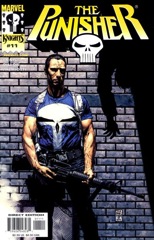 Ennis continues with the goofy issues. The dialogue out of this one is hideous. Ennis is going for cheap one liners. It’s awful.