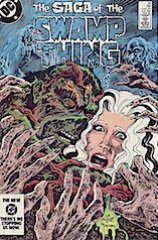
Swamp Thing 40 (September 1985)

810414.jpg
This issue’s kind of a downer-in-one. Bissette and Totleben are back at full strength and do a great job. The story concerns a housewife whose lycanthropy manifests itself (seemingly for the first time) while Swamp Thing’s in town for a visit. Moore juxtaposes the woman’s problems against the history of a local Native American tribe and the sufferings of that tribe’s women.

Bissette and Totleben have the task of mixing both those elements with the visiting Swamp Thing.

Strangely, it’s not exactly a visual feast–the art isn’t exuberant as much as measured. They’re carefully telling this story and they do a great job of it.

But Moore’s also moving his Constantine story along here too, but behind the scenes. There’s only a page of Constantine and he’s only briefly mentioned before. Alec and Abby briefly talk about him.

It’s a great issue. Moore’s flexing his narrative muscles.

Swamp Thing (1985) #39

Swamp Thing  39

Something strange happens with the art this issue. It’s Bissette and Totleben, but one or both of them is darned lazy. While there’s some great Swamp Thing art, all the human characters are hurried. And the amazing Swamp Thing as landscape (first time ever) is far less amazing than I’d expect from the artists.

That unfortunate condition aside, it’s a good issue. Moore toggles between three narrators–victims, vampires and Swampy–and it all works well. Swamp Thing versus underwater vampires, with Swampy learning how to flex the plant elemental muscles.

Moore even makes the vampires sympathetic, though the vampire baby isn’t cute at all.

The comic’s definitely missing something with Abby gone, but it’s also a really short issue. Moore’s plot is a gradual and expansive, but it’s still an all action issue. It’s not rushed though.

It’s just too bad the artists were having their only weak issue.

Swamp Thing 39 (August 1985)

16009.jpg
Something strange happens with the art this issue. It’s Bissette and Totleben, but one or both of them is darned lazy. While there’s some great Swamp Thing art, all the human characters are hurried. And the amazing Swamp Thing as landscape (first time ever) is far less amazing than I’d expect from the artists.

That unfortunate condition aside, it’s a good issue. Moore toggles between three narrators–victims, vampires and Swampy–and it all works well. Swamp Thing versus underwater vampires, with Swampy learning how to flex the plant elemental muscles.

Moore even makes the vampires sympathetic, though the vampire baby isn’t cute at all.

The comic’s definitely missing something with Abby gone, but it’s also a really short issue. Moore’s plot is a gradual and expansive, but it’s still an all action issue. It’s not rushed though.

It’s just too bad the artists were having their only weak issue.

Swamp Thing 36 (May 1985)

12385.jpg
Not a happy comic, not at all. Moore plays with having multiple points of view, fragmenting the story’s timeline to give everyone a chance at a surprising moment. He opens with Swamp Thing, who doesn’t really have a story this issue. Moore’s showing his mastery; he turns what should be a filler issue into an essential one. He focuses on Abby toward the end, which reveals the most.

It’s clear Moore’s real protagonist is Abby at this point, maybe because she has to be. Moore never gives Swamp Thing as good of moments. For example, there’s a short line here about Abby living in Houma during the week and in the swamp with Alec on weekends. It’s fantastical but wholly domestic.

That one nice moment is amid all the awfulness of the rest. Moore also establishes the series isn’t going to have easy fixes, even with the new, lesser antagonists.

Swamp Thing 35 (April 1985)

12384.jpg
The truly nightmarish quality of Moore’s Swamp Thing shows itself here in his ability to gradually peel back the layers of a small incident.

Moore frames this story around a collection of newspaper headlines (about nuclear power and, more importantly, nuclear waste) and a guy addicted to it. To nuclear waste. It’s really gross, but it takes Moore about half the issue before he lets Bissette and Totleben show the full effect.

The result is an uncomfortable reading experience. It’s not the worst thing Moore could focus on–he’s touched on worse in previous issues–but when the artists take so long to fully reveal… well, imagination gets the better of the reader.

The issue consists of a few contemporaneous conversations; its present action is mostly just Swamp Thing going for a walk.

Moore needs to get the exposition out of the way. Layering is a great device for it.

Swamp Thing 34 (March 1985)

12383.jpg
I should have remembered this issue, but I did not. The story is pretty simple. Alec and Abby start dating. In one of Moore’s rare moments, he forgets Swamp Thing’s acceptance of “Alec” as Abby’s name for him came in a dream sequence, not in scene.

Anyway, the issue is a big crazy art fest from Bissette and Totleben. Even before Abby eats the tuber, the art spreads across pages. Bissette and Totleben capture, even without much background to start, the tranquility of Alec and Abby’s time in the swamp. It is infinitely calming.

Then the hallucinogenic pages begin. I assume Moore wrote the pages out in detail, but Bissette and Totleben’s renderings perfectly match it. Most of the experience is from Abby’s perspective, though occasionally Alec contributes.

The story is relatively small, but the team turns it into a monumental occasion.

It’s a lovely example of comics as art.

Swamp Thing Annual 2 (January 1985)

16142.jpg
I am having a hard time deciding my favorite part of this annual. In terms of ambition and payoff, it’s probably the best annual ever. Moore, Bissette and Totleben don’t just produce a great story, but also a fun one and an emotionally devastating one. All while Swamp Thing goes to Hell.

The contestants for favorite moment are the end, which is another great Bissette full page spread emotional finish, the moment when Swamp Thing doesn’t want to meet Linda Holland in Heaven or the scene with Arcane in Hell. The first two are devastating, one quiet, one not, and the second is Moore having a lot of fun.

This story, as intense as it gets, is still fun. Moore writing Deadman, the Phantom Stranger, the Spectre and the Demon… all amazing.

It combines Moore and Bissette exploring DC’s afterlife and a great story for Swampy and Abby.

It’s amazing.

The Saga of the Swamp Thing 30 (November 1984)

12379-1.jpg
In many ways, this issue is an exercise more than a full issue. It is not, actually, a full narrative gesture, not in the way Moore has established himself on Swamp Thing. It reads very quickly and one of the reasons it does is because Moore does not encourage lingering.

Arcane is back and he’s bringing hell to Earth. Notice the lower case hell and the uppercase Earth. Much of the issue is single panel snapshots of people about to do awful things to one another. Really, really awful things. Moore and Bissette do not show these things… because the reader’s imagination will do far better (at being worse) than anything illustrated.

The issue also shows how well Moore understands the DC Universe, whether it’s a tie-in to Crisis or a cameo from the Joker. Moore gets it, maybe better than anyone else.

It’s great work, but completely disturbing.

The Saga of the Swamp Thing 29 (October 1984)

12378.jpg
This issue isn’t really a Swamp Thing comic, more an Abby one. Moore frames it in a dream, but a dream where Abby remembers all her latest experiences with her husband. Her possessed, dead husband who’s not really her husband.

While the end revelation is incredibly disturbing on a few levels, Moore makes sure the whole issue is uncomfortable. Abby’s investigation into her husband’s condition has a lot of effective uncanny revelations.

As usual, the art from Bissette and Totleben ties it all together. They only have one nice moment, when Swamp Thing and Abby meet up. Moore does the whole “falling in love” thing great. It’s not subtle, but it’s also not obvious. The unspoken element, of course, is the giant swamp monster. Abby lights up in that scene; great expressions from the artists.

The issue is expository, positioning the series for what follows.

Even so, it’s outstanding work.

The Saga of the Swamp Thing 27 (August 1984)

810274.jpg
The issue ends on two wildly divergent notes.

First, Swamp Thing and this previously scared little boy go for a peaceful walk back to the boy’s school after a monstrous night. It’s calm and gentle. Moore doesn’t give Alec too much dialogue—there’s still something tragic and sad about Swamp Thing, even if he’s at peace.

Second, Abby finds out she had something to do with the events leading up to the evening (well, the Demon suggests it and, as Jason Blood points out, even the Demon’s occasionally honest). The issue ends with her getting into a car with Matt.

Who, a few pages earlier, seemingly sold his soul to an evil fly to stay alive.

Moore, Bissette and Totleben handle these different moods naturally. Their Swamp Thing has room for it all.

For an action-packed issue (lots of fighting), Moore’s quiet ending is the perfect touch.

It’s excellent.

CREDITS

..By Demons Driven!; writer, Alan Moore; penciller, Stephen R. Bissette; inker, John Totleben; colorist, Tatjana Wood; letterer, John Costanza; editor, Karen Berger; publisher, DC Comics.