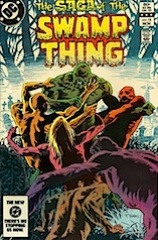
The Saga of the Swamp Thing 26 (July 1984)

12375.jpg
It’s a fast issue, so fast I don’t even think Alec has any dialogue (Abby reflects on the proper name for him, it’s good to know Moore’s thinking about it too). Instead it’s an Abby issue and Moore layers the whole thing, flipping between flashback and present action.

Most of the present action is Abby and Alec wordlessly running to save a bunch of children from a monster. The flashbacks reveal some of Jason Blood’s involvement, Abby’s first day at work (which also ties in to the plot) and more of Abby and Matt’s marital problems.

This issue is all horror–though the Demon, even by Bissette, is nowhere near as scary as anything else in the issue–Moore knows how to bring out the terror. It’s simple terror too; Moore and Bissette’s handling of it is what makes it so disquieting.

Still, it’s unfortunate Alec barely makes an impression.

CREDITS

…A Time of Running…; writer, Alan Moore; penciller, Stephen R. Bissette; inker, John Totleben; colorist, Tatjana Wood; letterer, John Costanza; editor, Karen Berger; publisher, DC Comics.

The Saga of the Swamp Thing 25 (June 1984)

810272.jpg
Moore solves the problem of not having a start point (since he previously “closed” the Saga). First, he opens with Jason Blood coming to town. Moore’s Blood is one part hilarious, one part dangerous. It’s a great character (though does it foreshadow Moore too letting the supporting cast outshine the titular protagonist?).

Second, this issue is set an indeterminate period of time from the last issue. Not too long, but long enough Abby and Alec are hanging out on a regular basis. Moore’s the implication of the relationship—more about closeness than interaction—is a gentle one.

There’s still the villain of the issue, the Monkey King, which is a scary supernatural monster. Bissette and Moore turn this cute little monkey (everyone likes monkeys!) into a horrific thing.

Speaking of Bissette, he and Totleben do another fantastic issue. Lots of talking, lots of visual pacing.

It is, once again, phenomenal.

CREDITS

The Sleep of Reason…; writer, Alan Moore; penciller, Stephen R. Bissette; inker, John Totleben; colorist, Tatjana Wood; letterer, John Costanza; editor, Karen Berger; publisher, DC Comics.

The Saga of the Swamp Thing 24 (May 1984)

12373.jpg
What’s strange about this issue isn’t so much the story or even the Justice League guest appearance (Moore writing the Justice League, with Bissette and Totleben on the art is otherworldly though). It’s the finish. Moore could use this issue for the series finale.

In dealing with an insane Jason Woodrue, Alec accepts his reality—he’s Swamp Thing—and he’s happy with it, happy with living in the natural world. It’s a joyous finish; he even, basically, says goodbye to Abby.

But it’s not the final issue and the way Moore leaves it, one wonders what can possibly come next and not feel forced.

The issue moves rather fast—it opens with the Justice League, a scene actually set during the previous issue’s events, and then there’s Alec and Woodrue fighting. It’s an action comic, something one tends to forget about Moore. He sometimes just writes really great action comics.

CREDITS

Roots; writer, Alan Moore; penciller, Stephen R. Bissette; inker, John Totleben; colorist, Tatjana Wood; letterer, John Costanza; editor, Len Wein; publisher, DC Comics.

The Saga of the Swamp Thing 23 (April 1984)

12372.jpg
So I should start by talking about Moore opening with Alec narrating and basically giving the reader the insight the previous issue’s exploration of his psyche didn’t have.

Or I could talk about how he, in his third issue, has cast Abby as the human conduit into the story (and retconned her attachment to Alec a bit).

I could even talk about how Alec’s dialogue and thoughts are about his lack of humanity but Bissette and Totleben give him the most human eyes in comic book history.

Instead, I’ve got to mention this one really awful page they draw. It’s the closest thing the issue has to a hero moment and they botch it. Swamp Thing looks awkward; there’s no payoff and they were going for one.

Of course, they immediately recover in a lovely sequence (with those eyes).

It’s another exceptionally strong issue and Moore’s still getting set up.

CREDITS

Another Green World; writer, Alan Moore; penciller, Stephen R. Bissette; inker, John Totleben; colorist, Tatjana Wood; letterer, John Costanza; editor, Len Wein; publisher, DC Comics.

The Saga of the Swamp Thing 22 (March 1984)

12371.jpg
Moore does a few things here. He skips ahead a few weeks, so we don’t get to see Alec return to the swamp. In fact, we don’t even get to understand what puts him in his initial condition this issue until the end of it. It’s not so much a layered narrative as Moore trying to linearly and visually show Alec’s mental response to discovering he’s not who he thought he was.

The loop the end creates, like the recurrences of the title in story proper, is pretty neat.

Moore splits the issue between Alec (in his dreamworld), Abby (as she discovers Alec’s new state) and Jason Woodrue. Woodrue isn’t exactly the issue’s protagonist, but he’s close. Moore spends the time establishing him so, when Woodrue has a breakdown, the transition resonates.

Bissette’s amazing composition, along with Tatjana Wood’s colors, make the whole issue dreamlike, not just Alec’s actual dreams.

CREDITS

Swamped; writer, Alan Moore; penciller, Stephen R. Bissette; inker, John Totleben; colorist, Tatjana Wood; letterer, Todd Klein; editor, Len Wein; publisher, DC Comics.

The Saga of the Swamp Thing 21 (February 1984)

12370.jpg
And here’s the famous Anatomy Lesson. It’s difficult to think about Swamp Thing before this issue–Moore doesn’t so much retcon as he explains–because it immediately changes every expectation of the series.

Moore uses Jason Woodrue to narrate and it’s a nice device. It lets Moore be enthusiastic about the scientific discovery process; he even manages to make General Sunderland even worse by revealing him as willfully ignorant.

I wish I remembered the first time I read it, how it affected the reader page by page. Moore understands how comic readers work, he understands the investment and the possessiveness. He paces the revelations and the action in the issue to pay off for that committed reader. The issue doesn’t really matter to new readers; it’s just reestablishing the ground situation.

The Bissette and Totleben art is fantastic, both futuristic and horrific in the same panel.

It’s an exceptional comic.

CREDITS

The Anatomy Lesson; writer, Alan Moore; penciller, Stephen R. Bissette; inker, John Totleben; colorist, Tatjana Wood; letterer, John Costanza; editor, Len Wein; publisher, DC Comics.

The Saga of the Swamp Thing 19 (December 1983)

12368.jpg
It’s Pasko’s final issue and he goes out on a high note. The opening quickly resolves the now protracted cliffhanger, then brings Arcane almost immediately into the story.

While I’m still underwhelmed with a reprint for the previous issue, it did establish the precedent for Arcane appearances, which Pasko continues here. When old Anton shows up, it’s a very special issue.

Bissette comes up with some disgusting Un-Men (the insect thing is creepy) and Alec and Abby have to escape them. Even though old home week continues, Pasko gives the cast members he created farewells. Dennis and Liz finally get close and the evil German doctor who wasn’t always evil tries for a redemption.

This issue, with Arcane, is so strong it overshadows some of Pasko’s good work on the series. It’s as though all it needed to excel was Bissette and old characters, but Pasko was also essential.

CREDITS

…And the Meek Shall Inherit…; writers, Stephen R. Bissette and Martin Pasko; penciller, Bissette; inker, John Totleben; colorist, Tatjana Wood; letterer, John Costanza; editor, Len Wein; publisher, DC Comics.

The Saga of the Swamp Thing 18 (November 1983)

810268.jpg
Hey, wait a second, I’ve already read this story….

This issue reprints the tenth issue of the original Swamp Thing series, when Arcane swims across the ocean and attacks Swamp Thing only to be defeated by the spirits of dead slaves. Wrightson art, one of Wein’s last good unsettling issues, it’s a good comic book. Wish whoever had been in charge had at least changed the editor’s notes so it didn’t refer to the second issue of the original series here in a Saga of the Swamp Thing book.

There are bookends, of course, and I guess they’re were the issue has problems. The flashback isn’t particularly important, at least not as a full reprint. Pasko, Bissette and Totleben could have retold it in a page or two. It’s an awkward fill, since it doesn’t do anything to resolve the previous issue’s cliffhanger.

They should’ve just taken a month off.

CREDITS

The Man Who Would Not Die!; writers, Martin Pasko and Len Wein; pencillers, Stephen R. Bissette and Bernie Wrightson; inkers, John Totleben and Wrightson; colorist, Tatjana Wood; letterer, Ben Oda; editor, Len Wein; publisher, DC Comics.

The Saga of the Swamp Thing 17 (October 1983)

12366.jpg
Wow, what an unpleasant issue. Pasko brings back Abby and Matt—with yet another retelling of the first series, but this time from their perspective, which reveals how they just disappeared from it at some point.

Keeping with the old home week feel to the issue, Arcane shows up at the end. Bissette and Totleben really know how to make him disgusting, maybe more than anyone else so far. It’s a glorified cameo, but gives the feel things are changing in the series.

What’s most striking about the issue is how Pasko ties Matt’s alcoholism to the horrors Alec and the supporting cast face. Interestingly, the second Abby calls him Alec, he ceases to be Swamp Thing to me. Bissette and Totleben’s artwork is absolutely fantastic, whether its the flashback, the monsters or just the page layout.

It’s a great issue, though Pasko takes a few pages to get rolling.

CREDITS

…And Things That Go Bump in the Night; writer, Martin Pasko; penciller, Stephen R. Bissette; inker, John Totleben; colorist, Tatjana Wood; letterer, John Costanza; editor, Len Wein; publisher, DC Comics.

The Saga of the Swamp Thing 16 (August 1983)

12365.jpg
For Bissette and Totleben’s first issue, Pasko does something of a refresh. The issue opens with a quick origin retelling, then reintroduces the supporting cast. It’s amusing the previous evil German guy is now a good guy. Apparently, being a Holocaust survivor means you get to later torture and murder people and it’s okay.

Most of the issue is spent with Swamp Thing in a small town where everyone accepts him. It’s the kind of thing Wein did in the seventies series (and did do in the seventies series, as I think about it). Obviously, there’s a reason why they all accept him. It’s an introduction issue, maybe even for readers who liked the original but missed the relaunch.

Seeing as how Abby shows up, for the first time, in a non-speaking cameo.

Bissette and Totleben are off to a fine start; they mix the horror and action well.

CREDITS

Stopover in a Place of Secret Truths; writer, Martin Pasko; penciller, Stephen R. Bissette; inker, John Totleben; colorist, Tatjana Wood; letterer, John Costanza; editor, Len Wein; publisher, DC Comics.