Kill or be Killed 2 (September 2016)

Kill or be Killed #2It’s definitely a better issue of Kill or be Killed, though Brubaker spends about a third of the issue just writing first person prose from the still obnoxious protagonist. And the prose isn’t particularly good. I mean, if it’s supposed to be the first person perspective from some annoying twenty-something entitled white kid who doesn’t know anything about writing prose, it’s fine. It also seems like Brubaker’s using it to give Phillips less to draw and, it’s already clear Kill or be Killed isn’t going to be one of Brubaker’s successes, so at least let the reader have as much great Phillips art as possible.

And there is some great Phillips art. There’s some paintings even–though it almost seems like they’re matching the story to what Phillips might have already around.

This issue doesn’t have the demon, which raises some questions (is the protagonist just insane?), and the protagonist–who’s so memorable I don’t even remember his name, annoying entitled white dude sums him up just as well (who’s shitty to his mom)–finds his first guilty victim. A thinking man’s Punisher this comic ain’t.

But it’s just all right enough, with Phillips getting just enough to do–a trip to upstate New York, some flashbacks involving the protagonist’s father (the guy’s family life is more interesting than anything Brubaker has for him to do as a demonically empowered vigilante), those awesome paintings of Phillips’s–to keep Kill or be Killed going. But it’s not a good comic. It probably won’t ever be a good comic.

CREDITS

Writer, Ed Brubaker; artist, Sean Phillips; colorist, Elizabeth Breitweiser; publisher, Image Comics.

Kill or be Killed 1 (August 2016)

Kill or be Killed #1 What if the Punisher weren’t an ex-Marine, what if he were just some emo rich(ish) white dude grad student who had to kill to keep a demon from killing him? As punishment for trying to commit suicide. There’s the gimmick to Kill or be Killed. The draw is gorgeous Sean Phillips New York City artwork–he seems more taken with the setting than the characters, in fact. The characters he rushes with occasionally, the setting is always perfect.
But how’s Ed Brubaker’s writing? It’s not great. It might not even be good. Kill or be Killed is a really strange way to do this story. Not in how Brubaker structures it–the narration from the protagonist is obvious but not in a bad way. No, it’s in what Brubaker does with that narration. He makes the protagonist really, really, really annoying.

It’s not even clear if Brubaker is just making him annoying for melodramatic purposes or if he’s making him annoying because the reader is supposed to find him annoying. It’s up in the air. At one point, the lead is talking about cops killing innocent black kids, then next he’s whining about being a trust fund baby who didn’t get to go to NYU grad school until he was twenty-eight. And, guess what, the girl he likes didn’t like him back.

It might work out, it doesn’t seem impossible it could work out. But it seems unlikely. Especially since Phillips has got no time for the demon. Kill’s demon is a visual tranquilizer.

The comic’s not terrible, it’s just terrible obvious. But the art’s real good. It does have the art going for it.

Oh, no. It’s an ongoing series.

CREDITS

Writer, Ed Brubaker; artist, Sean Phillips; colorist, Elizabeth Breitweiser; publisher, Image Comics.

Criminal: Tenth Anniversary Special (April 2016)

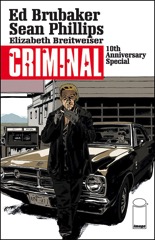
Criminal: 10th Anniversary SpecialWow.

On its own, Criminal: Tenth Anniversary Special is objectively excellent. Writer Ed Brubaker and artist Sean Phillips do the touching story of a boy and his jerk criminal dad. Set in 1978. And there’s a juxtaposing of an old Marvel-esque kung fu comic. It’s scary, it’s funny, it’s sad. It’s a great story.

But there’s so much texture to it all, as the special ties into the old Criminal books. It’s not a haphazard anniversary issue by a couple excellent creators; it’s an excellent anniversary issue, its creators taking it all very seriously. Brubaker and Phillips aren’t congratulating themselves with this Special, they’re awarding the reader with it. It’s this perfectly paced, perfectly conceived gem of a book. It’s got beautiful art from Phillips. He has this way of protecting the son whenever his father is around, implying it through the composition and the panel layouts. It’s such a smart comic.

It’s also fun. The kid meets a girl. She’s precocious. Brubaker hinges the whole comic on her–it’s a pre-teen romance of sorts–and he does a great job on her character. He presents the readers two views into the story, one through the kid’s, one through the girl’s. He does it with this wonderfully prompt pacing–Brubaker and Phillips and colorist Elizabeth Breitweiser (who’s become an essential part of the team) take advantage of every page, every panel. It’s flawlessly executed.

The Criminal: Tenth Anniversary Special is a class act and a great comic.

CREDITS

Writer, Ed Brubaker; artist, Sean Phillips; colorist, Elizabeth Breitweiser; publisher, Image Comics.

The Fade Out 12 (January 2016)

The Fade Out #12Well, it’s definitely great. The last issue of Fade Out is a great comic. And it’s a great close to the series. But does it elevate Brubaker and Phillips to that superior level of comic book creators, the ones only mentioned with hushed tones and reverence? I don’t know.

I don’t know yet.

I’ll have to reread The Fade Out someday, in one sitting, and decide. Because the pacing of this issue is key and I’m reading it in a single dose, but it was clearly broken out in plotting as part of a bigger whole. As a single serving, it’s that great success I just said. Brubaker and Phillips wrap things up and then wrap them up again. In doing so, they take readers through not just a recap of the story, but a recap of the experience of the comic, making them reexamine their own interpretations of the comic.

It’s really good writing. Brubaker’s comfortable with the cast, comfortable readers will get their sometimes abbreviated appearances. There’s a lot going on this issue, with Brubaker dropping two revelations (both make a reread seem like a good idea).

Phillips excels through all those complications. He even has this wonderful “Is that Clark Gable? I know that’s George Sanders” forties Hollywood visual in-joke element. He and Brubaker are doing a film noir as a comic, but stepped back, but still using film noir visual queues.

I don’t know what a perfectly finished Brubaker comic feels like (or, if I do, I can’t remember), but The Fade Out comes the closest.

CREDITS

Tomorrow, When the World is Free; writer, Ed Brubaker; artist, Sean Phillips; colorist, Elizabeth Breitweiser; publisher, Image Comics.

The Fade Out 11 (November 2015)

The Fade Out #11Ed Brubaker is about to deliver. He and Sean Phillips are break the skylight and get onto the roof. The Fade Out, an entirely grounded detective story set in Hollywood, is about to be where Brubaker joins the very small group of comics writers who I will buy regardless. Because what they do will be something special, even if its mainstream, because their styles may not reflect how comics are progressing as a narrative art form right now, but they will in a few years.

It’s like if Sleeper: Season Two had actually been as good as the first series. It’s like if Captain America really were as good as Catwoman. Brubaker jumps between projects with impatience. He gets excited for the new shiny. Only Fade Out doesn’t have the shiny, it just has the skills. It has the writing and the art and the writer’s understanding of what the art is going to do to this story. Brubaker understands how the comic book is going to read and he lets it inform how he’s writing.

It’s entirely commercial, entirely artistic and sublimely elegant.

He could screw it all up next issue, of course.

That would be very sad.

As for the comic itself, Brubaker gets around to revealing some things Gil should have known about from Charlie. Not to mention the reader. The reader should have known too. Except it works better here defining Charlie as a person, making him more understandable. It’s a genre standard and Brubaker pulls it off.

Then it’s Gil and Charlie on an adventure. It’s amazing. And Charlie’s narration of it, with how the plot progresses and then how Phillips illustrates it, that adventure is where Brubaker and Phillips do something extraordinary. They show how comics noir is its own genre. They prove the argument of their last ten years of work.

Even if The Fade Out flops next issue, Brubaker and Phillips have done something extraordinary with it.

CREDITS

Anyone Else But Me; writer, Ed Brubaker; artist, Sean Phillips; colorist, Elizabeth Breitweiser; publisher, Image Comics.

The Fade Out 10 (October 2015)

The Fade Out #10Brubaker’s winding up. This issue of The Fade Out is the part of the detective novel where the detective–in this case Charlie, who’s not particularly good at it–is collecting all the final details to have his breakthrough. In fact, the narration hints Charlie’s confident in his conclusions, which means Brubaker’s got next issue to stir it up more and then the last issue to let it all settle. Not a bad structure, but it does mean there isn’t much to this issue.

There’s exposition and some revelation, but there’s no character development. Brubaker sets the issue during the wrap party for the movie, which should be a big thing. It’s not. It’s a logical narrative progression–Charlie using the party for cover on his investigating–as the story wraps up.

The last few issues of The Fade Out have been breathtaking. This issue’s good, narratively important, but it’s not breathtaking. It’s a necessity and it coasts on existing momentum. Fingers crossed Brubaker is able to stir up some speed in the next issue.

Phillips’s art, of course, is breathtaking. One never has to worry about him.

CREDITS

Where Angels Fear to Tread; writer, Ed Brubaker; artist, Sean Phillips; colorist, Elizabeth Breitweiser; publisher, Image Comics.

The Fade Out (2014) #9

The Fade Out  9

I don’t know if I’d noticed before but probably not–Brubaker’s narration for Fade Out has the possibility of not just being a noir touch but also an actual part of the narrative. There’s like a single use of “you” referring to the reader so I’m reading a bunch into it like part of the mystery is figuring out who’s telling the story at the end. I’m probably wrong.

But if Brubaker was going to wait to reveal that narrative device, this issue would be the one to reveal it in. Gil and Charlie duke it out and the flashback reveals their back stories, separate to some degree, but mostly together. And the reveals make you want to go back and reread the earlier issues to see how Brubaker constructed it all.

There’s a lot in the flashback. Even though the present action takes place in a couple hours–at most–and is largely just one conversation leading up to the soft cliffhanger, Brubaker is able to make the issue dense with that flashback. It takes place over a decade or so, Phillips getting to illustrate a variety of settings, Brubaker able to work up tension in the flashback itself and not just how it relates to the present action.

Very cool; very good issue.

The Fade Out 9 (September 2015)

The Fade Out #9I don’t know if I’d noticed before but probably not–Brubaker’s narration for Fade Out has the possibility of not just being a noir touch but also an actual part of the narrative. There’s like a single use of “you” referring to the reader so I’m reading a bunch into it like part of the mystery is figuring out who’s telling the story at the end. I’m probably wrong.

But if Brubaker was going to wait to reveal that narrative device, this issue would be the one to reveal it in. Gil and Charlie duke it out and the flashback reveals their back stories, separate to some degree, but mostly together. And the reveals make you want to go back and reread the earlier issues to see how Brubaker constructed it all.

There’s a lot in the flashback. Even though the present action takes place in a couple hours–at most–and is largely just one conversation leading up to the soft cliffhanger, Brubaker is able to make the issue dense with that flashback. It takes place over a decade or so, Phillips getting to illustrate a variety of settings, Brubaker able to work up tension in the flashback itself and not just how it relates to the present action.

Very cool; very good issue.

CREDITS

Living in a Memory; writer, Ed Brubaker; artist, Sean Phillips; colorist, Elizabeth Breitweiser; publisher, Image Comics.

The Fade Out 8 (August 2015)

The Fade Out #8It’s another strong issue of Fade Out, which isn’t a surprise. Brubaker and Phillips are doing great work.

But it actually looks like Brubaker is doing something a little different with this series. His famous (are they famous, they should be) aside issues–which I believe he’s been doing since Catwoman–this issue features the first time (at least in my memory) someone else gets caught up on that aside.

Charlie finds out Maya’s story from her aside issue. It’s kind of crazy to see, just the way Brubaker handles it, having two protagonists collide. It shakes things up for The Fade Out, which didn’t need a shaking, but the shaking works out perfectly anyway. Brubaker shows he has the skill to do the series without a lot of leaps and jumps, so when he does those leaps and jumps, they’re all the more impressive.

Fade Out’s turning out great.

CREDITS

A Dead Giveaway; writer, Ed Brubaker; artist, Sean Phillips; colorist, Elizabeth Breitweiser; publisher, Image Comics.

The Fade Out 7 (June 2015)

The Fade Out #7The Fade Out doesn’t feel like anything but itself. Seven issues in and Brubaker and Phillips have shed any comparisons to their previous work; it’s another in their line of collaborations, but it’s wholly independent from them. One of the factors for it standing on its own so quickly is the lack of fantastical elements. It’s about creating the fantastic through “regular” human ugliness.

This issue opens with Charlie and Maya off on the beach enjoying a getaway weekend. Phillips has his delicate sex scenes, which give each panel a certain weight and pacing of their own, and even when Brubaker hints at the main plot lines, it’s gentle, conversational. The reader is on a getaway too. But, like Charlie, the escape can only last so long.

It’s not really a getaway so much as a scenic bridge. And maybe the best bridging issue I can remember, thanks to Phillips.

CREDITS

The Sound of Waves; writer, Ed Brubaker; artist, Sean Phillips; colorist, Elizabeth Breitweiser; publisher, Image Comics.