Dark Horse Presents (1986) #23

Dhp23

Here’s a somewhat strange issue… it opens with Stout’s history piece about Americans massacring Filipinos in the late 1800s and early 1900s. It’s even more relevant today (those massacred were Muslim and the whole thing has been brushed under the history carpet). It’s better as a history lesson than a comic.

Race of Scorpions is a practically unintelligible new serial. Duranona’s artwork is nearly impossible to comprehend. He’s got all this perspective but almost no shadows, so it all just jumbles together. He appears to have borrowed from Star Wars to set up his story of the young man who loses his guardians.

Geary’s Police Beat works again… but the real nice one is Arcudi, Barker and Nyberg’s American spree killer story. The story’s solid–disaffected WWII vet goes nuts–but the artwork is just fantastic. I’m not sure if it’s Barker’s pencils or Nyberg’s inks, but it’s simply gorgeous.

Dark Horse Presents (1986) #22

Dhp22

Seriously, a short story? I guess Andrew Murphy provides his own illustrations, but his story is a prose future story about cloning. Not a very logical one either (how do the clones age, for example). I guess it’s not the worst prose story I’ve ever read in a comic, but am I making a compliment? No.

Concrete is a thoughtful story of a young village kid in Asia getting ready for Concrete’s walking tour. Chadwick has probably never written a better story. Too bad the illustration is mediocre. He’s barely got any detail to his faces and I can’t remember a single stunning panel.

Rick Geary’s Police Beat, presumably short true police cases, is great. One page.

Trekker has Dave Dorman inks, which makes the whole thing look completely different. It’s not an entirely successful art experiment, but it’s the first Trekker I’ve sort of liked.

And Duckman is funny.

Dark Horse Presents 23 (October 1988)

35834.jpg
Here’s a somewhat strange issue… it opens with Stout’s history piece about Americans massacring Filipinos in the late 1800s and early 1900s. It’s even more relevant today (those massacred were Muslim and the whole thing has been brushed under the history carpet). It’s better as a history lesson than a comic.

Race of Scorpions is a practically unintelligible new serial. Duranona’s artwork is nearly impossible to comprehend. He’s got all this perspective but almost no shadows, so it all just jumbles together. He appears to have borrowed from Star Wars to set up his story of the young man who loses his guardians.

Geary’s Police Beat works again… but the real nice one is Arcudi, Barker and Nyberg’s American spree killer story. The story’s solid–disaffected WWII vet goes nuts–but the artwork is just fantastic. I’m not sure if it’s Barker’s pencils or Nyberg’s inks, but it’s simply gorgeous.

CREDITS

Filipino Massacre; story, art and lettering by William Stout. Race of Scorpions; story and art by Leopoldo Durañona; lettering by Jean Simek. Gateway to Hell: The Howard Unruh Story; story by John Arcudi; pencils by Gary Barker; inks by John Nyberg; lettering by Jim Massara. Police Beat; story, art and lettering by Rick Geary. Edited by Randy Stradley.

Dark Horse Presents 22 (September 1988)

35833.jpg
Seriously, a short story? I guess Andrew Murphy provides his own illustrations, but his story is a prose future story about cloning. Not a very logical one either (how do the clones age, for example). I guess it’s not the worst prose story I’ve ever read in a comic, but am I making a compliment? No.

Concrete is a thoughtful story of a young village kid in Asia getting ready for Concrete’s walking tour. Chadwick has probably never written a better story. Too bad the illustration is mediocre. He’s barely got any detail to his faces and I can’t remember a single stunning panel.

Rick Geary’s Police Beat, presumably short true police cases, is great. One page.

Trekker has Dave Dorman inks, which makes the whole thing look completely different. It’s not an entirely successful art experiment, but it’s the first Trekker I’ve sort of liked.

And Duckman is funny.

CREDITS

Concrete, Goodwill Ambassador; story and pencils by Paul Chadwick; inks by Jed Hotchkiss; lettering by Bill Spicer. Reflections; story and art by Andrew Murphy. Police Beat; story, art and lettering by Rick Geary. Trekker, Chinks; story and pencils by Ron Randall; inks by Dave Dorman and Lurene Haines; lettering by Ken Bruzenak. Duckman, Love Me Tender; story, art and lettering by Everett Peck. Edited by Randy Stradley.

Dark Horse Presents (1986) #20

Dhp20

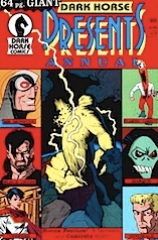
This issue is a sixty-four page giant–only most of the extra is filler. They could have gotten away with a lot less pages.

The Mr. Monster story is real short (and lame). Gary Davis has a short space alien story showing he’s read some Arthur C. Clarke (it’s long, wordless filler).

Rick Geary’s got a nice two page story, which is filler but really excellent filler.

Then there’s the start of a Trekker serial. It’s incomprehensible if you haven’t read the Trekker series and probably even if you have.

Doug Potter has an excellent story about homelessness.

Oh, I missed Bob Burden’s Mystery Men and Flaming Carrot two page filler.

Then a real Mask story, which seems to be wrapping up. The narrative’s a little pat dramatically, but I’m not sure Badger cared.

Bob the Alien and Mindwalk have stories. Bob‘s hilarious, Mindwalk‘s weak.

Finally, even more filler.

Dark Horse Presents 20 (August 1988)

35831.jpg
This issue is a sixty-four page giant–only most of the extra is filler. They could have gotten away with a lot less pages.

The Mr. Monster story is real short (and lame). Gary Davis has a short space alien story showing he’s read some Arthur C. Clarke (it’s long, wordless filler).

Rick Geary’s got a nice two page story, which is filler but really excellent filler.

Then there’s the start of a Trekker serial. It’s incomprehensible if you haven’t read the Trekker series and probably even if you have.

Doug Potter has an excellent story about homelessness.

Oh, I missed Bob Burden’s Mystery Men and Flaming Carrot two page filler.

Then a real Mask story, which seems to be wrapping up. The narrative’s a little pat dramatically, but I’m not sure Badger cared.

Bob the Alien and Mindwalk have stories. Bob‘s hilarious, Mindwalk‘s weak.

Finally, even more filler.

CREDITS

<

p style=”font-size:11px;”>Mr. Monster, The Thing in Stiff Alley!; story by Chuck Gamble and Michael T. Gilbert; pencils by Gamble, Gilbert and Chuck Wacome; inks by Gilbert; lettering by Ken Bruzenak. Anomaly; story, art and lettering by Gary Davis. A Mother’s Tragedy; story, art and lettering by Rick Geary. Trekker, Vincent’s Share; story and art by Ron Randall; lettering by Ken Bruzenak. The Mystery Men!; story and art by Bob Burden; lettering by Roxanne Starr. The Visit; story, art and lettering by Douglas C. Potter. The Mask; story and art by Mark Badger; lettering by David Jackson. Concrete, Watching a Sunset; story and art by Paul Chadwick; lettering by Bill Spicer. Bob the Alien, Bob, the alien, Goes Birddogging; story, art and lettering by Rich Rice. Mindwalk; story by Randy Stradley; art by Randy Emberlin; lettering by Willie Schubert. Wacky Squirrel, Mixed Results; story, art and lettering by Jim Bradrick. Black Cross; story and art by Chris Warner. Edited by Randy Stradley.

Dark Horse Presents (1986) #19

Dhp19

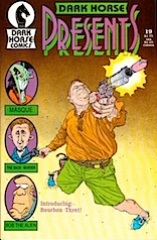
Finally; it only took eighteen issues, but this one is essential reading.

It’s not as simple as there not being a weak story… every single one of them is good.

I suppose, in this company, the weakest is Badger’s Mask. It’s starting to get old, with no real plot progression. He’s also doing the ink washes every other page, making it feel formulaic. Those complaints made, it’s still fine work. Though I notice the CIA’s no longer after a Cuban priest, just a South American one.

Rice’s Bob the Alien extended strip is really funny this time, not just amusing. I’m now looking forward to future entries.

But it’s all about Darrow and Geary.

Darrow’s Bourbon Thret is also an extended strip–sort of a Little Nemo without the bookends. The artwork is simply exquisite, seeing Darrow’s lines in black and white… breathtaking.

Then Geary has a great little mystery.

Dark Horse Presents 19 (July 1988)

35830.jpg
Finally; it only took eighteen issues, but this one is essential reading.

It’s not as simple as there not being a weak story… every single one of them is good.

I suppose, in this company, the weakest is Badger’s Mask. It’s starting to get old, with no real plot progression. He’s also doing the ink washes every other page, making it feel formulaic. Those complaints made, it’s still fine work. Though I notice the CIA’s no longer after a Cuban priest, just a South American one.

Rice’s Bob the Alien extended strip is really funny this time, not just amusing. I’m now looking forward to future entries.

But it’s all about Darrow and Geary.

Darrow’s Bourbon Thret is also an extended strip–sort of a Little Nemo without the bookends. The artwork is simply exquisite, seeing Darrow’s lines in black and white… breathtaking.

Then Geary has a great little mystery.

CREDITS

The Mask; story and art by Mark Badger; lettering by Tim Harkins. Bourbon Thret, Sead; story and art by Geof Darrow. Bob the Alien, Bob, the alien, Rides the Subway (and then gets off); story, art and lettering by Rich Rice. The Sack Murder of 1954; story, art and lettering by Rick Geary. Edited by Randy Stradley.