
 I sort of forgot about Secret Files. Especially this Catwoman one, even though I do remember Holly’s resurrection explanation being covered in it. Like I remember wanting to see how writer Ed Brubaker would address it. Now to decide if I want to spoil the reveal.
But first, the feature story, with Michael Avon Oeming pencils and Mike Manley inks. Brubaker cuts between some hoods reminiscing about their encounters with Catwoman over the years and Holly telling girlfriend Karon about it. It’s initially a cute idea, but then it gets a little weird because Karon doesn’t know Selina is Catwoman, so it’s basically Holly lying to her girlfriend while the hoods just rate Catwoman’s hotness through various outfits. Oeming doesn’t do cheesecake, but the hoods fill in the male gaze with their dialogue.
For a 2002 comic, it’s distressingly progressive but hasn’t aged great.
Oeming and Manley’s art is okay—they do better with Holly and Karon’s section—while the rest seems like a riff on “Batman: The Animated Series.”
Then there’s a Slam Bradley short—Brubaker wrote all the stories in this issue, which is almost a mistake. Like, he’s got different artists on each story, and only the Slam one really fits the regular Catwoman Cooke-inspired vibe (Cameron Stewart does the art), and maybe it should’ve been the other way around.
The Slam story also ages poorly. And not just because of Stewart. Brubaker writes it first-person from Slam’s perspective, and it’s all about him thinking about how men used to be men, and now they’re all on their smartphones or something. Selina is hanging out with him and helps out during fight scenes, but she’s utterly pointless to the story. It implies their relationship is further along than the regular series has gotten. Like, they’re at the hanging out and not talking stage of their romantically-charged friendship.
I think in the main book they’ve had like one case together.
It’s okay but doesn’t have one clamoring for a Slam Bradley solo book.
Then comes the Holly resurrection story. It’s two pages, with lovely Eric Shanower art, but it’s cheesecake. The style’s a Love and Rockets riff, only Holly and Selina aren’t the Locas, and Shanower’s not Jaimie. It’d be better if it were a more direct homage. Instead, it just treats Holly like she’s Maggie and Selina like she’s Penny Century—and Shanower’s cheesecake approach draws further attention to the first story’s tell don’t show male gaze.
It’s a miss. Even before getting into the story itself. But would it be a miss if I didn’t see what Brubaker and Shanower were doing without acknowledging? Probably? Like, it too suggests the regular book emphasizes really good Selina and Holly scenes, but… for the most part, it doesn’t. Catwoman is doing great, but its Secret Files tries to draw attention to what it doesn’t do.
Very weird.
Then comes the Black Mask story, establishing him as the series’s next villain. It’s Brubaker doing first-person narration again—more successful than Slam’s, but now an exhausted device—while Black Mask muses about how he’s got to deal with Catwoman. We once again see his slick lawyer sidekick, who’s down with evil but not Black Mask’s penchant for gruesome torture.
Stewart does the art again, and it’s fine. It’s just an extended Catwoman scene they didn’t have time to do in Black Mask’s reveal issue; they actually could’ve taken the last two pages from this one and tacked it on to that reveal, and it’d have been fine.
As someone who likes the idea of Secret Files well enough—don’t get me started on the Who’s Who entries—the Catwoman one is a disappointment. None of the stories accurately get the main series’s tone, which—thanks to Stewart doing some of the art—is clearly Brubaker’s problem, not the artist’s. It’s an even stranger miss taking Brubaker’s successful done-in-one fill-ins; he’s had a really good one on Catwoman already. You’d think he’d do great with an eight-pager focusing on a side character.
Nope.
It does have some historical value in the history of comic book objectification of women, but mainly as an example of a cop-out. A multi-tiered cop-out.
Anyway.
Can’t wait to get back to the series.

 It's one heck of a finish for the volume. Oeming's back for some of the dream sequences, with Glass finally getting around to explaining what's been going on with Karic. Sort of.
 Besides the cliffhanger, which is too manipulative, A Midwinter Night’s Dream is off to a great start. Glass has a lot of territory to cover just getting the story going–there’s lengthy expository narration at the beginning, along with some fantastic art by Santos. For the flashbacks, Santos only gets a few panels to make his point and he does every time.
 As a zero issue introducing the new Mice Templar volume, this issue isn’t effective. There are some really effective things about it–Bryan J.L. Glass and Victor Santos retell the finale of the previous volume from a different perspective and Santos gets in some wonderful pages–but the comic itself is too slight.
 As this issue begins, with some flashbacks to the big battle ending the Templar, Glass also establishes the relationship between Cassuis and Karic. It’s a dysfunctional mentor and student relationship. Karic thinks Cassius hates him and Cassius hates Karic.
 It’s a short but not sweet zero issue for the second Mice Templar series, which picks up almost immediately where the first series ended.
 What an issue. In hindsight, it should have seemed unlikely Glass was going to be able to wrap anything up while setting up for the next Mice Templar series.
 Once again, Glass gets a whole lot done in one issue.
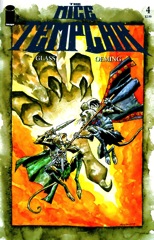 Trippy might be the best word for this issue. There’s a lengthy hallucination, mystical sequence as the finale, but Glass is constantly spinning the reader around before it. Actually, having a dream sequence is the most straightforward thing he does this issue. Everything before is much less so.
 This issue is a little busy. First, Glass showcases a rat battalion as they return home. They’re hunting. Nasty guys, these rats. It turns out some of the cast from the first issue has survived and are now prisoners of the rats, so Glass turns the focus to them for a while.