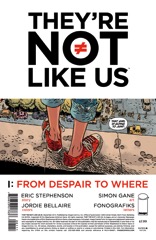
 Not to be too reductive, but the proper response to They’re Not Like Us appears to be “OMG! It’s like a real life X-Men.” Only, apparently, the gifted youngsters don’t use their powers for good, but for selfish reasons. Writer Eric Stephenson sort of foreshadows said youngsters–really a collection of twenty something hipsters–using their powers to harm others. Just like Professor X, the leader has rules… the first being to kill everyone who you knew before you join the team.
Will the Jean Grey-esque protagonist join with them, killing her family (who misunderstood her superpowers as schizophrenia)? Who cares. No one’s forcing me to read the comic, so I have no stake in it. Stephenson certainly doesn’t care about making his characters worth reading about.
Simon Gane’s artwork is good. A little self-indulgent, but good.
Like Us is a concept in search of a story.
B-
CREDITS
From Despair to Where; writer, Eric Stephenson; artist, Simon Gane; colorist, Jordie Bellaire; letterer, Fonografiks; publisher, Image Comics.
 During a fight scene, one of Stephenson’s survivors takes the time to tell her adversary about being bullied over her skin color as a kid. He’s swinging a flaming stick at her. It’s a bad scene.
 I didn’t read the three page of text matter. I skimmed it and none of it seems like I need to read it. I probably wouldn’t read it even if understanding the narrative required it.
 Okay, yeah, it’s the Fantastic Twelve or whatever. The giant scan man has just turned out to be the Thing. You know what I mean.
 There’s so much text in the back matter, like three or four full pages. Worse, I think you’re supposed to read it to understand what’s going on.
 Nowhere Men is weird. Half the issue has to do with these four scientists who form a for-profit think tank. Writer Eric Stephenson jumps around a whole lot–the comic opens in the seventies with the forming of the group, jumps ahead to when they’re old, then jumps ahead further to modern day.