MPH 5 (February 2015)

MPH #5Millar gets to a nice manipulative finish on MPH. He does give Fegredo a bunch of cool stuff to draw and the art’s great, but Millar has enough story for another five issues and he doesn’t want to tell it.

He suggests MPH is deeper for his lack of interest in proper storytelling, but it’s really not. It’s just more manipulative.

Half the issue is spent on a super-speed fight sequence. It’s pretty cool, actually. If it took the whole issue, it’d be even more cool. And then Millar could save the two big reveals for another issue, which would’ve worked a lot better.

But it still wouldn’t have been good. Because one of Millar’s reveals is a huge one and he tries to pass it off as small potatoes. It should be the defining element of the series; it’s not. Because it’s not flashy enough.

Still, beautiful art.

CREDITS

Writer, Mark Millar; artist, Duncan Fegredo; colorists, Peter Doherty and Mike Spicer; letterer, Doherty; editors, Lucy Unwin and Nicole Boose; publisher, Image Comics.

MPH 4 (November 2014)

MPH #4There’s quite a bit of talking in this comic. Not just the lead characters, who talk a whole bunch, but also the government guys out to catch the lead characters. There’s also a revelation scene, which Millar doesn’t do particularly well. It’s a talking heads issue and Millar is just dumping exposition to set up for the finish.

He opens the issue with the secret government agency explaining most of the backstory to the drug and to the mysterious prisoner, who’s been so unimportant he’s barely memorable. Millar plays some tricks, since he’s dealing with fortune telling and, presumably, next issue will have a big surprise or two, but the problem with MPH is the characters.

They aren’t just unsympathetic at this point, they’re annoying and tedious. Millar didn’t set them up strong enough and without development–especially after all the talking–they’re just dragging the comic down.

Too bad.

B- 

CREDITS

Writer, Mark Millar; artist, Duncan Fegredo; colorist and letterer, Peter Doherty; editors, Jennifer Lee and Nicole Boose; publisher, Image Comics.

MPH 3 (September 2014)

MPH #3Will the real Mark Millar please stand up…

After a couple relatively good issues, MPH starts to have some major problems. First and foremost, Millar has given up on characters for this issue. He has his protagonists robbing banks and sharing the takings with the people of Detroit, but the characters have no personalities. Oh, the one guy is jealous of the guy and the girl, but it’s very hard to care.

Presumably, Millar thought he did enough character work in the previous two issues to establish the characters but he didn’t. The comic is written, very much, for the trade–and that trade is written, very much, to be sold to Hollywood. This issue is all events, all gags, all gimmicks. The ending is idiotic.

Millar has a lot of ideas–and Fegredo does a fabulous job visualizing them–he just doesn’t have a story. He’s generating a property.

C+ 

CREDITS

Writer, Mark Millar; artist, Duncan Fegredo; colorist and letterer, Peter Doherty; editors, Jennifer Lee and Nicole Boose; publisher, Image Comics.

MPH 2 (June 2014)

MPH #2It’s bad, but I sort of wanted Millar to flop on the second issue of MPH. Not for any reason other than his adherence to the eighties multi-racial movie gang. He’s got them in here; nothing but it seems.
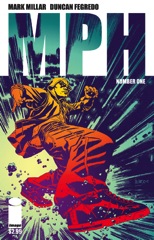
But he doesn’t flop. Even without doing some fantastic super-speed moments–there’s only one–the issue proves incredibly entertaining and Millar manages to get in some good character work. He’s got a new approach to how the characters experience the drug. The world’s on pause around their adventures. It takes him a while to get to this device, with the guy from the last issue zooming in and out of his friends’ lives.

MPH then has the problem of seeming too impulsive and I was ready for it to flop because of Millar’s brevity. He doesn’t skip the responsibility though, he owns it.

Additionally, it doesn’t hurt the Fegredo art is absolutely gorgeous.

B 

CREDITS

Writer, Mark Millar; artist, Duncan Fegredo; colorists, Peter Doherty and Mike Spicer; letterer, Doherty; editor, Jennifer Lee; publisher, Image Comics.

MPH 1 (May 2014)

MPH #1Leave it to Mark Millar to screw it up when he's got a good thing going. Even without the terrible soft cliffhanger, MPH does have some fantastic art from Duncan Fegredo. Fantastic enough to probably make the comic worth a look even if it didn't have a serviceable script.

There are all the standard Millar problems. It's too self-aware, the pop culture references are too forced, probably a few other things but I ignored them. However, Millar does write a good first person narration for his protagonist. It's some small time crook who ends up in prison for a relatively small crime and then gets superpowers.

The superpowers come from a pill called MPH. There's going to be an idiotic explanation for it, which the soft cliffhanger foreshadows. Still, the way Millar shows the guy's experience is fantastic.

The comic's predictably problematic (given Millar) but it's better than expected.

B- 

CREDITS

Writer, Mark Millar; artist, Duncan Fegredo; colorist and letterer, Peter Doherty; editor, Jennifer Lee; publisher, Image Comics.

Girl (1996) #3

G3

Milligan brings Girl to its unexpected and fantastic finish.

In some ways it’s the least visually outlandish issue of the series. Fegredo is confined to a very realistic rendition now. The result is something a little more visually engaging than the other issues. Because the reader finally knows exactly what Fegredo’s supposed to be drawing so he or she can appreciate it better.

Milligan comes up with a great narrative for the issue—it takes place over a couple days—and he still manages to surprise the reader every few pages. Once he sets up the last issue, he still has a couple more revelations in store for the reader and for Simone, the protagonist.

Simone, a first person female narrator written by a man, is one of the strongest female comic book characters I can think of. Milligan doesn’t just masterfully write a comic, he masterfully writes a person.

Girl (1996) #2

G2

Milligan delivers an outstanding issue. One of the greatest things about Girl is how unpredictable he makes the narrative. But it’s more than just coming up with a great cliffhanger to this issue, it’s coming up with a great resolution to the previous issue’s cliffhanger.

In between, Milligan fills in a bunch more about main character Simone’s life. He doesn’t spend a lot of time implying history, more giving her a revealing situation to move through. The final revelation (of this issue)—which Milligan even foreshadows, before playing with the idea of foreshadowing it—forces the reader to reexamine Simone.

Still, with an issue left, Girl is still somewhat up in the air. Milligan’s second issue is even better than his first, so I’m very anxious to see what he does in the third.

Fegredo excels again, making the people outlandish but real. Not to mention his fantastic panel design.

Girl (1996) #1

G1

I suppose there is a little sensationalism in Girl. It takes place in a town called Bollockstown and there’s a lengthy dream sequence and a couple mammals going out a window and plummeting to their deaths.

But Milligan makes the whole thing feel everyday. The comic’s about a–you guessed it–girl named Simone. Her family’s awful, so’s the town and she’s fifteen and stuck there. So her self-awareness generally hinders more than helps.

Though this issue ends on a big moment, the rest of the issue is rather quiet, even when she’s doing something loud. It opens in a flash forward, about two weeks after the majority of the issue; I’m guessing the series will fill in the difference. It’s a big open, but even it’s a little quiet.

Fegredo’s artwork is wonderful, giving Simone’s reality a lot of grim, but occasionally showing comfort.

It’s a great read.