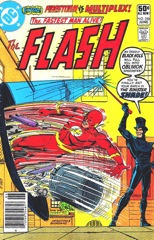
The Flash 298 (July 1981)

The Flash #298I’m not sure how to phrase it exactly, because Bates hasn’t exactly dumbed down The Flash for Infantino’s return to the book, but he’s definitely dulled the characters down. It’s like he’s changing the audience, aiming younger. There’s no character development anymore and the character details are lame. One colleague of Barry’s wonders if he’s always running off because the guy has bad breath.

Yawn.

There’s also not as much emphasis on the science of The Flash’s powers. Bates just lets Infantino run wild with the art and fills in with endless exposition. It makes for a strange read, because whether Infantino is trying hard or not, the art’s excellent. But Bates is no longer trying. It’s too bad.

The Firestorm backup still has Cowan on the art and thankfully no high school scenes. There’s a lot of action packed into a few pages and it all works well enough.

C+ 

CREDITS

A Deadly Shade of Peril; writer, Cary Bates; penciller, Carmine Infantino; inker, Bob Smith; colorist, Gene D’Angelo. Firestorm, The Multiplex Complex; writer, Gerry Conway; penciller, Denys Cowan; inker, Bob Wiacek; colorist, Jerry Serpe. Letterer, Ben Oda; editor, Len Wein; publisher, DC Comics.
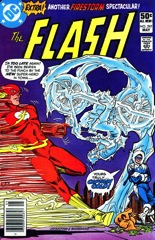
The Flash 297 (May 1981)

The Flash #297There’s something a little off about this issue. While Infantino is (hopefully) the new regular artist and he definitely has some good work in the issue–he can turn the smallest panel into the fullest one with all the movement and action–Bates is a little tone deaf.

The problem might be the two-fold nature of the plotting. Captain Cold is out on parole and has turned himself into a hero, but Barry’s mom is also in a coma following a traffic accident. Bates dismisses any struggle about being a superhero while being a supportive son–Barry decides being the Flash is more important, no question.

The Cold plot has a terrible resolution. Bates introduces a good story for him, then rushes through it.

Good thing the art’s nice.

Denys Cowan pencils the Firestorm backup’s high school students like thirty-somethings. Conway tries to do some character work, but there aren’t enough pages.

C+ 

CREDITS

Capt. Cold’s Cold, Cold Flame; writer, Cary Bates; penciller, Carmine Infantino; inker, Bob Smith; colorist, Gene D’Angelo; letterer, Todd Klein. Firestorm, Multiplex Means Multiple Choice… Death!; writer, Gerry Conway; penciller, Denys Cowan; inker, Bob Wiacek; colorist, Phil Rachelson; letterer, Milton Snapinn. Editor, Len Wein; publisher, DC Comics.

The Flash 296 (April 1981)

The Flash #296What’s strange about the feature is how much better Bates writes Elongated Man and Sue Dibney than he does Barry and the Flash. There’s a lot of charm to his characterizations of the Dibneys and it breathes a lot of life into the story.

Of course, the story also has Carmine Infantino artwork and every page has one or two phenomenal panels; Infantino is able to turn anything the Flash does into a moment of comic gold, whether it’s a fight scene or just a costume change. It’s not just how much movement Infantino implies, it’s how he composes each panel to have a narrative flow to it.

It also doesn’t hurt the story’s a genuine surprise with a great reveal.

The Firestorm backup has Conway trying too hard to make the protagonist likable, but some ambitious artwork from Starlin. Rather unfortunately, the detail doesn’t live up to the composition.

B 

CREDITS

The Man Who Was Cursed to the Bone!; writer, Cary Bates; penciller, Carmine Infantino; inker, Bob Smith; colorist, Gene D’Angelo. Firestorm, Rain, Rain, Go Away… Come to Kill Us Another Day!; writer, Gerry Conway; penciller, Jim Starlin; inker, Bob Wiacek; colorist, Jerry Serpe. Letterer, John Costanza; editor, Len Wein; publisher, DC Comics.

Showcase 14 (May-June 1958)

20120427-225028.jpgOnce again, neither Flash story is particularly impressive, though Infantino (inked both stories by Frank Giacoia) creates some neat-looking space ships in the first one. The second has some great art for maybe three pages, then the quality falls off a lot.

The stories themselves read fast and don’t have much personality or thought. For example, in John Broome’s story, Dr. Alchemy turns lead into gold… then proceeds to rob a bank for money. Doesn’t make any sense.

That story also has Infantino resolving the big action in a small panel, which is boring. At least in the first story–written by Robert Kanigher–Infantino gives the finale the appropriate scale.

There’s also more of Iris thinking about Barry Allen being super-lame. It’s almost like Lois Lane is dating Clark Kent and constantly berating him. Of course, Barry’s barely a character, so who cares?

Still, it’s been worse….

Showcase 13 (March-April 1958)

13275.jpg
What a bad issue for Flash.

Joe Giella’s inks on Infantino don’t have any perspective. Faces are flat, even with features implying depth. Then, on the second story, Frank Giacoia’s inks give everything a sketchy look. Neither story looks like each other, much less the standard Infantino.

Robert Kanigher writes the first story, with Barry headed around the world to solve crises while still needing to make a date with Iris. Iris is mean to Barry, he’s a doofus and all of his rescues involve beautiful women who complement Flash. The action seems more like Superman: The Movie.

The second story has Flash fighting Mr. Element. Writer John Broome is big on fantastic events, but Infantino gives them tiny panels. Iris is still mean to Barry here, even if he’s a little less of a doofus.

The issue doesn’t impress, not for art, certainly not for writing. It’s rather tiresome.

Showcase 8 (May-June 1957)

13270.jpg
Unfortunately, this issue does not feature the Flash fighting a giant finger. Instead, he fights some evil triplets and then Captain Cold (in different stories). The first story–written by Robert Kanigher–is better. Barry has to figure different things out in order to defeat the bad guys and Kanigher does show some of Barry’s character. There’s also a lot of Iris (as comic relief) in the story.

For the Captain Cold story, John Broome spends more time on Len Snart’s origin than he spends on any personality for Barry. Worse is Broome’s “science,” which gives Captain Cold a hallucination-making device. It’s really dumb.

The art, from Infantino (inked by Frank Giacoia), has its highs and mediocre points. It never goes bad. Infantino occasionally comes up with some beautifully composed panels; they aren’t constant but they’re enough to make for engaging art.

The issue’s okay; Broome drags it down.

Showcase 4 (September-October 1956)

13266.jpg
It’s hard to say who’s more enthusiastic about The Flash–Robert Kanigher or John Broome. Kanigher does the origin, Broome does the second adventure. Broome tackles time travel… Kanigher has Flash in a speedboat. I guess Broome wins.

Both have Carmine Infantino (inked by Joe Kubert) on art. Infantino doesn’t quite know how to tell a superhero story in this issue. His panels are all matter-of-fact and he doesn’t dynamically compose them. Flash in the speedboat is beyond silly.

But Kanigher and Broome–while writing a boring character in Barry Allen–manage to still write a compelling one. The stories’ villains are goofy; Barry’s excitement at his new abilities make up for them.

I don’t think I’ve ever read these stories before. They’re extremely influential, not just for DC, but also for Marvel (particularly Stan Lee’s Spider-Man origin).

The stories are guardedly ambitious, especially the Broome one.

Detective Comics (1937) #500

Dc500

For issue 500, DC went with something rather celebratory for Detective Comics–it’s very oversized (84 pages) and has many Detective Comics regulars–back to Slam Bradley–making appearances.

The opening Batman story, from Alan Brennert and Dick Giordano, is fantastic one about Batman going Earth-3 to save his parents. It’s a great, touching story. I love it. I’ve probably read it, in one place or another, like ten times.

The rest is mostly a mess. Len Wein’s Bradley story is atrociously written, the Mike W. Barr Elongated Man story is flat–the Hawkman story does have some beautiful Joe Kubert artwork and a nice Martian Manhunter cameo (he doesn’t appear otherwise).

The final story, by Cary Bates and Carmine Infantino, featuring Batman and Deadman, is a total mess.

I couldn’t get through Walter Gibson’s prose story.

But it’s worth it for the opener alone and it’s well-intentioned.

Detective Comics 500 (March 1981)

5605.jpg
For issue 500, DC went with something rather celebratory for Detective Comics–it’s very oversized (84 pages) and has many Detective Comics regulars–back to Slam Bradley–making appearances.

The opening Batman story, from Alan Brennert and Dick Giordano, is fantastic one about Batman going Earth-3 to save his parents. It’s a great, touching story. I love it. I’ve probably read it, in one place or another, like ten times.

The rest is mostly a mess. Len Wein’s Bradley story is atrociously written, the Mike W. Barr Elongated Man story is flat–the Hawkman story does have some beautiful Joe Kubert artwork and a nice Martian Manhunter cameo (he doesn’t appear otherwise).

The final story, by Cary Bates and Carmine Infantino, featuring Batman and Deadman, is a total mess.

I couldn’t get through Walter Gibson’s prose story.

But it’s worth it for the opener alone and it’s well-intentioned.

CREDITS

To Kill a Legend; writer, Alan Brennert; artist, Dick Giordano; colorist, Adrienne Roy; letterer, John Costanza. The “Too Many Cooks … ” Caper!; writer, Len Wein; artist, Jim Aparo; colorist, Tatjana Wood. The Final Mystery of Edgar Allen Poe!; writer, Mike W. Barr; artist, Jose Luis Garcia-Lopez; colorist, Wood; letterer, Costanza. The Batman Encounters – Gray Face; writer, Walter Gibson; artist, Thomas Yeates. The Strange Death of Doctor Erdel; writer, Paul Levitz; artist, Joe Kubert; colorist, Wood; letterer, Adam Kubert. What Happens When a Batman Dies?; writer, Cary Bates; penciller, Carmine Infantino; inker, Bob Smith; colorist, Roy; letterer, Costanza. Editor, Levitz; publisher, DC Comics.

Superman (1939) #242

S242

The Pseudo-Superman story comes to its close with Superman choosing to be de-powered. It’s a strange move, since he’s still really, really powerful. Maybe not Silver Age powerful, but he hadn’t really been doing those feats during the rest of the issues… it’s a little confusing. It’s an effective scene, but it doesn’t hold up under much scrutiny.

Similarly, Superman’s decision to fight Pseudo-Superman to the death… again, shouldn’t he have tried to work something out with him.

It’s a good close though. O’Neil fits tons of story in–most of the issue focuses on these two bums slash crooks who “kidnap” an inter-dimensional being and use it to beat up Superman and terrorize the world in general. Some great art on those pages.

The beating up Superman scene is particularly rough to read, since it’s all so vicious.

The final scene’s a little anticlimactic though.