Grifter 3 (January 2012)

grifter3empiregolgoth01.jpg
Grifter is, again, okay. It’s all of a sudden got Cthulhu references, which is sort of odd, and Edmondson is really confusing about Cash Cole and his brother.

Last issue it seemed like his brother, this issue it seems like they’re both Special Forces and therefore “brothers” but it turns out they’re definitely real brothers.

Maybe.

It’s an all-action issue though, whether it’s Cole or his girlfriend, who’s fighting some new bad guys in Gotham City. Edmondson tries real hard to integrate the comic into the DC Universe geography–Gotham City here, Green Arrow’s city at the end. Grifter, a paranoid sci-fi thriller, doesn’t really belong in continuity, yet it has to be in continuity. It’ll probably lead to some terrible crossovers.

The Cafu art is still all right.

Edmondson recovers from his lame cliffhanger last issue by using it for melodramatic purposes. But he does still recover.

CREDITS

On-Ramp; writer, Nathan Edmondson; penciller, Cafu; inker, Jason Gorder; colorist, Andrew Dalhouse; letterer, Wes Abbott; editors, Katie Kubert and Bobbie Chase; publisher, DC Comics.
Grifter 2 (December 2011)

GRIF_Cv2_ds.jpg
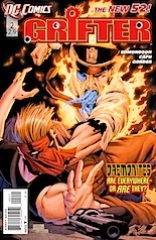
For most of the issue, Edmondson’s Grifter is just an alien conspiracy action thriller with the protagonist ludicrously wearing a bandana on his face.

As far as that genre goes, it’s fine. Cafu and Jason Gorder are a little off with some of the figure drawing, but not often, and it moves well. Edmondson’s not trying to reinvent the wheel, he’s just doing an action movie as a comic.

Until the end, when he gets into the stupid. Maybe his big reveal seemed like a good idea back when he was outlining the series to his editors, but it’s a terrible idea and the execution of it is even worse. Because it’s not an original idea; it’s been in some very famous Westerns. Edmondson had plenty of reference material for how to make it work successfully. Instead, he goes on his own.

And, with that failing, Grifter stops being amusing.

CREDITS

The Advantage Angle; writer, Nathan Edmondson; penciller, Cafu; inker, Jason Gorder; colorist, Andrew Dalhouse; letterer, Wes Abbott; editors, Katie Kubert and Bobbie Chase; publisher, DC Comics.

Grifter 1 (November 2011)

GRIF_Cv1.jpg
Grifter is not at all what I was expecting.

Well, I suppose I was expecting it to be bad and, while it’s not good, it’s far from bad. It’s actually reasonably interesting… even if the ending is stupid.

The protagonist—whoever came up with the name Cole Cash deserves an eye roll—is kidnapped by aliens and gets implanted or something.

It’s a lot like They Live, only the main character is a blond pretty boy so the property can get licensed. Actually, it’s just DC’s Gambit. It even takes place in New Orleans.

Now, the end is really dumb (how does this guy come up with a design for a mask in a graveyard… oops, sorry, spoiled that dramatic moment), but it’s not terrible.

Shockingly, I’m even curious to see how it turns out.

Maybe guy on the run story mixed with con artist story just appeal to me.

CREDITS

17 Minutes; writer, Nathan Edmondson; penciller, Cafu; inker, Jason Gorder; colorist, Andrew Dalhouse; letterer, Wes Abbott; editors, Katie Kubert and Bobbie Chase; publisher, DC Comics.

T.H.U.N.D.E.R. Agents (2011) #6

Ta06

Um. I don’t know if Spencer could have written an issue with less content. I mean… this thing is paced worse than one of those Ultimate Spider-Man’s where Peter just stares at a something for twenty pages.

The mission is over. Nothing is resolved with the twist from the last issue. In fact, Spencer just avoids it. The supporting cast all get two pages of useless story; none of them are active in those pages, which makes very little sense.

The female protagonist, Colleen, sort of takes over the book but for almost no reason. Whatever importance she has beyond being in charge, Spencer’s going to reveal later—he hints at it a little (there’s no backup artist this time, which doesn’t exactly hurt, but doesn’t help).

It’s like the whole issue exists on the presumption the reader will give it a pass for the previous ones being excellent.

T.H.U.N.D.E.R. Agents (2011) #5

Ta05

Yeah, I definitely think the longer first two issues spoiled me. Or maybe it’s just the position Spencer puts the reader in. After totally changing the status quo with the last cliffhanger, he changes it again this issue. Or at least he implies he didn’t totally change it like he suggested.

Maybe I’m just upset about the lack of fleshed out flashback sequences. The second issue spoiled me there. Here, it’s just a few pages of Ryan Sook and then no more….

It’s slick, computer colored Sook, but still Sook.

Spencer also introduces some of philosophy behind the villains–it’s kind of amusing, very hip and all, but it’s unclear how important it’s going to be.

The element of absurd humor is something new to the book; it’s still earnest and serious, but there’s now a knowing wink to Spencer’s writing.

He practically seems British (he’s not), commenting on American expectations.

T.H.U.N.D.E.R. Agents (2011) #4

Ta04

Now there’s a big surprise. Spencer was pretty cute the way he diverted attention from it; it works. Unfortunately, the issue is the first weak one in the series. Not because of the twist, but because backup artist George Perez apparently wasn’t hired to draw anything important.

Instead, Perez draws the T.H.U.N.D.E.R. orientation tour. It has nothing to do with the story itself. Maybe Spencer wanted to use it to distract the reader, but it’s not s good move. It’s suspicious. Like they wanted to have the Perez art whenever they could use it as a fill in.

Also, the twist leaves the series on somewhat unsteady ground. If Spencer’s messing with the reader about something so integral to the story so far… what’s next? There’s no point getting invested if anything goes.

It once again feels like an espionage thriller and not one set in the DC universe either

T.H.U.N.D.E.R. Agents (2011) #3

Ta03

Ah, here we go… Spencer has to deal with a regular length issue. He does well–the soft cliffhanger all of a sudden makes a lot of sense with the pacing. He’s going through the team’s first mission. Even though the issues focus on an agent, the handlers provide the continuity.

But this issue introduces an original agent (no idea if he was actually in the original series), one who resembles Dr. Manhattan in a lot of ways–and not just the blue skin. Also, is T.H.U.N.D.E.R. Agents out of regular DC continuity? Spencer’s writing suggests it isn’t set in a world of superheroes.

The flashback art by Howard Chaykin is some of his best work in years. It might be the colorist’s fault, but it all has this incredible sense of foreboding. It’s great–as is the present day, mainstream stuff.

Spencer does just fine with less pages; the issue works fine.

T.H.U.N.D.E.R. Agents (2011) #2

Ta02

Spencer does just fine with the pacing again. Of course, he’s got another over-sized issue.

This one concentrates on one of the agents, Lightning, who’s a disgraced Olympic runner. One assumes the T.H.U.N.D.E.R. organization did something to lead to that disgrace, but it’s never made clear. The protagonists—Toby and Colleen—continue their charming bickering. I wonder if Spencer called him Toby to make him seem youngish.

The art’s fantastic. Chriscross does really well on the non-mission art. His flashiness really works here; it’s not flashy and plastic like Cafu and Bit (who are still good, just very clearly Photoshop smooth). Chriscross’s flash is drawn flash. It brings real desperation to the character. Works out great.

There’s a good soft cliffhanger and Spencer comes up with a truly surprising drawback to superpowers. I wonder if he’s going to introduce one every issue.

The series is a pleasant surprise.

T.H.U.N.D.E.R. Agents (2011) #1

Ta01

Spencer does great with an oversized first issue, but I’m wondering how he’s going to be able to do his multilayered narrative in a regular length one.

While T.H.U.N.D.E.R. Agents seems pretty innocuous, it’s actually this spy thriller with double crosses and “Get Smart” references and some really good dialogue. Spencer sets it up with three layers… present day, twelve months before present and also eleven months before present. For a while, the confusing nature—Spencer’s introducing characters left and right; it isn’t until the end he reveals the reader only needs to track three of them for the time being—works against it. There’s a lot of action and Cafu and Bit do a fine job. It’s all very, very slick.

Then the protagonists get together and they immediately have great chemistry and everything sort of becomes clear.

It’s great. I can’t believe it’s a modern DC book, actually.