• Selected Declarations 22.01.25

    I don't know how well I can touch type on this iPad keyboard. Not particularly well based on the number of red squigglies. I forgot to write a Selected Declarations earlier, and now I'm getting the word count in before going to bed, up much later than I ought to be but also… I mean, I can count a nap as meditating and feel good about that classification.

    Missing a Selected Declarations post is intentionally low stress. Just make sure to do it later. The goal is the total for the year. I don't want too many rules for it, too many constraints, too many reasons to give up on it. Though I'm still not sure what first-person journaling is supposed to be doing for my writing. It's just a kind of writing I don't do anymore.

    Not sure if there's anything more to get from it, but I guess I'll find out.

    In other words, I'm still underwhelmed. Of all my blogging projects for 2022, this one is the least, and I'm including making new posts for old podcast episodes, which I already had from when the episodes were released; I just thought I should clean them out. So now I'm recreating. I find that project more amusing at this point. I'll also acknowledge I'm middle-of-the-night spite-writing to get in a word count.

    I'm not sure there's an enthusiastic way to free write on that subject.

    I did have a topic idea. One with a couple points even.

    Maybe there's space left for it. I finished reading Louisa May Alcott's Little Women the other day. I bought a copy in late 2019 or early 2020. I've meant to get back reading, but it's been a pain. Another 2022 reject off to a finer start than Selected Declarations.

    I was going to read Little Women before I started writing the unmentionable book project. Not for any specific reason, just something to get the writer synapses firing. Alas, the book did not get written, and Little Women remained unread.

    Until this month.

    And it turns out it was just what I would've wanted. Alcott's got excellent summary and transition devices. Totally could've aped those in drafting until I cracked them. And reading did almost immediately get me thinking bout writing. After two days of reading, I was taking notes on a writing project.

    Haven't made many notes about it since, but the initial interest is the big thing.

    I haven't had it for years.

    So, if I had written the book, Little Women would've been perfect. Though I'd have wanted to do the imperfect conclusion better than clotting did in Part Two of the novel.

    I started reading a paperback and finished with an ebook. With focus mode turned on and no distractions, the ebook on the phone was better reading.

  • Woman in the Dark (1934, Phil Rosen)

    Woman in the Dark is literally a movie from before they knew how to make movies like Woman in the Dark. The film’s also fairly obviously done on the cheap, and director Rosen doesn’t bring anything to it. But it’s a film noir story trapped in a Pre-Code romantic drama. For a while, it’s a road picture, and all of a sudden, the romantic drama works, but then the film reverts and never recovers.

    There are a few reasons it doesn’t work out. First, the suspense drama has a tepid finish, and then all outstanding story arcs get unceremoniously dropped. But mostly, it doesn’t work because Dark starts leveraging comic relief Roscoe Ates. And Ates is mildly amusing for a little while when he first shows up, but only because he’s got Ruth Gillette playing his suffering wife, who has to keep him in line.

    For the third act, Ates is solo and failing to get any humor out of his constant jokes. Some very slight restructuring and Dark could be Ates’s movie, which is a problem because he’s very much not the lead.

    Fay Wray gets top-billing; she’s the Woman in the Dark. But it’s more Ralph Bellamy’s movie. It opens with him getting out of prison on parole. He was in for manslaughter; he got into a bar fight defending the honor of Nell O’Day. O’Day is the sheriff’s daughter, which raises some parenting questions, but the sheriff–Granville Bates—is an asshole, so whatever.

    Also, there’s an age question. O’Day’s probably supposed to be eighteen or nineteen, which means she was a teenager when she caused the bar fight and so on. But, apparently, without causing any scandal either, as she’s a good girl, and Bates will do anything to defend her honor.

    Including harassing Bellamy after his release. Bellamy’s moved back home. It’s slightly important, but not really. With a bigger budget, maybe.

    Wray shows up on the run from Bellamy’s ritzy neighbor, Melvyn Douglas. Turns out rich guy Douglas is actually a big creep, and Wray wants nothing more to do with him. Bellamy offers to put her up—with O’Day around to de facto chaperone—only Douglas is going to take her back by conniving or force. It puts Bellamy in a bad position; he doesn’t want to punch anyone out and go back to the hoosegow, but Douglas and his sidekick Reed Brown Jr. are getting more and more intrusive.

    When Brown finally goes too far, and Bellamy intercedes, it’s almost immediately the worst-case scenario.

    Bellamy and Wray have to go on the run—hours after she first sought refuge with him—and there’s a nice road movie romance for the two of them. The film’s adapted from a Dashiell Hammett story, with screenplay credit to Sada Cowan and additional dialogue credits to Charles Williams and Marcy Klauber. One of those people included a subplot for Wray wanting a guy to respect her a little and not just paw at her. It’s sort of an unresolved arc, sort of not, but it’s a very interesting theme for a while.

    They end up in the city—presumably New York City, but it’s never made clear because of the budget—where they go to Bellamy’s old cellmate Ates for help. Things keep going wrong, and there are eventually a bunch of stakes; there’s the romance, there’s Bellamy going to jail, there’s Wray going to jail, then there’s someone potentially dying. It’s hectic. And it’s got a very perfunctory, very rushed conclusion, with Ates herding the narrative along.

    It’s a bummer.

    Okay performance from Bellamy, good performances from Wray and Douglas. Gillette, O’Day, and Brown are all fine. Ates is a goof. Oh, and Frank Otto’s good as Wray’s slimy lawyer.

    Woman in the Dark could be a lot worse; it does fail Wray and Bellamy, particularly Wray, whose character is more layered than the role needs. It should’ve been a better part for Wray, instead of evaporating for bad Ates gags.

    But it’s engaging enough for sixty-eight minutes.

  • The Stop Button Guide 60

    A collection of responses discussing the all four of the Marvel Cinematic Universe Phase Four feature films released in 2021: BLACK WIDOW, SHANG-CHI AND THE LEGEND OF THE TEN RINGS, ETERNALS, and SPIDER-MAN: NO WAY HOME.

  • Eternals (2021, Chloé Zhao)

    The nice thing about Eternals is the film’s most damaging element is obvious. Richard Madden is terrible. He’s not the lead—when Eternals has a lead, it’s Gemma Chan—but he’s top gun, so he gets a lot of screen time. And he’s terrible. What’s even funnier about Madden being terrible is the film leans into him being a “Game of Thrones” star. He’s got a love triangle with fellow “Game of Thrones” star Kit Harington, who’s ostensibly in the movie but really just for a handful of cameos.

    Harington is Chan’s adorable British boyfriend. Madden is her Scottish-accented alien super-being ex-husband. It’s a big flex when Harington and Madden face-off, and it’s clear not just Harington’s much better as a movie star than Madden, but Madden sucks the life out of scenes. He might be playing a Superman riff, but it’s an energy vampire Superman. He makes scenes worse. On the one hand, director Zhao can’t do anything with the performance, which has all the screen charisma of molded bread; on the other, she never compensates for it either.

    Eternals rises and falls with Madden.

    There are other big problems with the movie. It’s really boring for the first hour and a half. Eternals is solidly into the second act when it finally starts engaging. The film’s got a lot of expository information to dump, and every dump is a bad one. However, it manages to plod even more when it’s doing flashbacks.

    The film opens with a “Star Wars but serious” title crawl explaining the Eternals are alien super-beings who live on Earth to protect the people from the “Deviants.” There are giant space entities out there who make galaxies and blah blah blah. Doesn’t matter. The movie figures out how to integrate these beyond enormous entities once in the entire film, and it’s a gimmick shot done well. So, the giant entities don’t matter. The human-shaped super-beings matter.

    They show up on Earth in 5000 BCE. Madden immediately thinks Chan is cute; Chan immediately thinks Earth is charming. Salma Hayek is their leader, but she doesn’t really matter because she doesn’t have good fight scene powers. She’s a healer. Angelina Jolie’s the warrior one. Jolie gives the most amusing performance because she seems to get it more than anyone else. She’s stifling a smirk but still sincere when it counts.

    Like when she’s hanging out with best bro Ma Dong-seok. He’s another warrior, the one with the big heart. Ma’s good. He doesn’t have good comic timing—in English, he’s always had it in Korean–but neither does Zhao, so it doesn’t matter.

    The other Eternals are Kumail Nanjiani (laser fingers), Lia McHugh (illusion), Brian Tyree Henry (wills technology into existence), Lauren Ridloff (the speedster), and Barry Keoghan (the telepath). We meet them in the past, and then the film reintroduces them in the present when they’ve adjusted to regular human life. Albeit immortal regular human life.

    Nanjiani gets the biggest story; he’s a Bollywood star with an amusing videographer sidekick, Harish Patel. McHugh is forever an awkward tween girl with an impossible crush. Yawn. Henry is a family man trying to put immortal meddling behind him. He’s gay, an MCU first, and it’s okay, but he’s most charming with the family, and they rush through having the family around. Ridloff and Keoghan just kind of come into the narrative as needed, even though they’ve got more charm than anyone else. It’s particularly impressive because Keoghan’s character is a twerp.

    Bill Skarsgård plays the villain, an evolving man-beast. “Plays” meaning does the voice performance presumably some of the CGI modeling. The character eventually looks something like the monster from The Keep, which doesn’t seem intentional. Why recall one disaster in another.

    There are some nearly neat 2001 references but then not really.

    It’s unclear if fixing Eternals’s obvious problems would do any significant good. Besides Madden’s entire casting, there’s Chan’s lack of a protagonist arc, the momentum-killing flashbacks, Ramin Djawadi’s weak sauce epic movie score (just give up and hire Hans Zimmer for a Hans Zimmer score), and the awkward superhero references. Not just to the Marvel movies before it, but also to DC superheroes. Because world-building?

    It also doesn’t help one of the credits snippets promise a far more amusing sequel, which has a cameo with great promise.

    Zhao’s direction is fine. It’s often good. It’s never not fine. Ben Davis’s photography’s solid. There are a handful of composite shots where the foreground doesn’t match the CGI background, but it could be worse. Dylan Tichenor and Craig Wood’s editing’s good. Sammy Sheldon’s costumes. They’re all right.

    Eternals could be worse. Madden could be in it a second longer. And it might never be good, but it also could’ve been better. Score alone. Get someone who could do Madden’s acting for him with the music. Whatever. And it could also be a second shorter overall. Any shorter would help.

    Eternals is never really disappointing or even frustrating, just inconceivably tedious.

    But, if they deliver on the mid-credits promise, the next one should be a blast.

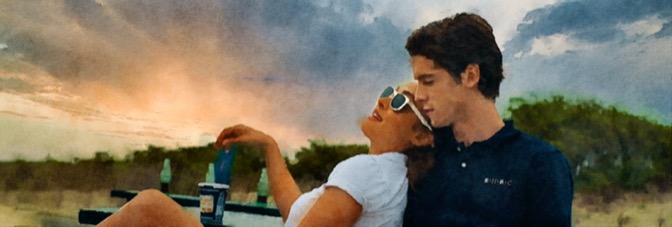
  • Summer Days, Summer Nights (2018, Edward Burns)

    Summer Days, Summer Nights never really has any “grabber” moments. It’s got a couple big misses, one I’ve got a lot to say about, the other would technically be a spoiler. If it weren’t also a total cop-out. The movie looks the cop-out in the eye and blinks, with writer, director, and costar Burns deciding to acknowledge the big miss he’s committing to making.

    Directing-wise, Burns does a fabulous job with Summer Days. The film takes place over Summer 1982 in resort-town Long Island. It’s on a budget, so Burns figures out all these great ways to showcase what he’s got to budget to include. There’s a big block party set-piece, and it’s beautifully done. Shame it comes at the end of the first act, and Burns never tries anything else anywhere near as complex or ambitious with the rest of the picture.

    It’s also where the soundtrack—with one exception, the movie’s got a great soundtrack—intentionally reminds of Fast Times at Ridgemont High and Summer Nights shows its hand a little much. Burns is doing an eighties teenager movie without any gratuitous sex or racism. There’s non-gratuitous sex, of course. But no racism of any kind. There aren’t any Black people. Lindsey Morgan and Anthony Ramos are Latinx. They’re it for people of color.

    There’s also no class privilege stuff, which is weird because it’s part of the setup.

    But Burns also isn’t doing a revisionist eighties teen sex comedy. Every female character in the movie proves her worth by having a boyfriend. Summer Days doesn’t just not pass Bechdel; it doesn’t even entertain the possibility it may. There’s even a terrible insert scene where Rita Volk cries to mom Susan Misner about how a boy likes her, and she likes him too, and it’s just not fair for some reason. Burns’s script is a series of romantic dramedy tropes. They never succeed, but sometimes the cast is likable enough, or the filmmaking’s solid enough; it doesn’t matter.

    Other times it matters. Especially with Volk’s arc.

    The film’s split between three couples. First, there’s protagonist Pico Alexander, playing the son of Burns’s character. They’re working-class, but Alexander only hangs out with the rich kids. When Summer starts, he’s planning on going to college to become a Wall Street tycoon, even though everyone tells him to be a writer. The writing thing isn’t important. It’s Burns’s biggest backstory cop-out. Right away, rich girl girlfriend Carly Brooke dumps him, and he soon finds summer romance with slightly older woman Morgan.

    Morgan tells him it’s just going to be a fling. We don’t find out anything about her backstory until the second half of the movie, despite her being the strongest female character.

    There’s just no time with the other arcs.

    Like Ramos and Caitlin Stasey. They were high school sweethearts, and she broke his heart. Fast forward seven years, she’s back in town. Now, neither Ramos nor Stasey have any personality outside this backstory, so they’ve got couple friends, Zoe Levin and Jon Rudnitsky, to keep their story busy. Levin and Rudnitsky are sort of Summer Days’s unsung heroes, right up until the third act when Burns forgets they were around. But Ramos and Stasey’s plot is a “will they or won’t they” one.

    Then again, so’s Volk’s arc with Amadeus Serafini. Serafini is Alexander’s cousin and staying with him and Burns for the summer. Burns sets Serafini up with a job at Misner’s dock, where daughter Volk also works. Volk’s sad her rich boy boyfriend left her for the summer, and Serafini’s got the hots for her because… she’s a girl, and he’s a boy. There’s no other story to them.

    Until we get to Serafini’s live music performance, which is kind of a surfer dude Bruce Springsteen song, only it’s a creepy, controlling stalker song about how Volk needs to get with Serafini, or her life is meaningless. He sings it to her in public. It’s a lot. Like, there’s a concept for a relationship there, but the movie does nothing with it. Instead, it’s just Serafini mooning soulfully at Volk about why she should love him back.

    Burns does seem to think the eighties setting and the decidedly strong production values are enough to get him a pass on all the lazy, shallow writing, but he is incorrect. They are not enough, mainly since his enthusiasm—directing-wise—for the eighties setting lessens after the first act and is immaterial by the third, except the occasional payphone.

    And the third act’s so dramatically inert, strong production values aren’t going to help.

    Best performances are Rudnitsky, Ramos, Stasey, and Levin. They kind of come in a bundle. Alexander and Morgan aren’t exactly good, but they’re very likable. They’re the most fun couple, thanks to that likability. Serafini and Volk are the worst. When he’s doing soulful surfer dude, Serafini almost makes it. When he’s weird creeper coworker, not so much. Volk’s got the worst part in the movie, and it’s kind of impressive she’s never terrible. She doesn’t have enough of a part to be bad; it’s a dreadful role.

    It’s pretty clear by the second act Burns doesn’t actually have anywhere to go with Summer Days, Summer Nights. But he knows how to get an hour and forty minutes out of that inertia. Unfortunately, ever-competent and often exquisite filmmaking isn’t enough to make the third act palatable.

    Even with lower and lower expectations, Summer Days, Summer Nights disappoints. It’s too bad. It looks phenomenal—William Rexer’s photography, Timothy J. Feeley’s editing, Stephen Beatrice’s production design, and Rosemary Lepre Forman’s costume design. They all do great work, as does Burns as far as directing.

    Shame Burns didn’t make the script worth the production or even actors.

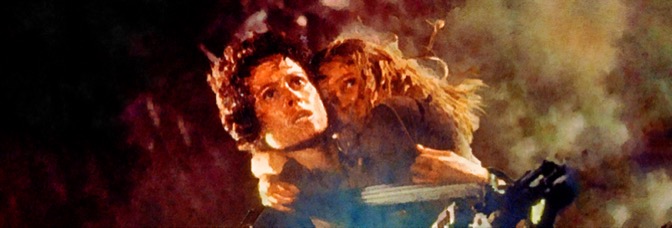
  • Aliens (1986, James Cameron)

    Thirty-six years after its release, recreating the original Aliens (albeit on home media) experience is difficult. Not only has there been a direct sequel, there have been multiple reboot sequels, and the extended, “special edition” version has been readily available for nineteen years now. I’m not ready for an Aliens canon deep-dive, but when did a much later sequel, they did it with details from the special edition.

    So it’s entirely possible to watch Aliens, the theatrical version—running a spry 137 minutes (the extended edition adds seventeen minutes)–in the context of what’s changed for the franchise since it was the traditional version of Aliens. Probably starting with thinking of Aliens as a franchise entry, not a sequel. I should also preface—I’ve seen Aliens a dozen times; I’ve seen the theatrical version thrice, including this time. “My” version is the special edition version.

    And I was worried it’d be hard to watch Aliens without that perspective getting in the way.

    Luckily, Aliens is not a vacillating memory, it’s a movie; once I stopped thinking about how the film works as a proto-old [man or woman] franchise—like Sigourney Weaver as a (mentally) more mature action hero, I was able to just let it play. Because Aliens is less about Weaver’s arc than I remembered. There’s one big missing character motivator in the theatrical version and it only changes the impact. Instead of Aliens leaning in on the motherhood allegory in the theatrical version, it’s about Weaver proving herself in an entirely different context than before. She’s still got a great arc with Carrie Henn, it’s just less the focus of the film. The focus is, of course, survival in extremely hostile, constantly worsening conditions.

    Aliens starts with an Alien epilogue. Weaver gets in trouble for blowing up her spaceship; they fire her. She ends up back on Earth in a shitty apartment, hanging out with the cat (the only other returning character), working a crap (compared to her previous position) job, and smoking too many cigarettes. She can’t convince the Company stooges to investigate her story, though she’s got an ally in self-described “okay guy” Company man Paul Reiser. Writer and director Cameron and Weaver do a very quick job setting up Weaver’s character, post-resolution. They start the development arc once Weaver wakes up—almost sixty years after she expected—when it’s unclear she’s going to get scapegoated, which runs one character development arc under another, not letting the subtle one through until the plot requires it.

    Then one day, Reiser shows up at Weaver’s door with a Marine lieutenant, William Hope. That planet no one believed Weaver about? They’ve lost contact with the colony. Reiser wants Weaver to come with him and Hope (and Hope’s Marines); just an observer, though. The Marines will have it. After some cajoling (and because otherwise it’s a very different movie), Weaver agrees and now Aliens proper is underway.

    For most of the runtime, Aliens never looks, sounds, or feels like an Alien sequel. Not in terms of the filmmaking. If it weren’t for the three hyper sleep scenes, it wouldn’t at all. There’s the opening, where Weaver—asleep in her pod—gets rescued. Then there’s the Marines waking up from their hyper sleep, which goes from feeling vaguely Alien to being very much Aliens. And then there’s another hyper sleep sequence where Cameron ties it back to the original even more. Though, stylistically—even when he’s doing the Alien reference—he often adds something to it. Something more akin to a 2001 reference, actually. There are a number of 2001 homages in the first act, but also Cameron doing something of his own. Aliens is a very thoughtful, thorough film. A verisimilitude achievement, requiring a lot of subtleties to navigate the film’s constraints. Even if the budget had been bigger, for instance, there were technological limits as far as creating the omnipresent special effects; Aliens is a special effects bonanza. And it’s all from scratch.

    The film occasionally will let Weaver’s observations determine a scene’s narrative distance. She’s seeing it new, the audience is seeing it new, also now the characters (the Marines) who are not seeing it new… they then get othered enough to become subjects. It’s one of Cameron’s neat narrative moves. He has a number of them, in addition to his neat directorial moves. The film’s chockfull of good moves.

    Aliens proper is the story of the Marines mission. They wake up, they banter and bicker, they find out in a briefing it’s an Alien sequel, then it’s basically down to the planet and the film never takes a break until the denouement. Aliens’s biggest chunk of runtime has a present action of maybe twenty-four hours, and short segues between the contiguous scenes. The film introduces ten supporting characters at the same time and requires you track them for the next two hours. It’s rushed but they’re rushed too. Got to get down to the planet.

    Once they’re on the planet and at the colony, the film changes gears again. Cameron’s done his take on Alien-style space travel, he’s done a back to Earth bit, but the colony’s something again. It’s a little bit of a Western, just one where they’re in high tech future rooms instead of an Old West town with a false front. And they’re on an alien world, which gives the characters no pause. With one exception—the space station in the first act—Cameron’s utterly devoid of wonderment when musing about the future and its strange new worlds. He never forces it to be grim and gritty though; it’s simply unimaginable it could be any other way.

    There’s some more setup in the second act with Weaver, Reiser, and the Marines finding out what’s going on with the aliens. They’ve also got to pick up Henn—a little girl who survives for weeks, hiding from the monsters in the vents. Aliens is all about the vents. Henn’s character started the still strong entertainment trope of lone survivor kid showing up to give some necessary exposition—the not-always Feral Kid—but Cameron isn’t craven here. He never treats Henn as functional, because he never makes any bad moves in the script. It’s such a good script.

    The Marines. There’s Hope as the lieutenant, but he’s new and doesn’t have any combat experience. One of the “funny” things about Aliens is realizing, even with third act twists, most of the problems are because Hope’s bad at his job. Al Matthews plays the sergeant. He’s more likable and memorable than good, but also he doesn’t have much he’s got to do. When he does have bigger moments, it’s usually to support someone else’s character development, like Michael Biehn. Biehn’s the corporal, he’s succinct not laconic, and kind of a Western hero. Biehn’s got the most interesting performance in the film because he’s the only one who defaults to trusting Weaver’s judgment. The movie’s often about the two of them problem-solving.

    In between shooting at alien monsters with acid blood.

    There are nine more Marines, but Bill Paxton and Jenette Goldstein are the most important ones. Paxton’s the wiseass who breaks under pressure and Goldstein’s the badass who doesn’t. Cameron’s got a really interesting approach with Paxton—he makes the other characters rein him in when he spirals and turns it into character development for all involved. It’s really effective.

    Of the Marines, only Biehn and Hope really get arcs. Paxton’s panicking always plays out in active scenes. Goldstein gets a little more character work than most but it’s about thirty seconds worth. Aliens is an action movie, after all.

    There aren’t any bad performances. Paxton gets the most tiring (but just imagine being under siege by aliens and stuck with him), but it’s never bad. Best performances are Weaver, Biehn, Reiser, Henn, and Lance Henriksen. Henriksen is the ship android who Weaver doesn’t trust because of the last movie. Cameron’s very obvious about their arc, which is the least of Weaver’s four character relationship arcs—Henn, Reiser, Biehn, then Henriksen–and makes sure every scene is excellent. The scenes are good showcases for Henriksen too.

    The whole movie’s a showcase for Weaver. Going back and fighting the monsters from her nightmare strips her to the id. It’s a great performance in what’s really just an action hero part. Weaver and Cameron make it seem like more, but it’s the performance and the direction.

    Lots of technical greats. James Horner’s music, Ray Lovejoy’s cutting, Peter Lamont’s production design, Emma Porteous’s costume design. Adrian Biddle’s photography is successful, competent, and good, but when Aliens betrays itself as a very grim, very gritty Flash Gordon serial, it’s usually because of Biddle’s lighting.

    The special effects are usually outstanding. There’s one bad composite shot—though Cameron directs the heck out of it—and some of the alien planet exteriors look too soundstage (Biddle’s lights). Otherwise, the effects are stellar. Including the slimy aliens, which is the most important part. Stan Winston does a singular job with the aliens.

    After the first act, Cameron’s direction tries to be more functional than flashy. It works. He asks a lot from the actors and they always deliver; it’s masterful action suspense.

    Thanks to Cameron, Weaver, and everyone else, Aliens is a resounding success. Special edition or theatrical version, it’s always spectacular.

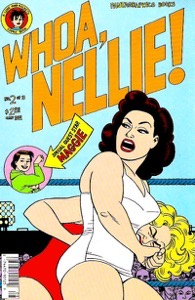
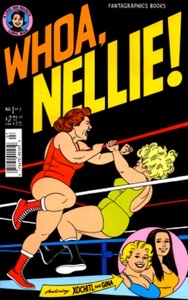
  • Whoa, Nellie! (1996) #2

    Whoa Nellie2

    While I wasn’t “worried” about Whoa, Nellie! last issue, I was concerned creator Jaime Hernandez didn’t have enough story, just the impulse to do a bunch of women’s wrestling art. After this issue, two of three, I’m very sad there’s not a fourth because Jaime gets the story going, and it’s good. He also brings back Maggie from Love and Rockets to support the issue but still acknowledges she’s still a protagonist. I could make a comparison to a television spin-off, but it’d distract from what Jaime actually does with Maggie here.

    The issue opens with backstory on Xochitl and Gina (finally). Xochitl was Gina’s babysitter, approximately ten years before Nellie! (and Rockets, because Gina being seventeen or eighteen puts a spin on things from that series too). They were great pals, and burgeoning artist Gina drew the duo as superheroes. Then one day, Xochitl wants to watch Aunt Vicki on the TV, and Gina gets a look at real-life lady superheroes. From there, Gina gets the idea they can be a wrestling team someday and sticks with it through to being a teenager, when they head off to Vicki’s training gym, where they become supporting cast in last big Maggie, well, Perla, story in Love and Rockets: Volume One.

    So Jaime gives all the contextualizing he needs to give. They’re a team; they’re lady superheroes; nothing can break them up.

    Except their first tag-team fight is a disaster, they get their butts kicked. Xochitl goes home to her family, Gina goes to high school, the mundane instead of the dreamed fantastic.

    Maggie (Perla) is visiting Aunt Vicki, who tells her the whole family history of wrestling—which, again, informs Love and Rockets: Volume One to a degree—and how Perla was supposed to be the next great wrestler. That destiny allows Jaime to do a page and a half Maggie daydream a la Rockets; he’s doing character development on the star of his last series, who isn’t a regular in this series. It’s very holistic.

    Because Vicki’s also got a character development arc. In fact, even though Gina and Xotichl have the action scenes—the wrestling—they’re not the focus. Vicki and Maggie sort of take over the comic, but all for Xotichl and Gina’s benefit. Maggie being there helps get Vicki to the character development precipice she’ll need to be in. If the comic’s going to be about Vicki’s expectations—or lack thereof—of Xotichl as the family wrestler successor.

    Something Xochitl doesn’t know anything about.

    It’s not a high drama comic. The wrestling’s pretty intense, but the combination family and vocational ambition drama—the stakes themselves aren’t high (yet), but the potential emotional repercussions for the characters is beaucoup. Jaime does a phenomenal job setting things up. I’ve got no doubt he can pull it off with just one more issue, but I still want more of this comic. It’s a delight. And has depth.

    The Gina and Xotichl backstory stuff is phenomenal. Like, Gina’s lady superhero observation riffs on Jaime’s entire oeuvre to this point. It’s really cool how this series echoes back to Rockets. It’s not a spin-off. It’s… well, I guess it’s a Love and Rockets comic book like the cover says.

    And, as usual, a darned good one.

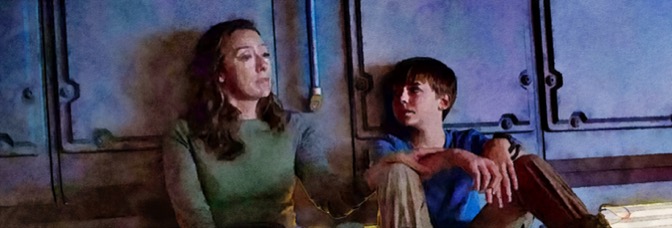
  • Lost in Space (2018) s02e10 – Ninety-Seven

    After spending most of the season away, this episode’s writing credit goes to reboot creators Matt Sazama and Burk Sharpless. I figured they were back to get the show in shape for season three, but I didn’t realize it’s all they were going to do. Sure, they spend fourteen minutes to resolve all the cliffhangers and themes from the last two or three episodes (including opening credits). But once Molly Parker and Toby Stephens stop the bad guy, the episode’s all about staying busy until the season cliffhanger.

    There’s a reasonably good action plotline involving dozens of robots trying to take back their warp drive. The episode teases the idea Maxwell Jenkins isn’t okay with Parker’s plan to vaporize all the robots—he says they’re intelligent beings, she says they’re not. But, as it plays… they’re kind of one-note villains, so she’s more right than wrong. There will be a big-budget rock’em sock’em robots sequence, and it looks excellent—Alex Graves does a good but indistinct job directing—but there’s no character there. Not even the vaguest implications. So, basically the old series Cylons? Only CGI.

    The mothership is once again in danger. This time from a robot alien fleet, and they only have two hours to get out of there. Two hours quickly because thirty minutes, as the show gets ready to set up season three. The script lays in heavy on the foreshadowing, too, possibly because the hook for next season is… well, a big change for the show. A potentially obnoxious big change for the show.

    The episode’s got some good acting from Parker Posey and Ignacio Serricchio. Taylor Russell’s arc is all about her being ready to be a grown-up, so it’d usually hinge on her acting. But it barely gets a focus—though Russell gets the only real arc, with even Jenkins (who’s got lots to do with robots) getting downgraded as the episode progresses. There’s just so much other stuff going on.

    For a season finale, it feels off. Between blowing off the resolution to the outstanding arcs and rushing into another crisis… I mean, I guess “Netflix Lost in Space” really is just “Battlestar Lost in Space,” or so it seems whenever it’s Sazama and Sharpless on the writing credit. Heck, the episode title, *Ninety-Seven*, is a “Battlestar” nod (or rip).

    The second season started much stronger than it finishes, even without the concept refresh for next season. The cast still—mostly—got it through, but there’s a lot of excess material in “Season Two,” which is particularly bad since most of the episodes ran forty minutes. They just didn’t have enough story. And no one seemed particularly invested in the story they did have.

    It’s a better episode than the worst in the season, but the next season teaser seems like it’s at best slowed the decline, not stopped it.

    The sci-if special effects are excellent, with Graves seeming to get the Star Wars feel of it. There’s also a nice Alien 3 nod. “Lost in Space” is still okay, just less so than before. And next season's setup is primed for a game of chicken with a shark tank.

  • Lost in Space (2018) s02e09 – Shell Game

    This episode may be the perfect example of “Lost in Space: Season Two.” It’s got a bunch of problems, and they’re all ginned up and exacerbated by the main cast. Mostly Toby Stephens and Molly Parker because they’re the parents. But this device—ignore an obvious problem and then act surprised when it becomes a dire situation—kind of sums up season two’s storytelling. When JJ Feild and Douglas Hodge joined the supporting cast as the eventual villains, “Space” had a chance to go somewhere.

    Instead, it keeps creating problems to delay any movement. If these were actual problems—which might have been what made the metal termite episode so good—it’d be one thing. But this episode’s all about how Parker Posey teams up with Hodge after Stephens pisses her off by dismissing her. Posey and Stephens were temporary pals—Stephens gave speeches about how he learned as a Navy Seal to lead people, but then it turned out he was full of shit as far as reading his comrades. Sure, Posey had the sads because she saw Nevis Unipan, the daughter of the guy she killed, but Stephens doesn’t know she’s a second-degree murderer; he just saw her in distress and ignored it. It’s not so much inconsistent characterization as lack of it. “Lost in Space: Season Two” lets the events dictate character, only there aren’t enough events, so the characters are spinning out.

    So Posey and Hodge are after the kids. Maxwell Jenkins and Mina Sundwall are going to help the robots, even if it means Hodge and Feild don’t get to torture the regular robot until a little later. Jenkins remains entirely obtuse to what’s going on around him, which would work if the show were from his perspective, but he’s not. He’s too befuddled to be functioning as well as he does here. Though it’s Sundwall and Taylor Russell who come up with the plans. Once the kids are all together, the episode works better, so it’s weird they keep the kids apart so much this season. The show refuses to play to its strengths.

    Feild, Hodge, and Posey are hunting the kids through the mothership while Stephens is out in space rescuing Parker. Except since Stephens didn’t do anything about Hodge being murderous last episode, Hodge has locked them out of the ship, and they’re going to run out of fuel and die in the gas giant together. There’s a bunch of busy sci-fi action tropes they go through while in orbit, but no heart to any of it. Director Stephen Surjik can do all the effects stuff. He just can’t pretend it matters.

    Things only go wrong at the end because of a character’s lack of, well, character and whether it can be overcome. It’s an episodes’ long C-plot at this point, and it was apparent from jump what needed to happen. But instead, the show moped along for four episodes just to get a drug-out finale before the season finale.

    If the show’s only got as much story for the season as it seems now… the meandering to get here hasn’t been worth it. There’ve been some nice moments for the actors this season—primarily Russell and Ignacio Serricchio (who’s unconscious this episode, apparently Hicks’ing for the grand finale)—but I’ll bet it finishes with the exact narrative stakes where it started with. There’s been no progress, just a bigger supporting cast.

    Fingers crossed I’m wrong.

  • Lost in Space (2018) s02e08 – Unknown

    There are a couple moments in this episode where characters could’ve easily gotten away saying, “That’s white of him” or, down a notch, “That’s not very cricket.” Once when Toby Stephens—who gets top-billing again in the irregularly included opening credits–is having his episode-long chitchat with newly revealed series villain Douglas Hodge. Hodge isn’t just the bad guy this season; he’s been the bad guy since before the show started, just in the background.

    Hodge isn’t bad. However, given the meatiness of the part, they could’ve cast better.

    At some point, he tells Stephens his evil plan, and it doesn’t really rile Stephens up too much because, you know, we’re all in the same country club or whatever. It comes off less as gentleman adversaries and more desperate stringing out of the story. Especially given Stephens was gung ho to confront female captain Sakina Jaffrey last episode.

    The other moment is when Maxwell Jenkins and the robot see some dudes torturing one of the other robots—who the show has already established is dying—and Jenkins can’t figure out why the robot’s not cool with it. Jenkins might’ve gotten taller, and his voice has started changing, but he’s really not doing much character developing. Though given it turns out “Lost in Space” is about humanity being, well, shitty humans….

    The main plot is about Molly Parker leading a mutiny against Jaffrey to save the survivors she and Hodge were going to strand on the planet. Jaffrey comes out of the episode looking all right, all things considered, but it’s because the episode skirts over her being okay with Hodge murdering her non-comms to get what he wants.

    Also, given the episode’s about Parker in a mutiny suspense drama, Stephens getting that top-billing again makes even less sense.

    Parker’s figured out a way to save the stranded survivors, which will require a very extensive effects sequence where she flies the mothership through a gas giant. There are reasons to fly through the gas giant, but they don’t matter as much as the fantastic sci-fi action sequences. The robot’s got a big part in helping with those sequences; Jenkins and Mina Sundwall tag along, mainly for Sundwall to explain to Jenkins and the audience how the robot’s behavior has subtly changed since last season. She thinks it’s going to be important. Jenkins thinks she’s a silly girl who doesn’t understand boys and their robots. Guess who’s right at the cliffhanger?

    Ignacio Serricchio gets a good, albeit contrived, plotline with his boss, Tattiawna Jones, as they end up suffering Hodge’s wrath. The episode tries really hard to imply Hodge is conflicted about his villainy, but it never comes off. Not sure if it’s the script—wait, I just realized it’s a Kari Drake episode without a saccharine family speech (she gets co-credit with Katherine Collins; maybe Collins cut it)—Jabbar Raisani’s direction, or Hodge. I’m leaning towards Hodge and the show’s general indifference to making him anything more than a stock villain.

    But the episode does look great, and the mutiny plot’s compelling. And the robot’s arc is good. Probably shouldn’t be the best arc, but whatever. It’s something. The only other character development arc is an unnecessary and forced one for Taylor Russell; Hodge gleefully (well, with muted enthusiasm, anyway) dishes on her mom Parker’s dirty deeds.

    Oh, and Parker Posey’s got a whole, not very good arc about how sometimes you can’t have a redemption arc.

  • Lost in Space (2018) s02e07 – Evolution

    Well, the robot’s back. Only took seven episodes. As Maxwell Jenkins teaches the robot how to care for horses, the episode flashback to JJ Feild’s intentions—cripple the robot and force it to fly the mothership to a new galaxy. Juxtaposed against the robot trying to tell Jenkins it’s not nice to subjugate other beings. And then Molly Parker’s around to… I don’t know; get in her screen time. She’s really had nothing to do for this particular arc, though I guess playing Jesus’s mom is a lot less demanding once Jesus gets his robot back.

    That whole plot—which has some good action sequences and solid character development (for the robot)—is about whether Feild will turn against his conniving superior, Douglas Hodge, and betray Jenkins and Parker. It’s reasonably effective throughout but not particularly interesting.

    Similarly, the plot on the mothership has Toby Stephens barging onto the bridge and telling off captain Sakina Jaffrey—she might be captain of the ship, but she doesn’t make decisions about his family without talking to him—then overhearing a mysterious message. He’s got to find out what he heard, so Stephens teams up with Parker Posey. They have a whole subplot about trust and fellowship and hacking. It’s Posey’s least interesting plot arc this season and probably Stephens’s most interesting one, outside of flashbacks.

    The rest of the cast—Taylor Russell, Mina Sundwall, Ignacio Serricchio—are all auxiliary. At least until the end, and the family gets back together for a big twist and a setup for the next multi-episode arc. Because it turns out Hodge and Feild don’t just have nefarious plans for the robot, they’ve got plans affecting the humans we care about too. Well, the humans the main cast cares about. It takes so long to uncover Hodge’s nefariousness… the entire regular cast has gotten safely aboard the mothership to get the next arc underway.

    Even with the suspense on the A-plot with Feild and the robot, it’s kind of a bridging episode. It’s a very active bridging episode, but that activity is busyness. Will Feild be revealed to be a scheming jerk, will Parker be revealed to be a scheming jerk—everything hinges on reveals because the episode’s got nothing else really going on.

    To some degree, the episode gets away with it thanks to Tim Southam’s direction. The occasional action sequences are good, regardless of playing like Jurassic Park meets City Slickers, and the robot’s arc is solid. If the episode weren’t so dependent on the reveal, it’d probably be solid for Posey and maybe even Stephens. Less Stephens. His outburst with Jaffrey doesn’t play well.

    Daniel McLellan gets the script credit.

    The episode’s functional and adequate, which isn’t exciting as a success or failure. Luckily, there’s Southam to make it occasionally seem exciting.

  • Lost in Space (2018) s02e06 – Severed

    JJ Feild is shaping up to be more likable than I was expecting, but also far flatter. “Lost in Space” shrugs through its male casting too much. He spends the episode being secretive about his plans if the robot-finding expedition is successful. He’s down on the planet with Molly Parker and Maxwell Jenkins, horseback riding to get to where the robot’s supposed to be. I’m not sure why horseback riding. Again, maybe someone demanded horses if they came back for season two. Otherwise, it’s just to drag out the episode and provide Western thrills. Western Jurassic Park thrills.

    And perfectly good ones. It's an outstanding episode despite Feild being too bland and the horses being a little much. Okay, fine, the whole Jenkins, Parker, and Feild arc isn’t the greatest stuff, but it’s okay, and the rest of the episode more than makes up for it.

    While the robot hunt is on the planet, there’s practically no other action on the planet; Taylor Russell and Toby Stephens don’t get any arcs this episode; they had their episode. Now it’s other folks’ turn, in this case, Mina Sundwall and Parker Posey.

    Sundwall and Posey are on the mothership where the metal-eating termites have gotten on board. The episode does a quick flashback to show how the termites got aboard when they made a big deal out of the mothership being safe a couple episodes ago. Then it’s go time, with the termites quickly feasting on the mothership and trapping Sundwall and Posey. Ajay Friese is there too—the combination stranded and besieged plot happens right after Friese helped Sundwall Nancy Drew last episode and Rob LaBelle as Sundwall and Friese's school teacher.

    They’re going to have a very dramatic arc where they face death and destruction multiple times, and characters have to do things they never thought they’d do. It’s a suspense storyline, and it’s excellent.

    Figuring into it is Ignacio Serricchio, who knows how to save the imperiled, but he’s having trouble convincing anyone to listen to him. It’s a particularly great episode for Serricchio, who’s also lost a lot of screen time this season, and an easy series best for Sundwall and Posey. They’re in mortal danger for extended periods; it’d be hard not for it to be series best.

    The robot hunt is fine. There’s a strange inertness to the scenes because Feild and Parker are usually just there to discuss simmering subplots for later or listen to Jenkins exposition dump on them. It’d work better with Jenkins alone, it’d work better with better music (“Lost in Space” can mimic Williams, but it can’t actually do good John Williams-esque from scratch), but it’s reasonably okay. This whole robot thing better pay off. Especially when the show noticeably struts in its non-robot plot lines.

    Fine writing, credited to Katherine Collins, and excellent direction from—of course—Tim Southam.

    It’s a swell episode.

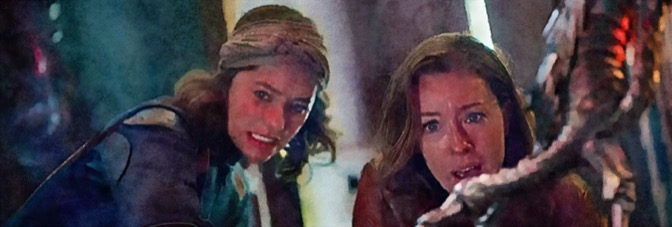
  • Legends of Tomorrow (2016) s07e08 – Paranoid Android

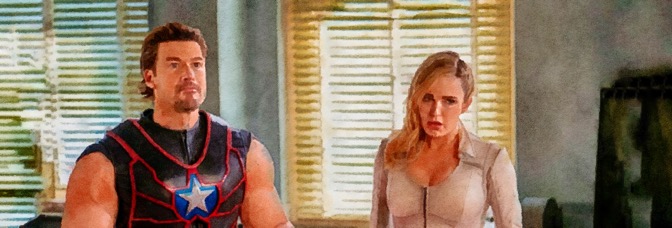
    Every once in a while, “Legends of Tomorrow” will do an episode reminding Caity Lotz isn’t just top-billed on the show or the captain (now co-captain) of the time ship; she’s also really the star. This episode is done from the perspective of the (presumably) android Lotz introduced in last episode’s cliffhanger. Rogue Waverider AI Gideon has created (presumably) android duplicates of the “Legends” to hunt down the human versions and stop them from screwing up history by helping people.

    The episode’s got opening titles setting up the new, evil team, and then there are appearance changes as well. Lotz is bustier in her android version, and Nick Zano has hilariously big arms because evil Gideon has a sense of humor. The other big change is Adam Tsekhman doesn’t appear in the episode, but his character’s alien form does. And this version likes eating people more than Tsekhman’s.

    The team feeds the alien the innocent people history demands they kill, and history demands they kill a lot of people. Their mission this episode is to clean up after the Chernobyl disaster. Not the actual disaster, but the disaster of the good Legends saving a bunch of people. So Shayan Sobhian and Lisseth Chavez delight in irradiating terrified people to death while Lotz wonders if good guys should act differently.

    When Lotz’s revised mission is to force Soviet general Ego Mikitas to lie to the citizenry about the Chernobyl threat being averted, he directly challenges her self-identification as the hero. A little investigating later, Lotz realizes there’s something else going on, and she especially can’t trust team doctor Jes Macallan.

    After the recap and the conclusion of the cliffhanger, the episode starts with Macallan mysteriously resurrecting dead teammates. Everyone notices it—Sobhian and Chavez don’t care thanks to bigger guns—and Lotz can convince Tala Ashe to think differently.

    It gives Ashe something more to do? She and Lotz don’t get to team up much anymore, and Ashe has been playing a different version of her character for a couple seasons, so bringing her back to the norm and then doing a Stepford riff on it has a lot of layers for Ashe to work with. Plus, there’s a lot of humor to the new characterization; it’s a dark episode, so the gags help. Zano’s goofy arms are worth at least a smile every time (and they’ve got an excellent spoof commercial tying into another DC property).

    The finale’s depressing and raises some questions about how time travel adventuring shows work in general—but for a done-in-one concept episode. Lotz gets to do a good arc.

  • Lost in Space (2018) s02e05 – Run

    It’s nearly a concept episode of “Lost in Space.” John Robinson (Toby Stephens) is stuck at the bottom of a mine shaft, injured, without medical attention. Daughter Judy Robinson (Taylor Russell) is racing to get to him but her SUV breaks down. They’re on an alien planet and there are metal termites. She’s going to have to run for it. Along the way, there are flashbacks establishing their relationship together before Stephens went and pissed everyone off by re-upping in the Navy.

    There’s the additional detail Russell isn’t Stephens’ biological daughter, which has the constant visual reminder Russell’s Black and Stephens is such a ginger you can see him getting a sunburn during scenes with overcast skies. Russell being Black doesn’t figure into the story at all—“Lost in Space”’s future Earth has its problems but apparently they got institutionalized racism licked—and being his step-kid barely matters. There are some good implications related to it—eventually—but the show never explicitly states them. They’re just character backstory for Russell.

    It’s a good A-plot. Derivative as all hell—Russell runs into raptors in the desert and has some Jurassic Park adventures, before finding herself in a Tomb Raider level and having to jump between rock outcroppings to beat the level. But Russell’s good and Stephens’s closer to it than ever before.

    Though it’s hard to imagine a similar episode with his biological kids—Maxwell Jenkins and Mina Sundwall—possibly because the show reduced their character depths this season.

    Jenkins’s subplot this episode is going to get his robot with mom Molly Parker and slightly ominous company man JJ Feild. Their subplot is mostly notable because the show again leans in on the space-campers everyone zooms around in looking like the Millennium Falcon.

    Sundwall has a Nancy Drew subplot following Parker Posey around the mothership. Sundwall wants to know what Posey’s scheming and has to enlist the aid of not boyfriend Ajay Friese. They too find themselves in a Star Wars “homage.” If it were any director besides Jon East, there wouldn’t be quotation marks. With East, however, I’m not sure he gets it.

    Vivian Lee has the script credit. Besides the Jenkins subplot, everything’s solid. Sundwall and Friese are fun together and the Nancy Drewing does give Sundwall some personality, which has been lacking lately. Russell and Stephens’s A-plot is really effective, mostly thanks to Russell (and the writing). It’s also where the special effects break down again, just like last episode. The CGI team must’ve been in a hurry; or just couldn’t figure out sand.

    There’s a good cliffhanger too.

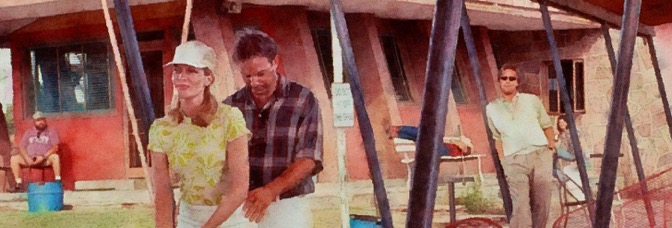
  • Tin Cup (1996, Ron Shelton)

    Tin Cup’s got very few problems. It’s just a romantic comedy about a ne’er-do-well golf pro who decides to improve himself to impress his rival’s girlfriend. There’s a little more nuance to it, but not much. Kevin Costner plays the hero, Rene Russo plays the love interest, Don Johnson plays the other guy. Because all the cast members are in their forties, Tin Cup has a little more sophisticated air. Costner’s old enough to have become a would-be golf sage. Russo’s got a grown-up backstory with a lot of implications. Johnson… well, Johnson’s sort of ageless. The part’s a caricature, but it’s caricature Johnson passively exudes, so every utterance is a revelation of asshole.

    But he’s not a great villain. He’s too likable. The movie gets away with it thanks to the cast’s charm, but it does sort of reduce the dramatic impact of Costner’s wooing Russo. There are a couple places in Cup where they avoid a topic or skip a thing because otherwise, it’d get too heavy. If it ever gets too weighty, it’s time to move on. Costner’s got a lot of West Texas golf pro zen monologues about golf to make, and those are funny and successful because Costner turns on the sincerity for a gag. But if you actually have to think about him—he’s basically an immature, lovable jackass who gets by thanks to innate intelligence and being good-looking and charming like a movie star. Costner’s against type partly because most of it requires a scrub, not a movie star.

    What’s strange is the film leans into being more comedic in the first act and then dumbs it in the second. The third act is a sports movie and a good one, albeit a low-stakes one. Director Shelton goes out of his way to showcase Russo’s comedic ability, only for her to not be in the movie enough in the second act for them to matter. Once the sports story starts, Russo’s demoted, but she also gets a lot less comedy. So when she’s with Cheech Marin—who plays Costner’s best friend, caddy, sidekick, and conscience—it’s fantastic because she gets to have fun.

    It’s when she’s not Johnson’s girlfriend; it’s when she’s got agency.

    But most of Tin Cup’s problems resolve themselves, and a couple become strengths. For better or worse, demoting Russo in the second act changes the impact of the third on Costner, making him a fuller character and giving the dramatic sports finish even more gravitas. Shelton’s got a problem with changing the tone for it; it gets more serious—real golfers are cameoing now—and almost all the jokes are gone. But it also makes the third act stand alone and special. Tin Cup’s an exquisitely produced film.

    For the most part.

    It has what I assume is a 1996 Top 40s Country-Western soundtrack. Shelton seems to try to cover for the pointless tracks with on-the-nose tracks (there are golf country songs), but the music doesn’t fit the characters. At times we’re supposed to think Kevin Costner is listening to these songs on his Walkman. Or at least the songs are playing, and Costner is inexplicably wearing a Walkman like he lost a bet to a guy at Sony, so maybe he’s listening to them? It seems more like he’d be listening to books on tape—for the character at his place in the movie, even if it were a golf book—but Costner gets zero self-improvement.

    Tin Cup is about being so special at one thing, you never have to say you’re sorry for anything else.

    Wow; sort of a metaphor for how the movie can still be good with that lousy soundtrack. William Ross does the score, and it’s okay—it really comes in for the sports finale, but then it’s basically just Hoosiers music—so I don’t know if he’d have brought enough personality. But the movie begs for a good score versus lousy songs.

    Though there’s a Chris Isaak song where you realize Costner’s mooning over Russo isn’t as dramatic or romantic as the song, which then makes it too serious for a moment. It’s an interesting glimpse into the movie being done straight dramatic.

    And the last song isn’t not catchy. The sex scene song, however, is grating. Though the sex scenes themselves are a little pointless. So, regular romantic comedy problems, but with a good cast and a fine production. And a terrible, worst kind of media conglomerate synergy soundtrack.

    All the performances are good with asterisks. Russo’s excellent in the first act until she gets reduced to girlfriend in the second act. Johnson’s outstanding, but it’s a thin part. Costner’s successful, but it’s hard not to be successful when the movie’s about your character never actually being wrong and usually quite the opposite. He’s a little loose on the more comedic—Marin’s there to pick up the slack—but he’s got the sincerity. And when scenes do go wrong, it’s not Costner’s fault. It’s the soundtrack.

    Tin Cup’s a mostly delightful nineties romantic comedy. One’s mileage may vary with the soundtrack—even if you like the songs, they’re pointless selections. Costner, Russo, Marin, and Johnson are a fine team. Linda Hart’s good as Costner’s ex.

    It’s a good time.


  • Whoa, Nellie! (1996) #1

    Whoa Nellie01

    Whoa, Nellie, one issue in, is just a Love and Rockets spin-off. There’s nothing wrong with it being “just” a spin-off; creator Jaime Hernandez has a great time with the wrestling scenes. The comic’s about would-be tag team women’s professional wrestlers Xochitl and Gina Bravo. They’re wrestler’s professional wrestlers; they’re just not a tag team. They fight each other. And Gina’s better. But she wants to do the tag team thing and refuses to give up on Xochitl.

    Xochitl’s aunt, Vicki Glori, manages them. She wants Gina to do better and tries to engineer a path forward for Gina without Xochitl. Only Gina doesn’t want to do it. The biggest twist in the comic is when Vicki’s supposed to fight Gina—and elevate her—and instead has to fight Xochitl.

    There’s some character material with Xochitl, who’s married with kids, and her kids don’t understand how wrestling works as far as the good and bad wrestlers. It drives a couple fun scenes. Vicki’s also got her character arc about being forced to betray niece Xochtil in favor of Gina. Gina doesn’t have much to do other than be a good friend to Xochitl.

    Gina and Xochtil came into Love and Rockets relatively late in the series, and both had their initial story arcs mostly resolve (as I recall).

    Jaime’s favorite material is clearly the wrestling matches, a combination of “realistic” (for wrestling) and comic strip pacing. He sets up sight gags, follows through, sets up some more. It’s a lot of fun and has a great pace. Doesn’t have any real drama so far—even with Xochitl and Gina getting in over their heads for the finale—but it’s really… nice. Even if you aren’t pre-inclined to a Love and Rockets spin-off, it’s about being good friends and trying to be a good mom and so on. There’s no malice, despite the chair-breaking wrestling matches. It’s very easy to like the characters and sympathize with them. Though, I suppose Vicki might seem like the villain unless you know her history.

    But only might. Jaime gives her the most character development drama in her arc.

    It’s a delightful read. Kind of slight so far, but also, who cares. The art’s great, with Jaime’s fun and enthusiasm welcome to the reader as well. The matches are great action. Yay, Nellie!.

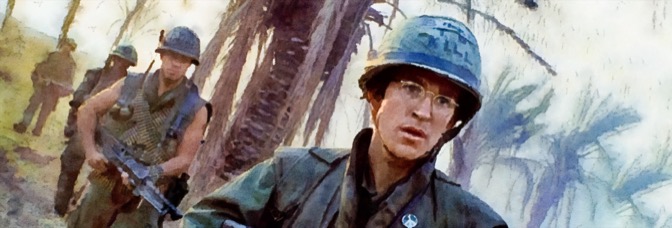
  • Full Metal Jacket (1987, Stanley Kubrick)

    Full Metal Jacket is a film of big swings. Director and co-writer Kubrick hits them all. The three most prominent are the structure, the character study, and the whole arc. The structure and arc are different because the film's got two distinct sections. Minutes one to forty-five or so is a "We're in the Marines Now!," anti-propaganda picture slash character examination (not study), and the rest is a "Week in the Life" picture, just for Marines in 1968 Vietnam.

    That rest is split into two parts, a survey of the Vietnam War through the very focused eyes of Marine "Stars and Stripes" reporter and then an impossibly taut war action sequence for the third act. Both parts share a narrator: Matthew Modine. And Modine's the protagonist, in a traditional sense. The story follows Modine from boot camp and his experiences there to Vietnam and his experiences there. Modine passively brings the new characters into the film, with Kubrick often—gently—shifting the narrative focus to follow another character for a while here and there. Or maybe Kubrick just makes Modine too good an observer, and personalities take over the focus.

    It's precise pacing, plotting, and cutting. For a while, in the first twenty minutes or so, Kubrick even allows the film to be playful. Always serious, but there will be a particular cut during a specific pop song, and it's just to create a positive coincidence. Because the first half of the film is harrowing. Modine and his fellow recruits suffer under their drill instructor, R. Lee Ermey, for their eight weeks in boot camp, without any character development for the recruits outside their training. At the very end, there's a tie-in reveal for Modine, which sets him up for the second half, but it's the last few minutes. Otherwise, behaviors inform Modine's character, not exposition. So we're watching him and seeing the character change without knowing where he's starting. Same for Arliss Howard, who gets some minor reveals in the second half, giving his personal arc a little more tragic vibe. And, then, of course, for Vincent D'Onofrio.

    The first half of Full Metal Jacket is about D'Onofrio not doing well during training, Ermey abusing him, and how it affects the other recruits. Except for his inclusion in the opening montage of guys getting their buzz cuts, Jacket will only show D'Onofrio from other characters' perspectives, whether in scene or through editing, until the last ten minutes of part one. We see how other people see D'Onofrio, and Kubrick only ever allows the briefest peek along the way.

    Ermey assigns D'Onofrio to Modine because Modine's a smart-mouth, making Modine responsible for D'Onofrio's success. And D'Onofrio does succeed (for a while), and Kubrick shows all the working to those successes in montage. He only shows the most objective scenes, just subjectively selects them, which actually sums up the film overall as far as style. The film moves over the existing narrative, pausing for specific events, ignoring almost all others. Because there's room for more traditional character development, Kubrick just doesn't want it there.

    When the film reintroduces Modine in part two, now in Vietnam and reasonably successful as a "Stars and Stripes" reporter, reestablishing the ground situation includes information not revealed in the first half. The film held back the information to let Modine's physical performance inform the later reveal. It's so good. Kubrick and company's character work in the second half is phenomenal and completely different from in part one.

    Modine's sympathetic in part one, funny in part one; he's not likable until part two. Because it doesn't matter if he's likable. Even after he's likable.

    Part two has Modine and new sidekick Kevyn Major Howard on assignment in the war zone just after the Tet Offensive. There are no history lessons in Full Metal Jacket, with the film skimming over Modine trying to get boss John Terry to cover rumors about it and Terry blowing him off. There's no "ah-ha" moment. There are never insight moments for Modine. Even when he gets interviewed for the news back home. The other characters reveal something. Modine doesn't.

    There's also a short, superior Tet Offensive war movie sequence, which ought to be having significant effects on Modine, but Kubrick won't show it. The protagonist and narrator is a mystery as far as details. But they don't matter because even with more exposition and details, Kubrick focuses on the physical performances, not the dialogue exchanges.

    Modine and Howard meet up with Howard, now in the infantry, and tag along with his squad. The squad gets an introduction sequence, with Dorian Harewood and Adam Baldwin being the most prominent. Baldwin's a loud-mouth racist, and Harewood's his Black best friend. There's a lot of racism on display in Full Metal Jacket, even as the characters explain they just hate everyone. One of the themes is how some of them figure out why that equation doesn't work, though only for the Asian Vietnamese, not their Black compatriots. It's simultaneously a defect and just more character development.

    The third act is Modine and the squad on patrol. It's very third act—almost epilogue—and spectacular action filmmaking. Kubrick does this whole thing with the sunset and tying it back to other night scenes (there are only a few). But just superb direction. And cutting and lighting and sound and so on.

    And the music. Wow, the music. Vivian Kubrick (with a pseudonym) does the music. There's not a lot of it, but it's exceptionally well-done. The pop music soundtrack's great too, with Kubrick letting himself have a little fun for the end credits in particular.

    Incredible photography from Douglas Milsome, production design from Anton First. Martin Hunter's editing is actually divine. He makes some peerless cuts in Jacket. Kubrick's direction is always great. It's a spectacular well-made motion picture, as well as a superlative one overall.

    The best acting is D'Onofrio. There are some really good short performances, and the main cast for part two is all excellent. Ed O'Ross, Kieron Jecchinis, and Bruce Boa all get single standout scenes. They may be in more of the movie, but they get single spotlights. Main players get more—Modine, Baldwin, Harewood, then two Howards (no relation).

    In the first half, Ermey's great too. It's hard to describe how Ermey exists in the film. Like everyone else, he's a caricature, but not. Broadly put, he's more a force of nature than anything else, but he's also very much not. Not even when Kubrick could use him like one. D'Onofrio's the best performance, but Ermey's the best-directed performance. Kubrick does something really singular with Ermey.

    Full Metal Jacket's great. It's never not unpleasant, but also never not exceptional.

  • 709 Meridian – 1×3 – Halloween: The Curse of Michael Myers (1995)

    Halloween: The Curse of Michael Myers (1995) 709 Meridian

    An audio commentary for the 1995 film, Halloween: The Curse of Michael Myers, directed by Joe Chappelle, starring Donald Pleasence, Paul (Stephen) Rudd, Marianne Hagan, Mitchell Ryan, Kim Darby, and J.C. Brandy as Jamie Lloyd.

    WHERE TO LISTEN

    Apple Podcasts
    Google Podcasts
    Spotify
    Stitcher
    RSS
  • The Stop Button Guide 59

    A collection of film responses discussing the fifteen Showa Era GODZILLA movies, starting with the 1954 GODZILLA, directed by Ishiro Honda, and concluding with 1975's TERROR OF MECHAGODZILLA, also directed by Honda. Includes a feature essay discussing the franchise. Discusses the original Japanese language versions of all fifteen entries, as well as two responses discussing English dubbed versions (including 1956's GODZILLA, KING OF MONSTERS!, starring Raymond Burr).

  • Selected Declarations 22.01.15

    It doesn’t feel right to do a Stop Button Martin Luther King Jr. Day post, so the week’s Selected Declaration will be early. I don’t not have a relevant post; I just don’t have the confidence in it. I’d have to draft, consider, read, reread. I’d take it seriously. And it’s too late for The Stop Button to be serious writing. There was a point where I was going to add cats somehow. Maybe not for a long moment, but it was a to-do item. Less about the site getting cat-hits and more about those darn cats contributing.

    It’s been a way too productive day, involving milk paint and… well, okay, I did sleep until almost noon, but I got some dishes done too. I also figured out a combination of long-term to-do structure and text management system in Craft. I was listening to the “Connected” podcast (so it’s bold for blogs, blog column titles, and applications, then quotation marks for podcasts).

    I don’t do a Stop Button style guide because there’s so little consistency over the years. There’s no consistency other than italics for film titles and probably bold for comics. Worse, I think there are blog posts where I make remarks deciding on style choices and very much have not. So a consistent style guide is too much. It’s also obnoxious. It would be obnoxious to make one and not in a funny way.

    I’m excited about this new system. It’s a stovetop analogy, four burners, then simmer, where active material goes. It’s a living document, as it were. Yuck.

    But having it organized in documents and subdocuments means widgets and shortcuts on all the devices. And maybe even keyboard shortcuts. It’s very weird using a good computer during the workday after years of being stuck on a Dell. Gets me way too interested in productivity. Especially since my goal with Craft is to have the perfect bullet journal without having actual paper or digital skeuomorphism. I don’t have the fine motor to doodle up a paper bullet journal; I want the rush of completion and accessible writing space… Experience over interface.

    Of course, I’ve only been using this new system for three hours, and most of my daily Craft usage is the calendar.
    I’m still taking it as an accomplishment for a lazy Saturday. It’s been a while since I’ve had a free Saturday off. Usually, there’s a reason I’m taking it off, task or travel. So just a Saturday off? Albeit one in the middle of a pandemic where I don’t want to go get the paint additive I need because I’m profiling antique malls as anti-mask and so have to delay parts of my home office project until a new kind of paint arrives in the mail. But a Saturday off.

    It also might just be neighborhood kids playing.

  • Lost in Space (2018) s02e04 – Scarecrow

    Since this episode doesn’t have the opening titles, I spent the entire thing terrified Leslie Hope directed it too (she did the excellent job last episode), and that goodness was somehow a fluke. Nope, those intolerable, endless, pointless low-angle shots are courtesy director Jon East. It’s the worst direction on the show ever. I should’ve been satisfied with the middling.

    Also concerning is the script. Kari Drake gets the credit, and, Writers Guild procedures aside, her name’s been on enough of them to foreshadow. There’s going to be a really trite scene between family members where they talk in less than soap opera platitudes. In this episode, it will be Molly Parker and Maxwell Jenkins. She’s just discovered him doing something she didn’t want him to do, but then the experience makes her realize with great power comes great responsibility. She tells him a context-free story about her mom like it resonates outside the platitudes. It does not.

    Parker’s one of the show’s sturdiest actors. She can handle what it throws at her. But even she’s “Lost” in this nonsense.

    The family’s been rescued by the mothership, which is no longer abandoned because Parker and Toby Stephens have seen Alien 3 and figured out how to contain the enslaved alien life-form humanity’s been using as a ferry driver across the galaxy. I expected the show to get into how beating and torturing an alien, even if it’s a scary metal alien, is wrong, but not really. New guy—combination roboticist and espionage-type—JJ Feild is very sad about all the torturing he had to do. There’s this interminable shot of him moping after watching Jenkins just, like, talk to the robot sincerely and get a better response for a while. I kept waiting for there to be a reveal—and there’s a bit of one—but the point is Feild’s super-sad about having tortured the alien for years.

    Those developments all come in the last third of the episode. It doesn’t really have acts—there’s a reveal cliffhanger involving the robot, ignoring Stephens being in actual dire danger—but the first third is about the Robinson family not being special once they get back to the mothership. Other than Jenkins, who everyone whispers about. Really hoping they’re not going to do a messiah arc. Not as much as I hope they keep Ignacio Serricchio and Taylor Russell platonic, but second only to that one.

    Parker helps the other space-camper moms organize wires; Mina Sundwall just hangs out, Jenkins is supposed to be chilling too, but he’s intrepid. Russell, Stephens, and Serricchio all get put to work on the desert planet where they’ve been camping out. We get to see Russell and Serricchio in their daily lives—she’s just a medical student again; he’s just one of many mechanics again. No one cares they galavanted across the galaxy.

    Stephens gets grunt work but at least reconnects with Raza Jaffrey (who finally gets to be charming) and Sibongile Mlambo (who finally gets to be sympathetic) before ending up in danger because the colonists aren’t thorough like his family would have been.

    Parker Posey’s got a machinations plotline involving getting out of trouble. It’s pat but necessary.

    The episode also features some weak special effects, and the new supporting actors, outside Feild, are often wanting.

    It’s probably the worst episode? I can’t think of anything comparable. It’s not an easy episode—inserting the cast back into their previously unexplored (outside flashback flashes) mundane existence. Doesn’t help East’s direction is bewildering and bad, or the script is trite whenever it tries to be sincere.

  • The Equalizer (2021) s02e09 – Bout That Life

    How does “The Equalizer” deal with Chris Noth’s permanent absence? It’s like he was never there. He’s heavily featured in the recap because he got Adam Goldberg out of federal prison, then nothing. He was also supposed to be mentoring teenage Laya DeLeon Hayes, who was conspicuously absent from Noth’s last episode. I kind of thought they’d kill him off offscreen somehow, though I suppose they still can.

    It’s just weird to have Goldberg, Liza Lapira, and Queen Latifah standing around talking about Goldberg’s release and the conditions and never mentioning Noth’s character’s involvement.

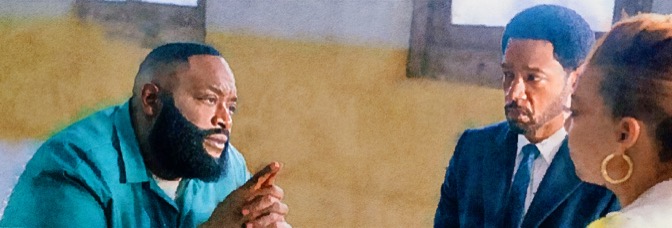
    The A-plot this episode is Latifah and Tory Kittles investigating a rap war. It’s not really a very “Equalizer” plot, more a whodunit procedural. Rick Ross is in prison for killing his rival, then a track drops with details only the killer could know. The acting on the arc is fine; it’s just really rote. The episode’s script credit goes to Jamila Daniel, her first on the series (she started as a producer for Noth’s recent showcase episode), and it feels more like a cop show’s drawer script.

    There is a relatively neat little scene with Latifah talking to a teenage female rapper, Lucky Ray, about the craft. It’s cute and hits a little bit more sincerely than the rest of the episode. Even if Latifah’s character here is not, you know, Queen Latifah. I’m still bummed she’s not Edward Woodward’s daughter from the original.

    Anyway.

    There’s a connected subplot about how Lapira needs to do the computer stuff because they’re going to Guantanamo Goldberg if he ever touches a keyboard again. Except she hates taking his directions, and he thinks she’s incapable of taking them. It’s a new facet to their relationship and seems to be there so someone can turn them into a “the straights aren’t okay” meme. They spend the whole time hating each other, with weird details like Lapira’s bar—on top of Goldberg’s now-off limits underground lair—has bad Wi-Fi, which seems completely unbelievable.

    The family plot is Hayes bringing home a boy, Nathaniel Logan McIntyre, who’s appropriate in all the ways—even if he’s from a poor family (straight-A student)—he just doesn’t want to go to college. It’s a peculiar arc, with some cringe “student debt is worth it” monologuing from both Hayes and Lorraine Toussaint, but when McIntyre gets to soapbox to present his side, it’s mostly well-done.

    Eric Laneuville directs. It’s way too classy direction for what the episode needs. Most of the actors can keep up, and Laneuville does really well with Ross’s family on the outside, wife Narci Regina, sons Maxwell Whittington-Cooper, and Jordan Aaron Hall. Whittington-Cooper is probably the best performance in the procedural arc. The character development just doesn’t go anyway since it’s a whodunit.

    The finale presses a reset on the series. Not sure they Thanos snap Noth out of continuity, but they definitely are done with the Goldberg in jeopardy plot. Hopefully, they do something with the refresh besides more bland cop show scripts.

  • Birdland (1994) #1

    319830

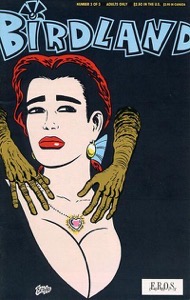
    Birdland Volume Two is a comic for all the people who thought Gilbert Hernandez couldn’t do an entire issue of people screwing and still have it land with some kind of deeper impact. The last series ended winking at profundity, and the mood cares into this issue. Beto opens the comic the dawn of time, zooming in to Earth, where a couple dinosaurs are getting it on, and you find out what a T-Rex with a dong looks like.

    Thanks, Beto.

    Nearby, a couple of cave people get it on, then they become another set of people—straight to the modern age, Beto doesn’t keep with it and go through all three ages–and then another set of people and another set of people and so on. There are scenes in the psychiatrist’s office and a different doctor using the magic necklace from the last series. Fritz’s horny hypnotizer or whatever.

    The new psychiatrist might be a Palomar or Luba, like, she looks familiar. But all of Beto’s beefcakes and cheesecakes look the same, just with different hairstyles and bra sizes, so keeping track of the many participants would be time-consuming and not really worth the effort. Because the story’s got nothing to do with them. Beto goes an entirely different route—taking a healthy jaunt through what appears to be a tie-in to the finale of the previous series—and ends up on a simple, visually evocative (but not at all pornographic) epilogue.

    Thanks to the route, the ending’s more than fine; it’s nice. It helps the art’s phenomenal on the two or three panels. It’s like Beto wanted to show he could still deliver concisely after spending an issue of bombastic pornography. He’s even figured out how to make it ambitious, having one sequence where everyone morphs into their partner mid-coitus, and the visuals on the transformations are excellent.

    Bang Bang has a future story, which means sex, spacesuits, and rocket ships. The whole thing plays like a musical montage, and only Beto knows the exact music. It seems like there’d be a lot of chanting, actually. He tries to make it audial with one of his art devices. It’s actually kind of interesting.

    Like, if the first volume had been done the same way, it wouldn’t have needed three issues or so many non-sex scenes.

    The first volume was a curiosity. This (twenty-eight years and counting) single issue volume is closer to being worth a look for, pardon the expression, art wanks.

  • Lost in Space (2018) s02e03 – Echoes

    After the casual nod here and there—the “hub” in the space-camper looks a lot like the Alien mess hall—this episode goes all-in on the Aliens homage, complete with a little girl (Nevis Unipan) surviving on her own for months and months with aliens out to eat her. Leslie Hope directs the episode. It’s excellent suspense direction. The flashback stuff with Parker Posey, explaining her backstory, isn’t good, but it’s not Hope’s fault. So mostly, it’s one of the best-directed episodes.

    The Posey material, both in the present and in the flashbacks, is at best wanting and, in actuality, is pretty bad. The script, credited to Liz Sagal, reveals Posey is a blue blood who became a professional con artist after her mom died and the money faucet turned off. Selma Blair’s back as Posey’s disapproving sister. Angela Cartwright plays the mom. Unfortunately, neither gets anything to really do, though—again—Blair and Posey are fantastic siblings casting.

    Given Posey’s dumb luck escapes all last season from her terrible decision-making, it strains credulity she’d survived three days as a professional con artist without an infinite lawyer fund, much less years. Especially since her actions in the present, while showcasing newly revealed extensive computer skills, also seem very obviously primed to cause significant disaster for everyone, including Posey. If part of the character is supposed to be her ability to act in self-preservation is broken… it needs to be addressed. Otherwise, it just comes off like lazy writing.

    Otherwise, the script’s good. Like, sure, Unipan’s a little much, and when Taylor Russell comes across her, the show owed us a line about it being from that antique movie Aliens, but there are some good surprises in it. Again, since the regular cast seems invulnerable to too much harm, those good surprises help a lot. Leads to some fun scenes and suitable tension relief valves.

    It also leads to way too much mooning from Mina Sundwall about Molly Parker not liking her enough because it’s apparently going to be a season subplot. Unlike the Maxwell Jenkins mooning over the robot—much of the episode teases a return of at least the evil second robot, if not the good one too, because the last time we saw the mothership, the two robots were crashing into it.

    Parker and Toby Stephens mostly get a concerned parents arc—they’re all wandering the mothership looking for signs of life and then explanation at the lack of them. It’s not until the end (when there’s set up for next time) they actually have much action.

    The episode gets a lot of mileage out of Sundwall and Jenkins in a familiar environment we’ve never seen them in—the show started with them getting away from the mothership in their space-camper. We also get some backstory on Russell’s birth father, which… would’ve been more interesting to see in the context of their voyage from Earth to where things went wrong to start the show. Like, there’s a constant reminder of the dad on the ship, and Russell was super-pissed off at Stephens when the show began for other things. Might’ve made for good character development.

    Anyway.

    The finale sets the show up for its next big dramatic turn. Or, depending on how you count them, its first big dramatic turn. Since all the other ones have been flashback reveals. It’s potentially compelling, even if it seems like it could’ve come at the finish of the season’s first episode, not its third.

  • Lost in Space (2018) s02e02 – Precipice

    Alex Graves is back directing this episode; unlike last time, he lets “Lost in Space” take advantage of its John Williams theme music to do some Williams-esque riffs. The major disaster sequence, which sets up the rest of the episode, gets very emotive music.

    The action immediately follows the last episode, with the family assembling and going over what they’ve learned and got to do. There’s a great moment when Ignacio Serricchio asks Molly Parker to repeat his assignment for the sake of exposition. Then things start going wrong immediately, with the kite Doc Brown ties to the clocktower in hopes of collecting the 1.21 Gigawatts–wait, wait, wrong movie. But something does go wrong with the kite. And then something else goes wrong. And then once they figure out the next thing to do, something else goes wrong, then something else.

    Then killer seaweed starts attacking the cast, getting Serricchio the worst and putting him in sickbay for the rest of the episode. Unfortunately, the only person onboard matching his blood type is Parker Posey, who’s been reading Mina Sundwall’s memoir of their voyages and discovered Serricchio’s got some secrets to hide. It’s interesting to see Posey be straightforward in her machinations with Serricchio and their scenes are funny thanks to his partial paralysis.

    Meanwhile, Taylor Russell feels like Toby Stephens doesn’t trust her enough when he says she needs to recognize she’s the doctor and can’t be doing the grunt work. This episode’s grunt work involves dangling the SUV out the back of the space-camper by a metal cable to save the family and refill the battery. But, unfortunately, the killer seaweed and various convenient inconveniences hamper their progress.

    There’s a lot of character drama for Sundwall and Parker. They find themselves unexpectedly paired for the episode’s adventures, and Parker has to acknowledge maybe Sundwall’s not as useful as her other kids. Of course, given these crisis activities are the areas where Jenkins failed on his colonial tests and Sundwall passes, it plays like the show just ran out of stuff for Sundwall to do and gave her a gripe arc.

    Their arc’s not great but does end up having a fairly reasonable conclusion.

    One big change in the family’s reaction to the life-threatening crises is no one seems worried they’re going to die. Last season, there was always a lot of angst around imminent failure and destruction. This season, no one gets very worked out about it. They just have to complete all the tasks, and somehow it’ll work out. It’s very much doing disaster movie. Though not pacing-wise. Credited to Zack Estrin, the script plunges from one disaster to another.

    We do get some more of the Cylon mythology, with the family discovering giant metal lightning rods built by the same intelligence as built the robot. They also find—six months after the previous season’s finale—the second, always evil robot’s lopped-off arm, which means they didn’t clean the garage in six months.

    The disaster dramatics are a little much, but the actors carry it—and the special effects are excellent—making the episode more effective than it would be based on the plot machinations. There are a couple cliffhangers, one sort of rewinding the stakes two episodes back to last season finale, and then one where Posey shows she hasn’t learned anything as far as planning ahead.

  • Lost in Space (2018) s02e01 – Shipwrecked

    After a reveal about last season’s finale, the episode reestablishing the ground situation—the Robinsons and friends have been marooned on a mostly water, very toxic planet for six months because the Cylon engine has stopped working. I may just call the robot’s “species” the Cylons. I haven’t decided. After they set it all up, the episode quickly becomes a “Murphy’s law” disaster movie, sort of like it was getting at the end of last season.

    Murphy’s law—I already googled it for us—meaning “Whatever can go wrong, will go wrong.”

    The family has the space-camper set up on a beach, and they’re growing corn and other vegetables. They don’t have enough power for the lights, but they’re trying with the solar panels and so on. The first act is all about the Christmas they’re having, what with Parker Posey still a prisoner in part of the ship and then Ignacio Serricchio being the slightly exasperated live-in handyman. For Christmas, Maxwell Jenkins has published—unclear with what resources—sister Mina Sundwall’s memoir about season one, Lost in Space. Everyone reading it or not reading it will be a subplot.

    But they’re one big happy family given the circumstances—they still think the mothership will come to get them even though they clearly wormholed to the Delta Quadrant last season finale—and dad Toby Stephens is going to teach Jenkins how to drive. But it’s really boring to drive one of the future SUVs, so they have to make it sound like driving a car in the dialogue. Sundwall’s super snarky about it, which isn’t funny, just justified. The first act kind of drags.

    Especially since, even though last season established Molly Parker and Stephens were partners now when she wants to go and try to refuel the ship at some regular lightning storms, Stephens says no.

    Then something bad happens, and all of a sudden, they’ve got to do it. And time, as it has to be, is going to be tight.

    The episode takes a few extra beats to reveal Parker’s plan to allow the audience to have an “ah-ha” moment, which is probably the weirdest move in the entire episode. The script, credited to remake creators Matt Sazama and Burk Sharpless, is relatively well-balanced, but they do not want to lean in on science and engineering in their science fiction. It’s not a significant problem. The episode’s got a new-to-the-series director, Alex Graves, and a really nice special effects budget given who difficult the journey will be for the family. It looks good. Probably the best the show’s effects have ever looked. So the season’s off to a good start on that front.

    Character-wise… since they’re marooned, they’re mostly spinning wheels. Jenkins is mooning over the robot, Russell and Sundwall are bored (though people reading her book gives Sundwall a plot). Serricchio’s in stasis, ditto Parker to some degree. Stephens is thrilled playing extreme farmer, which could be interesting but isn’t. Posey’s going to have the most significant arc in the episode. She’s currently trying to manipulate Sundwall (in addition to everyone else), but mostly Sundwall.

    It’s dramatically far more rewarding than when Posey was grooming Jenkins.

    There’s a cliffhanger with a reveal, then a tag with another reveal, but the show never resolves some of its season one leftovers. The six-month jump-ahead also helps them ignore treacherous Posey in their midst.

    But it’s a great-looking, entertaining start. The character dynamics are down, the actors are more comfortable—though Jenkins is growing fast, and Stephens shouldn’t have cut off his facial hair. Instead of looking like budget Michael Fassbender or Hugh Jackman, he seems like budget Damian Lewis, which isn’t the same thing.

  • Lost in Space (2018) s01e10 – Danger, Will Robinson

    If it weren’t for remake creators Matt Sazama and Burk Sharpless getting the script credit, I would’ve thought there’d been a producer change in this season. This episode caps a maybe five-episode arc where they’re racing to get off the planet as fast as possible because it’s breaking apart, and their mothership can’t stay looking for them either. It’s one calamity after another; again, not having seen the original series—but knowing it was Irwin Allen—was it an “everything goes wrong” disaster movie too?

    Also, this episode’s got David Nutter directing, presumably because he’s finally got good notices for genre projects. Unfortunately, he brings nothing to it. Every other episode of “Lost in Space” has had directorial enthusiasm. Nutter’s mechanical and competent.

    Unless it was his idea to have the now evil robot walk like RoboCop. That moment was about the only personality in the direction. It was probably the effects people.

    The episode opens with Maxwell Jenkins sitting in the space-camper watching his old TikToks of him and the robot. He knows dad Toby Stephens is alive, but he doesn’t know Parker Posey has resurrected the robot, turned it evil, and captured mom Molly Parker and sister Taylor Russell. Jenkins and Sundwall are just hanging out waiting for Parker to get home so they can take off and rescue Stephens. They watch the other survivors’ space-campers all taking off, establishing they were supposed to go with Cary-Hiroyuki Tagawa but snuck off his ship because Robinsons stick together.

    Stephens and Ignacio Serricchio are orbiting the planet on a section of their ship from a couple episodes ago. Luckily the space suits in “Lost in Space” have multiple episodes worth of oxygen. They spend the episode bonding and bickering. It’s the most they’ve had to do together, and it’s okay. Butch and Sundance, they ain’t. The show also feels the need to have Stephens specify he loves Russell even though she’s not his biological daughter, which is uncool. They’d already addressed her genetics better.

    After the episode establishes they’re fine—can they go to the bathroom in the suits like Dune?—Parker and Russell get back to the space-camper. Except Posey’s along with the now evil robot. So there’s Parker and Posey fighting about whether they can go save Stephens. There’s only so much time before they can rendezvous with the mothership. Posey says they can, but most of the angst will be worrying she’s lying about it.

    Jenkins tries to be friends with the robot again, only it’s bad now, so Jenkins is sad.

    Things get worse, and situations change along the way, leading to some quick and detailed thinking from Parker to save the day and get the episode in a good spot for a season finale cliffhanger. While I didn’t have the finale predicted and thought they’d go effects heavier with the space-camper—they basically end it like Lost in Space: The Movie, getting everyone lost in space and ready for adventure.

    It’s a jam-packed episode, but you’re basically just terrifying kids and parents over and over without much risk. I think they’ve lost two named characters this season? Not including flashbacks. If you’ve got lines, you’re safe.

    The season cliffhanger also tries too hard to include a callback hook and not just let it be about the cast, who have finally settled in and found the show normal.

    But it’s all right. “Battlestar Lost in Space” works.

  • Lost in Space (2018) s01e09 – Resurrection

    It’s unfortunate Molly Parker and Parker Posey are only going to get antagonistic scenes together because they’re good opposite one another. “Lost in Space” hasn’t really tasked Posey, and this episode’s the closest so far. Posey has kidnapped Parker after inadvertently killing Toby Stephens and Ignacio Serricchio. How was Posey supposed to know Parker was acting as ground-based mission control and Stephens needed her to fly his spaceship into orbit. Posey’s abject inability to assess the ground situation before she unleashes her schemes stretches credulity. It’s the most unbelievable thing in the show. No way Posey would’ve made it so far.

    Posey’s plan for getting off the planet is to turn back on the robot’s spaceship and have it fly her out of there. She promises she’ll send help for the stranded survivors, but Parker doesn’t believe her. It’s also immaterial because they will not figure out how to turn on the spaceship until the last possible minute. They will learn many things, not just about the robot and his spaceship but the show in general. Turns out humans didn’t all of a sudden discover interstellar travel when there was a calamitous asteroid strike on Earth, one of the alien ships crashed (or something), and so NASA or whatever stole its engine.

    There are flashbacks, complete with cute moments with static electricity for Mina Sundwall and Maxwell Jenkins, and Parker does really well with the figuring out.

    The A-plot is Jenkins and Sundwall discovering they inadvertently found the secret to getting off the planet a few episodes ago—fossilized animal dung. They’re not sure what kind of animal it’s from—Cary-Hiroyuki Tagawa tells them it’s an apex predator—but they know where to get it: a cave where everyone has to remain silent while chipping away at poop stalagmites. The whole band of survivors gets involved, including Raza Jaffrey and Sibongile Mlambo, who get maybe their series-best material here. Jeffrey’s got an excellent scene opposite Jenkins (who’s convinced Stephens is still alive because why not believe in the impossible, it’s a sci-fi action disaster show, after all, and it’s not like Stephens isn’t top-billed). Jaffrey’s out of line and awkward, but Jenkins is being obnoxious. Then Mlambo has a good scene opposite Sundwall and Jenkins, easily her best fully conscious scene.

    Taylor Russell spends the episode trying to find and rescue Parker, which the script sets up like a big problem only to reveal it just requires Russell to check the GPS on the SUV Posey stole.

    It’s a slight but good arc for Russell, who starts the episode almost telling Jenkins off for being the dipshit who let out Posey.

    I just realized—Molly Parker Posey.

    Anyway.

    It's a little too perfunctory a script credited to Kari Drake, but Tim Southam directs the heck out of it. The cave sequence is a combination of Alien and then Jurassic Park, so, basically, what if Roland Emmerich wasn’t a terrible director.

    The cliffhanger’s a tad annoying—the show really seems to be leaning into outrageous hard cliffhangers to encourage bingeing, something the show didn’t do earlier in the season—but for the season’s penultimate episode, it’s very solid.

  • Birdland (1990) #3

    37409

    I think this issue of Birdland is the best? I mean, I haven't really worked out what constitutes "best" for a porn comic, but Gilbert Hernandez has got a lot of variety in the art here. Like, combinations-wise. Literal orbiting orgy with issue's entire cast.

    Though not the series's cast. One of the characters from last issue has disappeared.

    It's also the best written, but for some particular reasons. First, there aren't any of the bickering siblings scenes for Petra and Fritz. So Fritz doesn't come off like a villain. Also, it's about people with their crushes, so some of the drama has this hint of sincerity. Finally, there's a transactional nature to the sex to further the plot.

    Obviously, it's unclear how much effort Beto's putting into the story over the art.

    But there are some excellent dramatic moves in the issue. The ending is a deus ex machina out of Plan 9—everyone just follows everyone else onto a flying saucer, but Beto hasn't got the pages to show everyone filing on, so there's some surprise instead. And there's an epilogue suggesting a bit more playfulness with the narrative, along with an Errata Stigmata appearance. Not really a cameo because she's just there for texture and effect.

    All told, Birdland does have enough character drama for a comic. Almost. The epilogue changes things a bit and skips a resolve for the existing cast as we know them… but there's enough drama.

    Like, Petra and Simon not realizing they're perfect for each other is tragic. Their star-crossed crushes on their siblings-in-law are sad. It's fine. They're very sympathetic. Well, Simon's sympathetic.

    However, sympathetic character drama is also not the point of Birdland. Birdland's about the porno, not the story, regardless of the epilogue's potential profundity, which seems to be Beto flexing philosophical at the very last minute when he doesn't have to do anything else with the material.

  • Selected Declarations 22.01.10

    I’m having a “the only way is through” feeling about Selected Declarations, which isn’t fantastic given it’s only the second regular post. Whatever deep thoughts needing writing about I thought I would have every Monday, I do not really have them. It’s also been a very 2020-2022 week, very unexpectedly, and I don’t want to write about 2020, 2021, or 2022. I’m not sure there’s a year with a 20- I’d like to write about. Either terrible things happened, or we learned terrible things had always been happening.

    Bliss as ignorance.

    But the only way to know if Selected Declarations can be a thing is to do Selected Declarations.

    I debated being cute and using “make” instead of “do.” It was a conscious decision not to be cute about it.

    Due to the very 2020-2022 week, I’ve spent a lot of time on an exercise bike, reading Little Women, or playing the new Apple Arcade Spades: Card Game+. Besides the day job, besides watching a lot of Netflix “Lost in Space,” besides the Godzilla and Star Trek phone games, it’s been those activities I’ve most anticipated.

    Somehow when I was a kid, I bypassed Little Women, despite reading primarily female authors. I wasn’t shitty about only reading male authors until… well, actually, until undergrad when I was doing a minor in creative writing. I definitely got more male-centric as I got older—and I imagine I missed Little Women because I stopped reading that obviously female-written books in middle school. As long as it was male protagonists, lady-written books were fine. But Little Women? Too far.

    And I know I read all the Laura Ingalls Wilder Little House. Like, I had a set.

    But Little Women is real good.

    It does not help to have seen the Greta Gerwig adaptation (though it’d be fascinating to look at how Gerwig adapted). There are just inevitable events to anticipate. And, then, I suppose, also one not-inevitable event to expect.

    It also doesn’t not help to be familiar with the story; one just has to keep a tight lip and try not to bawl too much during you know who’s scenes.

    Alcott’s use of transition and summary is also baller, which means it would’ve been just what I needed in undergrad writing.

    But, you know, misogyny.

    Next month’s book is finalized—I need to remind myself not to accelerate given all the other reading and watching plans for the year—just still in my Christmas trip luggage, so I’m not sure about the title.

    Other developments—I’ve committed to a “home office” redesign in the next few weeks, with painting involved. I’m not sure it’s Selected Declarations fodder, but it’d give me something to write about, I suppose. So only another fifty of these posts are left before I reevaluate the format.

    Good grief.