• Furious 3 (March 2014)

    Furious #3Glass doesn’t let up this issue. He makes things so intense, the previous issue’s cliffhanger is forgotten until this issue’s cliffhanger, which is similarly themed. The one problematic thing about Furious is how much Glass is hinging on the resolution to the Cadence Lark question.

    Based on this issue, which features Furious fighting a serial killer who’s out to rid the world of women, Glass will probably do fine. This issue’s hard, mean and still somewhat positive. The fight’s convincing not just in the blow by blow, but how Furious develops through it.

    Santos’s style–violent but appealing–is perfect for this issue too. The fight against the serial killer has to be uncomfortable, but equally balanced between concern for Furious as she gets assaulted and concern for how much the violence she visits on the villain as it psychologically tears at her.

    A page-turner to say the least.

    A- 

    CREDITS

    Fallen Star, Part Three, Blaze of Glory; writer, Bryan J.L. Glass; artist, Victor Santos; letterer, Nate Piekos; editors, Spencer Cushing and Jim Gibbons; publisher, Dark Horse Comics.

  • The Incredible Hulk 63 (January 2004)

    200834I guess this issue’s an improvement; the series is so far along at this point it’s hard to tell. But the banter between characters goes away a little. Doc Samson and Sandra (she’s the regenerating spy who started out Jones’s run or somewhere towards the beginning) don’t have any banter. It’s just Mr. Blue and Nadia. Jones again feels the need to turn every female character into an action hero. They aren’t heroes in the moment, they’ve had training. It’s ludicrous.

    The comic sort of feels like Jones wanted to do some kind of espionage thriller and married it to Hulk. This issue, though the Hulk’s in the comic far more than usual–even for Hulk issues–he’s just a sideshow attraction. The real story is the giant conspiracy.

    It’s boring to read a comic without a main character. Especially a comic called The Incredible Hulk.

    Still, the cliffhanger’s not half bad.

    C 

    CREDITS

    Split Decisions, Part Four: Blue Moon; writer, Bruce Jones; artist, Mike Deodato Jr.; colorist, Studio F; letterer, Cory Petit; editors, John Miesegaes and Axel Alonso; publisher, Marvel Comics.

  • Bloodhound: Crowbar Medicine 5 (March 2014)

    Bloodhound: Crowbar Medicine #5I guess the sidekick hero’s name should have been a hint.

    It’s a good issue. Real violent, real mean at times. Jolley even manages to get past the sidekick hero being really, really convenient. And he’s got a silly outfit. Even if it makes sense in the context of his powers, it’s silly. Looks like something out of the early nineties.

    But back to the comic itself, specifically as the last issue of this limited series. It’s kind of like the last Bloodhound ever. Jolley went and did everything he could to depress the reader, but also to close off the character’s existing story lines. Clev hasn’t got anything left. He’s battered to a pulp, he’s out of favor with the FBI boss–which needed more explaining, since he just saved the guy.

    It’s a downer. But it also does provide appropriate closure. I just hope it’s not permanent closure.

    B+ 

    CREDITS

    Writer, Dan Jolley; penciller, Leonard Kirk; inker, Robin Riggs; colorists, Moose Baumann and Wes Dzioba; letterer, Rob Leigh; editors, Ian Tucker and Brendan Wright; publisher, Dark Horse Comics.

  • Against All Odds (1984, Taylor Hackford)

    If Against All Odds had just a few more things going for it, the film might qualify as a glorious disaster. There are a lot of glorious elements to it, even if there aren't quite enough to make it worthwhile. Or even passable.

    Hackford's direction is outstanding. He's fully committed to Eric Hughes's terrible script. It doesn't matter if it's plotting, logic or characters, Hughes can't do any of them. Odds is three films stuck together–Jeff Bridges as an injured football player (an absurdly old one) who has to figure out what to do with his life, Bridges and Rachel Ward's travelogue romance in scenic Mexico, and then a good old fashioned L.A. city corruption story. Actually, the first and last tie together somewhat; it's the lengthy Mexican sojourn where Odds uses up most of its goodwill.

    It gets that goodwill partially from Hackford, who's got great photography from Donald E. Thorin and outstanding music from Michel Colombier and Larry Carlton. Odds always looks good and sounds good. But there's an excellent supporting cast–James Woods is phenomenal, Richard Widmark's great, Jane Greer, Swoosie Kurtz, Saul Rubinek–they're all good. The problem's the leads. Ward is awful. Sure, Hughes writes her as an object and can't figure out her character motivation, but she's still awful. Bridges isn't any good for similar reasons; silly writing, nonsense story arc. But at least he's likable.

    There are a couple moments where all the good things collide and Odds is sublime.

    There needed to be more.

  • Lois Lane #2Newell figures out how to manage the issue better this time–there’s still the informative scenes, a particularly one where Lois goes to a home for runaways–but they feel more natural. The plotting of the comic, which is somewhat confusing just because Lois isn’t a rational protagonist, is fantastic.

    There are a lot of subplots–Lucy, Lana, the detective, the rest of the staff at the Planet. While Lois doesn’t have time for them (about the only place where the issue falters is when Lois realizes how isolated she’s become), Newell takes the time. She shows how they’re reacting not just to the distance from Lois, but from their proximity to the events she’s covering.

    And then there’s Clark. While a Superman “family” comic, there’s no Superman (something Newell undoubtedly wanted, given the seriousness of the story), but she still gets in the complicated relationship between Lois and Clark.

    It’s excellent work.

    A- 

    CREDITS

    When It Rains, God is Crying; writer, Mindy Newell; artist, Gray Morrow; colorist, Joe Orlando; letterer, Agustin Mas; editor, Robert Greenberger; publisher, DC Comics.

  • A Voice in the Dark 5 (March 2014)

    A Voice in the Dark #5It’s a talking heads issue. Conversation after conversation after conversation. Not in a bad way, as Taylor does develop characters and flesh out the situations in the conversations. There’s a very good banter element, especially with the protagonist and her uncle. Taylor gets into college-related minutiae then goes directly into serial killer stuff.
    There’s still the opening frame with the protagonist cleaning up after killing someone–Taylor doesn’t worry about action shots. There’s some implied violence this issue, but he’s comfortable just having the violence talked about. The more riveting parts of Voice come from how Taylor structures his issues. There’s a cliffhanger this time around, but it’s a soft one and not the most interesting of the last few pages’ revelations.

    The art is solid. Again, Taylor is only really doing talking heads. He keeps the conversations visually compelling.

    The delayed narrative gratification better be worth it though.

    B 

    CREDITS

    Killing Game, Part Three; writer, artist and letterer, Larime Taylor; publisher, Image Comics.

  • The Incredible Hulk 62 (December 2003)

    The Incredible Hulk #62I can’t think of a more boring artist to do night scenes than Deodato. All of the art seems hurried, though some of it couldn’t be. Jones introduces little monsters who hunt Mr. Blue and Nadia. Except, of course, this issue is also where Jones reveals Mr. Blue’s identity.

    He could have hinted at it better, especially during the endless conversations with Nadia. Two essentially unarmed women against hundreds of little alien-like things (alien like Aliens, no design originality award here) and Jones has them banter. It’s all exposition, so why not exposition with subtext.

    There’s also some stuff with Doc Samson and his lady friend. Bruce Banner drives. Supposedly the lead character in the comic and he drives around.

    Bringing all the supporting cast together is just revealing how little Jones needed them for except for expository purposes. Hulk hasn’t just lost texture, it’s lost Jones’s ramblings too.

    C-

    CREDITS

    Split Decisions, Part Two: Night Eyes; writer, Bruce Jones; artist, Mike Deodato Jr.; colorist, Studio F; letterer, Cory Petit; editors, Warren Simons, John Miesegaes and Axel Alonso; publisher, Marvel Comics.

  • Rocket Girl 4 (March 2014)

    Rocket Girl #4
    I had been a little worried about Rocket Girl but everything is back on track this issue. There’s the 1986 scientists realizing they’re Cyberdyne, there’s the future detectives realizing they don’t know what’s going to happen, there’s Rocket Girl on the run from guys from the future.

    Those bad guys from the future turn out to be about the only problem with the comic. Montclare goes for a plot connection he really doesn’t need. The way he paces the series, it’ll be quite a while before he gets to it and it’s not good enough to wait on.

    Otherwise though, all of the plot moves are fantastic. There’s some great dialogue from the scientists and the future scenes go further in making the teen police department more believable. All they needed was to get boozed up, apparently.

    Reeder’s art for the issue is phenomenal. The action scenes, settings, just phenomenal.

    CREDITS

    Nowhere Fast; writer, Brandon Montclare; artist, colorist and letterer, Amy Reeder; publisher, Image Comics.

  • Creature (1985, William Malone)

    I'm hesitant to pay Creature any compliments, but it does have some unexpected plot developments. Not regarding the space monster, which rips off Alien comprehensively–though stoutly–but in how director Malone and co-writer Alan Reed plot the film. They have a large cast to work through as alien food and eventually move away from the Ten Indians style. It doesn't make the film much better, but it does make certain plot developments unexpected.

    They also give some of the characters actual arcs. The actors don't do anything with these opportunities, but they do have them.

    The easiest place to jab at Creature is Malone's direction. He's got a nice wide Panavision frame and no idea what to put in it. If the photography were more competent–either Harry Mathias can't light or the film stock was atrocious–some of the more awkward shots would be interesting. Low budget filmmaking sometimes leads to lots of innovation. Not so in the case of Creature.

    Really, the only good thing about the film is Klaus Kinski's ludicrous, scenery chewing–literally–turn as a horny West German guy. He brings a nice amount of derision for the material but also acceptance of his place in it.

    The rest of the acting is awful. Leading man Stan Ivar and his erstwhile sidekick, Lyman Ward, are astounding calm for being hunted by a monster. Diane Salinger and Wendy Schaal are weak, if somewhat less lethargic. The other cast members are indistinctly bad.

    Malone plays Creature with a straight face. Big mistake.

    0/4ⓏⒺⓇⓄ

    CREDITS

    Directed by William Malone; written by Malone and Alan Reed; director of photography, Harry Mathias; edited by Bette Jane Cohen; music by Thomas Chase and Steve Rucker; produced by Malone and William G. Dunn; released by Trans World Entertainment.

    Starring Stan Ivar (Mike Davison), Wendy Schaal (Beth Sladen), Lyman Ward (David Perkins), Robert Jaffe (Jon Fennel), Diane Salinger (Melanie Bryce), Annette McCarthy (Dr. Wendy H. Oliver), Marie Laurin (Susan Delambre) and Klaus Kinski (Hans Rudy Hofner).


    RELATED

  • Lois Lane (1986) #1

    Lois Lane  1

    Writer Mindy Newell gives Lois Lane a serious story to cover–a murdered child–which sends her into an obsessive panic. Newell shows not just Lois’s investigative work, but also how the pursuit affects her and those around her.

    The Gray Morrow art is elegant and disturbing. It’s a perfect combination; he’s able to handle the talking heads parts and the more emphatic, quiet parts. Newell and Morrow push on the informative angle, but they compensate it with the rest.

    Newell explores how disturbed Lois becomes, how single-minded. There are some plot contrivances–problems at work, Lucy in town–but Newell still just uses them to emphasize Lois’s irrationality and drive.

    The comic’s also got a great domestic scene with Clark and Lana. Newell’s very deliberate when it comes to the characters, particularly in their thought balloons.

    The comic is awkwardly paced, but Newell and Morrow execute it successfully.

  • Lois Lane #1Writer Mindy Newell gives Lois Lane a serious story to cover–a murdered child–which sends her into an obsessive panic. Newell shows not just Lois’s investigative work, but also how the pursuit affects her and those around her.

    The Gray Morrow art is elegant and disturbing. It’s a perfect combination; he’s able to handle the talking heads parts and the more emphatic, quiet parts. Newell and Morrow push on the informative angle, but they compensate it with the rest.

    Newell explores how disturbed Lois becomes, how single-minded. There are some plot contrivances–problems at work, Lucy in town–but Newell still just uses them to emphasize Lois’s irrationality and drive.

    The comic’s also got a great domestic scene with Clark and Lana. Newell’s very deliberate when it comes to the characters, particularly in their thought balloons.

    The comic is awkwardly paced, but Newell and Morrow execute it successfully.

    B 

    CREDITS

    When It Rains, God is Crying; writer, Mindy Newell; artist, Gray Morrow; colorist, Joe Orlando; letterer, Agustin Mas; editor, Robert Greenberger; publisher, DC Comics.

  • Prophet 43 (March 2014)

    Prophet #43The difference between a divine Prophet and an excellent one? The divine one has less story. The issue opens with the tree-man on Old John’s team. Bayard Baudoin does the art for his story. It’s very stylized, very lyrical. In just a few pages, Baudoin is able to define how the tree-man sees the universe and his place in it.
    Except the issue isn’t just his story. It starts with him, moves to the space battle–including another fun flashback to Youngblood. Even though Graham and Roy use such flashbacks more often now, they’re still surprising. For a moment Prophet all of a sudden becomes a comic about comics, a wild imagining of what could be. Then the moment passes–organically–and the story continues. It’s a very nice move the writers make.

    The third part involves the slaves (from many issues ago); it’s setup. Good, but obviously setup.

    B+ 

    CREDITS

    Writers, Brandon Graham and Simon Roy; artists, Bayard Baudoin, Giannis Milonogiannis, Roy, Matt Sheean and Malachi Ward; colorists, Joseph Bergin III, Baudoin, Sheean and Ward; letterer, Ed Brisson. Pieces; writer and artist, Daniel Warren Johnson; colorist, Doug Garbark. Publisher, Image Comics.

  • The Incredible Hulk 61 (November 2003)

    The Incredible Hulk #61Deodato uses a lot of six panel pages. Not just for conversations, though there are a lot of conversations this issue, but he uses them for action too. Big action at the size of a thumbnail, how rewarding. It’s not even good small sized big action. Deodato skimps on the details; the smaller size is an excuse.
    But even with good art, it wouldn’t be a good issue. There are now three sets of characters, Bruce and some guy he hangs out with at a bathhouse (really), Doc Samson who’s now a government assassin and then Nadia and Mr. Blue. Mr. Blue being a woman. Jones is trying to fill an issue with the back and forth conversations. It’s all really bad.

    Still, there’s a good cliffhanger. Even with the bad Deodato art. Jones introduces a new threat, which might prove interesting. But probably visually interesting.

    It’s a weak issue.

    C- 

    CREDITS

    Split Decisions, Part Two: From Shadowed Places; writer, Bruce Jones; artist, Mike Deodato Jr.; colorist, Studio F; letterer, Cory Petit; editors, Warren Simons, John Miesegaes and Axel Alonso; publisher, Marvel Comics.

  • Daredevil 1 (March 2014)

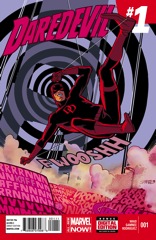
    Daredevil #1Daredevil is a lot of fun. Most of the issue is a chase scene through San Francisco. Chris Samnee composes his panels close to the action, not in long shots, so there aren’t big landmark double pages. Instead, he infers the setting around Matt. It’s a rather cool approach.
    Also important is the daytime setting; this comic is exciting, not downbeat, even when Mark Waid’s putting a little kid in danger. Waid knows exactly how to get the best result from the story, whether it’s in Daredevil showing off his powers of observation, how he paces the kid in danger, everything.

    It’s very well-done superhero comics.

    There’s also absolutely nothing compelling about it except Samnee’s art. And the art’s enough reason to read the book. Waid does an okay job, but the art’s where Daredevil is different.

    If it were just the writing, there wouldn’t be a reason to return.

    B 

    CREDITS

    Writer, Mark Waid; artist, Chris Samnee; colorist, Javier Rodriguez; letterer, Joe Caramagna; editor, Ellie Pyle; publisher, Marvel Comics.

  • Lazarus (2013) #7

    Lazarus  7

    Even though there’s a rather emotional turn of events this issue–Rucka and Lark pace the sequence perfectly–there’s almost a genial quality to this issue of Lazarus. As genial as a comic where the opening scene is a flashback to Forever getting caned as a child.

    But that genial quality, along with an odd sense of wonderment in the soft cliffhanger, are worrisome for the arc. Not terribly worrisome, just a bit. Rucka can either reward the reader or be honest to the story. While reading the issue, these concerns don’t come up. Only afterwards.

    The stuff with the peasant family trying to make it to the opportunity to better themselves is good. Maybe a little too much tugging on the heartstrings but no worse than any number of Westerns.

    Forever, in the modern day, is investigating a terror cell. It’s practically the B plot, but engaging.

    Lazarus’s stride is continuing.

  • 5672The headline on the cover promises an "off-beat" story from Harlan Ellison. Off-beat can't have been an intentional euphemism for bad… Ellison writes Batman as an insensitive, ill-mannered, narcissist.

    On patrol, Batman can't find anyone actually needing his help. Instead of thinking the best of people, Batman assumes the worst. Ellison might like the character, but apparently he thinks of him as a reactionary fascist.

    Batman moves from one interaction from another, never learning from his propensity to prejudge. The art, from Colan and Smith, is occasionally too rough but often okay. There are some nice Colan establishing shots but also some very undercooked panels.

    The Green Arrow backup is far superior. Not for the superhero content, which is competently illustrated by Woch and Dave Hunt, just poorly composed, but the finale. Cavalieri comes up with a great finish for the storyline.

    As finale for a pre-Crisis Detective, it's dreadful.

    D 

    CREDITS

    The Night of Thanks, But No Thanks!; writer, Harlan Ellison; penciller, Gene Colan; inker, Bob Smith; colorist, Adrienne Roy; letterer, John Costanza. Green Arrow, The Face of Barricade!; writer, Joey Cavalieri; penciller, Stan Woch; inker, Dave Hunt; colorist, Shelley Eiber; letterer, Todd Klein. Editor, Len Wein; publisher, DC Comics.

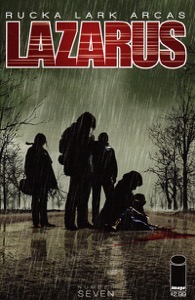
  • Lazarus #7Even though there’s a rather emotional turn of events this issue–Rucka and Lark pace the sequence perfectly–there’s almost a genial quality to this issue of Lazarus. As genial as a comic where the opening scene is a flashback to Forever getting caned as a child.

    But that genial quality, along with an odd sense of wonderment in the soft cliffhanger, are worrisome for the arc. Not terribly worrisome, just a bit. Rucka can either reward the reader or be honest to the story. While reading the issue, these concerns don’t come up. Only afterwards.

    The stuff with the peasant family trying to make it to the opportunity to better themselves is good. Maybe a little too much tugging on the heartstrings but no worse than any number of Westerns.

    Forever, in the modern day, is investigating a terror cell. It’s practically the B plot, but engaging.

    Lazarus’s stride is continuing.

    B 

    CREDITS

    Lift, Part Three; writer, Greg Rucka; artists and letterers, Michael Lark and Brian Level; colorist, Santiago Arcas; editor, David Brothers; publisher, Image Comics.

  • The Incredible Hulk 60 (November 2003)

    The Incredible Hulk #60Poor Bruce Jones. He gets back to the conspiracy storyline, brings back in Doc Samson–reimagined as some kind of super-spy–and generally gets the series moving again towards something. Sure, Banner barely has anything to do but the narrative works. Jones splits it between Banner, Samson and Nadia (the Abomination’s wife) and ties them all together trying to get the mystery laptops to work.

    All in all, the narrative is successful. Jones goes for an artful cliffhanger rather than a rewarding or intriguing one but artful’s okay.

    But Deodato’s back on the art and he butchers it. The juxtaposed fight scenes are awful, the Doc Samson fight scene is awful, even the Banner sitting in a cafe is awful. Deodato misappropriates his artistic attentions. The fight scenes should be compelling, what with Jones’s placement of them in the narrative, instead they’re painful to the eye.

    It’s a shame.

    B- 

    CREDITS

    Split Decisions, Part One; writer, Bruce Jones; artist, Mike Deodato Jr.; colorist, Studio F; letterer, Cory Petit; editors, Jennifer Huang, Warren Simons, John Miesegaes and Axel Alonso; publisher, Marvel Comics.

  • Loki: Ragnarok and Roll 2 (March 2014)

    Loki: Ragnarok and Roll #2You might think the comic would be about Loki, given his name on the cover, but it’s actually more about the system of gods Esquivel has set up. At least half the issue is Thor fighting Hercules. Sadly, there aren’t a lot of Marvel references in those scenes. Esquivel actually gets rid of a lot of those.

    And I’m not knocking the comic at all. It’s a rather good comic, especially Esquivel’s handle on the humor. It’s no longer dependent on winking; the few “regular” Thor and Loki references in this one aren’t the humor anymore. The situations Esquivel creates for the book do all the comedic generation now.

    Still, Loki is underused. There’s some funny stuff with his band, a great interview, but once the gods get to Earth, Loki gets lost. He’s a bystander. Hopefully Esquivel has something better planned for him.

    Either way, it’s a good read.

    B 

    CREDITS

    Writer, Eric M. Esquivel; penciller, Jerry Gaylord; inkers, Jerry Gaylord and Penelope Gaylord; colorist, Gabriel Cassata; letterer, Ryan Ferrier; editors, Chris Rosa and Ian Brill; publisher, Boom! Studios.

  • The Faculty (1998, Robert Rodriguez)

    Robert Rodriguez gives his actors a lot of time in The Faculty. The supporting cast–mostly the titular faculty of a high school (albeit one suffering an alien invasion)–gets to be showy. The film opens with a great showcase for Bebe Neuwirth, Robert Patrick and Piper Laurie. The main cast of kids trying not to be assimilated, they get a lot of quiet time.

    There's a lot of listening, a lot of thinking, a lot of reflecting. All amid this tightly paced teenage Body Snatchers. Kevin Williamson's script is careful to take the time to set up the characters. Rodriguez doesn't really use montage, instead of lets the camera dreamily float through the high school. He edits the film too; it's hard to imagine anyone else getting it right. Rodriguez cuts the film perfectly.

    All of the principals–Elijah Wood, Jordana Brewster, Clea DuVall, Laura Harris, Shawn Hatosy, Josh Hartnett–are excellent. Every one of them gets at least five great moments in the film; the script allows the characters self-awareness, Rodriguez gives the actors room to essay it.

    The standouts are DuVall, Hatosy and Hartnett. Their complexities are more omnipresent. DuVall's probably the best.

    And the supporting cast is excellent too. Patrick, Neuwirth, Famke Janssen, Daniel von Bargen. Rodriguez doesn't have a bad performance in the lot of them. They make the fantastical not mundane, but vicious in context.

    Thanks to the thoughtful verisimilitude on the part of all involved, The Faculty excels. It's a superior film.

  • Scaramouche (1952, George Sidney)

    Scaramouche is a deliberately constructed film. I’m curious if screenwriters Ronald Millar and George Froeschel followed the source novel’s plot structure, because it’s a very peculiar series of events. It doesn’t open with the leading man, instead starting out with villain Mel Ferrer. Janet Leigh, as his love interest, gets introduced long before Eleanor Parker–who’s second-billed and leading man Stewart Granger’s love interest.

    Except, of course, Ferrer and Granger are Frenchmen so the idea of them having one love interest is… against their character. But there’s also the matter of Richard Anderson, who sort of sets off the big plot–Granger’s want for vengeance–and on and on.

    Director Sidney does a beautiful job focusing the viewers attention where it needs to be in each scene, but also where it’s going to need to be in the next scene. A couple huge details–maybe even three–only come up in dialogue. Scaramouche isn’t a film for the disinterested viewer.

    But it’d be hard not to be enraptured with the picture. Charles Rosher’s lush color cinematography–which equally showcases the fantastic location action sequences but also the eye-shadow they’ve got on Parker–makes for a transfixing experience.

    All the acting is good. Granger’s an able leading man, Ferrer’s fantastic as the villain, Parker’s outstanding in the most complicated role. In the second most complicated (the men aren’t complicated though so it’s not much), Leigh occasionally wavers but is still quite strong.

    Wonderful Victor Young score too.

    Scaramouche is delightfully thrilling.

  • Cat People (1982, Paul Schrader)

    Cat People is so brilliantly made, often so well-acted, it's surprisingly those elements can't make up for its narrative issues. Screenwriter Alan Ormsby has a big problem–he's got to turn his protagonist from a victim to a villain to a victim. Sadly, he and director Schrader choose to employ the lamest technique possible towards the end of the second act… a revelatory, expository (if nicely stylized) dream sequence. With the Giorgio Moroder score, it seems like a really cool looking music video.

    Shame it derails the narrative and People never fully recovers. Some of the final scenes' dialogue is really lame.

    But there's so much good, starting with Schrader. He has a few directorial approaches he uses repeatedly throughout the film. First is the way he shoots eyes–his actors appear to stare into the camera (or just to the right of it). It makes the viewer feel like a voyeur. Schrader repeats that theme throughout the film. He's showing these personal moments, which requires excellent acting from his cast. Even Malcolm McDowell, who's playing an extraordinary creep, gets these little moments.

    In the lead, Nastassja Kinski is mostly excellent. Once the film loses its rhythm, she's in trouble, but she still remains sympathetic. John Heard's good as her paramour. Annette O'Toole's excellent as the other woman. Ruby Dee and Ed Begley Jr. are great in small parts.

    Cat People succeeds because of Schrader's attention to detail. Despite the story problems, a lot of the film is flawless.

    3/4★★★

    CREDITS

    Directed by Paul Schrader; screenplay by Alan Ormsby, based on a story by DeWitt Bodeen; director of photography, John Bailey; edited by Jacqueline Cambas, Jere Huggins and Ned Humphreys; music by Giorgio Moroder; produced by Charles W. Fries; released by Universal Pictures.

    Starring Nastassja Kinski (Irena Gallier), Malcolm McDowell (Paul Gallier), John Heard (Oliver Yates), Annette O’Toole (Alice Perrin), Ruby Dee (Female), Ed Begley Jr. (Joe Creigh) and Scott Paulin (Bill Searle).


    RELATED

  • Madison Avenue (1962, H. Bruce Humberstone)

    Madison Avenue somehow manages to be anorexic but packed. It only runs ninety minutes and takes place over a few years. There’s no makeup–which is probably good since Dana Andrews, Eleanor Parker and Jeanne Crain are all playing at least ten years younger than their ages.

    Director Humberstone doesn’t do much in the way of establishing shots–I think there’s one real one. Most of the exteriors are obviously on the backlot (even the real one is probably somewhere on the studio lot). He does have some decent transitions from interior to interior, but he never visually acknowledges all of the time progressions.

    And there’s no real conflict. Andrews is an ad man who loses his job and tells his ex-boss (an extremely amused Howard St. John) he’s going to come get his accounts. To do so, Andrews has to team with Parker. The problem with Avenue is its actors are good, its script has some good scenes, but there’s no depth to it. Norman Corwin can write decent back and forth banter, just not a real conversation.

    Parker’s got an unfortunate arc, but her performance is fine. She’s really good at the beginning. Andrews is appealing and doesn’t look fifty-four. He looks about forty-five, but he’s probably supposed to be playing thirty-one. Crain looks more contemptuous of her material than the other leads; she does okay.

    Nice supporting turn from Kathleen Freeman as Andrews’s secretary.

    Avenue’s a studio picture fifteen years too late.

  • Snowpiercer (2013, Bong Joon-ho)

    Snowpiercer is relentless. There are three quiet moments; I’m not estimating, I’m counting. The final quiet moment comes with some commentary on the earlier quiet moments. The relentlessness is appropriate, as the film concerns a train traveling through a frozen wasteland housing the last survivors of the human race. It’s a post-apocalyptic rumination on remorse and violence. Director Bong treats the viewer as a passenger on the train, forcing the viewer’s perspective through protagonist Chris Evans.

    At times, the film seems episodic, which is only appropriate as the first act comes to a close and Evans–along with his fellow insurgents (they’re the poor people in the rear of the train)–discovers the train’s cars are all different. So it’s appropriate the journey through those cars is going to be different. Vignettes might be a strong description, but maybe not. Especially not when considering how Bong lets supporting characters’ subplots play out in background.

    The casting is flawless. While Tilda Swinton spectacularly chews through all of her scenes, there’s great work from Octavia Spencer, John Hurt, Jamie Bell and Ewen Bremner. The three leads–Evans, Song Kang-ho and Ko Ah-sung–are all fantastic. Song only speaks Korean, but is excellent when just walking around. It’s a reluctant leading man performance from Evans; he, and all the other actors, show their characters’ sufferings without exposition.

    Snowpiercer is also a visual feast. Bong’s presentation this train and its passengers is a constant surprise.

    It’s a hard film; Bong doesn’t offer any quarter, neither does his cast.

  • Sovereign 1 (March 2014)

    Sovereign #1Chris Roberson splits Sovereign’s first issue into three parts; he’s trying to establish a whole world so splintering makes a lot of sense. Unfortunately, the three parts are not equal.

    The first part is some mystics having to bury people. Not their people, just people, because as mystics they have to bury dead. Roberson works in a mystic in training, which gives the reader further entry into the world.

    The second part is some prince who doesn’t want to be king but is going to be sooner than he thought. For the first part, which is set at night, Paul Maybury’s art is excellent. Once the day time scenes start? It’s okay. Mostly. It’s like Paul Pope meets E.C. Segar.

    The third part is the weakest. Lots of fantasy exposition; it’s set at sea, there are monsters, lots and lots of terminology.

    It’s too bad–the first part’s great.

    C 

    CREDITS

    Writer, Chris Roberson; artist, Paul Maybury; colorists, Jordan Gibson and Maybury; letterer, John J. Hill; publisher, Image Comics.

  • The Comics Fondle Podcast – 1×9
    We didn’t just make our monthly schedule, we also managed to post from a mobile (to prep for the grand C2E2 micro-episode experience. This episode Vernon and I talk about new comics. Lots of new comics. We also talk some C2E2 and about the latest comics-related TV and movies.

    WHERE TO LISTEN

    Apple Podcasts
    Spotify
    Stitcher
    RSS
  • At the Earth’s Core (1976, Kevin Connor), the digest version

    Take one bad movie–At the Earth's Core–running eighty-nine minutes and take one inept editor and tell him or her (the editor is uncredited) to cut it down to fourteen minutes. It's a lousy movie anyway, so what are you going to lose….

    Well, some bad things. Definitely some bad things. Like most of Peter Cushing's performance. This Super 8mm version (for watching at home before video), must have been intended for the younger male audience. The mystery editor keeps all the bad monster action and cuts away scantily clad Caroline Munro. She doesn't even get to keep any lines.

    It sort of plays like a fast forwarded version of the film, with only Doug McClure's action scenes kept in. There are a couple reasonably effective sequences involving Cy Grant as a caveman, but it's a rather unimaginative reduction of an already tedious film.

    At fourteen minutes, it's way too long.

    1/3Not Recommended

    Directed by Kevin Connor; screenplay by Milton Subotsky, based on the novel by Edgar Rice Burroughs; director of photography, Alan Hume; edited by Barry Peters and John Ireland; music by Michael Vickers; production designer, Maurice Carter; produced by John Dark, Max Rosenberg and Subotsky; released by Ken Films.

    Starring Doug McClure (David Innes), Cy Grant (Ra), Caroline Munro (Dia) and Peter Cushing (Dr. Abner Perry).


    RELATED

  • Lovesick (1983, Marshall Brickman)

    Lovesick is an unassuming comedy. Director Brickman will occasionally bring in frantic, sitcom-like plotting to jazz things up momentarily, but otherwise the film’s exceedingly calm and measured. It only runs ninety-some minutes; it’s gradual, without much conflict at all–in fact, when there’s conflict introduced, Dudley Moore’s protagonist will actually relieve pressure on the situation. It’s strange.

    Moore’s an analyst who becomes infatuated with a patient–Elizabeth McGovern–and finds his life in upheaval. Brickman carefully layers in how the upheaval causes Moore’s self-discovery. These are little asides, never the focus of a scene or conversation. It’s very confident stuff, especially since Brickman also goes the extreme route of having Alec Guinness (as Freud’s ghost) counseling Moore about his life.

    Alec Guinness as Freud, John Huston as Moore’s mentor. The film’s got excellent performances all around–Selma Diamond runs rings around Alan King, who’s also good–but Guinness and Huston give Lovesick a lot of charm.

    So does McGovern, who has to become a character in a few scenes after she’s revealed as the object of Moore’s affection.

    Also good in smaller parts are Ron Silver, Larry Rivers, Wallace Shawn and Anne Kerry. At times, if it weren’t Gerry Fisher’s exquisite photography and some excellent composition from Brickman, Lovesick feels like a little thing Brickman got together and worked on with his friends in their spare time.

    The film’s gentle, sweet, rewarding. It’s always genial and never without charm, but gets rather good in the second half.

  • Loki: Ragnarok and Roll 1 (February 2014)

    Loki: Ragnarok and Roll #1I’ll bet there’s a very unhappy Disney lawyer out there. Especially after Thor 2 made so much money. Batman and Superman–save The Boys–usually get the most thinly veiled analogues in indie series, but for Loki: Ragnarok and Roll, writer Eric M. Esquivel goes after Disney’s Thor. Not Marvel’s Thor, but the movie Thor. Between the bifrost and the frost giants as villains, I’m sort of surprised Boom! was able to get this one on the shelves.

    It’s good they did. After an awkward opening–how many winks to Marvel can you do–Loki is banished to Earth and the comic gets good. Esquivel writes the character well; a combination of intelligent and petulant but also able to understand the mortals around him.

    The cover promises rock and roll–as does the title–but not yet.

    The Jerry Gaylord art is good. It’s fun and intricate.

    Loki’s all right.

    B 

    CREDITS

    Writer, Eric M. Esquivel; artist, Jerry Gaylord; colorist, Gabriel Cassata; letterer, Ryan Ferrier; editors, Chris Rosa and Ian Brill; publisher, Boom! Studios.

  • All Hail the King (2014, Drew Pearce)

    It's too bad All Hail the King wasn't the epilogue to Iron Man 3. It's a continuation of Ben Kingsley's story from that film and it's the best thing out of Marvel. At fourteen minutes.

    Writer-director Drew Pearce only has three scenes in the film–he uses a montage opening to establish, so maybe three and a half. He gives Kingsley a bunch of great lines and a fantastic plot. It eventually follows up on elements from all three Iron Man movies. It's a humorous wink at the idea of dropped subplots and forgotten supporting characters.

    In addition to the dialogue and the acting–Scoot McNairy and Lester Speight are also great–Pearce's direction is outstanding. He has numerous jokes throughout, often letting them develop from a dramatic situation. That approach works perfectly with Kingsley's British stage boob.

    While it's a showcase for Kingsley, it's equally one for Pearce. King is near perfect.