• Copperhead (2014) #4

    Ch04

    This issue of Copperhead returns the series to its previous level of quality, which is fantastic, because I really wanted to love this comic and it looks like I still can.

    It’s a very busy issue. Faerber wasn’t busy last issue (the weak one); he’s busy here, he keeps Clara busy, he keeps Boo busy, he keeps the supporting cast busy. There’s stuff with the doctor–an actual scene before he gets drug into the issue’s primary subplot–and there’s stuff at the beginning, possible back story for Clara. It all works out beautifully.

    I say possible back story because Faerber tells this story about her, which may or may not be true, then has a whole montage sequence showing it might be true. It’s just a cool way of plotting out the issue… getting the reader wondering, then busy with other stuff, then delivering.

    Copperhead is back on track.

  • Crossed + One Hundred 1 (November 2014)

    Crossed + One Hundred #1Who would have thought Crossed + One Hundred wouldn’t just be good, but would be some really strong mainstream stuff from Alan Moore. He gets to create a language–future English–which undoubtedly gave him a lot to think about (since the language also shows how the world has changed since the apocalypse and what’s important and what’s not). And he gets to imagine a future civilization.

    Not surprisingly, it’s upbeat. Moore shows the humanity both in his cast of survivors, but also in the crossed. It’s very strange because they’re not sympathetic yet, but he’s got a anthropologic distance from them and it does make them very interesting.

    A lot of the details don’t have anything to do with Crossed and are probably just ideas Moore has had kicking around for a while. But he fits them perfectly to the world such a calamity might create.

    Gabriel Andrade’s art’s excellent.

    A 

    CREDITS

    Writer, Alan Moore; artist, Gabriel Andrade; colorist, Digikore Studios; letterer, Jaymes Reed; publisher, Avatar Press.

  • Batgirl #37There’s a somewhat pointless plot twist at the end of this issue. It’s sensational, when the writers haven’t actually set up a point for it. They aren’t asking profound questions or making profound statements, they’re actually just making fun of their villain.

    Which is, to some degree, a Batgirl thing to do.

    Until that point, the issue is pretty good. There’s too little interaction between Barbara and Dinah though. Stewart and Fletcher use Dinah–to good effect–for comic relief, but they don’t have her functioning as a real character, which hurts this issue. Especially at the end when she pops in just because they need snark.

    There’s some rather nice art from Stewart and Tarr during Batgirl’s action sequences too. Lots of foreground and background information important to the panel; they’re a good team.

    It’s a rather well-executed comic, with lots of great moments… and a weak conclusion.

    CREDITS

    Double Exposure; writers, Cameron Stewart and Brenden Fletcher; pencillers, Stewart and Babs Tarr; inker, Tarr; colorist, Maris Wicks; letterer, Jared K. Fletcher; editors, Dave Wielgosz and Chris Conroy; publisher, DC Comics.

  • Star Spangled War Stories 4 (January 2015)

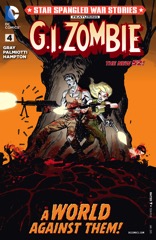
    Star Spangled War Stories #4Okay, so G.I. Zombie is kind of lame when he’s on his own. Not the comic, but the character. When he’s running around this issue, talking to himself, it’s really lame. If Gray and Palmiotti want to have some reason he speaks to himself in expository dialogue, they should introduce it. His origin is still in question… if he’s a motormouth, so be it. But establish it.

    Otherwise, not much happens in the issue. The army shows up and the zombie crisis gets contained to some degree. The better stuff is with G.I. Zombie’s partner, Carmen. She’s got the flashback at the beginning of the issue, she’s the one who gets to find the domestic terrorists’ amazing Bond villain base.

    There are some decent moments with G.I. Zombie, but the writers put too much emphasis on his lame dialogue and not enough on his experiences in the issue.

    It’s annoying.

    B- 

    CREDITS

    Exit Strategy; writers, Jimmy Palmiotti and Justin Gray; artist and colorist, Scott Hampton; letterer, Rob Leigh; editors, David Piña and Joey Cavalieri; publisher, DC Comics.

  • Copperhead 4 (December 2014)

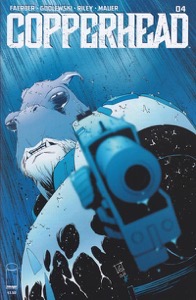
    Copperhead #4This issue of Copperhead returns the series to its previous level of quality, which is fantastic, because I really wanted to love this comic and it looks like I still can.

    It’s a very busy issue. Faerber wasn’t busy last issue (the weak one); he’s busy here, he keeps Clara busy, he keeps Boo busy, he keeps the supporting cast busy. There’s stuff with the doctor–an actual scene before he gets drug into the issue’s primary subplot–and there’s stuff at the beginning, possible back story for Clara. It all works out beautifully.

    I say possible back story because Faerber tells this story about her, which may or may not be true, then has a whole montage sequence showing it might be true. It’s just a cool way of plotting out the issue… getting the reader wondering, then busy with other stuff, then delivering.

    Copperhead is back on track.

    A 

    CREDITS

    Writer, Jay Faerber; artist, Scott Godlewski; colorist, Ron Riley; letterer, Thomas Mauer; publisher, Image Comics.

  • Star Spangled War Stories 3 (December 2014)

    Star Spangled War Stories #3I still don’t know why I like Star Spangled War Stories so much. Maybe it’s because of Gray and Palmiotti’s pace. This comic–featuring the cast of “Duck Dynasty” unleashing a zombie plague on the United States (the rural United States)–moves at a breakneck pace. About the only time it calms down for a moment is when G.I. Zombie’s partner, whose name I don’t remember, stops at a diner and there’s character development between her and a domestic terrorist whose organization she’s infiltrated.

    Otherwise, it’s all action. Only it’s G.I. Zombie running through this small town, trying to help people–Gray and Palmiotti establish the characters and settings quickly (sometimes during action sequences) but they still stick.

    It’s kind of like a monster movie from the fifties, only with a lot of action and some very modern sensibilities.

    Plus, the strangeness of Hampton doing big action still works wonders.

    B+ 

    CREDITS

    Small Town Welcome; writers, Jimmy Palmiotti and Justin Gray; artist and colorist, Scott Hampton; letterer, Rob Leigh; editors, David Piña and Joey Cavalieri; publisher, DC Comics.

  • Sally of the Wasteland 5 (December 2014)

    Sally of the Wasteland #5Bettin’s art is a little broad for the finish, which has Sally in a “normal” future environment. She and Tommy make it into safe hands, a huge underground society started by the college professors who knew nuclear war was coming.

    Most of the issue has Sally hanging out with the female security chief, though Gischler does get in an action packed conclusion. It all seems little familiar–a little Aliens, a little Terminator, a little Planet of the Apes–but the mix isn’t bad. And the issue, even with Bettin getting lazy as the comic goes on, isn’t bad at all. It’s rather good.

    It just doesn’t have an ending for the series. Gischler goes with a big cliffhanger, which sort of leaves Sally adrift. He’s not leaving it open for a sequel or setting up a sequel, he’s cutting out before the story ends. It’s frustrating.

    But rather good.

    B 

    CREDITS

    Writer, Victor Gischler; artist, Tazio Bettin; letterer and editor, Tom Williams; publisher, Titan Comics.

  • Judge Dredd #28It’s almost a great issue of Dredd. The opening story, with Wagner and Grant sending Dredd into the Cursed Earth (no longer called Mutieland) with a bunch of cadets for a test, is awesome. Smith’s art is good, the story has a nice flow and the supporting cast of cadets is good. It’s probably the best mix of narrative and Wagner wanting to expound on the judges’ rigorous training.

    Unfortunately, the second half of the issue has two Judge Anderson stories and neither of them is particularly good. The first one at least has good art from Kim Raymond. Raymond gives it almost a horror comic vibe, which is appropriate given Anderson is fighting a demon.

    The last story, with too busy art from Ian Gibson, is really lame. Grant and Wagner write the final one together, with Wagner writing the first Anderson alone. So he’s worse with help, apparently.

    B- 

    CREDITS

    Writers, John Wagner and Alan Grant; artists, Ron Smith, Kim Raymond and Ian Gibson; colorist, John Burns; letterers, Tom Frame, Tony Jacob and Steve Potter; editor, Nick Landau; publisher, Eagle Comics.

  • Wool 6 (August 2014)

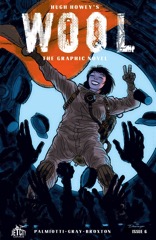
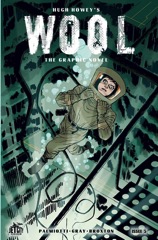
    Wool #6The last issue reveals Wool doesn’t just have a pacing problem or a perspective problem, it has a scale problem. Palmiotti and Gray never make the silo society seem real enough. They never show the silo in a way to make one believe anyone besides the cast lives there.

    It’s not imaginative enough in how they’re adapting the comic. Sure, Broxton’s art is a little claustrophobic, but there’s no opportunity for it to be anything else.

    Without a sense of the society, the writers don’t give the characters a setting, so their implied back stories and histories have less–or no–resonance. It hurts the comic immensely and could have been easily fixed.

    It’s a fairly good final issue. The tension is honest, the plot twists are not. They never get enough time, but Gray, Palmiotti and Braxton are all professionals. Wool ends competently, but without anything special about it.

    B- 

    CREDITS

    Writers, Jimmy Palmiotti and Justin Gray; artist, Jimmy Broxton; letterer, Bill Tortolini; editor, Matt Hoffman; publisher, Jet City Comics.

  • Marie (2014, Alfredo Tanaka)

    Director Tanaka starts out Marie in a hospital–after a flashy opening title card–and it’s impossible to know where the short is going. It’s a scary enough hospital and the titular protagonist (played by Kasia Koleczek) is already on the gurney. There’s no music, just the sounds of the operation getting ready.

    It’s creepy. And it’s all so Tanaka can ease the viewer into what comes next. The viewer is vulnerable, identifying with Koleczek in that opening sequence–with the way Tanaka transitions scenes, he earns some trust.

    Because Tanaka and his crew are more the stars of Marie. The music from Jack Northover and Jack Pescod, when it does appear, defines the rest of the film. Fantastic photography from George de Freitas and lovely editing from Sophie Black.

    It’s a precisely made film, perfectly balanced between narrative flow and intense visual flow. Marie is ambitious, confident and excellent.

    3/3Highly Recommended

    CREDITS

    Produced and directed by Alfredo Tanaka; written by Joe Aaron and Tanaka; director of photography, George de Freitas; edited by Sophie Black; music by Jack Northover and Jack Pescod.

    Starring Kasia Koleczek (Marie), Damien Hughes (Dr. Robert Newman), Rachel Howells (Wife) and Liza Ivanova-Galitsyna (Daughter).


    RELATED

  • War Stories (2014) #3

    Ws03

    If Ennis had just started out with the story he finishes telling in this issue, it would have been a much more satisfying story arc. He doesn’t want to seem too sentimental, I guess. But he starts narrating it in the past tense, directly referring to the war being over, so his protagonist clearly makes it.

    Only the protagonist isn’t really telling his war story. Ennis has this interesting thing–a war story where the narration doesn’t engage with all the visuals, the protagonist has forgotten the details, they’ve ceased to be the important thing about this period of his life. It could have been an awesome little story.

    Instead, Ennis tries to correct it all this issue and he rushes through it and it doesn’t work. It’s well-written, it’s just obvious and desperate.

    And Burns’s detail on the war battle can’t make up for his terrible human beings.

  • Judge Dredd #27It’s an uneven issue. Except the art, of course. Smith does a great job on the art. And Wagner and Grant do have some highs. The issue opens with the low–and the only time there’s a lot of forced symbolism about Dredd and the law. I think it comes up later, but the writers actually counter it.

    The highlight of the issue is about Dredd being on graffiti detail. It’s not a violent story at all and it sort of just shows regular life for a kid in Mega-City One. Because Grant and Wagner open with it being a Dredd story, then switch the protagonist, it feels expansive, something these short stories usually don’t.

    There’s a so-so story about a cult and then a murder mystery. The latter tries too hard with future details, but it’s solidly written. Wagner and Grant have a good tone this issue.

    B 

    CREDITS

    Writers, John Wagner and Alan Grant; artists, Ron Smith and Robin Smith; colorist, John Burns; letterer, Tom Frame; editor, Nick Landau; publisher, Eagle Comics.

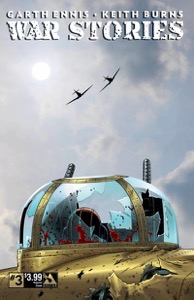
  • War Stories 3 (November 2014)

    War Stories #3If Ennis had just started out with the story he finishes telling in this issue, it would have been a much more satisfying story arc. He doesn’t want to seem too sentimental, I guess. But he starts narrating it in the past tense, directly referring to the war being over, so his protagonist clearly makes it.

    Only the protagonist isn’t really telling his war story. Ennis has this interesting thing–a war story where the narration doesn’t engage with all the visuals, the protagonist has forgotten the details, they’ve ceased to be the important thing about this period of his life. It could have been an awesome little story.

    Instead, Ennis tries to correct it all this issue and he rushes through it and it doesn’t work. It’s well-written, it’s just obvious and desperate.

    And Burns’s detail on the war battle can’t make up for his terrible human beings.

    B 

    CREDITS

    Castles in the Sky, Part Three of Three; writer, Garth Ennis; artist, Keith Burns; colorist, Digikore Studios; letterer, Kurt Hathaway; publisher, Avatar Press.

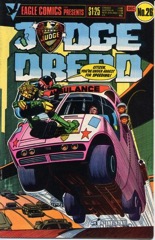
  • Judge Dredd #26There’s a lot of imaginative Ron Smith art this issue. He does an excellent job mixing action with setting detail, especially since all of Wagner’s stories have something to do with Mega-City One, whether with the block architecture or with the people.

    Unfortunately, Wagner’s stories of Dredd and the general public, even when they’re good, are too much of Wagner trying to play up Dredd’s ideals. The first story has a minor crime turn into a major, the second has Dredd showing compassion (while appearing not to show compassion), the third and fourth are Walter stories.

    The final story, from Alan Grant and Kelvin Gosnell, is this way too conceptually big, but way too small in terms of pages–and Smith’s scale–story of a runaway mobile traffic thing.

    These Mega-City One details, even with good art, are really hard to take one after another. There’s no story.

    B- 

    CREDITS

    Writers, John Wagner, Alan Grant and Kelvin Gosnell; artist, Ron Smith; colorist, John Burns; letterers, Peter Knight and Tom Frame; editor, Nick Landau; publisher, Eagle Comics.

  • Thoughts on The Thin Man

    Undoubtedly some of the most witty and urbane films of Hollywood’s Golden Age, the six movies that composed MGM’s Thin Man series showcased a pair of wealthy, inebriated detectives who solve murders in their down time. Through the series’ run from 1934 to 1947, William Powell and Myrna Loy turned Nick and Nora Charles into a cinematic institution, showcasing a marriage that was sexy, funny, and exciting, whether there was a gun pointed at them at any given moment or not. Thoughts On The Thin Man reflects on these famous films, looking back at Dashiell Hammett’s original inspiration, the genesis of the films, and the men and women who made them possible. This collection of essays covers all six movies, including detailed plot breakdowns, quotes, trivia, discussion of motifs, looks at the many spin-offs of the series, a couple of nostalgic odes, and even drinking games, including a custom cocktail devoted to the duo. Would you expect any less?

  • Wool 5 (July 2014)

    Wool #5Wool is a frustrating comic. Presumably to stick with the narrative structure of the source novel, Gray and Palmiotti constantly waste time and pass up opportunities for a better structure.

    This issue has protagonist Jules on a mission where she’s diving (in her environment suit) to the bottom of the silo. It’s flooded. It could be a great sequence, but it’s actually a waste of time because all it does is introduce a second sidekick for her. It doesn’t need the emphasis if all it’s going to do is bring in another character.

    Or they could have used it as a framing device for the issue. But no.

    Then the comic cliffhangs with her previous sidekick, now working for the evil information technologies department, chatting with her on the radio. Yet another possible wonder framing device for the whole series.

    It’s got its plusses, but Wool is way too loose.

    B- 

    CREDITS

    Writers, Jimmy Palmiotti and Justin Gray; artist, Jimmy Broxton; letterer, Bill Tortolini; editor, Matt Hoffman; publisher, Jet City Comics.

  • Judge Dredd #25Smith handles the art on both stories.

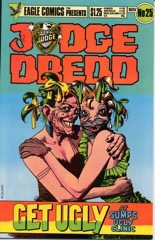
    The first story is about an ugly clinic (people go to get plastic surgery to look ugly). It’s a little silly, but it does get more interesting as it goes along. The problem is writers Wagner and Grant want to basically do some future musing and they don’t really have a narrative to it, much less a reason for Dredd to get involved.

    It’s a really weird ending too, because Dredd wants to shut down the ugly clinics and has to figure out a way to do it legally (in Wagner and Grant’s terms of legal). Only… I couldn’t figure out why he cares so much.

    The second story has a community group worried about the judges being too harsh. Does the shrill harpy change her mind about her shallow, liberal affectations when confronted with actual criminals?

    Besides being obvious, it works out.

    B- 

    CREDITS

    Writers, John Wagner and Alan Grant; artist, Ron Smith; colorist, John Burns; letterers, Peter Knight and Tom Frame; editor, Nick Landau; publisher, Eagle Comics.

  • Confessions of a Dangerous Mind (2002, George Clooney)

    As the dangerous mind in the title (Confessions of a Dangerous Mind), Sam Rockwell should be entirely unsympathetic. The film spends its first act mocking Rockwell and inviting the viewer to participate. With the exception of his chemistry with Drew Barrymore’s saintly character, there’s nothing redeeming about Rockwell’s character. Yet he’s tragically endearing.

    The film is based on Chuck Barris’s autobiography, where the game show host says he worked as an assassin for the CIA. Charlie Kaufman’s script–and Clooney’s direction of that script–never really raises a question about it. Even though there are real entertainment people giving interviews (it opens with Dick Clark’s recollections of Barris), Clooney approaches the spy stuff straightforward. It’s the story of a successful showbiz guy who was a spy.

    The conflicts caused by that absurd contradiction are where Confessions devastates. The relationship between Rockwell and Barrymore, which is a third plot line, separate from both the spy stuff and the TV stuff, doesn’t actually give the film its humanity, it gives it its emotional veracity. Rockwell, who’s phenomenal throughout, has a lot more acting hurdles to jump in the spy stuff–the TV stuff is almost straight comedy. The romance with Barrymore is a period piece but is intricately tied to the reality of the film.

    It’s great. Clooney and Rockwell do a great job. Rockwell’s breathtaking, Barrymore’s good, Clooney’s got a small part, Julia Roberts has a small part–they’re both really good.

    Confessions is flashy and noisy and precise and singular.

    4/4★★★★

    CREDITS

    Directed by George Clooney; screenplay by Charlie Kaufman, based on the book by Chuck Barris; director of photography, Newton Thomas Sigel; edited by Stephen Mirrione; music by Alex Wurman; production designer, James D. Bissell; produced by Andrew Lazar; released by Miramax Films.

    Starring Sam Rockwell (Chuck Barris), Drew Barrymore (Penny Pacino), George Clooney (Jim Byrd), Julia Roberts (Patricia Watson) and Rutger Hauer (Keeler).


    RELATED
  • Birthright (2014) #3

    Birthright  3

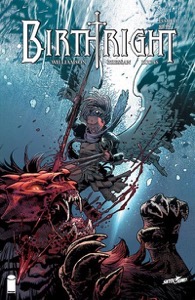
    It’s a particularly interesting issue because Williamson never talks about the big secret–the big gimmick, the big deception, the big unknown. There’s stuff related to it, but he never identifies why he’s on these topics. It would be a bad jumping on issue.
    There’s some good stuff with the parents. Not together so much, because Williamson is moving quickly. He doesn’t slow down for things he would need to stop and work with. The issue is kind of sprinting, actually. The mom has her good scenes, the dad has a couple scenes where it could lead somewhere better.

    Then there’s the brother. The older brother who becomes younger but still somewhat wiser–at least in the ways of Earth. His scenes are good too; probably the best in the issue.

    But Williamson is still soft booting the series with every issue. He still hasn’t found the Birthright’s sustainable tone.

  • Birthright #3It’s a particularly interesting issue because Williamson never talks about the big secret–the big gimmick, the big deception, the big unknown. There’s stuff related to it, but he never identifies why he’s on these topics. It would be a bad jumping on issue.

    There’s some good stuff with the parents. Not together so much, because Williamson is moving quickly. He doesn’t slow down for things he would need to stop and work with. The issue is kind of sprinting, actually. The mom has her good scenes, the dad has a couple scenes where it could lead somewhere better.

    Then there’s the brother. The older brother who becomes younger but still somewhat wiser–at least in the ways of Earth. His scenes are good too; probably the best in the issue.

    But Williamson is still soft booting the series with every issue. He still hasn’t found the Birthright’s sustainable tone.

    CREDITS

    Writer, Joshua Williamson; artist, Andrei Bressan; colorist, Adriano Lucas; letterer, Pat Brosseau; editors, Helen Leigh and Sean Mackiewicz; publisher, Image Comics.

  • Time Trap (2013, Michael Shanks)

    Time Trap is a good combination of humor and visual effects mastery. Director Shanks–who also did the special effects–does some amazing work on the short. It’s about some space guy who crash lands on Earth after the world’s ended and he has to create time bubbles to look for parts to his spaceship.

    So there’s a lot of effects, which are almost uniformly amazing, and then some humor stuff with the space guy, played by Mark Taylor. Taylor doesn’t have any lines and his face is covered so it’s hard to say what he brings to it.

    Shanks figures out a good system–the localized time travel, which allows for cool effects but also comedic moments–and Time Trap is a solid short.

    There are some fantastic shots in the film, combining the live action and the CG; Shanks is an impressive filmmaker. His script just lacks oomph.

    2/3Recommended

    CREDITS

    Written, directed and edited by Michael Shanks; director of photography, Edward Goldner; music by Shanks; production designer, Nicholas Issell; produced by Shanks and Chris Hocking.

    Starring Mark Taylor (Fripp).


    RELATED

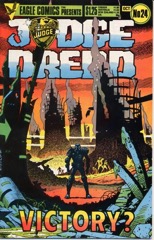
  • Judge Dredd #24The Apocalypse War saga ends. There’s some silliness–like Wagner and Grant referring to Dredd’s “Apocalypse Squad”–but most of the comic works out, at least as far as narrative.
    Dredd’s got to take care of the enemy’s mega city, which proves easy thanks to Anderson (who the writers use to get out of plotting difficulties), and then he heads home to win the war.

    There’s a little bit too much exposition and it doesn’t work because Wagner and Grant are overextending themselves. They’re giving more information than the story needs to succeed and it weighs down a lot of sequences. The subplots don’t really provide any additional texture, they just fill pages.

    And those pages have really bad art. Ezquerra is worse than he was in the previous issue. His composition is worse, his detail is worse. It’s a hideous looking comic.

    But the writing is effective. So… yeah.

    B 

    CREDITS

    Writers, John Wagner and Alan Grant; artist, Carlos Ezquerra; colorist, John Burns; letterer, Tom Frame; editor, Nick Landau; publisher, Eagle Comics.

  • Wool 4 (July 2014)

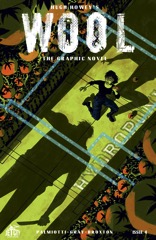
    Wool #4The issue starts with the protagonist narrating. The fourth issue and Gray and Palmiotti have finally settled on having the protagonist. And on having her narrate. Only she doesn’t narrate for long and the focus soon shifts back to the subplots.
    The sheriff–I can’t believe it, I remember her name is Jules–is in another silo and her world view is being broken. Luckily there’s some guy in the other silo who’s been there for thirty-four years alone and he’s rational enough to explain everything to her.

    Meanwhile, the regular silo and the somewhat familiar supporting cast–lots of supporting cast members have died off in Wool and it’s hard to bother getting too involved with the new ones–are planning a revolt. Perhaps it will succeed. Perhaps it will fail. It’s hard to actually care.

    It’s a good issue, but Wool’s too insubstantially constructed to succeed.

    B 

    CREDITS

    Writers, Jimmy Palmiotti and Justin Gray; artist, Jimmy Broxton; letterer, Bill Tortolini; editor, Matt Hoffman; publisher, Jet City Comics.

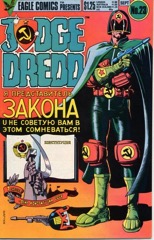
  • Judge Dredd #23From the start, Ezquerra’s art is off. His figures are weak, his composition is worse. Maybe he just burned out on all the war stuff–there are constant empty backgrounds, like he’s trying to do less work. It actually feels like someone doing an Ezquerra impression and and a rushed one.
    As for the writing… Wagner and Grant have two things to do in the issue. First is to resolve the Soviet brainwashing of the Chief Judge. Dredd has to infiltrate and take him out, which doesn’t cause Dredd any consternation because the Chief Judge knows he’s been brainwashed and wants to die. What that plot lacks in dramatic impact, at least the infiltrating should be interesting (and the extraction).

    Sadly, Ezquerra’s weak art hurts it a lot.

    Ditto the second plot point, the judges waging war against the Soviets. Or getting ready to.

    The art significantly impairs the issue.

    C+ 

    CREDITS

    Writers, John Wagner and Alan Grant; artist, Carlos Ezquerra; colorist, John Burns; letterer, Tom Frame; editor, Nick Landau; publisher, Eagle Comics.

  • Robocop 6 (December 2014)

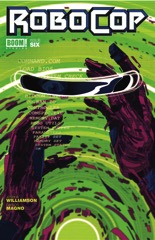
    Robocop #6It’s a bridging issue. An undercover cop goes after Killian–in one of Williamson’s most unexpected moves, the character (who everyone is accusing of being an undercover cop) turns out to be an undercover cop just in time for the cliffhanger. Robocop gets beat up by the new ED–209, which has a silly name I can’t remember. And Anne Lewis gets into a yelling match about how she’s not going to back down from her job (with another female detective).
    And Robocop gets new legs. He can run now. Not quite a jetpack, but… a running Robocop.

    Next time, because this issue is a bridging issue.

    It’d probably be okay if it weren’t for some real compositional laziness on Magno’s part. He’s wasting a lot of space, with angles intended to fill space with blah content. Without anything particularly good in the narrative, the art pitfalls hurt the issue.

    B- 

    CREDITS

    Writer, Joshua Williamson; artist, Carlos Magno; colorist, Marissa Louise; letterer, Ed Dukeshire; editors, Alex Galer and Ian Brill; publisher, Boom! Studios.

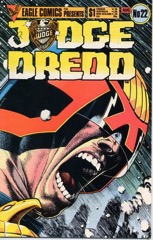
  • Judge Dredd #22It’s the war comic I’ve been expecting from Wagner for a while now. Dredd and the judges with him have a mission and they try to carry it through. There are changes, but minor ones. It’s just a war comic, even during the bewildering sequence where the judges have to knock down the supports on a giant highway system to stop the invasion.
    It all looks too simple. Ezquerra has some nice panels but he never establishes the lack of reality in the set pieces. Instead of it being fantastic, Ezquerra instead goes for cheap thrills.

    But the big silly action sequences are still mostly successful. Wagner writes them well, silly or not. The only drawback, other than the major problems, is Walter and the comic relief. Wagner goes too far with the comic relief, which leads to some lame jokes.

    It’s fine enough, it’s just a little bit tiresome.

    B 

    CREDITS

    Writer, John Wagner; artist, Carlos Ezquerra; colorist, John Burns; letterer, Tom Frame; editor, Nick Landau; publisher, Eagle Comics.

  • Escape from New York 1 (December 2014)

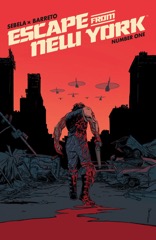
    Escape from New York #1I’m trying to figure out how to describe Escape from New York to those unfamiliar with the movie. You wouldn’t buy the comic on a whim, without a familiarity, because if you paged through it, you’d be immediately lost. Writer Christopher Sebela doesn’t really do an introduction, he does a direct sequel to the movie… then immediately invalidates it.
    But, let’s say you stuck with it for a few more pages. And then you wondered why Diego Barreto is drawing the main character so blandly. And why is the dialogue so terrible? Sebela rips off a line from Terminator 2. In a sequel to a movie from eleven years before T2. It feels weird. But not totally awful yet.

    It gets awful a few pages later with Sebela’s first “I thought you were dead” line from a diner waitress. It’s a terrible sequel; bad, officially licensed fanfic.

    It’s wretched stuff.

    D- 

    CREDITS

    Writer, Christopher Sebela; artist, Diego Barreto; colorist, Marissa Louise; letterer, Ed Dukeshire; editors, Alex Galer and Ian Brill; publisher, Boom! Studios.

  • Wool 3 (July 2014)

    Wool #3It’s almost like Wool, the comic book, is meant to inspire the reader to instead go read Wool, the novel, in order to understand the character motivations. Because Gray and Palmiotti try for intense scenes, montage sequences, all sorts of things they can’t get done because they haven’t set up the characters well.
    The villain is one dimensional. Even when his big secret gets revealed, it doesn’t offer him any depth because it’s a predictable big secret. As for the protagonist, the issue removes her agency–again–and sort of soft resets with the cliffhanger (and the big reveal).

    Broxton’s art helps a lot–he does post-apocalyptic really well and he can pace out the scenes visually–and Wool does configure its derivative and familiar details in a reasonable order… but the series is now half over and there’s not much going on outside sci-fi standards.

    But prettily.

    B 

    CREDITS

    Writers, Jimmy Palmiotti and Justin Gray; artist, Jimmy Broxton; letterer, Bill Tortolini; editor, Matt Hoffman; publisher, Jet City Comics.

  • Judge Dredd #21There are some amusing disconnects with Ezquerra’s art and Wagner’s script. It’s like Ezquerra didn’t get the jokes… or if he did, he paced them wrong. Or maybe there’s just no easy way to illustrate jokes amid a story about a nuclear attack.
    Wagner figures out a way to both have nuclear attacks but still keep the story on a personal level. There’s both kinds of action, usually with some talking heads scenes between the two opposing sides. The story doesn’t hold much water, but it’s just supposed to move and move it does.

    Even though there are some horrific ideas, the issue doesn’t leave much of an impression. It just moves so fast, so towards its goal, there’s nothing else going on. Except in the last few pages, Walter the robot gets some attention again. It’s amusing enough stuff, but just a little too silly.

    Even for John Wagner.

    B 

    CREDITS

    Writer, John Wagner; artist, Carlos Ezquerra; colorist, John Burns; letterer, Tom Frame; editor, Nick Landau; publisher, Eagle Comics.

  • Judge Dredd (1983) #20

    Judge Dredd  20

    Even though Carlos Ezquerra is an odd choice for a future war–Dredd co-creator or not, Ezquerra puts a lot of emphasis on the static parts of images instead of the moving, which is strange here–and even though Wagner goes overboard with some of the symbolism, it’s an awesome issue.

    It’s the end of the world and Dredd is trying to keep it going. The action cuts between the Soviets, Dredd and company and general action. The general action is where Wagner does the lame jokes–usually related to a block’s name–and the rest has some real obvious anti-Soviet propaganda regurgitation. It’s amazing no one learned anything between the 1980s and the Dredd time period.

    Still, Wagner and Ezquerra keep the situations tense and dire and the comic works out beautifully. It’s a plummeting elevator car more than a roller coaster.

    Some nice humor throughout too.