• Beware the Creeper (2003) #4

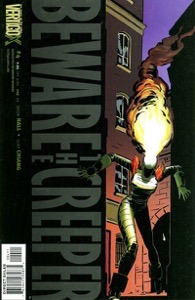
    Beware the Creeper  4

    The cop’s narrating again. Not sure why, not after he took an issue and a half off. Writer Jason Hall puts too much on the cop, especially since he gets tricked twice in the issue. One’s plainly clear; the other he should’ve figured out since it happened during the war. But he lacked the critical thinking skills, which then makes his narration showing such abilities incongruous.

    The comic doesn’t go where I thought it was going. It might still end up there by the end; there’s a whole other issue because this issue’s all about revealing the Creeper’s identity. There are two possibilities we know about and an unknown large number of ones we don’t (there’s no reason to assume it has to be one of our twin sister leads). Hall goes right to it with the reveal, complete with something close to a confession.

    Though, maybe the ending is what I remembered.

    Anyway.

    Cliff Chiang’s art is fantastic. Even with the bland blond copper back and the indistinct female protagonists, Chiang’s doing just fine. There are numerous action montages throughout—no real scenes because Hall watches the Creeper from a distance—and some excellent work in them. Not sure how Chiang’d do with a straight action scene, but it doesn’t seem like it will come up in this book.

    The ending is melodramatic, sentimental, and cruel. It’s also rather affecting, especially for a comic with such a thin narrative. Creeper’s a strange book; Chiang’s dragging it across the finish line, but Hall sometimes doesn’t seem to know they’re even trying to get there.

  • She-Hulk: Attorney at Law (2022) s01e08 – Ribbit and Rip It

    A couple things to get out of the way again for this episode. During Tatiana Maslany’s perfect beyond words Ferris Bueller “go home already” fourth wall breaking (she’d already inhabited the part, now it’s time for her to bend the devices to her will), she says next episode is the “finale.” They’re doing another scene to get them there. And the hook for next episode’s good. It’s not perfect, but it’s coming at the end of a transcendent accomplishment: “She-Hulk: Attorney-at-Law” just perfected the superhero show crossover episode.

    Well. Sort of. I mean, I think they did it once before, and I think it involved the same other half of the crossover, “Daredevil” Charlie Cox, making his big return to the proverbial tights after showing up in the latest Spider-Man, answering the question of whether or not the Netflix Marvel shows “count.” They do for Cox, anyway.

    And it’s no surprise why. It’s a magnificent return, starting with him and Maslany facing off in court. Her client (Brandon Stanley playing the perfect dipshit) is suing superhero fashion designer Griffin Matthews for faulty jet boots. Even though Maslany also frequents Matthews’s establishment (he’s designing her lawyers’ gala dress, in fact), she’s stuck trying to case. She wasn’t expecting a New York City lawyer who can tell when people lie just from their heartbeats.

    It gets more complicated after Maslany and Cox have drinks—I’d forgotten how wonderfully slutty Cox plays the part, seducing Maslany with the potential of using her powers for good. Between that soulful moment and Cox saying “Sokovia Accords,” the MCU suddenly gets that “street level” thoughtfulness it’s been missing since… well, always, actually. At least outside Netflix.

    Anyway.

    Because it’s a crossover, they’ll have to costume up at some point, but because it’s a first-time crossover, they’ll have to be enemies at the start.

    It’s glorious, even if director Kat Coiro should’ve done at least one bad-ass “Daredevil” long fight instead of just joking about them.

    The next episode’s going to be a whopper based on the cliffhanger, but between this episode and the last, “She-Hulk”’s earned itself all the seasons. Though the four-minute setup should’ve been a mid-credits sequence; someone needs to rethink the MCU show’s lengthy end titles.

    It had so better end with “She-Hulk Will Return in She-Hulk: Season Two.” It so better.

    She could also move to New York and do a season with Cox. Whatever. But they’ve finally hit that sincere and unique sitcom level; they need to keep it going.

  • She-Hulk: Attorney at Law (2022) s01e07 – The Retreat

    I’ll disclose I did not go into this episode without expectations. A friend said it was when “She-Hulk” hits its full potential, and he’s entirely correct. I just didn’t realize how much the show was going to include in that potential. This episode gets silly and soulful in a way reminiscent of the Dan Slott comic (he gets a towing company named after him in the MCU), but with Tatiana Malsany’s Year One character experiencing it. With the best use of MCU legacy goods to date.

    I am speaking, of course, of Mister Timothy Simon Roth, who’s been having a rough time of it—actual good performance-wise—for some time now. When he was in Incredible Hulk, it was a hail-marry villain casting, back when good villains supposedly mattered in superhero movies.

    This episode mostly takes place at Roth’s retreat, where he has group therapy for powered individuals, including Asgardian refugees, so alien species as well. And, presumably, daywalkers.

    The episode starts with Maslany having a pop music romance montage with Trevor Salter, culminating in their first adult sleepover. Only then Maslany doesn’t hear from him for the whole weekend; Sunday morning rolls around, and instead of Salter lighting up her phone, it’s Roth’s probation officer, played by John Pirruccello.

    Maslany and Pirrucello head to the retreat to investigate some discrepancies in Roth’s power inhibitor, where they discover more than meets the eye.

    Sorry, wrong franchise. For now, right, Disney?

    Anyway.

    There are some surprise returning guest stars—who Maslany breaks the wall to contextualize—along with some breakout “problem” supers, like Joseph Castillo-Midyett. He wants to be a swashbuckler, but everyone assumes he’s a matador; he’s got some kind of laser sword. His best friend’s an Asgardian man-bull named Man-Bull (played by Nathan Hurd). But is it a front for something nefarious, or is it on the level?

    The episode addresses pretty much all the outstanding concerns, like Maslany’s experience of living She-Hulk: Year One, but also what tone the show’s going for. There are big, terrible developments on the misogynist Star Wars fan bros front, with Ginger Gonzaga, really only showing up to remind Maslany (and the audience) about it, but “She-Hulk”’s got a lot more going on.

    Series best direction from Anu Valia and a genuinely superb script, credited to Zeb Wells. Maslany’s got her best scenes, including as She-Hulk (they up the CGI for her close-up monologuing). It’s so good.

    “She-Hulk”’s arrived even better than expected, promised, or hoped; where’s the season two announcement? Hell, where’s the season three announcement

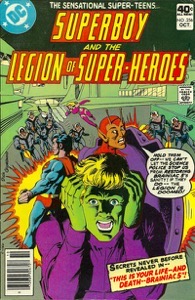
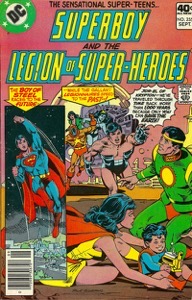
  • Superboy and the Legion of Super-Heroes (1977) #256

    Superboy  the Legion of Super Heroes  256

    It’s one of those Legion of Super-Heroes issues where they’re asshole teenagers (actually much older people pretending to be teenagers to deceive their time-traveling friend Superboy), and it seems more like the Legion of Super-Delinquents.

    This issue, they assault some theme park owner and terrorize innocent people out of the place so they can create a trip through Brainiac 5’s memories. He’s still “insane,” and they’re desperate to cure him. That cure involves one person programming his trip down memory lane while someone else reads his mind to figure out how to manipulate his feelings. When they do find a traumatic event, they change it instead of contextualizing it.

    Oops, spoilers. Whatever. They want to brainwash their friend better. Is the Legion a cult?

    Anyway.

    While one team is trying to cure Brainy, Superboy and Cosmic Boy are destroying space police cruisers. Good thing they’re experts at saving falling ships since now they’re the ones causing the falling. Since I’ve started reading this book, I don’t think the Legion has ever been wrong. I also don’t think the government squares have ever acknowledged their infinite wisdom. Why wouldn’t they tell the government what they needed for Brainy?

    Why ask when you can take, I guess? They’re not not little fascists.

    And sometimes they’re scantily clad. I’m pretty sure you can find whatever nudie magazine was in the DC offices based on one of the girls, but Cosmic Boy’s got lots of lewd shots in this issue.

    Gerry Conway’s still writing. He’s got a few good pages, mostly not. He drops the names too much in conversation, presumably for new readers. Given the arc is a sequel to an arc, which was a sequel to another arc, accessibility is not the series’s strong point.

    No matter how often characters refer to each other by names and cool monikers.

    The art’s Joe Staton and Dave Hunt. Not their worst, but not any good either.

    Legion is wearing me down. Who wants to read about these asswipes.

  • Tomb of Dracula (1972) #23

    Tod23

    So this issue continues from Giant-Size Chillers, even though the timeline’s off between that comic and the previous Tomb. Writer Marv Wolfman tries to retcon it a little, with the flashback to Chillers showing Dracula talking to his stooge about his Russian holiday, even though the Russian vacation went unmentioned in Chillers itself.

    The timeline disconnect doesn’t end up mattering since the vampire hunters don’t appear this issue. I mean, Taj goes back home to India for a page (his last name’s Nitall, which means his name rhymes with Taj Mahal), but it’s only to keep the burner going on a C-plot. And to reveal Taj has a wife back home no one knows about.

    I’m sure it’ll matter eventually.

    Anyway.

    Dracula.

    He’s in a haunted mansion with tortured young woman Shiela. She’s recently inherited the house, and it’s been haunting her ever since she arrived; it also killed her boyfriend, but in a way no one would believe her. Except for Dracula; because when the house starts screaming and the wind blows from closed windows, it’s hard not to believe in haunted houses. However, Dracula’s still relatively unimpressed. He tells Shiela he’s seen lots in his years, and this haunted house isn’t special.

    Of course, if it were literally slicing into his skin like it’s doing Shiela, he might have more of a vested interest.

    After a couple flashbacks, Dracula decides they’ll solve the mystery the next night and goes out for a snack. When he returns (presumably very close to dawn), the situation has gotten much worse for Shiela, and he’s got to intercede.

    In Chillers, Dracula decided Shiela would be his next familiar. It’s been long enough since Clifton Graves screwed up the job; he’s ready for (no pun) fresh blood.

    It’s a solid issue; nice art from Gene Colan and Tom Palmer, and some decent character development on Dracula. He does, however, rant about his daughter, Lilith, being more inhumane than even her father… which doesn’t gibe with her solo adventures but whatever. It’s like they figured out the general Dracula timeline, but everything else is up in the air.

  • All Creatures Great and Small (2020) s03e04 – What A Balls Up!

    No avoiding Nicholas Ralph’s desire to join up anymore. It’s front and center, complete with the questionable choice of playing instrumental cadences in the background when Ralph’s thinking about it. They only do it twice—maybe three times, and I’ve blocked one—but it’s the worst creative decision I can remember on the show.

    Thank goodness the interludes are brief because it doesn’t take Rachel Shenton too long to figure out what’s up. Ralph’s been miserable with his genius idea to test the local cattle for tuberculosis, even getting in trouble with the Ministry of Agriculture, plus he’s also feeling like a heel for not going and fighting. He just doesn’t think he’s doing anything important.

    Or something. It’s unclear because Ralph still keeps his own counsel, even as everyone else is in desperate need of talking. Shenton’s suddenly worried about her marriage to Ralph, even as they prove themselves a well-suited couple. Anna Madeley’s friendship with Will Thorp is getting near romantic, something Madeley’s been trying to avoid, but it’s finally hit the inevitable stage. Callum Woodhouse is fine, actually; he’s finally feeling comfortable and confident. However, Woodhouse’s confidence and Ralph’s busyness mean Samuel West doesn’t feel in charge of the practice anymore, so he takes to fussing on very special guest star Derek (as the profoundly adorable Pekingese Tricki Woo).

    In addition to taking Ralph out of town to the previously unseen ministry (which West speaks about in hushed, fearful tones), the episode’s also got the first swearing I can remember on a “Creatures,” albeit old-timey British swearing. Adrian Rawlins guest stars as the blowhard Ministry guy who is sick of Ralph screwing up his paperwork on the TB testing. Rawlins is hilarious, with more depth than initially suggested.

    There’s a lot of depth throughout the episode. Shenton finally gets her own arc, post-marriage. Madeley’s romance arc is devastating. West’s adorable with the dog and has a whole range of stifled emotions.

    There’s an action sequence, which is phenomenal—director Andy Hay gets more drama out of thirties automobiles on a picturesque English roadway than most get out of fighter jets or spaceships. Woodhouse has a wonderful subplot, lots of good direction, and lots of good acting. Sophie Khan Levy is back as the rival vet’s daughter, who West learns is friendly with Woodhouse.

    Chloë Mi Lin Ewart has the script credit again. It’s shaping up to be her season–this episode’s terrific.

    Even with those lousy music choices.

  • American Made (2017, Doug Liman)

    While Tom Cruise is most of the show in American Made, it’s not a star vehicle. Star vehicle suggests it’s got somewhere to take him. Made exists because of Cruise’s likable performance, not the other way around. Thanks to that likability, he even gets away with an eighties TV “Louisiana” accent. The film also avoids putting an age on Cruise’s character—real-life person Barry Seal was thirty-nine when the movie starts, while Cruise (here in his mid-fifties) can play thirty-nine, mentioning it might get audience members doing math and distract from the fun.

    Made’s just fun. Based on the true story of an airline pilot who went to run drugs and guns for the CIA and Pablo Escobar, the film’s a hand-held period piece action crime comedy. Most of the action’s in the first and second acts before Cruise becomes an Arkansas land baron. His CIA handler (an okay but bland Domhnall Gleeson) wants a spot to train the Contras in the U.S.; near Cruise’s private airstrip makes perfect sense since he’s bringing them into the country anyway.

    The film avoids all the logistics of Cruise’s operation. If Made’s accurate, anyone with a plane can fly in and out of the U.S., avoiding detection by flying low—the plane photography in Made’s excellent and only occasionally obviously CGI—no filed flight plans, no FAA, no nothing. So who’s lying to us, “Wings” or Made?

    Also, getting into the minutiae would cut down on the fun. Director Liman and star Cruise are sure Made is going to be a lot of fun, as Cruise gets favors from a certain Arkansas governor, hangs out with Ollie North and Manuel Noriega, all while avoiding Cruise and Wright’s kids to the point their names and number aren’t necessary. They start with one or two and end up with at least three, but it could be four. Wright’s okay when the movie’s got something for her to do, which isn’t often. Not even after her deadbeat little brother (an okay but bland Caleb Landry Jones) shows up and starts bringing about Cruise’s downfall because he’s a dumb redneck.

    There are a lot of Confederate flags in Made and Cruise’s definitely a Johnny Reb, along with all his team of pilots, and the soundtrack’s almost entirely “Country Rock before they started wearing the hoods on stage” classics. We wouldn’t know if anyone was actively racist or bigoty because there aren’t anything but white people in the movie. Cruise has a cute scene with a Black kid at one point, and it’s like someone realized they needed to clarify.

    Speaking of the other pilots… while William Mark McCullough is the only one to get any real scenes outside montage or long-shot, I swear one of them is John Glover, but he’s not credited anywhere. IMDb’s missing the character (they’re called “Snowbirds,” which sounds like a Bond villain’s all-female killer ski bunny squad, and there’s no “Snowbird #3,” who’d be Glover).

    Anyway.

    American Made’s well-produced, with always okay direction from Liman. César Charlone’s photography is occasionally too “DV,” particularly in the cockpit shots, but never bad. Editor Andrew Mondshein does a fine job with the innumerable entertaining montage sequences. Made’s fine and fun, with a delightful Cruise lead performance, but it’s entirely fluff.

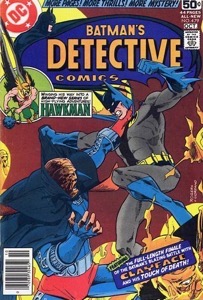
  • Detective Comics (1937) #479

    Detective Comics  479

    I wasn’t expecting much from this issue; the team of writer Len Wein, penciller Marshall Rogers, and inker Dick Giordano hasn’t impressed in their one-and-a-fifth (they did a bookend on a reprint) issues of Detective so far. Wein’s writing a sequel to Rogers’s arc with Steve Englehart, trying to maintain continuity, like Batman hallucinating a woman is Silver St. Cloud, so he shakes her. He can’t handle her breaking up with him. I think Wein’s done this issue; did he have an outline for Batman stalking Silver St. Cloud, secreted away in the DC vaults, perhaps? Pretty much nothing else makes sense from here.

    Once again, Batman’s trying to stop Clayface II, who’s trying to cure himself of being a murderous jelly protoplasm monster. Batman doesn’t care about any of that nonsense. He’s not interested in the who, the why, or the how, just the where and maybe when. It’s one of those resolutions where Batman doesn’t put the dynamite in the clown’s pants and push him in a hole to blow up, just, you know, doesn’t tell the clown he’s got dynamite in his pants–not murdering on a technicality. Englehart wrote Batman as a childish thug. Wein writes him as a callous one.

    As for the art, Rogers and Giordano occasionally have good panels. There are also lots of lazy ones; anything over a medium shot, and neither artist gives Batman a face in the distance. There are some nice moody city shots and rural road shots because Rogers does a swell job with the scenery, but the Batman fights don’t impress much.

    After that underwhelming feature story, Wein’s back to writing the Hawkman backup, which features Hawkman talking to birds, who fly him and Hawkgirl across the country or something. Like a few dozen birds getting together, lifting them into the air, and flying with them.

    It’s camp.

    Even though the story only runs eight pages, it feels longer than the Batman feature. Hawkman and Hawkgirl are back on Earth after getting kicked off their planet by the new leadership, only to discover they’ve apparently lost their jobs at their museum. There’s something strange about the new curator, who has a teleportation cape, which sets up needing bird friends.

    Rich Buckler and John Celardo’s art is mostly okay. The eventual supervillain’s absurd even for this story, and Wein’s got the same ending to both this story and the feature as far as villain reveals.

    Maybe if the Hawkman weren’t so slow, it’d be better. As is, it’s more sluggish pages in an already sluggish comic.

  • American Gothic (1995) s01e05 – Dead to the World

    This episode’s got five writers credited, apparently two different teams (Robin Green and Mitchell Burgess on one, Shaun Cassidy, Michael R. Perry, and Stephen Gaghan on the other). Guild arbitration or extreme fairness? Regardless, World works better than almost anything else with five credited writers; the episode’s all “Gothic”’s strengths, none of its… well, weaknesses is a little extreme (though not inaccurate given last episode’s teenage girl objectification issues). None of those problems here, though Barnaby Carpenter is back from last episode, now running the town junkyard.

    He’s helping Paige Turco investigate the accidental death of her childhood friend, played by Melissa McBride. Now, we, the audience, know McBride’s death wasn’t accidental. The episode opens in flashback; McBride was dating Gary Cole (then still a deputy, which is an interesting timeline), and he had her snooping on just-born Lucas Black. McBride figures out he’s the baby’s daddy and freaks out, so he drives her into the river to drown her quiet.

    The opening flashback, with the sped-up video, is the worst-looking sequence in the episode. James. A. Contner is probably the series’s best director so far, definitely for Turco. Turco’s intrepid reporter is still too bold but has a complex layer of compassion beneath it. Once she starts questioning McBride’s mom, played by Linda Pierce (quietly and eventually devastating as a Southern belle caricature), Turco pretty quickly figures out Cole’s involved somehow. Only when she confronts him he’s not too worked up about the implications.

    Cole and Black have the B plot. Black’s in an archery competition with his best friend, Christopher Fennell, and Cole tries to teach him winning’s more important than anything else. So it’s a supernatural villain figure trying to instill toxic masculinity in Black, juxtaposed against the C plot, where sheriff’s deputy Nick Searcy tries (and fails) to protect his ex-wife and son from her bastard new husband (a too soap opera-y John Shearin).

    Meanwhile, Sarah Paulson can just watch sadly as Black falls into Cole’s clutches. She and Black have an exceptional scene where he asks her about getting smarter after dying—which she’s done from his perspective, but maybe not her own. The show hasn’t gotten into the rules of Paulson’s spirit existence at all, which allows for big swings (and hits).

    Then Brenda Bakke and Jake Weber are both around a bit too. Weber is the one telling Searcy about Shearin being abusive, while Bakke’s using her role as school teacher to screw up Fennell’s chances in the contest. We finally get to see her and Cole canoodling, and it’s fantastic. We also finally get to see the new sheriff’s department set, which is solid; it’s nice they’ve got a recurring location.

    There are some 1995 TV bumps, mostly the guest star acting or just the general shot composition, but World’s finally got everything clicking, even if the regular cast’s too big for an episode. Cole’s particularly great this episode, Black and Searcy are fantastic, Turco’s coming along, Bakke’s finally to act even if briefly, ditto Weber.

    “Gothic”’s great.

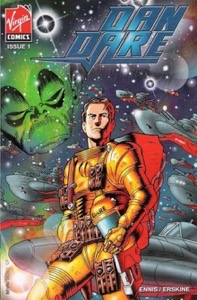
  • Dan Dare (2007) #1

    Dan Dare  1

    Dan Dare’s all about the reassuring, calming presence of the capable colonialism and patriarchy (i.e., the British Empire). I have a feeling it’s going to get even more interesting once Anglophiliac Dan Dare returns to active duty.

    The original series—the British Buck Rogers—dates back to the fifties, and writer Garth Ennis keeps with the mid-century British colonial mindset, just in the future. I can’t wait for the King or Queen to show up.

    So, former space hero Dan Dare has retired to seclusion in a recreation of the British villages of his youth. The originals are presumably all gone because the Americans and Chinese nuked each other; the British had a shield to protect them. Instead of sticking around to help out with the Cursed Earth, the Brits took to colonizing space, presumably running into an evil alien race and getting into space fights.

    There’s been peace long enough for Dan and his sidekick, Digby, to retire. Their Girl Friday from back in the day has gone into public office, so we’re not far away from when the original five-year mission ended. It’s an “Old Man Dan Dare” series, a Garth Ennis specialty; only it’s very British and not grim and gritty. Artist Gary Erskine thoughtfully updates mid-century sci-fi designs and keeps it all very English. Even when the Prime Minister is visiting an asteroid on his way to ask Dan for help, you can imagine them having tea and biscuits.

    Erskine’s art is good. There are a handful of places he’s in a hurry (Dan Dare’s from Virgin Comics, which barely survived long enough to publish the whole series), but it’s good. Besides some sci-fi space action and Dan walking his adorable dogs, most of the issue is talking heads. Digby and the former Girl Friday having a chitchat on a space station, the Prime Minister and Dan having a philosophical debate about England’s place in the world (running it, if Dan Dare has a say). Erskine does well with all that talking.

    Ennis does really well writing it too. Even though the Prime Minister is a dipshit, Dan’s at least a colonialist, if not a monarchist, if not a fascist. It’s going to be interesting to see how Ennis does this character development.

    The ending cliffhanger’s solid, while the story is basically a combination of Star Trek 1 and 2 first acts. Got to get the captain back, best destiny, and all that business. Dan Dare’s off to an ace start.

  • My Life Is Murder (2019) s03e05 – Silent Lights

    It’s a Christmas episode—or the closest (I think)—“Murder” has ever gotten. From the first scene, we find out Lucy Lawless is a Grinch, which comes as no surprise. She has a series of rambling complaints about Hallmark holidays, but basically, everyone forgot about her. Except for Ebony Vagulans and Lawless didn’t appreciate it (plus, it all happened off-screen). Vagulans is back in the apartment with no information about the Paris trip. I had a feeling it wasn’t going to be a subplot, but I didn’t realize they were going to forget it. Not to mention since returning, Vagulans doesn’t have any character development going on. She’s just comic relief.

    Ditto Tatum Warren-Ngata, as Lawless’s temporary replacement operative who’s back for a scene again. She’s gone from being part of the team to being a convenient foil; the suspect, an absolutely phenomenally bro-y Ido Drent, has never seen Warren-Ngata while Lawless and Vagulans have been around already. Rawiri Jobe’s barely around either, having Christmas-ed away. Martin Henderson, as Lawless’s brother, shows up in the epilogue, and again the emphasis is on Lawless being abandoned for Christmas. Scrooge bah humbugged one too many times.

    Oddly, the lack of material for the supporting cast is because Lawless gets some more character development. The show’s first season had her constantly coming across fellow widows, but it hasn’t been a theme lately. And it’s still sort of not because even though Lawless is interested in supporting recent widow Ginette McDonald, Lawless doesn’t share her own story, just her sympathy. Great subplot, especially since McDonald’s fantastic.

    She and her dead husband went overboard with Christmas decorations, pissing off the hipster bros and broettes who’ve moved into the neighborhood. They’re vegan, they’re influencers, they’ve got Ring cameras; it’s a hilariously itemized list of twenty-first century annoying. I don’t think Drent ever says “blockchain,” but only because no one wants to talk to him very long.

    McDonald’s husband fell off their roof while adjusting the Christmas lights; she’s convinced Drent or his wife, played Michelle Langstone, had something to do with it. Lawless finds enough oddness—and rudeness from Drent and Langstone—to investigate.

    Robbie Magasiva and Tai Berdinner-Blades play the other, sweeter but still hipster neighbors.

    Drent’s a great heel, Magasiva’s good, Langstone and Berdinner-Blades are on the negative side of flat. It doesn’t matter—they’re playing caricatures—but still.

    It’s another good episode for Lawless, and there’s plenty of excellent material for some of the guest stars, but the supporting cast is on the bench here.

  • American Gothic (1995) s01e04 – Damned If You Don’t

    Even in 1995, “American Gothic” knew not to cast an actual teenager as the fifteen-year-old Brigid Brannagh plays. It just didn’t know not to still ogle early twenties Brannagh as she plays that teenager. While, sure, it’s Southern Gothic, it’s also contorting itself to allow objectifying Brannagh, even though she’s in constant danger of rape from Max Cady-lite ex-con Muse Watson. Watson’s just out of jail and surprised to find Brannagh grown up (though he never would’ve met her before); she’s the daughter of his former employee, Steve Rankin, who’s gone on to buy Watson’s junkyard and, presumably, move into his house.

    While the episode shows off its crane multiple times for the junkyard location, it never shows Rankin’s house actually being near the junkyard. So there’s a little bit of a disconnect.

    Rankin has to put Watson up a few days as a favor to town sheriff and likely demon Gary Cole. Cole did Rankin a favor in his youth when he was messing around with the boss’s daughter; first, Cole wanted Rankin to let Brannagh work at the sheriff’s station as an intern under Cole’s wing. When Rankin doesn’t go for it, and there’s a mysterious household accident, Cole comes up with the temporary halfway house favor. Now, presumably, someone had an idea why Cole would want Brannagh as a sidekick (he’s not creepy to her), but since Cole’s always an enigma (or limited by the writers), the episode often feels too constrained.

    The A-plot with Cole and Rankin is basically just a guided “Twilight Zone” with occasional crossover to the B and C plots. B plot is Lucas Black wanting to make a tornado machine for his science fair; it’s fantastic. He gets different offers of help from Jake Weber and Cole while weighing his new friendship with cousin Paige Turco, as well as disappointing ghost sister Sarah Paulson. Black and his friends start the episode, actually, at the junkyard. The show does a great job sharing plot points and characters, like Turco questioning Rankin about her parents’ death. Of course, Watson knows something about it, but the script seems to forget. It also misplaces Watson’s family, who presumably still exist somewhere.

    Turco’s town investigating plot is dawdling, so when it seemed like Watson may pay off, it got some energy back. The stuff with Turco and Black is good, the stuff with Black and Weber is good, Black and Cole—there are no problems with the B or C plots in this episode. Not when the A plot’s got so many different ways to be problematic. In addition to the objectifying, director Lou Antonio also goes for exaggerated angles. This episode has lots of bad video editing and montages; visually, “American Gothic” ages terribly.

    Thank goodness for the actors and much of the writing (script credit to Michael R. Perry and Stephen Gaghan).

  • She-Hulk: Attorney at Law (2022) s01e06 – Just Jen

    Are self-contained wedding episodes a thing? This episode of “She-Hulk” breaks the fourth wall so Tatiana Maslany can tell the audience it’s one of those episodes. Those being self-contained wedding episodes, which—if they are a thing—I have many questions about. Like do they usually involve random guest stars with no bearing on the series, who’ve either never been on the show before or have no dramatic impact whatsoever?

    It’s a perfectly good lawyer and Maslany character development episode, but it’s also a bizarre one if it’s supposed to be a trope.

    So Maslany goes to her childhood family acquaintance’s wedding as a bridesmaid. Patti Harrison plays the bride. Eh.

    Harrison’s obnoxious (getting married on a Thursday), and Maslany wants to show her up by going as She-Hulk. But then Harrison bursts into tears, and Maslany agrees to play human for the wedding. Except then powered but not super villain influencer Jameela Jamil shows up to take her revenge on Maslany. Can Maslany make it through the episode without getting angry? Will cute boy Trevor Salter still like Maslany when she’s angry? Why so many rhetorical questions?

    Because rhetorical questions are a slippery slope.

    Anyway.

    The wedding stuff’s just okay. Kara Brown gets the writing credit, and the script goes overboard making Maslany sympathetic and Harrison terrible. I can’t remember what shitty thing Harrison’s doing, but Maslany should’ve just left at some point. Like, her only family member there is the stoner cousin, played to two or three-line perfection by Nicholas Cirillo. And then there’s a whole night with Jamil at the wedding venue (they had to get there Wednesday) where she and Maslany could bicker or something.

    Plus, Jamil’s not the show’s best casting. A little goes a long way because, at some point, she has to realize Maslany can crush her head like a grape, only she never does, even though they superpower-fought in the first episode. So it’s the part too. She’s too many contradictory kinds of bad at once.

    The lawyer plot has Ginger Gonzaga teaming up with Renée Elise Goldsberry to defend David Pasquesi in some divorce cases. Pasquesi’s known as “Mr. Immortal,” and whenever his wives yell at him, he kills himself to widow them and move on. Pasquesi’s great, Goldsberry and Gonzaga are an excellent team (six episodes in, and I don’t think Gonzaga’s actually helped Maslany on a case yet)—it’s the superhero lawyer show; it’s perfect.

    It’s just got a weird wedding thing going on next to it. Good direction from Anu Valia at least keeps the nuptials moving along.

    Then there’s a very dark cliffhanger, which again suggests Disney’s not going to shy away from the trolls in its properties’ fan bases.

    Can’t wait. Hope there’s literal troll-hunting by episode nine.

  • Werewolf by Night (1972) #20

    Werewolf by Night  20

    I’m not sure Doug Moench read much Werewolf by Night before writing this issue, which has eighteen-year-old Jack Russell walking around talking like a cheap forties gumshoe. Moench also doesn’t seem to know the bad guys kidnapped his sister because she too has the werewolf curse; when Jack goes to rescue her, the bad guy—Baron Thunder—reveals they just want his werewolf blood to make a super soldier serum.

    Pardon the expression but, like, what?

    Because Moench’s not lazy. He writes a bunch of narration for Jack. Including the werewolf fighting the bad guy for four or five boring pages. Jack’s got a ring to let him control the werewolf—he grabbed it from a rich guy who offered it to Jack’s landlady as a come-on—so he (and Moench) explain why he’s making all the various wrestling moves as the werewolf.

    Thunder’s got a scary house on a haunted hill. It looks like a haunted mansion from a cartoon. It’s absurdly silly; penciller Don Perlin works the fight scenes; he’s interested in the fight scenes. They’re boring and not very good, but he’s engaged. The haunted mansion on a hill? Shockingly bad. Even for Perlin and inker Vince Colletta. This issue reads like the book got told to go cheap on the art, and to compensate, they told Moench he could write 300,000 words.

    There’s a little with Jack and his werewolf neighbor, Raymond Coker. The cops have it out for Coker—they just happened to have decided the Black werewolf must be the bad one—but there’s also a third werewolf in the mix now, and it’s got something to do with the magic ring.

    Even with the tedious fight scene, this issue does seem like Moench is trying to resolve the loose plot threads. Not sure why he changed old lady hit woman Ma Mayhem into a Marvel seventies blonde, but it’s another change. At first, I thought Topaz was back. Nope. Bummer.

    Werewolf’s rarely renamed consistent longer than a few issues, and its best days are long gone.

    Will Moench do something interesting with it, or will he too fall victim to the curse of the werewolf (By Night)?

    It’s too soon to tell, but it’s not looking great.

  • Kevin Can F**k Himself (2021) s02e08 – Allison’s House

    Despite the title, this episode is not about Allison’s House, though there are technically two houses in the episode Annie Murphy’s protagonist could be possessive about. It’s also not really about Murphy; it is, but it also isn’t. The show’s grown quite a bit since its first episode, with Murphy realizing her life as the “too good looking for my schlub husband” sitcom wife was all bullshit and her husband, Eric Petersen, was an obnoxious, lying man child. The first season grew Mary Hollis Inboden from supporting cast to co-lead and gave Murphy a real-world character arc with high school crush grown-up Raymond Lee.

    This season’s been all about Petersen’s best friend, Alex Bonifer, realizing Petersen sucks—very simplified recap—and liking liquor store clerk Jamie Denbo, who’s stuck in a miserable marriage similar to Murphy’s. There’s some beautiful echoing between the seasons and their respective adultery arcs. In the latter half of this season, Candice Coke’s gotten a lot more to do as Inboden’s girlfriend, a cop investigating, well, Inboden and Murphy, usually unknowingly. As Petersen’s dad, even Brian Howe has gotten a character arc this season. So while “Kevin” hasn’t exactly become an ensemble show, the supporting cast has become far more critical than they started.

    House shows a Worcester, MA unlike any we’ve seen before on “Kevin”—one without Murphy—and how everyone reacts to it. The action picks up six months after last episode’s surprise finish, with Inboden playing amateur P.I. and trying to track Murphy, Lee becoming her reluctant sidekick. Coke has moved in with Inboden but is getting sick of living in Worcester and wants to leave. Inboden’s reluctant, which Coke assumes has to do with “mourning” Murphy.

    Meanwhile, Petersen’s milking his widower status, getting Howe and Bonifer to dote on him while dating the shoe girl from the bowling alley. Erin Hayes plays the new girlfriend; she makes an excellent impression in three scenes. Bonifer and Denbo are still carrying on, just at somewhat different speeds.

    By the end of the episode, everything gets resolved. There isn’t much in the way of surprises—so they didn’t introduce multiverses or time travel, like last episode briefly implied might be possible (so, no spoiler?)—just thorough, exquisite character development and acting. Show creator Valerie Armstrong gets the script credit and makes her directorial debut with the finale. She’s off to a phenomenal start.

    “Kevin”’s been an almost entirely outstanding show; Murphy and Inboden’s acting is off the charts, Petersen’s spectacular, and this season gave Bonifer, Coke, and Denbo glowing adjective turns too. The first season was a wild, dangerous ride; this season’s been a far more introspective and personal one, with the finish tying the bow.

    It’s so damn good. I can’t wait to binge-rewatch it someday.

  • She-Hulk: Attorney at Law (2022) s01e05 – Mean, Green, and Straight Poured into These Jeans

    There aren’t any big guest stars this episode; it’s all regular cast—including Renée Elise Goldsberry getting a big part after showing up in the background for an episode. Two episodes? Did I sleep through a scene in the first episode where they introduced the law firm staff? Because they really should’ve. Especially since Josh Segarra’s back this episode, and no one says his name (it’s “Pug”), so if you weren’t paying attention for his minimal involvement an episode or two ago… he’s basically just some dude.

    But forgetting the characters not being introduced by name, this episode is the law firm sitcom I’ve been waiting for. Tatiana Maslany has to go to court to fight for the “She-Hulk” moniker, and her ostensible nemesis Jameela Jamil starts a wellness brand with the name to be an asshole. Goldsberry represents Maslany and the two bond over lawyer stuff, but also the alter ego business. Their tactics are good both as legal show banter and character development. She-Hulk, the character, has an odd place in the Marvel Universe, someone who can change their appearance at will, without a secret identity; the show’s been staying pretty light on the psychology of it, but it’s nice to see it still affecting the arcs.

    Then Ginger Gonzaga and Segarra have a subplot about trying to get Maslany clothes for both She-Hulking and not. It’s a strange delayed costume reveal arc, complete with an Easter egg reminding of the last time a Marvel show did such a delay. Albeit not a Disney+ one. Gonzaga and Segarra are fun together, even if the arc’s busywork.

    Because it’s a law firm sitcom episode, not an “MCU movie star guest stars” episode. Though I’m not sure anyone’s thought out the legal ramifications of superheroes and trademarks yet in the MCU. Kevin Fiege should get on it.

    Script credit to Dana Schwartz, Anu Valia directs; it’s exactly what it should be. I’m going to be so sad if the last episode doesn’t promise another season. “She-Hulk”’s what a Marvel show should be.

  • All Creatures Great and Small (2020) s03e03 – Surviving Siegfried

    Like they heard my questions, this episode has Rachel Shenton returning to her family farm to check in on things. Sort of. There’s no discussion of whether or not she’s still working at the farm or what’s up with little sister Imogen Clawson (who doesn’t appear in this episode; I keep forgetting this season is a Rona-season). She’s instead going to ask dad Tony Pitts to get on board with Nicholas Ralph’s TB testing program.

    Other than the visit with Pitts, Shenton spends her entire time this episode hanging out with Ralph. Mostly at work. Farmer Isaac Crawford wants Ralph to falsify a cow autopsy to collect on the insurance, but Ralph doesn’t think fraud is cricket. It’s a subplot for Ralph and Shenton, giving them something to do, while the main plot belongs to Samuel West.

    The episode begins with a World War I flashback, which is never good. Andy Sellers plays the young version of Ralph, who’s in the veterinary corps and protecting the horses. They’ve just found an injured one they think they can help. It’s devastating. The flashbacks are recurring, too, because, in the present, Ralph’s going through a couple things involving his old war buddies.

    Michael Maloney, playing the old man version of Ralph’s commanding officer, has a skittish racehorse giving him problems and wants Ralph to evaluate. Depending on Ralph’s report, Maloney might put the animal down. As the present-day story progresses, with West trying to rehabilitate the horse, the flashbacks show how Sellers and Jolyon Coy (as young Maloney) squared off about the horses back in the war. Again, devastating stuff.

    The episode—script credit to Ben Vanstone—knows there are only so many times they can dunk the viewer into despair, so Callum Woodhouse gets the lighthearted subplot about trying too hard to restock the dispensary.

    Anna Madeley plays support to Ralph’s arc, the only person he’s willing to confide in. There’s a brief mention of the current war at the beginning of the episode, but nothing for Ralph to do with it. Given how much the season premiere foreshadowed Ralph’s interest in enlisting (again, I haven’t googled James Herriot for spoilers), it’s weird quickly he’s forgotten.

    It’s a particularly great episode for West, who rarely gets this kind of extensive focus and character development.

    Besides Ralph forgetting he wants to join up and Shenton not getting to establish herself post-wedding, living with her husband and his coworkers, “Creatures” is checking all its boxes this season.

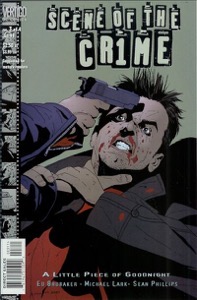
  • Scene of the Crime (1999) #3

    Scene of the Crime  3

    Scene of the Crime doesn’t exactly stall out this issue, but it definitely goes into idle. Not sure why I’m doing car references, possibly because of an ill-advised speeding car sequence, which artist Michael Lark visualizes too quickly. Our hero, Jack, has just been to a hippie commune where he’s gotten in trouble, a la Philip Marlowe (or The Dude), and he and his P.I. buddy have to make a run for it. The issue’s been building to them going to the commune to question the prime suspect. When they don’t, it seems like the revelation is going to wait. Instead, Jack gets a talkative visitor to get us to a cliffhanger.

    The issue’s lost the San Francisco personality. Not just with the road trip to the commune, but it’s rainy this issue of Crime and rainy Lark (with Sean Phillips inks and James Sinclair colors) overpowers the location.

    Writer Ed Brubaker’s got some decent moments. The best—technically speaking—is when Jack and his aunt talk in exposition dumps to help him along to the subsequent investigation scene. It’s a neat trick, though a little obvious. The supporting cast doesn’t get much personality in this issue, not those related to the murder, not those in Jack’s personal life. His ex-girlfriend reappears, and he has a profoundly narcissistic conversation with her, something Brubaker definitely isn’t doing intentionally. Again, Scene feels very much of its time.

    Right down to a jackass hipster P.I. being homophobic while wearing a fedora in 1999.

    It’s been so long since I’ve last read the series I can’t possibly remember how it finishes (the end reveal tosses most of Jack’s working theory, and the reader isn’t privy to anything more). I’m convincing myself two was the peak, however. I do remember really wanting another series, something they never did, but in addition to it being a 1999 comic, a 1999 me wanted that sequel.

    Even with the lackluster issue, it’s not bad (just problematic). Rainy Lark is glorious, and Brubaker’s got some of the better narration going.

    Maybe it’ll end just fine. As long as there aren’t more hippie communes.

    Fingers crossed.

  • Pickup on South Street (1953, Samuel Fuller)

    Pickup on South Street is not based on a novel; the opening titles have a story by credit for Dwight Taylor, with director Fuller getting the screenplay one. The film’s got a peculiar plotting and roving protagonist, plus some terrific monologues, and I was wondering if they were Fuller or someone else.

    They’re Fuller. Fuller and his actors, but it’s his script. It just makes Pickup even more impressive.

    The film opens on a hot New York City morning; on the subway. Jean Peters is hanging onto a grab handle while a couple men ogle her. Fuller really leans into the creepy guy bit for a moment before Richard Widmark slides up next to her. They share a polite smile as Widmark reads his newspaper and picks her purse.

    Fuller wanted to call the film Pickpocket, but the studio said no.

    What Peters and Widmark don’t know is the oglers are actually government agents; they’re following Peters because she’s passing secrets to the Soviets, and one of the agents, played by Willis Bouchey, saw Widmark rob her. Jerry O’Sullivan plays the other agent; he doesn’t get credit (and barely any lines), but he’s very much part of the opening sequence tension. Fuller starts Pickup tense and never lets it slow down. Even when Widmark’s taking a break at one point, he’s got to hurry.

    Bouchey heads to the cops, teaming up with captain Murvyn Vye to track down the pickpocket. Meanwhile, Peters has to explain to her creepy ex-boyfriend (a perfect Richard Kiley) about not being able to deliver the package to his boss. He’s been telling Peters it’s industrial espionage, just business stuff, barely illegal. Peters goes along with it because she was a working girl, and Kiley helped her go legit. Though it turns out his idea of legit is being a Soviet spy.

    There’s a timer on the delivery; the whole point is to catch Peters’s contact, so Vye calls local stoolie and neighborhood pal Thelma Ritter. She ostensibly sells neckties, but it’s a cover for her information racket. She’s got a personal code for selling out her fellows, an arrangement she assures everyone is understood. There’s this wonderful class tension between the cops and regular crooks like Widmark, then Peters realizing she doesn’t understand how that part of the world works, even if she can navigate her way through it.

    Ritter gets the film’s best scene, a lengthy monologue about her life at that point, struggling to save enough cash to ensure a proper burial and not Potter’s Field. Absolutely devastating stuff, with Fuller laying the groundwork for it from Ritter’s first scene. She and Peters will team up later on, with Peters and the cops looking for Widmark, and Ritter wants to make sure Widmark makes it out of this mess okay.

    The film’s a smorgasbord of phenomenal sequences, with Fuller taking advantage of a studio budget to showcase himself and the film. Widmark and Peters have numerous sweaty, sexy scenes together as they both try to play one another. Once Peters gets some context for Widmark from Ritter—and once Ritter vouches for Peters to Widmark—the relationship gets even more layers. Unlike the Ritter monologue, I couldn’t believe the Widmark and Peters “courtship” was from a novel; it’s too filmic.

    But Fuller’s also got a bunch of action sequences. There are lots of crane shots, lots of long takes with multiple actors, and a couple of harrowing scenes as the Commies get serious (and murderous).

    Even with the “red herring,” the bad guys are just greedy bad guys, and Fuller never commits too hard with the jingoism. It’s all talk for Widmark, a three-time loser who’s a week out of prison and either facing a life sentence for picking Peters’s purse or some treason charge; he’s the film’s enigma. Everyone else—including Bouchey, Vye, Kiley—explain themselves at one point or another. Widmark doesn’t; can’t. So we watch the intricate plot unravel and become clear on his face, which is one of Fuller’s best moves.

    Along with all the other great moves.

    Pickup’s surprisingly serious. Like, it’s got a happy-go-lucky score from Leigh Harline for most of it, and there are some jokes, but it’s not funny. It’s dangerous, and it’s tragic, and it’s beautiful. Fuller, with a budget, is peerless because he’s exuberant about the film, has recurring sight gags for the audience, and invites active participation and enthusiasm.

    The film takes place over about two and a half days. First day morning, Widmark picks Peters, the cops start looking for him, she starts looking for him. By that first night, she’s already negotiating to get the MacGuffin back. No one’s getting any sleep; everyone’s bouncing around with nervous and worse energy. It’s a New York movie, too; enough location shooting and solid sets (there’s a fantastic library sequence), so they’re bouncing around the big city, adding the urban isolation bit, which informs the three main characters.

    It’s wonderful.

    The best performance is obviously Ritter, who’s incomparable. Then Peters, then Widmark. Peters has a tricky part—tough girl stuck in the femme fatale role she doesn’t want to play—and does really well. Widmark’s just got to be a charming asshole who wises up to human connection.

    All the technicals check out—Joseph MacDonald’s photography, Nick DeMaggio’s cutting, Al Orenbach’s sets, Travilla’s costumes—Pickup on South Street is an outstanding motion picture, start to finish.

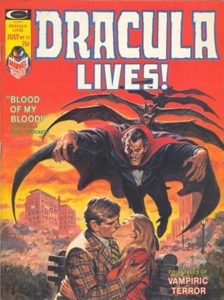
  • Dracula Lives (1973) #13

    Dracula Lives  13

    They do briefly mention Dracula Lives’s impending demise; very, very briefly. It’s an excellent finale, with a couple surprising successes, but—outside a three-page Russ Heath portfolio (two Draculas and a Lilith, with lots of nipple bumps the Code’d never allow)—it’s a very different kind of issue. Besides the letters column (which doesn’t seem to reference the imminent cancellation) and the “Marvel black-and-white magazines coming soon” (which includes all the canceled titles still), there aren’t any text pieces in the issue. Lives has had a bumpy ride, so at least they go out strong with the comics.

    The first story is a Western set in Transylvania. An Old West sheriff has-been goes bounty hunting Dracula; some rich guy’s son fell for a vampire bride, and now there’s a bounty to collect. Tony Isabella writes, Tony DeZuniga on art. It’s gorgeous, slightly experimental art from DeZuniga, playing to the situation’s unreality. Isabella splits the story between the bounty hunter’s Old West forced retirement story and tracking Dracula through the castle. It’s absurd, but thanks to the art, it more than works.

    There’s not good art on the next story—George Tuska pencils and Virgil Redondo inks combine into a bland Dracula outing, but the peculiar story more than makes up for it. Rich Margopoulus gets the writing credit, and it’s an ambitious tale. In the present, Dracula meets a hippie artist chick who reminds him of a vampire bride he had a lot of fun with a few hundred years ago. This hippie chick’s a New Yorker moved to Paris, where she finds dudes are really more interested in bedding her a few times than staying with her. On the further negative, they’re also shitty to her about her art.

    Unfortunately, there’s never a scene where Dracula likes her paintings, but it’s a fine, bittersweet tale deserving much better art.

    Then comes the surprise of the issue—Tom Sutton. He writes and arts the story of a swamp mutant and how the local normies abuse him. It’s a devastating seven pages, with shockingly good art and narrative sensibilities. It doesn’t feature any vampires, much less any Dracula; not sure if it’s coincidentally great filler, Sutton’s flexing (or just his personal work), but the story’s an incredible, devastating success. It doesn’t reinvent any wheels, instead perfects them.

    The last story is a Gerry Conway “History of Marvel Dracula” tale, with art by Steve Gan, set relatively soon after Dracula’s conversion, which means anywhere from ten to 100 years. Dracula’s still playing local despot, defending his serfs against outside aggression. He saves a village girl—collaterally, he’s trying to kill the enemy soldier—and she becomes enamored with him. Dracula’s not interested in school girl crushes, however, he’s got the other local warlords to argue with. They don’t seem to realize the vampire bit is for real.

    Conway’s always done a little better in Lives than Tomb (despite being the first Tomb writer, I think), and even though he lays it on a bit thick—the story’s about how Dracula decided to free his serfs—there’s solid character development and excellent Gan art. It took them a while, but Marvel eventually figured out these origin tales.

    It’s an outstanding late period Dracula Lives; mostly strong art, all solid or much better stories. I’m going to miss this book.

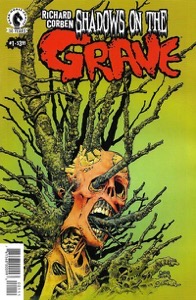
  • Shadows on the Grave (2016) #1

    Shadows on the Grave 1

    Despite having read this comic before, I did not heed Mag the Hag and was surprised when the last story in the anthology really is a straight Greek tragedy. The comic opens with Mag the Hag introducing herself—she’s Shadows’s Crypt-Keeper—and then going on at length about the contents of the issue, including the story of Denaeus.

    What stands out about Denaeus’s story is how differently creator Richard Corben plots a chapter versus a stand-alone. The other three stories are all done-in-ones horror stories; Denaeus is an epic; it’s Corben with more time to play. He has a great time with it, including a lot of humor, which would be out of place in the other stories.

    The first story is about a traveling puppet show and the incredible life-like puppets. Two little boys get curious about the puppeteer’s secret, especially after hearing strange noises from the wagon.

    It’s a somewhat obvious story with beautiful art from Corben. Whether it’s the reaction shots on the little boys, the way the action unfolds, or the haunting inhumanity, Corben does it all. It’s a great start to the comic.

    The second story is about a couple emergency landing on an island. It reads rather quickly but features some more incredible art.

    Corben’s style changes are a little different in the third story. He’s got his rounded, deep style, and then he’s got his inky style. The third story is inky. Well, some of it. He’s got a little bit of the rounded but mostly inky.

    This farmer beats his wife one time too many, so she poisons him. Only he doesn’t die. Or maybe he does die. Either way, he’s still walking and talking. The story tracks the events from a distance as neighbors wonder what’s happening. It’s got one hell of a money shot, which Corben drags out magnificently. In the first and second stories, he’s not coy; in the third story, cards are close to the chest.

    Then the Greek tragedy for fourth and the issue. The aforementioned humor comes both in dialogue and sight gags. But it’s still straight Ancient Greece stuff—Denaeus is a strong man and potential Royal Guard officer; he’s a great angle of entry for telling the story.

    Plus, there are some potentially interesting plotting decisions; while the first three stories are all about Corben’s control, the Ancient Greece one is where he’s got room to let loose. Presumably. Hopefully.

    I can’t wait to see what’s next in Shadows.

  • All Creatures Great and Small (2020) s03e02 – Honeymoon’s Over

    Having returned from his honeymoon and discovering the pleasures of the flesh, Nicholas Ralph is no longer obsessed with enlisting in the Army to fight in World War II. There aren’t even any references to it in the episode. It’s just about the changes at the veterinary hospital, with Samuel West getting annoyed at there being so many people around. The title doesn’t refer to Ralph and Rachel Shenton, while, technically, Honeymoon’s Over, they’re still in the adorable canoodling salad days, their burnt attic breakfasts giving way to… well, you know.

    Ralph also wants to understand more about this practice in which he’s now a partner, but West tries to shut down all the conversations. Thanks to some needling from housekeeper Anna Madeley, West sees an opportunity to make Ralph sorry he ever asked to know more. Except then, it turns out West never expected Ralph and Shenton to work together, and he gets even more upset about the new arrangements.

    Meanwhile, now full vet Callum Woodhouse has more responsibilities but still takes a somewhat relaxed approach to his profession. At least until he meets new customer Sophie Khan Levy, the daughter of the rival vet, who needs help with her Dalmatian. Woodhouse and Levy have a delightful arc, gentle, smart barbs, subtle flirting, and a solid veterinary case.

    The main vet case is Lynda Rooke’s calves, who have a mystery ailment, and Ralph discovers sometimes you’ve got to play people counselor to be the best animal doctor–really touching stuff between the two of them, with Rooke opening up to an unprepared Ralph. It’s got a nice echo against West’s arc, which the episode directly emphasizes a couple of times.

    Then there’s a scene with Will Thorp coming to tea after he and Madeley go for their walk, so he’s still around. Not much time for them to be cute together, but some.

    Chloë Mi Lin Ewart and Ben Vanstone get the writing credit (principally Ewart, but Vanstone did “additional material”). I remembered Ewart’s name from a somewhat disappointing episode last season, but once Over gets rolling, it’s all good. The show just needs to establish how cantankerous West will get in this new situation.

    Besides Ralph not being obsessed with battle glory, the one oddity is Shenton’s new day-to-day. Last episode suggested she was going to be still working her family farm, which could be where she’s biking home from, but the timing never seems quite right. It’s also the first episode in ages not to have her family appearing.

    That oddity’s more curiosity, though; she needs the time to be around the house to piss off West, after all.

    The last episode’s season premiere seemed a little overcooked; this “All Creatures” is on firmer ground.

  • Resident Alien (2019) s02e16 – I Believe in Aliens

    Well, they got me. After last episode’s seemingly reductive, overly saccharine stumbles, I thought I’d figured out how “Resident Alien” was going to be closing out season two. I was wrong on most counts. The arc I was most hoping would get some resolution does—it’s something they’ve literally been putting off half the split season, so it’s long overdue. Given how recurring guest stars drifted in and out, I wonder how much Rona shooting affected things.

    Anyway.

    Everyone’s back for this episode, even if they’re just background. One scene promises a Jenna Lamia and Diana Bang friendship, which ought to get a whole episode to itself. Alan Tudyk’s also got a character development arc, which isn’t particularly easy because he’s playing an asshole alien who’s cagey in his narration about himself. Thanks to the script—credited to series creator Chris Sheridan–Tudyk can get past it long enough; it’s a powerful sequence given who’s inciting the revelation.

    Without getting into the big spoilers for next season, how the episode “works” is where I was most wrong. I thought it’d be a reset point for the series, what with Tudyk rescuing his alien baby and “adopting” the almost thirty Paul Piaskowski. While those characters play into things, it’s not for reset purposes. It’s for ongoing narrative things; “Alien” doesn’t wind down to prepare for its next season; it revs the engine. Three to five revelations, double agents, double-double agents (maybe not), and unexpected alliances. The episode has to race through montages to get the setup done.

    There’s great acting from Tudyk, Sara Tomko, and Corey Reynolds. Reynolds has more than a dozen four-star one-liners and blathering monologues. It’s so many they’re either doing it to distract, which isn’t impossible, or they just needed to use all the room’s great lines before the end of the season or something. Regardless, Reynolds is hilarious. He also gets a character development arc, supporting deputy Elizabeth Bowen, who should get a bigger one but doesn’t exactly. Bowen’s excellent, and so is Alice Wetterlund, but they both get a little less than it seems like they should.

    Because the episode’s too packed with Tudyk’s full realization of the evil grey alien plan and the cosmic repercussions, not to mention the fate of planet Earth.

    The episode’s also got a fun framing device, even though it raises some timeline questions.

    While the episode ends on many an ominous note, it’s settled enough; waiting for next season isn’t going to be an antsy thing.

    Also, last thing—Robert Duncan McNeill again directs. Last time I accused him of Capricorn. This time, there’s no Capricorn, and he does a fine job. Though distracting with Capricorn also might’ve been the point….

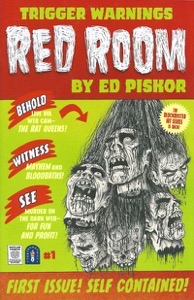
  • Red Room: Trigger Warnings (2022) #1

    Red Room Trigger Warnings  1

    The cover to Trigger Warnings #1 promises a “self contained” story, which is technically accurate–all five issues of Red Room, the first series and now this issue, have been self-contained, but self-contained’s not the same as a good jumping on point.

    Especially since this issue is a direct sequel to the original Red Room #1, checking in with serial killer turned snuff video star splatterer Davis and his teenage daughter Brianna. Since we’ve last seen them, Davis has continued his rise to fame and fortune as “The Decimator,” and Brianna has graduated high school, deciding to study journalism in college.

    And wouldn’t it be cool to get a head start investigating her dad’s weird crypto-currency lifestyle?

    Meanwhile, Davis is in trouble at work—at the Red Room—because he’s been killing women on the side. The inbred human cattle the Red Room provides for him to slaughter on camera aren’t doing it for him; he’s getting the itch for the normies. Except outside murder is forbidden, it might tie someone to the business, so Davis is in trouble with Sissy, the Red Room boss lady.

    Creator Ed Piskor splits the comic into three sections on each page. Top strip is Brianna’s story, middle is a Red Room video still with the white Republicans talking in the chat about how cool it is to see gross poor people butchered, bottom is Davis’s story. There’s some crossover between Davis and Brianna’s story, including some intentionally confusing but definitely tone-setting transitions, while the Red Room videos are independent. It’s a wild format for a whole issue, with Piskor keeping the nauseating material steady but with ebbs and flows of concern for Brianna between the top and bottom strips. Davis is terrified Sissy will punish his kid for his indiscretions, while Brianna’s just trying to figure out what’s happening in her world.

    So, while technically self-contained, not the place to start Red Room. Hell, you don’t even get a sense of how disturbingly gory Piskor makes it.

    It’s an excellent start to the new series; I wonder if Piskor’s bringing back the original cast to check up on them. The format also means Piskor’s smallest panels need a lot of detail, with Brianna going between multiple urban and rural settings; he does a beautiful job with all the art. Trigger Warnings shows no signs of being any less mortifying or grand than the original series.

  • American Gothic (1995) s01e03 – Eye of the Beholder

    There’s a slight mea culpa feel to this episode, which is really Pilot: Part III. The show’s finally ready to set up the ground situation, for real this time, and it’s going to be more accessible. There aren’t any big CGI set pieces this episode, but there’s more with crows being sheriff Gary Cole’s evil messengers. The show also remembers there ought to be some Black characters, so Jake Weber’s sidekick Michael Burgess gets the A-plot. Cole wants him to testify against Weber in Lucas Black’s custody hearing, so Cole sends Burgess’s wife, N’Bushe Wright, some kind of cursed mirror.

    To get his wife back, Burgess will have to betray a friend.

    It’s a nice arc for Burgess, who previously just nodded along to Weber’s medical dialogue, and its not too dreary ending is successful. “Gothic”’s got a problem with its cast, lead, supporting, and guest—they can only take so much before they’ll have to leave town, one way or another. Especially since last episode set up the town as the “Bermuda Triangle of South Carolina,” with the most missing persons in the state.

    Because Cole kills them, presumably.

    So it could very easily do a loose anthology format for the A-plot, with the Cole versus Weber and Paige Turco for Black’s soul being the continuous season plot. It still may. But from this episode, it appears “Gothic” will keep things entwined and dependent. It’s a well-executed story, which includes Black making a new friend in conveniently introduced boarding house proprietor Tina Lifford (also Black, so the show’s got at least two Black recurring cast members now).

    There’s some spectacular acting from Black in this episode, whose performance is a masterclass in good kid acting. Cole’s awesome, though his character’s supernatural powers are starting to raise many questions for characters and viewers alike. There are some bad nineties video editor filter montages to show when Cole’s using the powers, and since he can go into a church and be devilish… they’re racing towards needing some explanation.

    Weber’s barely in the episode (Nick Searcy’s not at all), while Turco kind of hangs out with Black, kind of wanders around her long abandoned hometown. It’s a mystery arc. “Gothic” is basically tying four strong protagonists together and hoping Cole’s compelling enough to keep moving in lockstep. So far, so good.

    While not entirely absent, Sarah Paulson doesn’t get much this episode. Including a resolution to her and Black’s “fight” last episode, which was the hard cliffhanger and was in the previous episode recap… something else the show apparently decided to tone down.

    Judi Ann Mason gets the writing credit based on her story with show creator Shaun Cassidy. Jim Charleston directs. On the one hand, Charleston’s not very good. On the other, he knows to let Black and Cole have their space. However, Thomas R. Moore’s editing is way too impatient.

    The end’s a little too neatly tied, going past not too dreary into saccharine. Hopefully, they’ll get the tone settled, as they’ve established the ground situation (again).

  • Eve’s Bayou (1997, Kasi Lemmons)

    Eve’s Bayou is Southern Gothic, but it’s got a kids’ summer story grafted onto it; by the end, the two genres are working together to great effect. I mean, the end’s got problems, but the way the film gets to it is captivating.

    The film opens with Tamara Tunie narrating from the future—when she was a kid in early sixties Louisiana and played by Jurnee Smollett, she killed her dad one summer. Right away, we get the hook, for better or worse, and it makes the father—played by Samuel L. Jackson—entirely suspicious when he otherwise might not have been.

    Okay, he spends all his time at a party with Lisa Nicole Carson instead of his wife Lynn Whitfield, but he’s just a good host, right?

    Obviously not. Obviously. Multiple times throughout the film, when one of the adults finds out Jackson is a cheating man slut, they react with exaggerated surprise, even though we meet Jackson grinding on Carson. He just happens to be a good dad to kids Smollett, Meagan Good, and Jake Smollett. Good’s about to be a teenager, Jurnee Smollett’s ten, and Jake Smollett’s the youngest. Jack Smollett will be an occasional comedic relief valve and often adorable, but he’s otherwise irrelevant to the narrative. He gives cast members something to do in the background, though he’s absent from the crucial third-act moments.

    It’s not his story.

    Despite opening with the narration and finding Jurnee Smollett in the past, Bayou widens for the first act, spending lots of time with Whitfield, her sister-in-law Debbi Morgan, and Morgan’s husband, Branford Marsalis. Marsalis is grandstanding delight in the first act; it’s a showcase, letting him be charming to Morgan, a good uncle to Smollett, and even get in drunken fisticuffs with Jackson. Morgan becomes the film’s principal female adult in the second act, whereas in the first act, she’s supporting Whitfield (at least during the party).

    Just as the film seems like it’ll stay wide, it focuses in on Smollett and her reactions to the various events going on with the adults. She also sees something she shouldn’t; when she shares that secret with Good, it works to drive the sisters apart a little. Once aunt Morgan has a vision about a kid being hit by a bus, Whitfield orders the kids under house arrest.

    Simultaneous to this house arrest is Whitfield’s suspicions about Jackson’s catting around now noticeably affecting home life. So the kids are cooped up in a layer cake of agitation. It’s just a matter of who breaks bad first.

    Smollett’s the protagonist in front of those events. Her actions, reactions, and observations drive Bayou. Luckily, she’s excellent. The film doesn’t have any shabby performances, just ones needing either more time or… well, the finale reveal calls a couple of the characters into question, even more, changing the tone before the closing narration comes in to change the tone again.

    So a couple of the performances have asterisks by them.

    But Smollett’s fantastic, ditto Good, Morgan, and Diahann Carroll (as a rival psychic to Morgan). Whitfield and Jackson have asterisks unrelated to the conclusion, just because they’re the parents in a troubled marriage from the kid’s perspective. Outstanding performances, lots of complexities, certain constraints. In addition to the aforementioned Marsalis, Roger Guenveur Smith (as Carson’s husband) and Ethel Ayler (as Grandma) are also delightful.

    Then there’s Vondie Curtis-Hall, who shows up for an unexpected romance arc for one of the adults, and he looks like a romance novel cover. He serves almost no purpose in the movie—there’s not even real character development for his love interest—but he’s terrific. The wig’s magnificent, the performance is wonderful.

    Speaking of character arcs to nowhere… despite featuring three psychic characters, the supernatural aspect’s entirely window dressing. It doesn’t actually affect the narrative, not even really in how the psychic characters experience anything. Like, they’re aware of their visions and premonitions, but Bayou avoids ever affirming their accuracy.

    Then the epilogue narration skips over all the interesting elements. So a muddy finish, but an otherwise excellent picture. Lemmons’s direction is good, her writing strong. Other than the very nineties “psychic” montages, the technicals are all good. Even the montages aren’t bad; they just terribly date the film and muss with Amy Vincent’s photography.

    Bayou’s a complicated, conflicting, haunting experience.

  • Beware the Creeper (2003) #3

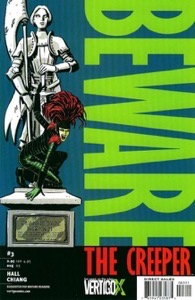
    Beware the Creeper  3

    Almost nothing happens this issue. The cop starts investigating the missing sister, thinking she’s the Creeper. He teams up with her twin, Maddy, for a combination walking tour of Paris and detective snoop. He discovers all the things we saw happen last issue, which isn’t great plotting from writer Jason Hall. Depending on the final two issues, it sure seems like Beware the Creeper didn’t need five issues. Unless they knew it’d take artist Cliff Chiang until this issue to get cooking because, wow, the art’s great.

    There are some big, complicated composition pages where Chiang’s got the Creeper hopping all over the Paris rooftops, but it’s also how the various reveals work. Before the cop starts investigating, most of the issue is just snippets of the Creeper’s hijinks, alongside contemporary reactions and media coverage. She’s the current hero of surrealism as she wages her prank war against the wealthy Arbogast family.

    Now, I have a vague recollection of the finale reveal, so I’m going to baby step so as not to spoil, but as the Creeper targets this one family, people start noticing and asking what’s made them a target. The matriarch realizes it’s got something to do with her shitty son and sends him off to Germany, where he can carouse in peace, seemingly not being as violent to the call girls there. The Arbogast son is a prime suspect in the missing sister’s assault, something the comic laid so heavily into back in the first issue I thought it was Hall doing a red herring.

    I don’t think so anymore. I think Hall’s just really, really obvious, and the setting and Chiang’s gorgeous art distract from the obvious plotting.

    There’s also not much in the way of character development. Yes, the cop is moping over the missing sister and tries to seduce her twin as a stand-in at the Eiffel Tower, but what else is a French cop going to do? Hall plays the remaining twin, Maddy, as an enigma who has at least one big secret from the other characters and the readers. Again, Hall’s pretty obvious.

    Or I’ll be entirely wrong and surprised. Fingers crossed. Either way, I can’t wait to see Chiang’s art. It’s magnificent this issue and has just been improving as Creeper creeps on.

  • American Gothic (1995) s01e02 – A Tree Grows in Trinity

    Tree picks up immediately after the pilot, only it’s been however many months since they shot the pilot, and now they’re filming for fall airdates. Lucas Black and Sarah Paulson are both a little visibly older, Jake Weber’s got a completely different haircut, Paige Turco’s costumes are better, and Gary Cole’s even eviler.

    With the previous episode, I was worried the lackluster mid-nineties CGI special effects and bewildering “horror” direction would set the tone for the series itself, regardless of the director returning. Unfortunately, the regular series seems to be doing more bad CGI effects and editing transitions with less money for the effects. More bad effects. It looks goofy.

    But it also doesn’t matter. The show survives the bad special effects, the unimpressive direction (Michael Katleman), and photography (Stephen McNutt). It excels, in fact. Not despite its technical failings but indifferent to them. Once the actors start talking, nothing else matters.

    The show’s split between the good guys—Black, Weber, Turco—and the bad guys—Cole, Brenda Bakke—with Paulson detached because she’s an ethereal being. Everyone else is a pawn in some way or another, most obviously Nick Searcy, who’s got a great, awkward scene with Weber to kick the episode off.

    There are a couple guest stars this episode: Arnold Vosloo (still during his “Renaissance Productions-only” phase) and David Lenthall. Vosloo’s an out-of-town reporter who’s got one heck of a story to tell, while Lenthall is the county coroner. He’s got to do autopsies on Paulson and her father, except Cole doesn’t want anyone finding out he snapped Paulson’s neck and whatever happened with the dad. And Lenthall owes Cole.

    Paulson doesn’t take kindly to Lenthall screwing up her autopsy and letting her murderer go free, so she causes a supernatural incident in the morgue. It’s so much bad special effects at once—and Lenthall’s bad—it seems like the show’s going to derail. But then the regular cast takes over, and things smooth out again.

    While Weber’s not on the level of Black, Cole, or Searcy, he takes it up a notch this episode as he gets to interact with Bakke for the first time. There are some nice muted character reveals and development, and Weber works them in beautifully. And Turco’s better, though she’s still just hanging around. Bakke’s Southern belle femme fatale is captivating, even if the characterization’s not without its issues.

    Series creator Shaun Cassidy again gets the script credit, with the episode really finishing up the pilot responsibilities. It might’ve been nice for CBS to let them do a two-hour premiere… or at least give them enough money to keep the effects on the same level. But, no, “American Gothic” appears it will have some lousy mid-1990s TV show CGI.

    And I do not care.

    Because the rest of it, even when the cast’s interacting with that lousy CGI, more than makes up for it. I’d forgotten TV could look terrible and still be great, thanks to the actors and writers, back when it was more filmed stage productions than segmented movies.

    Anyway.

    “American Gothic” gets great by the end of this episode. It’s incredible.

  • Superboy and the Legion of Super-Heroes (1977) #255

    Superboy  the Legion of Super Heroes  255

    In a genuinely startling event, it turns out when it comes to Joe Staton, sometimes you have to fight fire with fire—this issue features Staton’s most successful work. His inker? Vince Colletta. It’s not good art by any stretch, but it’s far more competent and consistent than Staton’s been on the book. Will Colletta be back to save the world from Staton’s pencils? Who knows, the issue feels like a fill-in.

    The end of the last issue promised a Brainiac 5 resolution. This issue also promises a Brainiac 5 resolution… for the next issue. Instead, it’s a very Superboy story for Superboy and the Legion. He’s back home in Smallville, trying to be a regular kid in the fifties or sixties or teens, except he’s just too darn super. Lana Lang is on to him, so he’s got to do hijinks while helping out at Pa Kent’s store.

    The Smallville sojourn doesn’t last long, with the Legionnaires coming back in time on a mission. Someone robbed the Superman Museum in the future, and they need Superboy’s glasses, except the future villain already came back in time and stole the glasses while he was distracted at work. They go back to the future, fight, fail, then go back to Krypton before it explodes to swipe some more Kryptonian glass, which is renowned around the galaxy.

    Why couldn’t the bad guy go back in time to Krypton himself, maybe even head to a glass factory? Don’t ask.

    There’s a funny moment when the Legionnaires ask Superboy to suit up–they wouldn’t want anyone seeing Clark Kent with some scantily clad exhibitionist time travelers. It’s unfortunately not self-aware; writer Gerry Conway keeps the plot moving, but there’s nothing to it. Clark’s bored in Smallville because it’s dull, and he’s not wrong; Conway writes a dull Superboy solo story.

    It’s a mediocre narrative, but the not-horrendous art gets it through. Staton and Collettta. I’d never have guessed it.

  • My Life Is Murder (2019) s03e04 – The Village

    I think this “My Life is Murder” is the most empathetic episode ever. When Lucy Lawless gets to the solution to her murder mystery, there’s a lot she doesn’t like about it and has feels. She also has feels because her brother, Martin Henderson, has gotten out of prison and hasn’t contacted her. He’s the gardener at her latest investigation, a suspicious drug overdose in an elite retirement community. The victim’s a former judge, introducing assassination potential, and her son, Kelson Henderson, is an entitled prick.

    Luckily, Kelson Henderson’s only got the one scene. Lawless is really investigating because Rawiri Jobe gave her the case, promising an interesting mystery—the victim died of a heart attack while on LSD. Tatum Warren-Ngata is back helping Lawless out, but like last episode’s teaser promised, Ebony Vagulans makes her return. Vagulans doesn’t have time to help out with the case; really, it’s mostly wrapped up by the time she arrives from Paris (which the show seems not to be explaining). Having Martin Henderson participate in the investigation—Lawless’s reluctant man on the inside–also changes the chemistry.

    It’s a more ensemble “My Life is Murder,” which is fine; the cast is more than enough fun to sustain it. Though Jobe doesn’t get much to do—he and Lawless are apparently on the outs, she won’t even go for coffee with him as the show continues to shroud their extra-professional relationship in bemused secrecy. The revelation of previously unknown brother Martin Henderson also causes some relationship bumps.

    However, there’s a weird scene with Joseph Naufahu and Warren-Ngata in his café; he pesters her to buy something or stop using his WiFi. I sort of assumed if you worked with Lawless, you got to hang out at Naufahu’s. It just seems like an excuse to give Naufahu a scene, but he’s setting a weird boundary with Warren-Ngata.

    All of the suspects are good. There’s husband Temuera Morrison (in a charming, brief cameo—they got him for an afternoon, it looks like), next-door neighbor Elizabeth Hawthorne, drug-dealing nurse Jessie Lawrence, and bent community manager Blair Strang. Any of them could have a motive, but having Henderson on site—doing more than gardening, it turns out—complicates Lawless’s investigation when he’s found out.

    Lots of good acting. Strang’s hilariously put out once he realizes Lawless is a cop, and then Hawthorne’s fantastic. She and Lawless have a nice character arc. Lawless handles the more emotional stuff well—her scenes with brother Henderson, for instance; it’s probably her best performance this season.