-

-

I was happier than I should be to discover executive producer Sam Raimi didn’t direct this pilot episode of “American Gothic.” Raimi and Rob Tapert’s Renaissance Pictures produced the series (for Universal and CBS), so I just figured Raimi directed the first one. But, no, it’s Peter O’Fallon. Instead of talking about Raimi being unable to direct a TV show, I just get to say O’Fallon’s an exceptionally mediocre TV director. It’s not entirely his fault; it’s the mid-nineties, and it’s TV. There’s hacky CGI to shoot for, there’s some video footage split in, and there’s whatever’s going on with Ernest Holzman’s photography. Hopefully, O’Fallon won’t be the show’s template but given his bare competence doing a genre show with supernatural special effects… it’s kind of amazing when the show gets great.
The show doesn’t get great and stay great; it just has enough great scenes, sometimes cut short by commercial breaks (still the bane of narrative flow), sometimes just gone wrong. The show gets through its rocky but compelling start by the halfway mark. In time for Paige Turco’s graveyard exposition dump to be forgiven, even as O’Fallon misses they’ve dressed Turco in a Southern Gothic hooded cape thing, and he doesn’t know how to shoot for it. “Close-ups O’Fallon” is not an inappropriate nickname.
Thank goodness he’s not back directing.
Shaun Cassidy gets the script and creator credit for “Gothic.” He’s responsible for the episode’s considerable successes, though it’s all about getting it to the right actors. Just one episode in and “Gothic” has four outstanding performances. Top-billed Gary Cole’s murderous Southern sheriff, garbage human being Nick Searcy as his conflicted deputy, Sarah Paulson as the traumatized, non-verbal girl Cole murders in the third scene (which Searcy witnesses), and Lucas Black as Paulson’s little brother. Paulson has the best moment in the episode; now a spirit, she’s called Black back to their house (and her murder scene), so she can show him Cole rape their mother ten years ago, watching his own conception.
The mom’s long dead, their dad (Sonny Shroyer) cracked in the first scene and went after Paulson with a shovel—Cole was being opportunistic in killing her—and Black’s got to know the truth if there’s going to be a show.
The episode also introduces the good guys—Jake Weber as a town doctor, a Yankee moved down South to better the place, and Turco. Turco is Black’s adult cousin (we don’t get the family tree just yet) who left town when her parents mysteriously died in a fire… their bodies discovered by Cole, who must’ve been a teenager or something. Unclear at this point.
Then Brenda Bakke is Cole’s femme fatale accomplice. She’s the good girl school teacher by dawn, Southern vixen by night. Weber and Bakke are both quite good; they’re just quite good for 1995 television. They’re not transcending like the four top-tier performances.
Turco’s just okay. It’s not a great part this episode. She’s literally inserting herself into the plot, and there’s not room. She’s got some good moments, though. Unfortunately not the graveyard monologue… Five Easy Pieces it’s not.
At the start of the episode, I was more than a little concerned with the nineties Renaissance Studios mise-en-scene (i.e., brightly lighted, artless action sequences and lousy CGI), but “Gothic” comes through thanks to writing and casting. I do hope future directors are a little better with composition, establishing shots, and spotlighting performances; the cast shouldn’t have to hoist the whole thing up, regardless of their ability.
-

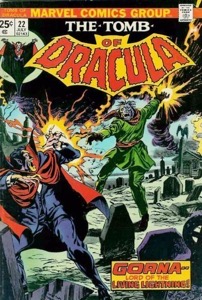
I got halfway into this issue, until Quincy Harker shows up after Lilith attacked him in Giant-Size Chillers, and stopped to go read Giant-Size Chillers, as it seems to have taken place before this issue.
But then the end of the issue says go read Chillers and then you’ll be ready for next Tomb. Dracula goes from the U.S.S.R. to England in record time, even for a Marvel comic.
Drac’s still in the Soviet Union after his encounter with Roger Corman’s James Bond villain Doctor Sun. He gets into a regional squabble with a local vampire who won’t bow to Dracula’s commands. It’s an ego trip for Dracula, who then becomes the Soviet vampire’s suffering widow’s de facto protector. The Soviet vampire, Gorna, has been terrorizing his wife since he died, feeding on her, killing her suitors, and just being a general pest. Her parents knew Gorna was a vampire but didn’t tell her, so when she thought he was dying, the wife told him off.
So now he’s torturing the wife more than he would’ve otherwise, dragging out her vampiric conversion.
Outside a very awkwardly written flashback, the wife’s not even as big a character as her parents. They’re the ones who finally confront Gorna (it’s unclear why they waited so long to actually intercede), and they have the best moments with Dracula. He’s vicious to them, but the comic can’t help but play it like a comedy beat.
The parents are also the ones who bemoan how godless Communism has made Russia ripe for vampires and all sorts of other evils, as they’ve abandoned God. It’s unclear what writer Marv Wolfman’s going for—obviously, somehow, U.S.S.R. bad, but the parents are also numbskulls. And they enabled their daughter’s abusive marriage; the husband used to lock her up for weeks on end, which the parents must’ve known about. Basically, it’s a horrible situation for the wife from every angle.
Even before her dad and his town council buddies form a lynch mob and put on skull masks to go kill the vampire. It’s entirely unclear if the family tells the town they’ve got the Lord of Vampires, Count Dracula himself, on their side.
Good art, obviously; it’s Gene Colan and Tom Palmer, and the story’s engaging. It’s a little ho-hum, especially Quincy’s whiny C plot, but an okay TOD.
-
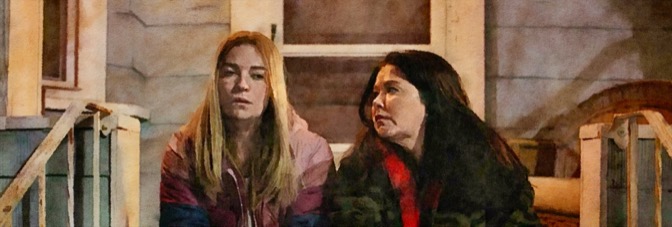
As is not uncommon for pay cable original programming, “Kevin Can F**k Himself” always ends with a teaser for the next episode. What’s coming up next week or just in general for the season; I think cable shows have been doing it for almost twenty years.
There’s not much original footage in the teaser for the next episode, the final “Kevin.” No hints for what’s to come, though there’s a throwaway line in this episode potentially introducing a whole new aspect to the show. Retroactively. Can’t wait.
But will it be a victory lap or a conclusion? This episode, which is almost entirely character development for Annie Murphy and Mary Hollis Inboden—separately, as opposed to their other big character development arcs—finishes the story to a certain degree. The show’s compartmentalized the character arcs enough next episode can have Annie Murphy waking up in the Rosebud Motel with a hangover and succeed.
The episode begins with Alex Bonifer on a bender, telling anyone who’ll listen to the wild story of his best friend’s wife who—with Bonifer’s sister’s help—tried to murder her husband. Murphy and Inboden had assumed Bonifer was safely in the drunk tank, tucked away so Murphy can go through with faking her death (she hasn’t told Inboden her reservations yet). Plus, Murphy’s got a big non-Bonifer problem: Candice Coke.
Copper Coke has discovered her girlfriend Inboden on some security cam footage before an assault and robbery (back in season one). That subplot will blow up for everyone, with Murphy needing help from odious husband Eric Petersen to ensure they don’t end up in jail. All Murphy’s got to do is convince Petersen he’s in danger of arrest; good thing he’s an amateur arsonist.
Once Murphy gets that ball rolling, Jamie Denbo tells her Bonifer’s out of jail, and the episode becomes a race to find him. Murphy’s looking for her own reasons while ostensibly doing it to help Inboden. Coke’s also looking for Bonifer, with more valiant motives; she just wants to help out her girlfriend.
Pretty much everyone gets a great scene together: Murphy and Inboden, obviously, but Murphy and Bonifer, Murphy and Denbo, Murphy and Coke, Inboden and Coke, Inboden and Denbo. Just lots of phenomenal acting as these characters can’t avoid collisions.
Meanwhile, Petersen’s hanging out at home with dad Brian Howe, thrilled to have his most able accomplice yet—Murphy.
It’s a great episode. Writing credit goes to director Craig DiGregorio in his superb debut. His directing of the performances is particularly good; both Inboden and Murphy hit new peaks here.
So, so good.
-

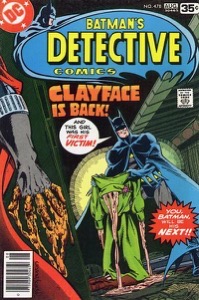
When Steve Englehart started his Detective run, he quickly settled on a fascist, macho narration style to describe Batman and his male perfection. When Hugo Strange showed up and proved to be just as cut, the two men complimented each other’s physiques and prowesses, with Strange’s evil assistant lady making fun of them.
At the time, I thought Englehart was self-aware.
Turns out he more likely was making fun of the lady for not knowing how to appreciate men appreciating men.
Englehart’s been off Detective two issues now, for some reason taking inker Terry Austin with him and leaving penciller Marshall Rogers with Dick Giordano to ink. Giordano’s an odd choice for Rogers, unless they wanted someone with the technical skill to turn Rogers’s pencils into inks without any personality or agency.
Len Wein’s writing now, and in Englehart’s fascist, macho style. This issue takes place the evening of Englehart’s last issue (which means the previous issue, a reprint with bookends, took place earlier in the same day). Batman’s pissed off because Silver St. Cloud left him, so he takes it out on some punks, beating the shit out of them like Frank Miller’s writing.
After going home—Wein’s got some weird narration details, but Batman deciding the one burglary was the only crime in Gotham for a night is something—Bruce Wayne gets mad at his parents’ portrait; if they hadn’t died, he wouldn’t have lost Silver!
Bruce Wayne yell whining, and breaking things is obnoxious.
Pretty soon, the cowl’s back on because there’s still the actual comic—there’s a new Clayface II. This one’s not a criminal but a scientist who tried to cure his congenital disabilities, which went wrong, of course, and left him a science supervillain. He occasionally has to turn people into protoplasm, blood lust a side effect of the procedure.
The Clayface II origin’s not great, but it’s so much better than Wein sorting through the Englehart refuse; it gets the comic to a barely tolerable but not terrible cliffhanger.
-

There’s only one more episode this season, so I guess some of the subplot resolutions make more sense now. For some reason, I thought there were two more episodes. This episode does Capricorn for the first time, and it’s rather disappointing. One of the season’s subplots turns out to just be busywork for a couple of the supporting cast members.
Besides that failed scene, which comes right at the end, so it stands out, the episode’s successful. There’s nice character development for both Alan Tudyk and Sara Tomko. Tudyk’s got an unexpected partner while Tomko’s got an unwanted house guest; Alice Wetterlund detoxed at Tomko’s and has been hanging out with Gary Farmer all week. That Capricorn—Farmer, Tomko, Wetterlund—it’s all good.
The episode opens with another flashback, this time to New York City almost thirty years before, which sets up part of Tudyk’s adventure for the episode. He’s got an action episode, which “Alien” doesn’t often do, and he spends most of the episode in his alien form (or at least a significant portion of it), something else “Alien” hasn’t done for a while. It’s a special effects extravaganza, ably directed by Robert Duncan McNeill. I was happy to see McNeill’s name on the director credit, but it’s going to be hard to forget the bungled Capricorn going forward. It’s the first time I remember “Alien” getting tedious, other than when they do too much country rock for the montages.
Corey Reynolds and Elizabeth Bowen both get a little to do—at least one fantastic one-liner from Reynolds—but they’re mostly just treading water; Bowen’s worried because special guest star Terry O’Quinn disappeared, Reynolds is preoccupied with a potential romantic partner and mayor Levi Fiehler’s stress-induced insomnia. Fiehler’s upset because wife Meredith Garretson is lawyering against his resort plans, leading to various people talking about his childhood sleepwalking.
That childhood sleepwalking is almost indistinguishable from the alien abduction flashback details, which seems like the show’s making a big swing regarding Fiehler.
Or not, apparently. It’s just some filler; give the town supporting cast something to do while Wetterlund’s hiding out with Tomko and Farmer. Tomko’s ready for Wetterlund to go, Farmer wants to keep playing PS4 with her. Tudyk going on a dangerous adventure upends things.
There’s good acting from Tudyk, Tomko, Farmer, O’Quinn. Wetterlund doesn’t get much to do, mainly playing for laughs, including teaming up with Jenna Lamia for a scene or two.
Big things happen, nothing will ever be the same, and it’s no wonder the show got renewed for another season, based on the foreshadowing. As long as they can keep the saccharine out, it’ll be just fine.
-

The Machine is the best episode of the season so far, which is no small feat, and one of the three best “Kevin” episodes overall. It’s phenomenal; Kate Loveless and Jasmyne Peck have the writing credit; Anna Dokoza, of course, directs. The episode runs long, around forty-five minutes, and saves most of lead Annie Murphy’s story for the end. Until then, she’s around, but almost as an extension of Mary Hollis Inboden’s “moving out” story arc with girlfriend Candice Coke.
Of course, Inboden doesn’t know Coke’s living together invitation has to do with Coke getting video of Inboden seemingly about to commit felony assault (for Murphy). But Inboden’s taking too long with the move, her first time leaving the house, and her estranged brother Alex Bonifer. Inboden’s incredibly conscious of the momentous changes in store, while Murphy seems oblivious. Murphy’s back working at Raymond Lee’s diner, though their on-again-off-again affair will get them in trouble when they collide with some of Eric Petersen’s sitcom antics. Add Coke finally acting on the video, Bonifer and Jamie Denbo having a messier than expected (and mutually undesired) breakup over Petersen, and it’s another packed episode.
Petersen’s antics—usually with dad Brian Howe checking in on the subplot—happen from the living room couch, starting with terrorizing a local newspaper reporter. Throughout the episode, he’ll use his misfortune-causing powers, tying in for the ominous cliffhanger. It’s an outstanding work, complete with Murphy’s character arc picking up in the second act as she reacts to the people around her being more than names in the end titles of Petersen’s sitcom life.
Great acting from Inboden, Murphy, Petersen, Bonifer, and Denbo. Coke and Lee get more challenging material than usual and do well with it; Coke and Murphy’s antagonistic relationship seems ready to go off. “Kevin”’s heading into its final two episodes; this one kicks off the last act, showcasing everything exceptional about the show, whether the performances, the sublime commentary on television tropes, or just the writing in general. Bonifer and Denbo’s romance continues to be a season two high point. It’s such good work.
“Kevin”’s almost done, but it’s sure not slowing down as it approaches that finish.
-

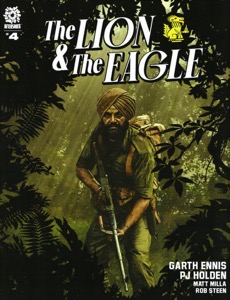
First things first: writer Garth Ennis does, as usual, get some tears from me. Lion & the Eagle #4 isn’t what I’d expected, for better and worse, but the inevitable Ennis war comic cry arrives; very last minute this time; I’d been expecting the issue to be a constant tearjerker.
Ennis purposefully avoids the consistent dread, fear, and misery to get that final surprise. This issue opens with the British Colonel talking to his Indian major about things and realizing even passive racism is terrible, and he needs to stop perpetuating it. The scene’s a big swing and a big hit. It’s a great start, followed by orders to withdraw; the operation is a failure, and it is over. The troops will have to retreat on foot through the jungle, leaving behind the wounded, something the Colonel promised his doctor pal he’d never do.
Character names aren’t crucial in Lion & the Eagle, though names being important ends up being a plot point in the extended epilogue. Despite opening the series as a character study, Ennis has become comfortable pulling back the narrative distance to a long shot. There are still lots of names floating about. Reports, whether status or casualty, are the majority of the talking heads scenes.
The talking heads scenes are where artist PJ Holden loses the book. He leans into the efficiencies he’s been developing as bandaids throughout the series. Instead of expeditiously getting the comic through an otherwise slow scene here and there, the entire issue is bland talking head panels. Worse, Holden’s rushing through the faces and expressions. At one point, letterer Rob Steen assigns a balloon to the wrong person in a long shot, and his confusion’s wholly justified. Even in long shots, with the characters wearing very different outfits, Holden’s composition’s muddy.
Thank goodness for the script. The issue’s a whirlwind, with the Colonel realizing command means not being able to keep promises, which has all sorts of repercussions for his relationships. There’s a great flashback to him visiting his Indian major’s village, too. Ennis has got some fantastic moments throughout.
And the finale’s good. Ennis brings all the Colonel’s character development (i.e., realizing imperialism is bad, actually) together and loops around to the first issue. Sort of a “and what did we learn today,” but outstanding.
I’d been hoping Lion & the Eaglecould bring Ennis up to the next level. It’s unclear if Holden held it back or if Ennis just hasn’t gotten there yet. Based on how much character development he saved for the final issue, I’m guessing the latter, though the former sure doesn’t help.
Still, the comic’s going to be a superb single-sitting read.
-

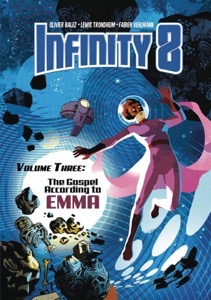
In theory, Infinity 8 is going to get exponentially more complicated as it progresses. With the conclusion of this volume, The Gospel According to Emma, the reader and the Infinity 8’s captain know almost nothing more about the solar system-sized space mausoleum the ship’s investigating. It’s not the captain’s fault, of course; like always, he and his sidekick call an agent up to the bridge to go over the mission, explaining how time will reset in eight hours. It’s not the captain’s fault the agent they picked—Emma O’Mara—is a zealot hell-bent on dooming everyone onboard the vessel for her religion.
Emma’s not just an agent either; she’s a Marshal and a celebrity. She’s not even supposed to be working—or so the ship’s officers think—she’s just another passenger headed across the galaxy. But she’s actually conspired with her religious sect to sabotage the vessel in order to discover a secret about her religion. There are various sects, all believing something different about their prophet’s final message—because it’s missing. Well, if the prophet had the message on him when he died, the prophet’s somewhere in that space graveyard.
Everything dead is somehow somewhere in that space graveyard. There’s some talk from the first officer about an intention at the center of the mausoleum, but Emma’s not really listening because she’s got almost a dozen coconspirators to check in with. In addition to everyone knowing Emma’s a badass Marshal, they also know she’s a pious one; three Infinities in, and Emma’s the only one the first officer doesn’t perv on.
I mean, he doesn’t have much time before she zaps him, but still, turns out there’s a limit to his inappropriateness.
Emma’s coconspirators are bankrolling the endeavor, as her sect apparently doesn’t have the available cash to do so. They each want something different from the space graveyard, which a psychic divined. So divination’s real in Infinity 8 or at least possible. Since we don’t know if time travel exists yet, there could also be an easy explanation for the fortune-telling.
Writers Lewis Trondheim and Fabien Vehlmann craft an action-packed suspense thriller, with Emma moving from ally to ally, enemy to enemy, making significant discoveries about the nature of her religion, reality itself, and herself. The volume’s got the most character development in an Infinity 8 so far; Emma’s religious journey, not to mention the trials of her subterfuge and insurrection, make for one heck of an arc. Plus, there are numerous villains in this arc. There are coincidental villains—like the robot trying to determine whether or not an interrupted message means to kill Emma or not—and there are deliberate ones.
And then there are the wanted criminals who Emma comes across in her daily life. Assembling her own “Dirty Nine” gang of tomb raiders seems like it’s going to bite her from the start (she starts getting suspicious almost immediately), but it takes a while for the actual villains to reveal themselves. Their motives even longer.
As usual, it’s eventually up to Emma to save the galaxy; she just happens to be in a pickle because she’s already betrayed her space cop badge to be a fundamentalist terrorist. Not to mention the story’s time limit’s built-in.
Lots of tension, absolutely no time to relax. Unlike the previous volumes, thanks to Emma’s zealotry, she doesn’t ever get to have a personable moment. Instead, she becomes personable through her volume-long character development. It’s excellent work from Trondheim and Vehlmann on the script.
Olivier Balez does the art this volume; it’s very different, warmer, cartoonier, with great enthusiasm for the various alien species. Balez maintains that enthusiasm, whether the aliens are being funny, evil, or getting lasered in two. Balez gets a lot of tones to move between, from macabre space archeology, robotic battles, standoffs, heists, double-crosses, triple-crosses, and religious melancholy. Gospel runs the gambit. About the only thing wrong with the art is it ends too soon; Balez could’ve gotten at least another page out of Emma’s finale.
So, while there are promises for future Infinity 8 volumes—we find out another piece in how Earth came to be destroyed this volume, the most information yet—Trondheim still hasn’t revealed enough to tip any scales.
Emma’s not even halfway through Infinity; Trondheim and his collaborators have more time ahead than behind; anything could happen, so long as it involves space graveyards and capable agents. The possibilities are almost… infinite.
Can’t wait.
-

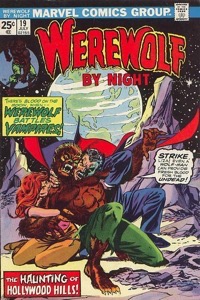
The Gil Kane, Tom Palmer, and probably John Romita cover sells this issue as Wolfman Jack versus vampires on the moon. But the interior art isn’t Kane, Palmer, or Romita; it’s Don Perlin and Vince Colletta. Wolfman Jack versus the vampires is actually on a movie set, tying into a Dracula Lives story about a hacky Dracula actor going on a murder spree before the real Dracula kills him. Writer Mike Friedrich’s a real trooper, doing a sequel to another series’s story, one he didn’t write (Marv Wolfman wrote the first one).
I think Perlin might be trying with the composition, but it doesn’t work out. He’s got no rhythm to the fight scene, which isn’t a surprise, but he’s enthusiastic, which is both a surprise and unfortunate. Between Friedrich and Perlin, Jack in his human form is doing acrobatics, and as the werewolf, he’s… it’s hard to say. At least an unlikely jump kick makes visual sense; the werewolf versus vampire fight, not so much. Not with the Perlin.
The Colletta inks are dreadful, as one would expect. Every once in a while, there’s a very detailed panel, and it’s clear someone tried, Perlin or Colletta, and got there. But it’s a handful of panels; every other panel’s terrible. Some middling competence can’t overcome it.
Friedrich spends half the issue checking in on all the subplots. There’s kidnapped sister Lissa, who Jack’s having a relatively easy time tracking (he finds torn clothing on a fence at one point), there’s next-door neighbor Raymond Coker, who’s got a big secret of his own, there’s meddling copper Lou Hackett, who doesn’t appear thank goodness, and there’s Jack’s nymphomaniac apartment groupies, who try to seduce him or something. It’s so weird. Though also, it’d be fascinating if it were thoughtful.
Coker and Jack have a showdown, with Coker explaining he’s worked his way over from Jamaica, leading Jack to acknowledge the difficulty of that situation. Far cry from when Wolfman had Jack be a (seemingly unintentional) shitty racist to Coker.
But then one of the girls has an emergency at the studio, which relates back to the lawyer for the big game hunter’s movie producer brother, who tried to kill Jack and kidnap Lissa a long time ago. It leads to the vampire fight, then an overly dramatic cliffhanger.
Friedrich’s got a rocky start; he likes framing in flashbacks too much, and Jack’s always way too surprised when there’s a full moon; it improves as it goes along. Coker and Jack may be the second relationship we’ve seen develop on page in Werewolf, so it stands out. Especially with the cliffhanger.
Of course, the issue’d be incomprehensible for a new reader. Story for the content, art for the “do people really read a book with Don Perlin drawing werewolf fights?”
Yes, yes, we do. No questions, please.
-

“Liza with a Z” closes with a Cabaret medley, including Liza Minnelli playing the Emcee for a couple songs. She starts in the audience, a la the “Cabaret” Broadway revival (only twenty-six years before), and quickly works her way onto the stage, joined by dancers, and does a whirlwind ten-minute set. The opening titles tell us “Z” is a “concert for television,” and it’s fascinating to watch how Fosse presents that concert.
“Z” is a spotlight for Minnelli as a singer, dancer, actor, and personality. The special’s title comes from Say Liza (Liza with a “Z”), a half colloquial memoir song where Minnelli describes her frustration at people calling her “Lisa.” It’s a hilarious, personable number and showcases Minnelli’s ability to toggle between tones. She can go from soulful to goofy to sweet to sexy (pretty sure she, Fosse, and her costume designer created go go sultry in “Z”) in less than a breath.
The medley is the first time the special directly references Cabaret, though “Z” is very much an offshoot from the film and its success. Some costumes occasionally feel a little Cabaret, but the special doesn’t open with it. Minnelli never addresses the audience as an audience, never telling them eight cameras are filming this evening’s production. At the beginning of “Z,” Fosse and cinematographer Owen Roizman shoot Minnelli as subject. It’s not about the audience; they just happen to be there for Minnelli’s performance.
For a couple numbers, Minnelli looks up towards the balcony (but also the cameras), not out at the audience below her. Fosse looks back down at her. But then, very deftly, the camera starts watching Minnelli looking up to the overhead cameras; we watch Minnelli sing from the wrong camera, only to quickly discover there’s no wrong camera. Every different shot’s going to reveal something else about Minnelli’s performance.
Once the stage fills with dancers, Minnelli starts directly addressing the audience, sometimes to set up the next song, sometimes to take a bow; there’s a spectacular Son of a Preacher Man number, ending with Fosse doing some incredible sleight of hand with the dancers. “Z” might be a filmed live performance, but Fosse and Minnelli are packaging it for the television audience. Or, frankly, theatrical. Fosse and Roizman shoot Minnelli as the only visible figure surrounded by darkness a few times, and it’d be devastating on the big screen.
There are some bumps, of course. Preacher Man is the last great number until the medley; after its commercial break, there’s a cute song about New Yawkers in love, including Minnelli and the dancers acting out a bunch of it. But it’s not a showstopper; it’s just more examples of Minnelli’s remarkable abilities.
The real problems are the last two songs before the medley sprint.
First is You’ve Let Yourself Go, which could be the anthem for the “Are the Straights Okay?” meme about a wife sick of her husband getting bald and chubby. Then comes My Mammy, a song Minnelli would regularly perform as a standard, all about how your slave mammy always loves you. I guess it’d be worse if it were a white dude singing it (as they often did), but yikes. Thank goodness Fosse and Minnelli weren’t pitching a musical Gone With the Wind… someone might’ve said yes.
Fosse tries with Let Yourself Go, using some of the spotlighting techniques he’d already iterated, but Mammy’s just a simple “it’s a variety special” number. Thank goodness. Hopefully, the blandness will make it forgettable.
The medley saves the day; the commercial, cross-promotional medley to remind people they really liked the super-depressing pre-Holocaust movie (or to encourage people with peppy dance numbers to see said film) is one hell of a way to save the day. But it works because it’s Fosse and Minnelli.
Like its star, director, cast, and crew, “Liza with a Z” is phenomenal.
This post is part of the Fifth Broadway Bound Blogathon hosted by Rebecca of Taking Up Room.

-

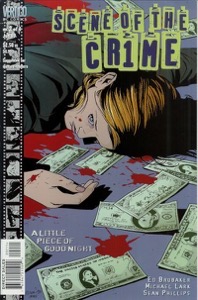
I was going to say all writer Ed Brubaker needed to do to completely tie together all the San Francisco crime eras was a grandfather in a wheelchair in a greenhouse, but Big Sleep’s L.A. Scene of the Crime is all San Francisco, all the time; Brubaker knows what he’s doing too. This issue introduces lead Jack’s old buddy Steve, who’s also a P.I. Steve once gave Jack a tour of Dashiell Hammett’s San Francisco; when Jack became a P.I., Steve followed suit and looped him. Steve gives Jack information from his fancy international detective agency.
It’s a trope going back to Hammett, if not earlier. But it’s a knowing one and well-executed. Michael Lark’s pencils (now with Sean Phillips inks, which I’d forgotten) take their meeting out of time, like private dicks who lose their pretty blonde clients to violence and get big sads about it are eternal. Great colors from James Sinclair too. Phillips’s inks add a moodiness to the issue, although some of the dreariness is due to the circumstances.
The issue opens with Jack going to a murder scene, the motel he’d just left, with his crime scene photographer uncle in tow. The uncle can get Jack information about the case, whereas Jack just pisses off the cops. At least until the detective shows up and Jack tells him all; Jack telling all is going to be a recurring theme in this issue; he doesn’t have any secrets at this point. Other than the actual client being his cop buddy’s mistress.
Or not really his buddy; his relation. Jack goes to question him, goes to question his client, her mother, the hippies from last issue. Only the hippies have left, the mistress is indisposed, her mother’s not interested in Jack’s help, and the cop buddy doesn’t know anything. Brubaker’s got the formula down—visit the various characters, find answers to questions no one’s asked, and then try to piece together how it all fits together. Classic detective novel, just set in nineties San Francisco.
Though there aren’t any computers around so it could be anytime San Francisco, though the city’s hippie history is about to play a significant part in motives and so on.
There is a super icky moment where Jack whines he can’t be a cop because he’s incapable of shooting anyone, but he means it as a bad thing; the copaganda’s strong, so it’ll be interesting to see if Brubaker does any dirty cop tropes.
The first issue was mostly engaging, occasionally too forgiving with the first person narration—Brubaker’s better this issue, with Jack plunging headfirst off the wagon—and a neat variation on a theme. This issue shows Brubaker’s got more up his sleeve than smart homage, and Lark, Phillips, and Sinclair are keeping pace. Scene of the Crime just got really good.
-

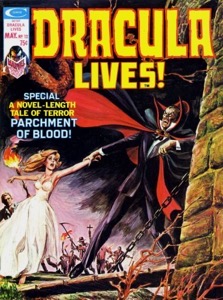
No mention of Dracula Lives!’s forthcoming cancellation in the letters page, nor any explanation for the Bram Stoker’s Dracula adaptation skipping a month. Instead, the issue seems committed to origin stories; how Bram Stoker’s Dracula became the Marvel Universe’s Dracula. Or, in the case of Doug Moench’s three-part feature, how Marvel’s Dracula became Bram Stoker’s Dracula became Marvel’s Dracula.
Moench’s story is set in 1597, which is only important compared to Gerry Conway’s set in 1465. Moench’s Dracula is a sad, solitary sort. He hangs out in the castle, writing in his diary, whining about how he can’t find any good human blood these days. The villagers have gotten wise to Dracula being a bloodsucking vampire, though it turns out there’s plenty about vampires they don’t know yet.
While Dracula mopes, a stranger comes to town and offers to ride the village of Dracula for a thousand gold coins. He’s going to wait until Dracula comes to the village to feed, then head up to the castle and try to find some way to kill him. Except on this particular night, Dracula’s really, really pissed the humans are staying inside instead of coming out to be fed on—don’t they know he can’t enter a domicile without an invitation!
They do not, of course, because they don’t even know Dracula’s afraid of the sunlight yet. Or his aversion to crosses. Drac’s got a few surprises up his sleeves for the villagers, not just near the castle but also in a second village where he goes to feed the next night. But the stranger is somehow one step ahead, preparing those villagers for the attack; dejected, Dracula commits to his new role as lord of the undead and gets busy raising an army.
There’s a different artist for each chapter. Sonny Trinidad does the first; he and Moench have done some nice Lives stories. Trinidad’s work is quite nice this issue as well. Yong Montaño does the second part, which features Dracula and the new villagers, but also the first villagers getting too cocky. Montaño’s decent enough, but more on the people than the vampire. He’s got a comedic sensibility, and it doesn’t work here.
The third artist is Steve Gan, and it’s full Gothic horror. Beautiful stuff. However, his Dracula’s not as good as Trinidad’s. You’d think they’d have just ordered everyone to ape Gene Colan at some point.
Moench’s very intentional about Dracula’s character development. At the story’s start, Dracula’s a withdrawn, self-loathing monster. By the end of the story… well, he’s in a different spot. It’s an excellent feature and Moench’s best writing on the series. Does it make up for the missing Dracula adaptation chapter? Sure, fifty years later; at the time, I think I’d have been concerned.
Moench also contributes a text piece about Christopher Lee. It’s long, detailed, and enthusiastic because Moench’s a fan. It’s unclear why, however, since he seems to agree Hammer movies stink and Lee mostly made Hammer movies. The article’s disconcertingly spread throughout the magazine, presumably to make room for more advertisements.
The second story is the Conway one. Set six years after Dracula’s transformation to vampire and over a hundred years before Moench’s, this Dracula still has vampire orgies. He decides to go on a culinary trip and messes with the wrong German, who vows to avenge his sister’s death at Dracula’s hand.
Fang.
Whatever.
So Hans goes to kill Dracula in Transylvania, but times it wrong for vampire-killing success. Still, it’s warm and sunny, and Hans falls for a fetching local girl. Will Hans’s thirst for vengeance ruin their romantic bliss? Will it somehow tie into Tomb of Dracula? Will Conway bull in a china shop his way through the subtleties? Will it even matter?
Just to answer the last—no, it won’t matter, none of it will matter. Tom Sutton does the art, and it’s terrible. The story’s ten pages, and he manages to get worse every page. It’s indescribably bad art and a lousy way to finish an otherwise outstanding issue.
-
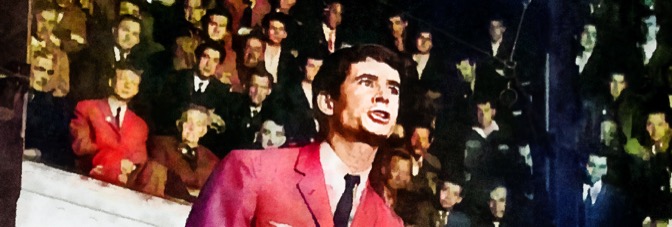
Given how much writer, director, and special guest star Welles cares about performances—not only does he dub over one of the other actors, he steals a juicy monologue from Michael Lonsdale—one would think he’d have seen the problem with star Anthony Perkins. Because everyone’s looping their dialogue in The Trial, Perkins gave this performance at least twice. But probably more. And it never works.
There are contexts where Perkins’s performance could work. Had Welles turned the film into a Fox melodrama, a la Peyton Place, with aw-shucks Perkins discovering the realities of the American legal system, it might’ve worked. Not sure how all the ladies throwing themselves at Perkins would work then, though. It might’ve just been easier to get a different lead.
Perkins plays the part like he’s Jimmy Stewart gone to Washington; only Welles’s adaptation of the source novel doesn’t let time progress or characters develop. I had to check and see if the end’s the same as in the novel (it’s not, Welles made a very, very bad choice), and it also turns out the novel takes place exactly over a year. The movie takes place over a… week? Two? There’s some suggestion of time passing late in the second act. Still, since Perkins is an erratic, obnoxious American in some vaguely Eastern European city, he could also just be an entitled, impatient asshole.
Welles breaks out the film as a series of vignettes, which is nice because it helps compartmentalize the more and less successful scenes. Even with Perkins Mayberrying his way through the film, Welles is fully committed to the adaptation and busts ass. In addition to Perkins, Welles also has to contend with wanting cinematography from Edmond Richard. Richard’s lighting is so universally flat and bland, so ignorant of shadow, it gives the impression there wasn’t time or money for anything better. They’ve got the nifty sets—Jean Mandaroux doing the art direction—and Welles has all sorts of neat shots, but there’s no personality.
It’s so flat it’d be better in color. At least there’d be some insight into what the characters are experiencing in their nightmare world. We see them, but we never see how they see one another. It might also explain why every woman in the movie throws herself at Anthony Perkins, ranging from his widowed landlady (Madeleine Robinson) to a couple dozen tweenage girls. In between, he romances Jeanne Moreau and Romy Schneider the most seriously.
Actually, wait, there’s also Elsa Martinelli. I lost count.
Perkins isn’t surprised at being irresistible, either. It’s apparently the norm for him, which suggests a far more lurid prequel, which Welles might’ve enjoyed directing. He tries his damndest to make Perkins and Schneider’s romantic interlude play like an exaggeratedly overt Hollywood melodrama. It’s never sexy because the women all have ulterior motives, and Perkins knows it and plans on bedding and abandoning them.
While Perkins disappoints, the rest of the cast is mostly excellent. Moreau, Schneider, and Akim Tamiroff are the standouts. Welles’s extended cameo is just okay. He under-directs himself.
The Trial’s fascinating. It’s long, it’s repetitive, it’s confounding, but it is fascinating as well. The use of music is outstanding; Jean Ledrut composed. The editing’s okay—better than the cinematography—but the cutting sometimes overcompensates for Welles not being able to do something because of budget.
Then there’s the ending. Of course, Welles had his reasons for changing the novel’s ending, but if he was going to do something so silly, why didn’t he end it at Stonehenge (where the demons dwell)?
But then, thanks to Welles being Welles, the film pulls up just a bit through the end credits—narrated by Welles—for a better landing. He just needed to remind everyone he’s Orson Welles, and he made this picture.
This post is part of the 2022 Classic Literature On Film Blogathon hosted by Paul of Silver Screen Classics.

-


X Isle ends worse than expected. The screenplay or treatment adaptation got to the point where the original writer was hoping the director would love to do an Aliens but robots sequence. Instead, in the comic medium, it goes from discovering the evil robots with tentacles who are actually just doing their job (zookeeping) to the alien nav computer revealing all the secrets and someone saying the robots are getting closer. It’s awful comics, which is too bad since this issue’s got the first time artist Greg Greg Scott gets to do an actual comic page and not (at best) a movie adaptation.
When the robots wake up and start collecting the loose animals (including invading humans), one has a cute but cruel scene. But with word balloons and motion implied between panels and reaction shots. Oh, Scott does reaction shots other places this issue, but they’re between two indistinguishable white men. Tim Allen and someone dramatic or Ashton Kutcher and someone dramatic, playing against type, maybe. Ashton is whining on about how coming to save Tim Allen’s daughter got Sam Jackson killed last issue, and now it’s going to get Ashton killed this issue. Tim Allen tells him to man up or something so they can rescue the obnoxious daughter, who’s fighting little monsters who want to eat her and talking about how she needs to live to lose her virginity.
Every line of dialogue is terrible in this issue. Maybe co-writer Michael A. Nelson just gave up. Hopefully, he just gave up, and this dialogue isn’t supposed to be good work. The art’s not bad overall, but it’s not impressive. Besides that robot sequence, those two pages were better art than the rest of the book combined. For a moment, I thought it was going to get good. It reminded me of the Lost in Space movie, and I was thinking, you know, it’d be better than whatever they’re going to do.
What’s so strange about X Isle is it’s a lousy spec script. It’s a bad treatment. But it’s targeting a Roland Emmerich-type who wants to cash in on “Lost” being a hit on TV. But not Roland Emmerich because it’s relatively low budget. It’s like a Sci-Fi movie spec script, actually.
Maybe I’d have watched it with Bruce Campbell in the lead? As Tim Allen?
Otherwise.
It’s pretty bad. X Isle’s pretty, pretty bad.
-

This episode down-shifts the action a little, leveraging returning guest star Benedict Wong—who star Tatiana Maslany frequently breaks the fourth wall to comment on appearing—without moving any of the subplots forward. Other than Mark Linn-Baker’s too understated sitcom dad in the real world bit. He shows up for a scene to Wrecking Crew-proof Maslany’s apartment after the attempted assault last episode. No straight-to-the-heart and twist zingers for the incel bros this episode, but Maslany does get in a fun “what’s Twitter complaining about?” comment in.
Is that Earth-616 Twitter, Earth-199999 Twitter, or our Earth Twitter? I really want to know the rules behind references in the MCU; I hope we find out all the twists, turns, and hurdles someday.
A bad (as in, bad at his job) stage magician named Donny Blaze (unclear if he’s Johnny’s brother) has been using actual magic to add some oomph to his shows. He starts teleporting random audience members, usually women in short skirts, into other dimensions. One, played by Patty Guggenheim, fights her way through a demon dimension while making bargains and having adventures, escaping to Wong’s living room just in time to spoil “Sopranos” for him.
Rhys Coiro (director Kat Coiro’s husband) plays Blaze. He’s a complete dipshit, which is one of those strange casting choices. Leon Lamar plays his enabling sidekick. They’re both fine but somewhat lackluster compared to Wong and Guggenheim. Guggenheim’s hilarious as a party girl with a heart of gold; she ought to get a spin-off. They should at least do a special about her fighting her way through Hell, Vormir, or wherever.
Wong does a lot with a little; he’s mostly reacting to Guggenheim being fabulous and Rhys Coiro being scummy.
The subplot has Maslany reluctantly starting to date in her big green persona, which proves to attract a different caliber of Tinder match. Michel Curiel plays her dreamiest match. They have a wild night out.
“She-Hulk” is on entirely solid ground now, but—even more than “Ms. Marvel”—it feels like they’re making a TV show here, meaning a second season should be in order, especially if the MCU movie guest stars are going to do two-episode arcs. At the same time, the guest stars—even the tangential ones—are distracting from the regular law firm cast. Ginger Gonzaga’s the only one to show up here, again entirely support for Maslany, with no one else making the cut.
It’d just be such a perfect way to comment on the overall MCU (Wong makes a good Spider-Man: No Way Home reference at one point).
-

Since “My Life is Murder” started as a relatively straight Melbourne-based mystery procedural, I don’t know if they would’ve done a horseback riding episode first season. I don’t think they did one last season. But they have so much fun with it this time; I imagine it has to be because star and executive producer Lucy Lawless wanted to ride horses against a beautiful New Zealand backdrop. This episode’s mystery involves a stud farm—of the equestrian variety—which provides lots of opportunities for breathtaking scenery and beautiful horses.
The show’s either an advertisement for New Zealand to the point they ought to suggest B&Bs, or it’s all a humble brag about how much better things are there than everywhere else. Except for the murdering, of course. There’s lots of murdering about.
Lawless’s regular sidekick, Ebony Vagulans, is still pretending to be in Paris this episode, so Lawless again has new sidekick Tatum Warren-Ngata. Not sure how they’re going to handle having both of them around (the teaser spoils Vagulans’s return). Lawless and Warren-Ngata continue to make a good team. Lawless has a fine foil in most of the episode with old curmudgeon Roy Billing, leading to Warren-Ngata getting into trouble. Warren-Ngata’s on leave from the Navy; I guess she can come in and out as needed.
Anyway.
Billing sort of runs the stud farm because new owner Te Kobe Tuhaka is a sharp dresser but not a horse studder. Tuhaka’s dad started the business, and Billing worked for him. The dad also semi-adopted Steel Strang, whose murder kicks off the episode. It looks like a horse done it, but Ramiri Jobe found some contradictory evidence. It’s contradictory enough that it’s unclear why he’s having Lawless do the case off the books since it’s like, you know, evidence.
There are several suspects—the horse, obviously, Billing, Tuhaka, Tuhaka’s estranged sister, Miriam McDowell, stud farm human stud Jono Kenyon (who immediately cozies up to Lawless), and studding scientist Jessica Grace Smith. The solution will involve almost all of them; very intricate plotting; Stacy Gregg gets the writer credit.
Overall, it’s another solid episode. Lawless and Billing have a great time together (so do Lawless and Kenyon). There are a couple character reveals for Lawless; one secret she’s keeping from Warren-Ngata (and the audience), then another secret she’s keeping from everyone (but the audience).
-

Last season’s Christmas special ended with World War II getting started (or as close as they could get to the war starting without it starting); this season begins with the recruiters in Darrowby, but the vets are exempt from service. It’s a running subplot throughout the episode, initially very gentle, as Nicholas Ralph discovers you can override your exemption and opt-in. Everyone else starts wondering why he’s so keen.
Because it’s not a “James Herriot goes off to war” episode—one thing about “All Creatures” being based on memoirs is you could just google and spoil the story; I’m going to let myself be surprised, or not. No, it’s a wedding episode. Ralph and Rachel Shenton are heading down the aisle, complete with bachelor’s night at the Drovers, Ralph’s parents coming to town (Gabriel Quigley and Drew Cain have surprisingly little to do), and everyone worrying Shenton’s going to have second thoughts again.
There’s a lot of nice character stuff for Shenton, with the various people in her life asking how she’s feeling about this wedding, including little sister Imogen Clawson, who’s ready for Shenton to move out (even if Shenton isn’t), vets’ housekeeper Anna Madeley, and, of course, dad Tony Pitts, who gets gruffer and more adorable every episode.
But Ralph’s arc is muddled, partially through intentional obscurity (the enlistment subplot), partially because part of the story is Ralph, Samuel West, and Callum Woodhouse getting blackout drunk at the Drovers for the bachelor’s party. Madeley’s got to get them motivated and moving, with a veterinary case making it hard to make the church on time.
The episode feels more like a special than a season premiere, with nothing really being established for what’s next. There’s also this weird moment when Woodhouse comments on Ralph’s Brobdinagian sense of duty, based on something in the veterinary case, but the example was someone class shaming Ralph, not his sense of duty. It’s a disconnect.
The episode’s good; the performances are rock solid; nothing feels off; it just doesn’t feel like we’re really back in Darrowby yet. Even the Tricki Woo (essayed, as ever, by Derek) cameo feels too forced for a regular episode but just right for a summer special.
It also might just be the “missing wedding ring” subplot, running through the entire episode, is the closest the show’s ever gotten to saccharine. “All Creatures” has always been exceptionally well-balanced (save a couple times), and it’s always weird when they go too far.
-

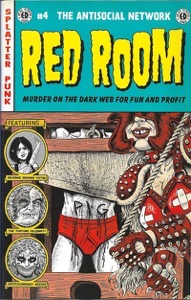
I don’t know how creator Ed Piskor is going to keep it up with Red Room. Sure, he’s doing four issue volumes, but does he have an overall plan? I suppose I could’ve read the back matter. Because, as usual, Piskor finds an entirely new way to slice the comic, this time following the story of one Raina Dukes. In the eighties, pre-Internet, her father’s snuff video was infamous. In Piskor’s most unrealistic plot detail, the U.S. Government passed a law requiring possessors of such materials to pay restitution to the victim’s family. He tries to make it realistic as a ploy by the convicted rich and powerful to get time off their sentence.
So, Red Room takes place in a universe where the rich and powerful get convicted. Sure, Jan.
Raina’s spent her life preparing to take revenge on the woman who killed her father on camera. First, the “Crypto-Currency Keeper” tells us her story, followed by the story of the murderer, followed by the “Tales from the Crypt”-esque conclusion.
Again, as usual, it’s fantastic. In terms of done-in-ones, it’s probably the best issue. Piskor’s got great pacing for both stories, with the murderer’s origin filling in some details of how the Red Room started. The art’s phenomenal; Piskor leans into the horror comic narrator with the Keeper, but Raina also does first-person narration of her story. There are a couple surprises, though when the Keeper tells the reader not to think things are going to be too predictable, it’s a distraction from the story format.
The only time the issue slows down is for the epilogue, which ties it back into the rest of Red Room to some degree. Until then, it’s a beautifully paced revenge story, followed by a horrifying but uncomfortably close to grounded flashback origin.
I’m not worried about the comic per se; it just seems like Piskor’s doing a very focused anthology. He can only do the victim’s kid out for revenge once, right?
Then again, it’s Piskor and Red Room, so I wouldn’t bet against him being able to do it all day, every day, if he wants.
It’s so good. And, for a Red Room, surprisingly less gory than usual. It might be the most accessible issue yet.
-

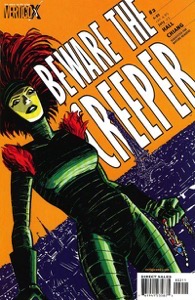 Now, here’s the great Cliff Chiang art I remember on **Beware the Creeper**. He maintains quality with faces while still doing all the great Parisian street scenes. He’s got a lovely sequence with a girl, apparently living on the street, waking up and starting her day. It’s charming, which **Creeper** can often be, when writer Jason Hall lets it. Most of the time, however, he’s holding onto the reins way too tight for funny business.
This issue picks up a month after last issue. That issue ended with someone attacking and raping Judith, probably some rich boy painting poser (last issue pointed an arrow at him, this issue acts as though he’s already been revealed). Then the Creeper appeared and terrorized the poser for a few panels, telling him to “**Beware**”.
“Beware” becomes the Creeper’s catchphrase as she has nighttime madcap adventures in Paris. We don’t see many of them, just the ones where she’s attacking the poser’s family. She starts the issue stealing some of their jewels and tossing them in the river. The jewels, not the family.
Just like the comic heavily implies the poser is the rapist, it also implies Judith is the Creeper. Of course, her identical twin Maddy is always around too, so who knows. Hall’s got a handful of moves he can make.
But we don’t learn anything about the Creeper. We don’t learn anything about Maddy and Judith’s lost month. Judith and her surrealist friends want to start some trouble, Maddy wants to work on her new play and garden. Then the blond guy cop is around too, getting suspicious about Judith and the Creeper.
The art’s a wow, the story’s baseline okay. There’s a cute **Year One** “your feast is nearly over” montage and some literary cameos, but there’s no character development; in fact, Hall works intentionally against it.
Thank goodness Chiang’s clicking. -

“Resident Alien”’s been leaning on the soundtrack a lot this half-season. Usually, it’s too much country country rock, but this episode’s got some great songs, used to excellent effect. It’s like someone didn’t like how they were doing it and fixed it.
Thank goodness.
There are only a couple more episodes this season, so it would seem this episode is moving the chess pieces into position for the season finale. The episode starts teasing Linda Hamilton’s latest discovery, along with an unexpected character reveal; it’s unexpected enough the show might be able to wrap her arc this season.
But she’s only in it for the opening. The rest of the episode is the regular cast about their business, with Alice Wetterlund’s painkiller addiction the main character development plot. The A plot is Alan Tudyk dealing with returning guest star Terry O’Quinn, come to town at sheriff’s deputy Elizabeth Bowen’s request. O’Quinn’s an alien hunter who can see real aliens, just like little kid Judah Prehn, which O’Quinn soon realizes and sets about turning Prehn against Tudyk.
Both those arcs—Wetterlund’s and Tudyk’s—go a lot darker than expected. When “Alien” started, it was a far cry from the Capraesque comic series, but it’s mellowed since the start. This episode removes the mellow.
The subplots include mayor Levi Fiehler and wife Meredith Garretson fighting over the planned resort; Fiehler supports it, Garretson does not. Garretson’s helping Sarah Podemski with her injunction against construction; the show says Podemski’s character’s name about sixty-four times in a three-minute scene, so it’s like they knew no one else could remember it either. It’s Kayla, incidentally.
Podemski plays a little support in Sara Tomko’s subplot later on; Tomko’s reeling from meeting her real mom last episode, which gives her and her friends (save Tudyk) all sorts of feelings. Well, not Wetterlund either, because she’s self-destructing, particularly with boyfriend Justin Rain. But there’s a little movement on Tomko’s plot, enough they’ll be able to do something with it before the end of the season.
Then Corey Reynolds has his awkward romance arc with Nicola Correia-Danube still going while conspiring with Fiehler against Garretson and those danged environmentalists.
Another packed episode, especially since the show’s making sure to give Jenna Lamia at least one great comedic scene an episode. She actually might get two here.
Lovely little moments from Gary Farmer, too, as he tries to help adopted daughter Tomko navigate her latest emotional trauma.
They’re in good shape; can’t wait to see where they close up this season.
-
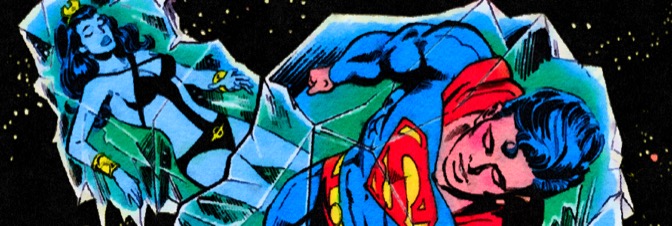
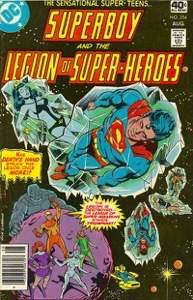
One of the disappointing but reliable experiences of reading Joe Staton’s Legion of Super-Heroes has been the panels where his art seems to be improving but then doesn’t. In this issue, the same thing happened, and I reminded myself of the phenomenon. First, the art would seem reasonable, then go disastrously wrong.
Even with Dave Hunt inking Staton, the art doesn’t go disastrously wrong in this issue. There are some problem panels, to be sure, but there’s consistently better Staton and Hunt art on this issue than I’d have thought possible.
I wouldn’t bet on much more improvement, but I also wouldn’t have bet on the art getting this reasonable.
The story’s also surprisingly okay, with writer Gerry Conway exhibiting a knack for writing Brainiac 5. The story doesn’t cure or redeem Brainiac 5, which adds a layer to his participation—Superboy goes to him for help; no one can save the seemingly dead Legionnaires but Brainy.
Only Superboy then gets killed with Kryptonite lasers, which seem like such an obvious idea Richard Pryor should’ve used them. Or did he?
Anyway.
Brainiac 5 will figure it all out and save the day with the help of some familiar but irregular guest stars, which allows Conway one of those enthusiastically belabored Legion fights where everyone’s powers are essential. Conway keeps the reader in the dark about Brainy’s plans, so the big battle specifics come as surprises. It’s perfectly decent superhero stuff.
Besides the Brainiac 5 as bad guy stuff, the only other subplot involves the Legion finally tracking down their financier R.J. Brande. He doesn’t tell them how he escaped the shit monsters a few issues ago, but he does finally tell them he’s broke and they’re up a creek.
It’s not a great scene, especially not for the art, but it’s brief and doesn’t drag the rest down.
I’m not optimistic about the book with the current team; maybe someday, though, which is a long way from the norm.
-

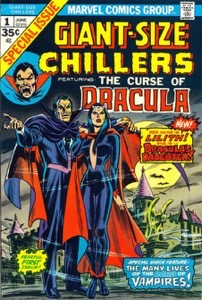
I don’t think I lost anything not reading the resurrectrion of Lilith in order. I missed out on some of the gimmick: Lilith is cursed with vampirism, not a natural vampire. She and her dad, Dracula, go to a rugby game because Lilith likes watching sports and she reminds him of her origin story. She was product of a political marriage when he was human, so when his father died, he cast her and her mom out. Mom paid a Romani to look after baby Lilith and killed herself; fast forward until Drac’s a vampire, he just killed a bunch of Romanis for turning him into a vampire, so the one who’s caring for now adolescent Lilith curses her as revenge.
The curse involves Lilith being a daywalking vampire, but also possessing the body of human girls whose fathers don’t want them. So, basically, her caretaker made sure the curse reminds Lilith she’s got a shitty dad all the time.
Lilith’s resurrection is never explained though. Thirty years ago—so during World War II, apparently—Quincy Harker killed Lilith, maybe as payback for Dracula killing Mrs. Quincy Harker, but they don’t sort out the order.
Or writer Marv Wolfman did and he overwrote it so much I couldn’t get through it. Wolfman starts the comic in second person, talking to Dracula about his return to London. It’s strange because Wolfman tries to be mysterious about it, but basically Drac’s just visiting with some lackey about getting a new mansion. It’s a lot of lead up for very little, so it’s nice when the Lilith story actually has some action. Even if—and again, reading Lilith’s first appearance out of order—she’s not quite the complex anti-hero of the Steve Gerber strips. She’s just feeding on folks left and right, including her human host’s father.
Also, had I read in order, I’d have known the human host’s pregnant. I just found that out with the human host’s current beau over in Dracula Lives; quelle surprise.
Gene Colan gives Lilith’s bat form long, flowing lady locks, which I feel like I’d have remembered in Lives. It’s a look, especially since inker Frank Chiaramonte really leans into the horror. The bats are icky monsters. Dracula is garrish. Gone are Tom Palmer’s noble inks; this Dracula is human, but demonic. So Lilith’s bat having some seventies hair is something. Maybe I love it, actually.
Doesn’t matter.
Lilith coming back is basically just to spin in her off. We get a scene where she tells Dracula it’s finally time for him to admit they’re both Draculas and she should rule the Undead with him. He says no, never, you’re no kid of mine, and leaves her to be upset about it. Despite the often overwrought narration, Wolfman does a good job with Dracula being a dick this issue. It’s a special too, so it’s a flex; you’re marketing the regular book as having an asshole lead.
Especially with the actual main plot, which involves that house Dracula wants. The mansion. There’s a girl living there and the house is haunting her. Her name’s Sheila Whittier and she’s mysterious and tormented, trapped in a British haunted house movie. When it crosses over with Dracula, she thinks he might save her, but then he doesn’t because he’s a dick.
It’s amazing.
Of course, he comes back because he needs the house and there’s a resolution, but still. He dumps this helpless woman right after accidentally saving her.
The art’s objectively not as good as on the main series, but for a special, there’s a certain charm to it being brusk. Similarly, while Wolfman’s exposition is a lot—in the British horror movie context it at least makes sense—the characterizations play through. It works out. Good special.
Then Wolfman spends a couple pages addressing continuity between Tomb of Dracula, Dracula Lives!, and Giant-Size Chillers Featuring The Curse of Dracula. Basically, they knew they were all over the place but they’re trying to do better and sort through it all. Wolfman promises a timeline, but I’m not sure Lives lasted long enough for them to do one.
A couple Atlas reprints (possibly colored for this reprinting) close out the Giant-Size.
First is a Stan Lee and John Romita (Senior) joint about an Austrian village’s vampire and public corruption problems. It’s middling.
Second is about a haunted house on a graveyard. Russ Heath does the art, no writer credit. The Heath art, including fifties horror good girl art, eventually sells the story but it’s a slog to get there.
The reprints do remind of how nice they were to have over in Lives.
Chillers is more than worth its 35¢ cover price.
-

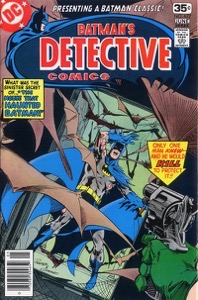
Despite my youthful indiscretions in reading the famed Steve Englehart and Marshall Rogers, I had no idea what came after it. Turns out neither did DC at the time, since this issue’s got Len Wein, Rogers, and new inker Dick Giordano doing three new pages around a reprint from 1971.
Batman and Commissioner Gordon go to visit Rupert Thorne in Arkham—Rogers’s Arkham is situated right next to the Gotham Mountains—and Thorne tells Batman about Hugo Strange’s ghost. Gordon says it’s a bunch of hooey, but Batman met a mysterious ghostly figure last episode (not to mention he’s Batman, and he’s met ghosts before, right, he’s friends with aliens and gods).
As Gordon soapboxes about ghosts being stupid, Batman remembers back to the previous issue, which is reprinted. Wein and Marv Wolfman get the writing credit. Giordano’s inking too, but it’s Neal Adams pencils. Lots of great art, but the writing’s so insipid the art doesn’t matter. There’s the curse of bad superhero comics… sometimes the writing can ruin the art as a narrative. Individual panels look great but taken as a whole, super yuck.
Batman has tracked a missing Robin to a newly appeared haunted mansion somewhere in Gotham. Robin’s in college in the story, which means Dick Grayson took a long time to graduate, no doubt too busy superheroing.
The mansion’s haunted and starts scaring Batman, who takes to whining, especially after he walks in on his funeral, and all his friends show up to talk about how much he sucked. Superman calling him “The Caped Conman” is nonsense but more amusing than the rest, especially when a tweenage Robin decides with Bats out of the way, he can run Gotham his way.
The reveal’s terrible. Racist too. Be terrible even if it weren’t. It also doesn’t have anything to do with ghosts. It’s got to do with “Batman: The TV Show” levels of silly death traps, but no ghosts.
The last page, back to the present, has a cliffhanger involving a new villain.
Wein and Wolfman write the story in second person “tension” talk, directly addressing Batman and telling him how and why to be concerned or afraid. It’s a bad device once, terrible twice, but then they do it another forty-five times or whatever. It’s atrocious and succeeded in making me miss Englehart.
It’s certainly not a good sign for the post-Englehart but not yet post-Rogers Detective Comics.
-

I don’t think I’ve ever referred to a performance as delicious before. I haven’t on The Stop Button (if Google is to be believed), but I’m also pretty sure I’ve never said that phrase before. Delicious performance.
Dennis Price gives a delicious performance in Kind Hearts and Coronets. He narrates almost the entire film; there’s a prologue to establish the setting and ground situation a little. It’s the late nineteenth century (which director Hamer and co-screenwriter John Dighton forget numerous times), and a British royal is due for the gallows in the morning. Price is that royal. He’s spending his last night on Earth writing his memoirs, which will eventually get to his conviction, but first, he’s got to cover all his other crimes.
Price’s narration starts with his childhood, which succeeds thanks to Audrey Fildes’s performance as his mother. She’s out of the film, tragically, in a dozen minutes or so, but her character’s incredibly complex in that time. Fildes ran off with an Italian singer (also Price, but in a mustache), who died upon hearing his son’s first cries. Fildes’s noble family cut her off, even in her tragedy. Thanks to the flashback device, we get to see Fildes and Price (as her husband) in the salad days, which carries her character development through into Fildes as a widow. By the time Price is playing the part, in his late teens, presumably, Fildes has become obsessed with reclaiming her position.
Along the way, Price’s character makes some friends who are important (and not) later on.
It’s a wonderfully done summary sequence, though it does delay Kind Hearts kicking off. Part of Price’s initial success is distracting from the inevitable—Alec Guinness playing eight different parts. It’s no secret, he’s credited with all of them in the opening titles, but the film takes its time before bringing him in. And the first time is just a walk-on, walk-off so Price can get a look.
Fildes can’t wait forever for her family to take her back; eventually, after one tragedy and slight too many, Price decides he’s going to commit to pruning his family tree until he and Fildes’s line is back in contention for the title.
Once Price starts hunting Guinness in his various parts, the film takes on a slightly absurdist tone, and it works. It’s having fun with Guinness doing different parts—including one woman—at various ages, though all snooty. Price is also snooty, which ingratiates him to a couple of his targets. One’s an old bank manager; the other’s a young layabout photographer with a beautiful wife, played by Valerie Hobson. Price is taken with her, but he’s been carrying on a long-time affair with childhood friend Joan Greenwood, who threw him over—marriage-wise—for a man with a career while Price just had a job.
The second act of Kind Hearts is Greenwood realizing she’d made a big mistake not latching on to Price’s star and Price realizing he lucked out Greenwood was as shallow as him because he’s got an idea on getting Hobson away from her Guinness.
Thanks to Price’s narration—which comments on his motivations, feelings, and thoughts throughout—he’s able to remain the star of the film, which Guinness otherwise ought to be walking away with. The film never addresses, other than the Italian patriarch, why Price doesn’t look like Guinness. It’s also unclear how Fildes fits into the family and who she would’ve been abandoning when she ran off.
Another missing piece is Greenwood’s brother, who apparently doesn’t survive to adulthood in any meaningful way for Price (or Greenwood).
Greenwood’s actually where Kind Hearts goes the most wrong. Well, she and Hobson. Hamer and Dighton write the Guinness roles as caricatures, which Guinness then inhabits and exudes pure brilliance, but the female characters aren’t even caricatures. They’re entirely one note. Sure, they’re from Price’s perspective because he’s narrating, only they’re not. Hamer’s direction manages to showcase Greenwood and Hobson, but never their performances. It’s too bad.
Great music from an uncredited Ernest Irving, Douglas Slocombe photography, Anthony Mendleson costumes—Kind Hearts is a fantastic production. Hamer’s direction is solid, other than the aforementioned problems, but never particularly impressive. The production and the performances drive the film’s success.
Nice little turns from Miles Malleson and Clive Morton in the prologue.
Kind Hearts and Coronets: plenty of Guinness to nibble on, but Price’s the feast.
This post is part of the 9th Annual Rule, Britannia Blogathon hosted by Terence Towles Canote of A Shroud Of Thoughts.
-


I haven’t been betting against Lion & the Eagle. The first issue assuaged any Aftershock fears I was having after writer Garth Ennis’s horror comic for the company. The second issue was excellent. I fully intended to be Ennis war comic weeping the next and final issue. But I wasn’t expecting Ennis to do anything major with the title; artist PJ Holden’s already doing the European album size. Being square and bigger is enough.
And then Ennis has a spectacular series of narrative jabs this issue, turning Lion over on its head a couple times before turning it around too. It’s incredible. Especially since he doesn’t do it until the second half of the issue. The first half’s full of exposition and action; the second half’s reflection on it. Only then Ennis completely changes the narrative distance on Lion after giving it some solid whacks as the doctor character tells the army guy what’s up a couple times, and the army guy’s got to sit with it. Then there’s a Communist soldier soapboxing about the military-industrial complex, and it’s phenomenal. I can’t give away the big twists, either. There are two, one with the narrative distance, one with the narrative. Both do peerless character development work. Ennis is on fire.
And Holden’s keeping up. This issue’s simpler—the occasional silhouette, more frequently white backgrounds—but more emotive. Holden focuses on how the scenes hit, whether they’re talking heads or the dramatic ones. Not to mention there’s a phenomenal battle scene. Holden scales from close-ups on emphatic white to gory, frenetic battle action. It’s a beautiful book.
So now I’m expecting an Ennis war comic weep and being floored by whatever he and Holden come up with. Ennis has been doing excellent war comics for over twenty years now, and, somehow, he keeps getting better. He leverages the natural exposition of military command—someone can always be explaining something to someone else—and then works in historical detail, but he’s breaking out of that norm with Lion. He’s using character relationships while also playing with narration.
This series will make a wonderful collection someday; hopefully hardbound and obviously oversized.
-

Since Covid-19 doesn’t exist in either of “Kevin”’s universes, I forget this season is their Rona season, and it might have affected how they plotted the season. Because even though last episode had a surprise party gone wrong plot, I also forgot “Kevin” sometimes does sitcom tropes in their “sitcom” part of the episode. The imbalanced episodes—and Annie Murphy no longer hanging around Eric Petersen as much—have meant shorter sitcom portions.
This episode’s got a blackout, which I’ve seen in at least one sitcom I can readily recall, and there must be countless others. It’s such an easy episode (the blackout episode, not this episode of “Kevin”; this episode of “Kevin”’s an intricate marvel). The action picks up about a week after last episode, which had Mary Hollis Inboden’s birthday party, followed by a cliffhanger with Candice Coke making a show-shattering discovery.
Also continuing directly from last time is Brian Howe’s girlfriend, Lauren Weedman, who everyone finds annoying. And Murphy’s still pestering ex-boss, high school crush, ex-lover Raymond Lee. In fact, she’s bugging him when the lights go out, and Petersen, Alex Bonifer, Howe, Weedman, and Jamie Denbo show up. Petersen thinks Lee’s cafe is the perfect spot to hang out during a blackout, not suspecting he just walked in on Lee telling Murphy to stop complaining about Petersen so much.
Murphy leaves the cafe to commit a felony with Inboden; only then a couple cops—Inboden’s new pals through Coke—pull up on them and want to earn points with detective Coke by doting on her girlfriend, Inboden. It’s an incredibly stressful sequence; Anne Dokoza has done some fine directing work on this show, and I think this episode’s probably her best. The cop adventure leads to an unexpected wrench on the way to the actual crime. Meanwhile, Inboden’s sullen—more sullen than usual—and isn’t talking to Murphy about it, which turns into concurrent character development arcs. Very nice script, credited to Sean Clements.
There’s an excellent subplot for Bonifer and Denbo again, who again ably essay far more complex roles than initially written.
Lee and Petersen “bonding” is also a great bit, especially with Petersen invading Lee’s space at the cafe.
“Kevin”’s second season is quieter than the first (so far) but just as impressive an accomplishment for cast and crew.
-

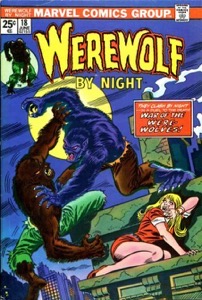
I really haven’t been reading the creator credits well enough. First, I thought this issue was Doug Moench writing; it’s Mike Friedrich. Second, I thought it was Don Perlin’s first issue as full artist (penciler and inker), but he had that role last time. Third, he’s got an inker: Mike Royer. I blame the Don Perlin and Mike Royer art; it’s like an anti-Mozart effect. Instead of listening to the music for a temporary IQ bump, you look at the misshapen heads in Werewolf by Night and lose points.
I assume they come back but possibly not until you’re done reading Werewolf by Night and the book’s not even half over.
So, some of the problem with talking about Perlin art is Perlin is a punchline. At his very best, he exhibits the chops to do an Archie fill-in. One with a lot of adults making comedic mad expressions. This issue’s surprise villain is not the other werewolf (teased on the cover) but “Ma Mayhem,” the foremost witch in California. The Committee—led by Baron Thunder—has sent her to collect Wolfman Jack. She arrives just as copper Lou Hackett arrives to question Jack about being a werewolf, and Jack saves Hackett from her, well, her hatchet.
She’s got a bag of weapons for werewolf fighting, but she wasn’t prepared for another one to drop in.
Jack’s seventeen-year-old sister Lissa has arrived downstairs to witness the werewolf fight, and to get Ma Mayhem’s attention; she just has to get a Russell werewolf; they didn’t say it had to be Jack.
The issue starts with a flashback to the late 1700s when Baron Russoff (pre-Americanization) suffers his monthly lycanthropy, so it all ties in. I thought the Tomb of Dracula crossover revealed a limited family curse time, but it might have been the pre-TOD origin. The Russell family curse has changed at least three times in the two years since the character debuted.
The most incredible thing in the book is thinking about how Friedrich was probably writing it Marvel-style, meaning he was writing to match the Perlin and Royer art. There’s a mini-riot late in the book, and Friedrich reminds the reader it’s taking place in the pitch black so no one can see they’re fighting werewolves, but it’s bright as day. Sure, Linda Lessmann’s coloring plays a part, but Perlin and Royer don’t get lighting either.
So knowing Friedrich knew what he was bringing forth, he gets a little slack. He also does make Jack racist to his Black next-door neighbor, so he gets a point for that one (before Friedrich showed up, Jack was straight-up racist).
The art’s disappointing, but it’s never not going to be disappointing, which will become the latest curse for Werewolf by Night. Significant asterisks aside, it’s a nearly okay combination of silly action, werewolf action, and Bond villainy.
It’s a Seventies comic, after all.
-

There are three big swings in this episode. Two are significant but subtle; one is not subtle at all. The first involves Annie Murphy and Candice Coke. They’re teaming up for the day to put together a party for Mary Hollis Inboden’s birthday, which no one knew about until the day before. Murphy and Coke are running errands and having a miserable time together, but then they get around to talking about Murphy’s husband, Eric Petersen, and how much it sucks being around shitty dudes. Inobden’s got a soft echo of that experience, hanging out with drunken brother Alex Bonifer for her birthday tradition at the ice skating rink.
Before “Kevin” started, the advertising played up the “sitcom wife realizes her husband’s a jackass,” but the show doesn’t treat the sitcom universe in that way. The show’s a fascinating examination of characters through various television trope lenses. This episode is the first time there’s really been something outside Murphy’s sphere, and it’s Coke’s, and it shares space with Murphy. It’s excellent, gentle but barbed because bickering sequence. Grace Edwards has the writing credit for this episode, and it’s awesome.
The second subtle swing involves Bonifer and Jamie Denbo. The reason Petersen helps Murphy with the party is because he wants to set Denbo up with his dad, Brian Howe. Howe’s new girlfriend (Lauren Weedman) has a terrible laugh. Petersen thinks Denbo’s available because she’s separated from her shitty husband; the plan goes terribly, particularly for the ambushed Denbo. Later on, she confronts Bonifer about it, and we get to see Bonifer’s character development start to pay off.
They’re outstanding. They’re not Murphy or Inboden, but they’re outstanding. Bonifer’s arc this season is incredibly difficult, and he’s nailing it every time. Then Denbo’s scaled up nicely.
Of course, the third swing is for Murphy alone. She’s seeing Robin Lord Taylor around town, stalking her, even though he’s comatose. The show’s letting Murphy’s character development boil unattended while giving Inboden the dramatic interactions. Very cool.
I can’t wait to see where they take this season; there’s going to be so much great acting.
-

I’m pretty sure this episode of “She-Hulk” is the first time the MCU has acknowledged white males aged eighteen to thirty-four are entirely pieces of shit. There’s a bit with the news showing Twitter posts complaining about She-Hulk, then the MCU version of the Wrecking Crew is a bunch of Trump voters who’ve decided to finally commit to just assaulting women. It’s a fantastic flex from the show, and watching CGI She-Hulk beat the shit out of the Wrecking Crew, who seem like they’ll be back, is going to be great.
This episode’s where the show finally delivers on all fronts—there’s legal comedy-drama, there’s MCU business, there’s fourth wall breaking, there’s a celebrity cameo. The show takes several shortcuts to get there, including B plot protagonist Josh Segarra. Segarra plays Pug, who’s from the comics, and I’m pretty sure he wasn’t in the last episode. He certainly didn’t talk or get introduced. In fact, when he shows up in this episode, the focus is on returning guest star Drew Matthews.
Matthews is an assistant district attorney shit-bag Maslany and Ginger Gonzaga used to work with; he needs their new firm’s help with a matter involving a New Asgardian shapeshifter. It’s a lot of… not MCU workplace jabs and jokes. The MCU got over the Blip faster than real life got over lockdown. It’s a bit disconcerting seeing “She-Hulk” comment on workplace harassment fifteen minutes after Tatiana Maslany broke the fourth wall to assure viewers the show’s not just about returning MCU guest stars (no Mark Ruffalo this episode, but Tim Roth and Benedict Wong).
Roth and Wong are in the A plot—we can call them A and B plots with “She-Hulk,” Maslany broke the wall to talk to us about how they work—spinning out of their adventures in Shang-Chi and the Legend of the Ten Rings. It’d be fascinating to see the Disney+ numbers to see if “She-Hulk”’s an entry to Shang-Chi or vice versa.
Anyway. Maslany’s still trying to get Roth out on parole, and Wong seems to be the key, only Wong’s the Sorcerer Supreme, and he’s got things to do. It’s an excellent sequence and a wonderful comic adaptation; they’ve cracked “She-Hulk.” Unfortunately, it does seem like there’s been a lot left on the cutting room floor—Segarra’s introduction, Gonzaga and Maslany being besties, Gonzaga having a part—but the show delivers. Roth, a stunt cast back in Incredible Hulk, finally gets to loose himself in the part.
And Wong’s a delight.
And Maslany’s a delight. “She-Hulk”’s loads of—surprisingly grounded—fun.
-
Subscribe
Subscribed
Already have a WordPress.com account? Log in now.
 The Stop Button