Batman Versus Predator (1991-92)

Bvp

Batman Versus Predator, in case the title doesn’t give it away, is bad. It’s real bad. It could be worse, sure, but it’s real bad.

It doesn’t open terribly—sure, the Kubert Brothers art is pretty bland from go, but the subject matter is at least sort of interesting (compared to where it goes later). And writer Dave Gibbons (who doesn’t just overwrite the comic, he badly overwrites it) has some style for the opening. He juxtaposes the Predator attacking some old guy and his dog with the Gotham City championship boxing match. The former isn't important (other than it's a little weird the Predator is attacking a junkyard watchman), but the latter turns out to be the whole comic. See, the Predator isn’t initially interested in hunting Batman or even (armed) criminals or (armed) cops. It’s out to take out the championship boxers.

Because they’re champions. Says so on the news. The Predator watches a lot of news in Batman Versus Predator and repeats sound bytes to make dialogue. Because Gibbons is incapable of writing an action sequence without a bunch of stupid recycled sound bytes the Predator has picked up somewhere. At one point, it seems like the comic would be at least somewhat better without their constant addition. But then, once the Kuberts never get any better—they can’t make the Predator versus the criminals interesting, they can’t even make Batman versus the Predator interesting, though it’d probably be hard to do given the big showdown is in the woods surrounding Wayne Manor. But there are times when it doesn’t seem like Batman Versus Predator isn’t going to be a complete waste of time.

Sadly, all of them are in the first issue (of three). And by the end of the first issue, it seems kind of unlikely the book is ever going to turn around.

Most of the comic, overall, is about the crooked businessmen and gangsters who run Gotham (and the boxers) getting wiped out by the Predator. It kills them because… it knows they’re swinging dick criminals and it came to town to hunt some white collar looking criminals. Then it takes on Batman and puts him down for the count—there’s this terribly ineffective device where Gibbons and the Kuberts have a single panel showing Batman getting home all cut up at the bottom of pages while above the main action with the cops or crooks or whatever plays out.

Because Jim Gordon’s got a big part. Not sure why he doesn’t try to take out the Predator himself as the Kuberts draw him just as buff as Batman, which is considerable because they’re Batman is super buff. So big and buff it’s like, obviously you need some meaty muscle guy like Ben Affleck for that part.

But you wouldn’t want to see Batman Versus Predator: The Movie with Batfleck or anyone else, because the only thing the comic succeeds at showing is how bad it would be. Even though it’s about two “characters”—Batman arguably has less personality than the sound byte spouting Predator here—who are known for their wonderful toys, there’s not much competition.

You’d think after fighting aliens since the fifties or whenever they first showed up in a Batman comic, Bats would have some better ideas than he comes up with here. Nope. There are a couple times in action scenes where it’s like… why did that work? The Predator is scared of cars?

The big action finale has Batman in special armor, which looks like the suit from the end of Batman Forever, though I don’t think the Kuberts got a thank you, and then he has a sword at some point. Because armor and swords and whatever.

Batman Versus Predator is pretty dumb, even for a comic called Batman Versus Predator. I’ll bet if you bought this comic back in 1990 thinking it would resemble Watchmen in some way because of Gibbons, you were pissed as all hell. Though, as someone who bought it back in the day—at age twelve—I recall being shameless about it.

I shouldn’t have been shameless. I should’ve acutely felt the shame.

Sleepwalkers (1992, Mick Garris)

Sleepwalkers is a very peculiar motion picture. Director Garris never quite composes the shot right, even though he’s really close. Maybe he needs a wider frame or just to zoom out a bit. Instead it always looks like he’s shooting for the home video pan and scan. Rodney Charters’s photography is totally fine, unless they’re trying to do an insert then he never matches and there’s only so much he can do for the CGI morphing scenes.

Sleepwalkers opens with dictionary text setting it all up–Sleepwalkers are these monsters who suck on the life force of female virgins. Cats hate them. Then the action starts. Mark Hamill in a “really? why?” cameo. Then the opening titles. And cut to small-town Indiana–but that Southern California smalltown Indiana with the mountains and all–where teenager Brian Krause is sitting around shirtless and cutting himself.

But, oh, isn’t he kind of a dish. Because it’s weird. Sleepwalkers is always weird, but it actually starts ickier than it finishes because even though the film–mostly writer Stephen King–wants to be really explicit about Krause’s love affair with mother Alice Krige because it’s sensational… and then never does anything with the attention it brings. It’s just icky, then tedious, then annoying because Krige’s performance gets worse as the film goes along.

She’s Mama Monster, which means she stays at home while Krause goes to high school and finds a target. He’s going to feed on the target, then share with Krige. Sleepwalkers is a mix of bad thriller, not great gore, weird monster-based sci-fi, and the incest thing. If Garris and King weren’t making a terrible movie, who knows, maybe they’d have created a new sub-genre. Or at least not made this godawful thing.

But it’s really interesting to see how these disjointed pieces all fight together. Ingenue Mädchen Amick starts the film with Garris trying to make her seem like a slutty virgin. She’s at work at the movie theater, listening to fifties rock on her Walkman, dancing seductively as she sweeps up popcorn. It’s weird. And a little icky but nothing compared to Krause and Krige’s sex scenes; Sleepwalkers’s icky spectrum is long. So then Amick meets Krause and he’s kind of creepy then he’s not, even though the film thinks him reading his story about him and his mom to his English class is a good scene. It’s really bad. But kicks off a “is Krause going to be redeemed” subplot, which doesn’t really matter because Sleepwalkers ends up being a monster movie for most of its run time. Like people running from monsters.

Somehow I’ve missed the part how the first act is also about Krige and Krause torturing cats. Krige’s homebound because she’s deathly afraid of cats. Maybe. It’s unclear. But it sure seems like it. For such a long movie–Sleepwalkers is a long ninety minutes, not in a good way because Garris is astoundingly uninventive–King’s script doesn’t really do character development. Even as scenes often go on way too long. Like the ones with Cindy Pickett and Lyman Ward as Amick’s parents, in a tedious “is this a Ferris Bueller reference” or isn’t it subplot. Everything in Sleepwalkers is tedious.

Some really bad acting throughout. Including the King cameo. Krige’s terrible, though it’s hard to say how much of it is her fault. Though she did take the role. So. Krause kind of has an interesting arc but his performance starts bad, gets worse, gets better, gets worse than worse.

Ward and Pickett aren’t good. Pickett’s worse but only because she’s in it more. Ron Perlman’s really bad as a state trooper. Glenn Shadix is the pervert school teacher out to blackmail Krause. He’s really bad.

Amick makes it through. She’s never good, she’s never terrible, she’s occasionally sympathetic. She’s not trying. Amidst all the trying aspects of Sleepwalkers, Amick weathers the storm. She never seems like she’s in such a bad movie. Krause and Krige always do.

Interesting music from Nicholas Pike. Not terrible. Uses Enya well, even if it does make Sleepwalkers seem like a Cat People ’84 rip-off, eight years too late. Sleepwalkers is in a hurry to get to the monster stuff and then the monster stuff isn’t even cool. They can make objects disappear and change appearance–Krige and Krause–but their reflections in the mirror are of their monster forms. The monster forms are more gross and awkward than scary. And they’re annoying, because they’re not very good. Sleepwalkers is this mish-mash of tone, narrative distance, genre–and it never lets up. Sleepwalkers consistently makes unique and bad choices through its runtime. Including the ending. And it never does anything right. Garris and King don’t pull off a single thing.

It’s the type of movie where the monster woman in her hippie disguise trying to find a virgin to feed her son and lover shoots a car and it blows up. Sleepwalkers is either accidentally ambitious or wholly incompetent. If they’d pulled it off, the film would’ve been amazing. Instead, it’s astounding. And bewildering. And frequently icky bad.

Love and Rockets (1982) #39

Lr39

Two stories end in this issue, with Poison River having one more to go. But the issue opens with the finale Wigwam Bam, which Jaime didn’t announce last issue, and the last Love and Rockets, which Beto did. Wigwam Bam opens the issue, Love and Rockets finishes it.

Jaime gets a lot done in Wigwam Bam. It helps he’s finished the Hoppers stories. He’s got time to spend a lot of panels on Hopey. Her East coast adventure comes to a very grim conclusion, albeit a grim conclusion arrived at via lots of humor. Meanwhile Izzy is off visiting Maggie’s dad and he gives her an old journal. So the story is Izzy reading Maggie’s journal and Hopey’s awful day.

While Jaime doesn’t get into Hopey’s interiority much–he more lets her expression or even eyebrow her way through it–it’s an excellent Hopey story. Maybe the best Hopey story in Wigwam Bam. Because it’s all about her. Jaime sticks with her, doesn’t jump away. Instead it feels like he’s jumping to her, instead of avoiding her. Very nice.

And the Maggie journal stuff is fantastic. Because it answers open questions, like what happened a dozen plus issues ago when Speedy died, before Jaime did a jump ahead. The journal is mostly about Maggie’s first best friend, who appeared a long time ago (also in flashback) before dying suddenly and tragically.

There’s also plot, not just everyone in Hoppers having stuff going on so here’s ten to sixteen pages. Hopey’s awful adventure this issue is fantastic. The best plotting–with the most layers–Jaime’s done in a while. He doesn’t “save” the story, because Wigwam Bam isn’t so much a story as a period in Jaime’s Love and Rockets stories.

Otherwise, he probably would’ve saved the story.

Beto’s second-to-last Poison River is outstanding. There’s some postscript on the gangsters, then Luba returning home. The grown Luba. Lots of character development for Luba and Ofelia, not much clue as to how Beto’s going to finish it. He brings back elements from earlier chapters but everyone’s outgrown them in one way or another. Beto’s getting the story settled before it ends while reintroducing Luba and Ofelia, with a relationship dynamic much more familiar than Poison had been covering before.

Of course, given how Beto’s plotted the story, it could go on another ten chapters without coming to a conclusion. It all depends on where he’s going to finish Luba’s origin story. Based on the timeline, I don’t think it can end with them showing up in Palomar. They’re still too early.

Anyway.

Then comes Love and Rockets, which is Beto’s simple but not, obvious but not, stone-cold masterpiece. It’s way more impressive than it originally appeared–it also echoes things from Poison. The two stories don’t exactly complement one another, but Rockets has always felt like Beto doing things he couldn’t do in Poison. And then when he started doing more in Poison, he started doing more in Rockets too.

Beto perfects the panel jumping from subplot-to-subplot in Rockets’s finale. Along with the characters addressing the reader directly. He goes all over the place, does so much, including a lot with fourth tier supporting cast members. Turns out it was all important.

And it ends on one of Beto’s montages, which he hasn’t done in a while because he hasn’t been ending a story. And the montage perfectly grounds the finish. So much amazing storytelling done so concisely. It’s awesome.

Love and Rockets might actually be Beto’s most complex narrative. There are just so many characters–so many entirely new characters–so much random interaction… it’s really impressive stuff. Particularly because Beto’s ambitions on Rockets have been rather muted.

So good. It’s the best overall issue in a while.

Love and Rockets (1982) #38

Lr38

Beto gets two stories, Jaime gets two stories. Beto’s are installments of Love and Rockets (the surprisingly penultimate one) and Poison River (part ten, but apparently not penultimate). Jaime’s got two Wigwam Bam entries–parts six and seven.

There’s some funny stuff in Jaime’s entries. Not to mention Izzy and Hopey reuniting. But Beto’s got two phenomenal stories. And they’re really short. Love and Rockets is nine panels a page, six pages. Eighth part of Love and Rockets and it’s still unclear who’s going to get a focus. Maricela makes sense; the story has become about her and Riri over the installments. And other characters have fallen off. Or been shipped off to Palomar for safe keeping. But Beto’s got a story with the skinheads. They haven’t gotten a lot of attention–kind of ever–but their story is the framework everything else in Rockets plays off. Even though those characters don’t participate in as many story threads as the other ones.

Beto’s done an unpretentious character intersection thing set in Los Angeles and Hollywood. And he’s never drawn attention to it. Even when Love and Rockets has seemed a little too slight or a little too much (the band), Beto’s never let it get out of control–he’s always been able to keep it on the path to get it to this conclusion.

It’s not a particularly flashy story–even with the surprising title–but Love and Rockets really does show off Beto’s writing skill.

So does Poison River this issue, but it’s always been the flashier of the two stories. It’s a ten page crime story. Luba’s sort of just been a red herring. It’s all about her husband, Peter, and his father and the various criminals they’ve interacted with over the years. The end of the entry returns focus to Luba, but Beto took it away from her for a lot of this story. And apparently it’s not over next issue, so maybe he’ll have a chance to tie it all together?

It seems possible. Though more from what he’s done in Rockets than River. River has excellent sections, but the connective tissue is sometimes tenuous. Rockets isn’t sections–with one exception–just connective tissue laid out linearly.

Jaime’s Wigwam Bam chapters aren’t anywhere near as ambitious as Beto’s entries. Even when Jaime goes for something a little more–a regular cast member’s grand exit–it doesn’t really come off. It kind of comes off, but it’s not a main cast member. No matter how hard Jaime has tried to make them one for more than a dozen issues.

Meanwhile, Hopey has a weird encounter with a famous female comedian. It’s really funny stuff and Jaime’s comic timing is great, but it’s kind of just Hopey mugging for the… page. Juxtaposed with Hoppers and Hopey is Izzy heading east and visiting various people. What’s must upsetting about Wigwam Bam this issue is how well the second installment opens only for Jaime to run away from all of it. He’s avoiding scenes again.

Though Rocky and Fumble have parts, with Rocky now a friend of Danita and Fumble on her bed. It’s cute, but also during Jaime’s apparent abandoning of Danita as a character. She’s not the one who leaves, she’s just utterly reduced. It’s weird.

So while the Wigwam Bam stories are effective, sometimes it’s Jaime trying to be effective. The Hopey and Izzy stuff is excellent, but it’s measured and precise and deliberate. Jaime’s avoiding again, like I said. He hasn’t lost his mojo. He’s just figured out how to do his mojo.

Meanwhile Beto’s seemingly effortlessly turned his “play” story Rockets into something amazing and rescued Poison River (once again) from its troubles.

Love and Rockets (1982) #37

Lr37

Nobody gets a happy ending in Jaime’s opener, part five of Wigwam Bam. It really seems like it’s been longer. How long has it been since Maggie was around or Hopey wasn’t a red herring? Two issues? Three? Jaime’s cast–Danita, Ray, Doyle, Doyle’s girlfriend, whoever else–the kids–it feels very much like a comic strip. The way the characters constantly interact with one another without any actual on-page development. Or if there is on-page development in a relationship, it’s the point of the scene, it’s the big event.

This story has two big events. One for Ray, one for Doyle. Well, one involving Ray, one involving Doyle. Doyle’s event has more to do with Nami, who’s stalking Doyle since he rejected her. Will he reject her a third time? As for Ray, he’s still having relationship problems with Danita, even if he doesn’t know it. Even if she doesn’t know it. So he’s got a big event, only he doesn’t really get to experience it. But neither does Danita.

Nami’s the closest thing to a protagonist the story’s got.

Then there’s some Hopey at the end and a lot with the little kids roaming Hoppers, bewildered by the adults.

There’s some really nice art throughout and the narrative moves just fine. It’s just Jaime’s putting things off more. He always puts things off.

Whereas Beto, with Poison River, Part Nine–it’s hard to believe it’s been nine but anyway–Beto isn’t putting anything off here. He’s revealing all involving Maria–Luba’s mom who walked out in the first installment–and the truth about Peter, his dad, all the gangsters, Peter’s band, Isobel, and maybe a couple other things. Peter’s stomach fetish. But the story plays out naturally, detailing Peter’s obsession with Maria.

Yes, it means he stalked and manipulated Luba even more than he already seems to have stalked and manipulated Luba. So creepy. But humanized in a way the rest of Poison River hasn’t done for Peter. It really has some surprises regarding his dad, past and present, as well. And the Isobel stuff isn’t exploitative like Beto flirted with earlier.

I imagine reading the Peter flashback in chronological order with the rest of the story would change it quite a bit.

And then at the end it’s the first time teenage Luba has felt like real Luba. In a moment of tragedy, of course, but Beto does a whole lot with this installment. He’s totally changing the… ahem… course of Poison River, but also the course the reader’s assumed it was on.

Bold, successful stuff.

Then comes a six-page Love and Rockets installment, checking in on the various characters in nine panels on the first page, only for the reveal to be Steve–following his car accident–went back to Palomar to discover himself.

So now we’re back in Palomar, for the first time in at least nine issues, and Beto’s doing a lot of catch-up. Khamo’s alive and with Luba, though he’s disfigured from the self-immolation. They’ve got new kids, who are adorable trouble-makers. Toddlers these new ones. But then Steve runs into Pipo and her teenage son Sergio, who wasn’t a teenager last time he was in the comic. And then there’s Chelo and Mayor Luba and what’s going on with Heraclio and Carmen and Guadalupe and there’s a a baby for Carmen and on and on. Lots of catchup. Steve’s background to a lot of it, often literally silent.

Guadalupe is headed to the States to visit Maricela and Riri, which they mentioned before, but she actually befriends Steve in Palomar to practice English for the trip. It’s fast, it’s intricate, it’s great. It’s weird for Palomar to get such a hurried treatment, but Beto does a great job with it.

Vanilla Sex (1992, Cheryl Dunye)

Vanilla Sex is the combination of a short anecdote from director Dunye, which she recounts to someone else, set (mostly) to a series of photographs scrolling up the screen. Occasionally, the footage changes to what seems to be home movie of Dunye and some other people playing around, nude (until Dunye shows up, it almost seems like it’s historical nudist footage), in the great outdoors. Fun playing not sexy playing. Fun non-sexy playing.

The photographs are of Dunye and a couple other women. They appear to be process photographs–they’re trying to stage, presumably, another photograph or installation piece–but it’s not clear it doesn’t matter. What matters is how they relate to the anecdote, which is about a time Dunye went to California and heard the white California lesbian definition of “vanilla sex”–no toys–versus her own, East Coast, Black lesbian definition–a Black person with a white partner.

At least one of Dunye’s friends in the photographs is white–the other appears to be Gail Lloyd, because even when Dunye’s short subjects have no narrative (or even titles or credits), there are familiar faces–and the anecdote echoes off the imagery. Same with the home movie footage. It doesn’t directly relate, other than showing how Dunye’s community, but it does echo with that anecdote.

Vanilla Sex doesn’t have a narrative (at all, even as the series of photographs gets more and more interesting, they don’t have a conclusion); instead it’s a visualized musing, with its three elements–the monologue, the progression of photographs, the wilderness party footage–playing off one another, informing one another. Dunye’s got a superior sense of filmic narrative, even when she isn’t doing narrative.

Glengarry Glen Ross (1992, James Foley)

The first half of Glengarry Glen Ross is phenomenal. David Mamet’s screenplay is lightning fast during this section, moving its characters around, pairing them off for scenes or moments–the brevity is astounding. Half the movie is over and it feels like just a few minutes. Then the second half hits and the pace is still good, but the energy is different. It meanders. Apparently the only thing keeping director Foley going was having different locations and different camera setups–many questionably framed for pan and scan; in the second half of the film, set entirely on one set, Glengarry Glen Ross starts to fizzle. The actors keep it viable for as long as they can, but then it becomes clear Foley’s just composing for one actor, one performance, not all the actors, all the performances. The film never solidifies and it’s so fast, it’s almost over before it becomes clear Foley’s not going to bring it together. He instead relies on James Newton Howard’s peppy smooth jazz score. It’s never a good idea to rely on smooth jazz, peppy or not.

Every performance in Glengarry Glen Ross is outstanding. Foley’s problem isn’t giving the actors time to act, he does fine with that aspect of his directing. Sure, even in the first half, he isn’t directing their scenes perfectly, but he’s definitely giving them room to act. Jack Lemmon, Al Pacino, Ed Harris, Kevin Spacey, Alan Arkin, Jonathan Pryce, Alec Baldwin. They’re all great. Pryce and Baldwin don’t have particularly great parts, but they’re great. Baldwin gets a big speech, which he nails. Pacino, Lemmon, Harris and Spacey get the meatier parts (Spacey the least, Harris and Pacino just through force). Lemmon’s the lead for most of the film. Only not so in the second half, which Mamet might be able to cover if Foley knew how to stage the second half. He avoids doing an adaptation of the play–Glengarry Glen Ross was a play first, also by Mamet–for the first half, only to be forced into it in the second half and have no idea how to do it. Arkin doesn’t get much meat, but he still turns in a great performance. The performances are impeccable.

And impeccable performances, along with strong dialogue, keep the film going for quite a while. There aren’t even any danger signs until Harris and Arkin’s subplot in the first half, when Howard E. Smith’s editing seems to be elongating and distracting their conversations instead of curating and appreciating them. Glengarry Glen Ross isn’t a mystery. There’s a mystery in it–sort of–and Foley stumbles when trying to integrate it. All the humanity in the film is from its actors essaying the screenplay. None of it comes from the filmmaking itself, which is a big problem.

Again, Pacino, Lemmon and Harris are all phenomenal. None of them have great characters to work with–they have some great material, but not great characters. As an example of excellent acting, Glengarry Glen Ross works. As a film? Not so much.

2.5/4★★½

CREDITS

Directed by James Foley; screenplay by David Mamet, based on his play; director of photography, Juan Ruiz Anchía; edited by Howard E. Smith; music by James Newton Howard; production designer, Jane Musky; produced by Stanley R. Zupnik and Jerry Tokofsky; released by New Line Cinema.

Starring Al Pacino (Ricky Roma), Jack Lemmon (Shelley Levene), Alec Baldwin (Blake), Alan Arkin (George Aaronow), Ed Harris (Dave Moss), Kevin Spacey (John Williamson) and Jonathan Pryce (James Lingk).


RELATED

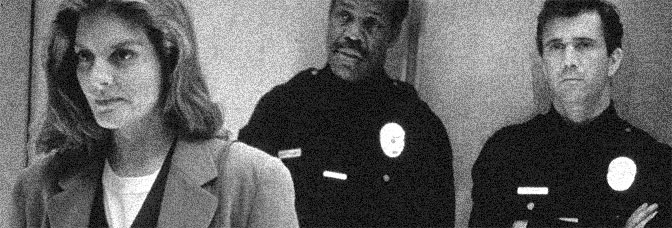
Lethal Weapon 3 (1992, Richard Donner)

Lethal Weapon 3 is an expert action movie. Director Donner, cinematographer Jan de Bont, editors Robert Brown and Battle Davis do phenomenal work. Even though the cop action thriller plot of the film is its least compelling–dirty ex-cop Stuart Wilson is funding real estate development through arms dealing–those sequences are still good. The actors carry over everything from their stronger subplots into those scenes.

Mel Gibson gets the showier subplot, romancing a likeminded–and similarly martial arts trained–fellow detective, played by Rene Russo. The ever-about-to-retire Danny Glover has something of a family drama, but also a crisis of character arc. Joe Pesci is around to make plot contrivances a little more palatable. He’s also great for the other actors. Everyone reacts well to Pesci, even if they don’t have a lot of dialogue.

Because Donner is excellent at directing the actors in this film. The sequence where Gibson realizes Russo’s a little bit of a goofball (after the audience is already in on the joke) is beautifully done. Gibson and Glover do get their moments–lots of male-bonding, lots of man tears–but Gibson’s scenes with Russo are basically a showcase for her. She brings such a strong personality to the character right off the bat, the subsequent character reveals are basically mini-delights for the audience. And Gibson and Glover. It’s a phenomenal part and Russo’s fantastic.

Between the two leads, Glover gets the better personal story arc. He gets the harder material–he also gets some great comic material–while Gibson basically just toggles between fun and crazy. Gibson’s really good at the toggling and there’s a maturity to his performance–just because the beast looks upon the face of beauty, it doesn’t mean he’s as one dead, not in Lethal Weapon 3.

The score–one assumes Michael Kamen did all the Michael Kamen sounding action music while Eric Clapton and David Sanborn handled the soul-searching, but who knows–is omnipresent and occasionally too much. It’s too slick against that beautiful de Bont photography and Lethal Weapon 3 starts to feel plastic. But then the actors do something, something in their performance, something in the script, and the integrity comes through. Sometimes the music even ends up helping with it.

Solid supporting turns from Steve Kahan, Damon Hines and Gregory Millar. Glover’s family otherwise doesn’t have enough to do–Darlene Love’s in maybe three scenes, gets one good one. Ebonie Smith has zip. Traci Wolfe has a couple decent moments, but again, not enough. Lethal Weapon 3 is a strange picture in it having too many good things going on while it still needs to be an action movie. Going longer wouldn’t have helped either, the pacing is perfect.

Stuart Wilson’s villain is a bit of a liability. Donner uses him sparingly, or always with a better performance in the same scene. Except maybe two with chief henchman Nick Chinlund–the villains in Lethal Weapon 3 are really lame, thank goodness the rest of the film makes up for it.

Also want to mention the great production design from James H. Spencer.

Lethal Weapon 3 is a great time at the movies. Donner finds just the right mix of comedy, action, drama and suspense.

2.5/4★★½

CREDITS

Directed by Richard Donner; screenplay by Jeffrey Boam and Robert Mark Kamen, based on a story by Boam and characters created by Shane Black; director of photography, Jan de Bont; edited by Robert Brown and Battle Davis; music by Michael Kamen, Eric Clapton and David Sanborn; production designer, James H. Spencer; produced by Joel Silver and Donner; released by Warner Bros.

Starring Mel Gibson (Martin Riggs), Danny Glover (Roger Murtaugh), Rene Russo (Lorna Cole), Stuart Wilson (Jack Travis), Joe Pesci (Leo Getz), Darlene Love (Trish Murtaugh), Steve Kahan (Captain Murphy), Damon Hines (Nick Murtaugh), Traci Wolfe (Rianne Murtaugh), Ebonie Smith (Carrie Murtaugh), Gregory Millar (Tyrone), Delores Hall (Delores), Nick Chinlund (Hatchett), Jason Rainwater (Edwards) and Mary Ellen Trainor (Stephanie Woods).


RELATED

The Player (1992, Robert Altman)

Whatever his faults (and faulty films), Robert Altman never bought into what anyone said about him–not his critics, not his audience. The Player is an overtly hostile outing. Altman never had much nice to say about the film, as I recall, but he doesn’t try to say nice things with the film itself. He makes this unbelievably concise, unbelievably expository, unbelievably cynical film–the agreement for the viewer is unconditional capitulation to the film’s “dream.” Movies, now more than ever. The Player is a film for the film literate. It doesn’t come with a syllabus, but the references target a particular audience. Altman fans, actually. Altman makes The Player as indictment against those who like his work, yet went to go see The Player.

Hostility is one thing, indifference is another, but The Player is practically open warfare against the viewer. It’s amazing.

Of course, it is based on a novel. Presumably that novel had a similar plot; The Player tracks Tim Robbins’s somewhat successful, but not successful enough Hollywood executive through a murder investigation. The investigation’s into him. At the same time, the sharks are circling at the studio and darn if he just doesn’t want to romance the dead guy’s lady friend.

Altman sets everything up real fast. Not just the ground situation, but the film’s visual language. After an ambitious, self-aware lengthy opening shot, photographer Jean Lépine and Altman keep the moving camera. Only now there are lots of graceful cuts into the movement–Maysie Hoy and Geraldine Peroni’s editing of the film is a sublime achievement. Writer Michael Tolkin (adapting his novel) owes everything to them because Robbins’s romance with Greta Scacchi would never have worked without Hoy and Peroni. Altman doesn’t want the characters to be real because he doesn’t think they deserve it. Then he goes out of his way to make the viewer dislike the characters. But he directs the actors to play it less Hollywood and more real. And Hoy and Peroni cut it do make as emotionally effective as possible. Tolkin’s script’s plotting, especially of the relationship between Robbins and Scacchi, is phenomenal. Maybe his best move in the film, because with a different score, I’ll bet The Player could have been noir. But Altman didn’t want to do a noir, because he hates the characters.

It’s a real complex situation and expertly directed. Altman finds a way to mimic interview style for the many celebrity cameos. Even though The Player is a movie about real Hollywood, it’s clear who is a part of it and who isn’t. Altman’s so dismissive of it all, whether it’s the real Hollywood or the imagined. It’s kind of sad, really, as one of the film’s ideas is that older films were more sincere through their filmmaking. And Altman (and The Player) crap all over that idea. Twice. Like I said, it’s hostile.

Altman’s animosity aside, everything else about The Player is great. Sure, Tolkin’s script only works because of the filmmaking–which is another great meta commentary on the plot–but it does work and it works well. He’s got some great moments for actors and Altman has a phenomenal cast. Dina Merrill has a small but great part because Altman understands how an actor’s performance can resonant through a runtime. The Player is masterful work. Resentful, maybe, but more masterful for it.

Great supporting turns from Fred Ward, Whoopi Goldberg, Cynthia Stevenson, Brion James, Lyle Lovett. Scacchi’s good as the love interest but it’s not a great part.

Excellent music from Thomas Newman. Breezy music. The Player is all about smooth movement, whether shots or narrative pace.

And then there’s Robbins. He makes the movie. Robbins makes the movie so much he gets to walk away from it for a while and it’s still his movie (maybe because it takes him so long to get introduced properly in the first place). But Altman gets it, he knows how to make this movie be great and he wants the viewer to know they’re awful for making him do it. We aren’t in on the joke, we are the joke.

Love it.

Reservoir Dogs (1992, Quentin Tarantino)

The least violent part of Reservoir Dogs is the bloodiest. One of the characters is in a pool of blood, slipping on it as he delivers his dialogue. Director Tarantino finds a moment of Shakespearian tragedy and builds a film to it. He uses stylish ultra-violence, Dogs is visceral with the blood, but the action itself implies a far more frugal production. He uses seventies music, but not the trendy stuff. His somewhat fractured narrative, which owes something to classic film noir, wants to be an updated version of seventies crime. And he succeeds with it. Tarantino would never be able to get away with Dogs having actual tragedy if he weren’t able to sell everything else he packages with that tragedy.

Dogs acknowledges the idea of being outlandish exploitation but the film’s so tightly constructed, Tarantino never lets anything get wild. The film’s most “uncontrolled” sequence, as Michael Madsen does a freestyle torture dance to “Stuck in the Middle with You,” turns out to be Tarantino’s most controlled sequence in the film’s primary location, where everything is controlled. But with Madsen’s dance, Tarantino takes the time to acknowledge the various realities of the situation. He breaks the movie magic, not because he wants to offer commentary or deconstruct genre, but because the film needs reality. The tragedy doesn’t work with reality. Without the reality, Dogs wouldn’t be difficult. It’d be amusing, sure, but it wouldn’t require the viewer to mentally engage with the film.

And Tarantino starts with those demands on the viewer right off. The first scene of the film demands the viewer make some value judgements on the cast. Harvey Keitel has to be likable, same goes for Tim Roth, even Lawrence Tierney a little. Certain actors just get to be actors, certain actors have to do a bit of a feint, but the scene has a whole bunch to do. It’s the hook. And it’s not in Tarantino’s monologues, it’s how the characters talk to one another, how they react to one another. The rhythm isn’t in one actor’s voice, but in how the banter works.

Many of the actors do get great scenes, some even get great monologues–Harvey Keitel, for instance, just gets tons of great stuff to do in the film. Right from the start, he gets the hardest work opposite Tim Roth and then Steve Buscemi. When Keitel and Madsen finally get around to facing off, there’s so much built up energy, anything seems possible. Of course, anything is not possible, because Tarantino is trying to get things somewhere specific.

Most of the film’s runtime takes place in a warehouse. Most of the film’s present action, once the flashback structure establishes, takes place in various locations. Tarantino takes forever to open up the film. It takes Dogs forever to get to a daytime scene without violence. Tarantino puts off letting the viewer identify with any of the characters. Because Dogs, for the viewer and for the characters, is about sympathy with the devil, taking responsibility for that sympathy and even requesting for that sympathy. It’s really, really good.

Andrzej Sekula’s photography is fine. Sally Menke’s editing is phenomenal. The sets are the real star. David Wasco’s production design. Tarantino shoots on cheap but Dogs never looks it. Wasco and Tarantino make it look like there’s no other way to see this film, no other angles. Tarantino holds his shots, making the hanging clothes or the wash basins extremely important–they burn into the viewer’s mind. Especially in the first act. The film implies a larger world outside itself, in no small part thanks to the set design and decoration; Tarantino asks a lot of the viewer.

And he does reward it. He promises it right off with the actors. Keitel, Buscemi, Chris Penn. They’re doing dynamic, sensational work. Even though the introduction of these characters and their development throughout the film might make them less sympathetic characters, the performances are magnificent. Especially Keitel and Buscemi. And Michael Madsen’s really good. Everyone’s really good. Except Tarantino. He’s really bad at acting. He gives himself a bad part, which is kind of good. Kind of. He’s still bad.

Tim Roth’s great.

Nice support from Randy Brooks and Kirk Baltz. Stephen Wright’s unseen DJ is almost an essential compenent.

Reservoir Dogs is never startling. Tarantino isn’t trying to exploit his viewer, he’s trying to tell a story. It’s not a big story. It’s not a grand story. It’s something of a tragic anecdote. Something tragic that happened to these guys when they were doing a job.

It’s an outstanding film.

4/4★★★★

CREDITS

Written and directed by Quentin Tarantino; director of photography, Andrzej Sekula; edited by Sally Menke; production designer, David Wasco; produced by Lawrence Bender; released by Miramax Films.

Starring Harvey Keitel (Mr. White), Tim Roth (Mr. Orange), Michael Madsen (Mr. Blonde), Steve Buscemi (Mr. Pink), Chris Penn (Nice Guy Eddie), Lawrence Tierney (Joe Cabot), Edward Bunker (Mr. Blue), Quentin Tarantino (Mr. Brown), Randy Brooks (Holdaway), Kirk Baltz (Marvin) and Steven Wright (K-Billy DJ).


RELATED