Category: 1976
-
By the time Rocky gets to the big fight, you forget there’s actually going to be a big fight. While the film does open with a boxing match, until somewhere decidedly in the late second act, Rocky isn’t a sports movie. It’s a character study of a boxer, sure, but he’s not in a sports…
-

A Whale of a Tale is very much not a “whale” of a tale. The film’s about a little kid (Scott C. Kolden) who spends a summer working at Marineland of the Pacific. While Marineland clearly let the film production shoot on location, it also feels very much like the whole venture is Marineland-produced. At…
-

The feature has Ernie Chan and Vince Colletta art and all the visual failings such a pairing promises. But the story’s… oddly… good? A Silver Age Batman villain—The Signalman—returns for a bunch of themed heists. What makes it interesting is how well Signalman does against Bats. Len Wein writes; Signalman has a lot of bravado…
-

I’ve never heard of writer David Vern before, but I hope it’s a while before I read another of his comics. The Batman feature’s not the worst thing in the world, but it’s pretty annoying thanks to the Ernie Chan and Frank Giacola art. Also, the story’s written like a Hostess Fruit Pie advertisement, like…
-

I went into this issue expecting the back-up—Black Canary versus the Calculator, continuing writer Bob Rozakis’s back-up from last issue—to be better than the feature, which wraps up guest star vigilante the Black Spider’s first appearance. I was wrong. While the feature is not good at all, the back-up is even worse. The feature starts…
-

The feature has art by Ernie Chan and Frank McLaughlin. Chan’s figure drawing is rough. Batman looks silly and uncomfortable, contorting his way through the story. Gerry Conway’s got the script credit, so when the mystery villain turns out to be a Punisher clone called the Black Spider… well, at least they got Conway to…
-

The Desert of the Tartars is a warless war epic. Set at a remote desert fort, a young officer (Jacques Perrin) discovers army life isn’t what he was expecting. The film opens with Perrin leaving home, ready for the great fortune awaiting him, only to learn he’s been assigned to the ass-end of nowhere. The…
-

You know, a three-hour King Kong movie may just be a bad idea. Though the television version of Kong is intended to be a two-night experience, turning the original two hour and fifteen minute movie into two two-hour network blocks. An almost mini-series event, only not because the only way to get it so long…
-

I was waiting for Bronze Age to get to the Batman Family reprints, assuming since DC moved Batgirl from backups to an anthology—and even a feature or two—the stories must be better. Surely Elliot S. Maggin and Bob Rozakis had to be better at writing her comics than Frank Robbins. Silly me. Most of the…
-

The Enforcer is cheap in all the wrong ways, both in terms of budget and narrative, which probably ought to be clear in the first scene, when the movie opens on a butt shot of Jocelyn Jones in Daisy Dukes. She’s hitchhiking but it’s all a setup for the villain reveal—Jones is in an ostensible…
-

Grandiose sci-fi adventure picture about a utopian future city; the only catch is everyone has to die at age thirty for population control. Michael York is a cop who executes those people who don’t want to comply; they’re called runners. Eventually York has to go on the run, aided by comely Jenny Agutter, pursed by…
-

The first hour of Mikey and Nicky is trying to decide if you’re going to like either of them. Because they don’t deserve sympathy, it’s just whether you’re going to like them. It’s possible to be sympathetic to Peter Falk (Mikey) while still liking John Cassavettes (Nicky). The movie runs two hours, there’s maybe fifteen…
-

It’s Arbor Day, Charlie Brown opens with Charlie Brown (Dylan Beach) and Linus (Liam Martin) making vaguely sexist cracks about Linus’s mother’s ability to ride her bicycle. Just as you’re thinking writer Charles M. Schulz is taking it a little far, he cuts to baby Rerun (Vinny Dow) on the back of the bike who…
-

Futureworld ends with a ten minute chase sequence. It feels like thirty. The movie runs 107 boring minutes and I really did think thirty of them were spent on Peter Fonda and Blythe Danner battling evil robots. And not even Danner. Fonda. Just Peter Fonda running around giant underground maintenance rooms. Fonda and Danner play…
-

It’d be nice if there were anything good about Brenda Starr. Stuart’s direction is–at its best–mediocre. It’s always predictable, it’s sometimes bad. He has familiar patterns–over the shoulder, close-up, walking two shot. He repeats them, every time with a bad cut from James T. Heckert and Melvin Shapiro. Sometimes the sound doesn’t match, always when…
-

The Man Who Fell to Earth is an endurance test. The film runs 138 minutes and has a present action of… dozens of years? Eventually Candy Clark and Rip Torn are in old age makeup, milling about the film from scene to scene, like being forgotten by it would be worse. Everyone’s a drunk by…
-

The Omen is a terrible bit of cinema. It’s a long bit, almost two hours, filled with Jerry Goldsmith’s–shockingly Oscar-winning–chant filled “scare” score. It doesn’t scare. It annoys, which just makes everything go on longer. Director Donner certainly doesn’t help with it. He drags things out too. Like anyone needs more scenes of Gregory Peck…
-

Take one bad movie–At the Earth's Core–running eighty-nine minutes and take one inept editor and tell him or her (the editor is uncredited) to cut it down to fourteen minutes. It's a lousy movie anyway, so what are you going to lose…. Well, some bad things. Definitely some bad things. Like most of Peter Cushing's…
-

For the first few scenes, Alex North definitely composes The Passover Plot like a big Biblical epic of the fifties. It’s not, of course, and not just because Plot’s from the seventies. It’s cheap and director Campus uses that reduced budget interestingly. Maybe not well, but definitely interestingly. Actors get close-ups when they don’t need…
-

What a difference a cast makes. It’s hard to determine the real star of the first attempt at “Three’s Company.” It’s either Valerie Curtin or Susanne Zenor, both of whom are–to the best of my recollection–very different from the similar characters on the eventual series. Curtin has these fantastic one liners from writer Larry Gelbart;…
-
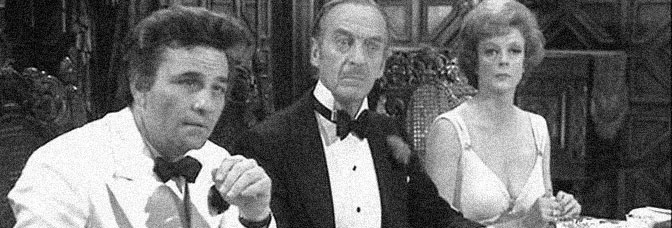
Writer Neil Simon did not adapt Murder by Death from one of his plays, which I’ve always assumed he did. While the film does have a more theatrical structure–a great deal of Death is the cast in one room–the action does follow the characters around and some of their experiences would be impossible without cinematic…
-

The titular assault in Assault on Precinct 13 doesn’t start until just over halfway through (and not at Precinct 13, but whatever). Until that point, Carpenter methodically lays out the elements to synthesize at the sieged police station. He introduces a tense gang situation, a new lieutenant (Austin Stoker), a convict being transferred to death…
-

In terms of De Palma’s direction, Carrie is a little bit of a mess. It’s a combination of Hitchcock as camp–which really cuts into the effectiveness of the finale–more religious imagery than, say, The Ten Commandments and, finally, some truly brilliant composition from De Palma. He, cinematography Mario Tosi and editor Paul Hirsch create a…
-

I think Slumber Party ’57 is supposed to be a titillating sex comedy but the lame jokes invalidate the latter and the exploitative misogynistic creepiness hopefully nullifies the former. Before getting to the acting, I do want to mention director Levey’s transitions. At times, it’s hard to tell if they’re intentionally strange, but when he…
-

Silver Streak is a wonderful film. It opens with all these little scenes on a train between Gene Wilder and Ned Beatty and then Jill Clayburgh. At this point, Streak seems like a very intelligent romantic comedy. There’s no drama yet, just excellent dialogue from Colin Higgins’s script. If he didn’t write it for Wilder–who…
-

Okay, I’m not the only one who wondered if Rendezvous might have been dubbed. The short is a high speed drive through Paris—sometimes the pace seems questionable, like Lelouch was able to speed it up (which seems unlikely in most parts, because other cars move at a normal pace) and the traffic patterns are odd.…
-

Poor Alec Holland… he finally regains his humanity, hooks up with a girl (who seems to be excited at the idea of seducing a widower) and then his comic gets cancelled. The final issue of Swamp Thing is a hideous affair—so bad no one’s ever revisited it, not even as a joke. These last two…
-

Who could predicate this turn of events… Alec Holland’s got a brother no one has ever mentioned before and he cures Swamp Thing…. Maybe the lame Ernie Chan cover sets it up. Or maybe Conway bringing in some obscure character from ten issues previous—I remember the name, but not the character—to turn into this idiotic…
-

It’s another decent issue from Michelinie and, big shock, it’s not a Swamp Thing comic so much as a “Twilight Zone” episode. Here it’s about some government nuclear test causing a virus and the government secretly quarantining the infected… including the lead scientist’s family. He’s the main character of the issue. Swamp Thing just sort…
-

Michelinie returns to do a Swamp Thing meets aliens issue. Swampy gets whisked to an intergalactic zoo where he takes part in the conveniently timed uprising of the prisoners. Swamp Thing is completely passive in the issue—Michelinie spends a lot more time on the jailer and his favorite female companion and he turns in a…
 The Stop Button