Before Watchmen: Silk Spectre 2 (September 2012)

872691Cooke and Conner set up Laurie as a hippie superhero; it’s kind of cool and definitely a decent look at sixties San Francisco. What’s interesting–and something I don’t think the original series ever established–is Laurie goes the “with great power” route. She turns into Silk Spectre because she can help people if she does. It deepens the character quite a bit.

And she needs it, because Cooke and Conner spend almost half the issue on the supervillains plotting to get kids tripping and consuming. It’s an incredibly boring scene and it goes on forever and ever.

Her boyfriend’s not much of a character either. I haven’t determined if they’re supposed to be teen runaways, but one would think his parents might be concerned.

The ending cliffhanger’s either going to be awesome or some terrible way to be grim and gritty.

Shockingly, Wein writes an okay pirate backup too.

CREDITS

Getting Into the World; writers, Darwyn Cooke and Amanda Conner; artist, Conner; colorist, Paul Mounts; letterer, Carlos M. Mangual. The Curse of the Crimson Corsair, The Devil in the Deep, Part Seven; writer, Len Wein; artist and colorist, John Higgins; letterer, Sal Cipriano. Editors, Chris Conroy, Camilla Zhang and Mark Chiarello; publisher, DC Comics.

Before Watchmen: Silk Spectre 1 (August 2012)

869319For Silk Spectre, Darwyn Cooke and Amanda Conner go the romance comic route. Or at least closer to it than I was expecting, but it makes sense given Laurie’s age during the high adventuring days of Watchmen.
She’s got her teen story going while Sally deals with aging and raising a kid to be a costumed adventurer. Cooke and Conner make both women utterly sympathetic, but it only works on Sally’s side because the reader knows her story.

Without it, she’d come across as a tiger mom. Except maybe the phone call to Hollis, which is as close as the comic gets to self-indulgence. It needs a little more, but it’s quite good as is.

Conner’s art never gets too cute, but always maintains the romance comic tone. It’s rather good and hard to imagine Spectre without it.

Higgins’s backup art, however, is severely lacking. It’s a muddled mess.

CREDITS

Means Goodbye; writers, Darwyn Cooke and Amanda Conner; artist, Conner; colorist, Paul Mounts; letterer, Carlos M. Mangual. The Curse of the Crimson Corsair, The Devil in the Deep, Part Two; writer, Len Wein; artist and colorist, John Higgins; letterer, Sal Cipriano. Editors, Chris Conroy, Camilla Zhang and Mark Chiarello; publisher, DC Comics.

Before Watchmen: Minutemen 6 (March 2013)

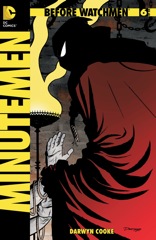
MINUTEM Cv6 solicitCooke plays both Hollis and the reader. We all find out at the same time–maybe Cooke’s trying to show Hollis made the same negative assumptions the reader does, but I don’t think so. Cooke’s been intentionally fooling the reader for at least three issues and in ways he doesn’t fool Hollis.
The comic still somewhat succeeds because Cooke writes Hollis so well. He’s likable and sympathetic. It’s funny Cooke doesn’t give him a single vice while everyone else gets a bunch.

But Cooke never makes Minutemen its own thing. He ties into the original Watchmen a lot for the epilogue. The series itself is basically the story of Hollis editing his book. Only the reader gets the truth this time.

One probably shouldn’t second guess Alan Moore, especially not with a contrived, triple surprise ending. Cooke even misses the issue’s best possible moment.

Still, it could’ve been much worse.

CREDITS

The Minute of Truth, Chapter Six: The Last Minute; writer and artist, Darwyn Cooke; colorist, Phil Noto; letterer, Jared K. Fletcher; editors, Wil Moss, Camilla Zhang and Mark Chiarello; publisher, DC Comics.

Before Watchmen: Minutemen 5 (February 2013)

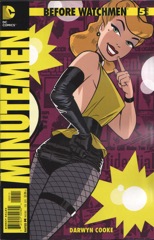
884587Yeah, Cooke goes exactly where I expected him to go. I suppose one could say there’s a balance to how he treats gays, but there’s not. He turns one group into martyrs and demonizes the other. It’d probably make Alan Moore ralph; one’s got to wonder if it’s there as a middle finger to Moore, actually.

Otherwise, it’s an excellent issue. Cooke gives the Minutemen a great mission with lots of twists. The final one gives Hollis some great scenes. The issue feels the tightest, with Cooke layering in visual references better than he has before.

It’s not all action. There’s also the ties to the original series, mostly with Sally and the Comedian. Those scenes are a lot more perfunctory than the action plot.

Of course, I think it’s the first issue where Cooke primarily has original material. No wonder he works better with it.

As always, lame backup.

CREDITS

The Minute of Truth, Chapter Five: The Demon Core; writer and artist, Darwyn Cooke; colorist, Phil Noto; letterer, Jared K. Fletcher. The Curse of the Crimson Corsair, Wide Were His Dragon Wings, Part Seven; writer, artist and colorist, John Higgins; letterer, Sal Cipriano. Editors, Wil Moss, Camilla Zhang and Mark Chiarello; publisher, DC Comics.

Before Watchmen: Minutemen 4 (December 2012)

879845On one hand, this issue is the most how I’d expect a Watchmen prequel from Cooke to read (if it weren’t four issues in). There’s back story on the Minutemen after the war, including when Sally and the Comedian reunite. Cooke humanizes him quite a bit… even if he does rip off Full Metal Jacket and a handful of other war movies to do so.

And he turns Sally into a stronger character than expected. Nothing like how she reads in the actual Watchmen comic, but a better character in this series. Cooke has made a few things his own, including the Silhouette’s experiences in Germany in the thirties.

Sadly, he comes up with a contrived reveal for the end of it. It’s cheap and completely unbelievable if it plays out the way he’s suggesting here. It’s rather distressing.

Finally (as usual), Higgins’s pirate thing is a waste of time.

CREDITS

The Minute of Truth, Chapter Four: War Stories; writer and artist, Darwyn Cooke; colorist, Phil Noto; letterer, Jared K. Fletcher. The Curse of the Crimson Corsair, Wide Were His Dragon Wings, Part Two; writer, artist and colorist, John Higgins; letterer, Sal Cipriano. Editors, Wil Moss, Camilla Zhang and Mark Chiarello; publisher, DC Comics.

Before Watchmen: Minutemen 3 (October 2012)

875222Poor Hollis, in love with a girl who doesn’t know he exists. Strangely, Cooke doesn’t narrate the book well when Hollis–in the sixties–is commenting directly on his younger self’s actions. The narration does work otherwise though.

The charm of Minutemen is gone. Once again, there’s a meta reference to it in Hollis’s opening narration. What remains is a destruction of the Golden Age ideal. It’s a good comic, but Cooke seems to be doing it in embrace the cynicism.

I can’t decide if he’s doing it as a way to interaction with Watchmen’s media legacy or if he’s doing it as a joke. If he’s laughing at the idea of doing a sequel to a work without the original writer’s involvement. If he’s calling Before Watchmen fanfic and nothing more.

Regardless, Cooke produces a thought-provoking comic book, both in its story and also free of those constraints.

CREDITS

The Minute of Truth, Chapter Three: Child’s Play; writer and artist, Darwyn Cooke; colorist, Phil Noto; letterer, Jared K. Fletcher. The Curse of the Crimson Corsair, The Evil That Men Do, Part Three; writer, artist and colorist, John Higgins; letterer, Sal Cipriano. Editors, Wil Moss, Camilla Zhang and Mark Chiarello; publisher, DC Comics.

Before Watchmen: Minutemen 2 (September 2012)

871391And now I’m not sure with where Cooke takes things. He turns Minutemen, in its conclusion this issue, into a really tough, uncomfortable book. It’s like I can’t decide if it’s homophobic, if Cooke’s just using the material or if he’s just being straightforward about it. There’s probably no comfortable way to handle it.

I’m talking about the superheroes, not the bad guys. For the bad guys, Cooke goes even more subtle and poetic even. He’s really playing with his format this issue; not just how his style doesn’t seem to lend itself to grit, but also how he occasionally mimics the original Watchmen panel arrangement.

It’s a good issue, well-written and well-illustrated, but I’m not sure how much I like it.

He also has a meta allusion to the Before Watchmen series at the open.

Higgins’s pirate art is too slick this time, sinking the backup story.

CREDITS

The Minute of Truth, Chapter Two: Golden Years; writer and artist, Darwyn Cooke; colorist, Phil Noto; letterer, Jared K. Fletcher. The Curse of the Crimson Corsair, The Devil in the Deep, Part Six; writer, Len Wein; artist and colorist, John Higgins; letterer, Sal Cipriano. Editors, Wil Moss, Camilla Zhang and Mark Chiarello; publisher, DC Comics.

Before Watchmen: Minutemen 1 (August 2012)

869965I’m a little surprised, but I only have one problem with Minutemen (at least the Darwyn Cooke material). Who the hell is Hollis Mason talking to? He’s basically summarizing his book, right? It doesn’t make any sense.

The only surprises are Silk Spectre and the Comedian–she’s a model faking being an adventurer and he’s already a vicious psychopath. The revelation of a rough childhood reads like giving his behavior an excuse, even if Cooke doesn’t intend it. But it doesn’t really matter because it’s Darwyn Cooke doing period superhero art.

There’s not much better, except maybe Darwyn Cooke doing really violent period superhero art and he does that art here. The issue’s a feast for the eyes and Cooke’s got the time period down.

The pirate backup has good art from John Higgins, but two pages isn’t enough space for Len Wein to do anything in terms of writing.

CREDITS

The Minute of Truth, Chapter One: Eight Minutes; writer and artist, Darwyn Cooke; colorist, Phil Noto; letterer, Jared K. Fletcher. The Curse of the Crimson Corsair, The Devil in the Deep, Part One; writer, Len Wein; artist and colorist, John Higgins; letterer, Sal Cipriano. Editors, Wil Moss, Camilla Zhang and Mark Chiarello; publisher, DC Comics.

Watchmen 12 (October 1987)

17194.jpg
Moore finishes Watchmen with two obvious questions. There’s the big one the final panel closes on and a smaller, cuter one from a couple pages before.

But there are a couple other questions he raises this issue. Two people, who have no reason to lie to anyone, lie. It’s as though Moore gives the more innocent characters a way out while still showing the complexities for the rest.

He also implies the complexities of the human condition with the old Silk Spectre, bringing Watchmen back onto the mortal plane from its grandiose heights.

But the issue is nowhere near as successful as the series’ best issues. Moore and Gibbons succeed in providing a satisfactory conclusion; sadly, that conclusion doesn’t have any other the narrative enthusiasm Moore shows elsewhere in the book.

In fact, the ending is so genial, so affable… it’s surprising Moore didn’t have a followup planned.

Yes, really.

Watchmen 11 (August 1987)

17193.jpg
Adrian revealing his master plan, or just rambling on about himself, takes up most of the issue. At first, the amount of ego Moore gives him is a little jarring, but it soon becomes almost soothing, all because Moore understands the importance of a great final gag. Even when it’s about the end of the world.

While his unveiling is great, the best part of the issue is the supporting cast all coming together across the street from the newsstand. Moore lets his cynical characters clash with the idealistic in little and big ways–the lovers physical fight, the marrieds argument, the comic book reader rebuffing the newsstand vendor’s overtures of friendship–it mirrors the unvoiced conflicts of the main characters.

There’s also, finally, Moore’s subtle reveal of title’s origin. Just one dialogue balloon, it’s a jarring reveal, because it shows how much Watchmen is about.

Moore overreaches, but gloriously.