Category: Judge Dredd
-

The issue has Wagner looking at various aspects of the future–block life, block wars, reasoning apes, what happens when a judge needs to retire–but none of them really stand out. The first story, resolving the Judge Child storyline while Dredd deals with a block war, has art from Brian Bolland. It’s gorgeous, but too static,…
-
It’s a really weak issue. Both writers–Wagner and Mills–go as melodramatic and sappy as possible. How can Judge Dredd be sappy? For most of the issue, Wagner focuses on Dredd’s sidekick robot, Walter. The joke with Walter is he is annoying and an issue of Walter stories seems a little too much. The Judge Dredd…
-

It’s not a bad ending. It’s not a good one, but it’s also not a bad one. Writers Wagner and Alan Grant–one of them does a terrible job on the first half of the issue, with the resolution to the Angel family, where the writer goes overboard with exposition. Especially about Dredd’s judge training. The…
-
It’s another strong issue, with Wagner giving Dredd a series of imaginative sci-fi encounters. The first one is the most traditional, with Dredd trying to track down a human visitor to a strange alien world. But Wagner has already established the character–who has contracted a strange alien disease–so Dredd has to enter that story. But…
-
A lot of the issue is rough going. Wagner tries out a few things on the second two planets–Dredd and company go to three–and has some success. But the adventure on the first planet, which has a bunch of different alien species at war, but as televised entertainment, is tedious. Still, Wagner somehow distracts from…
-
Wagner takes Dredd and company–though the company is rather indistinct–on an intergalactic quest. They’re in pursuit of the Angel family, who have kidnapped the Judge Child. There’s not a lot on the pursuit, but rather a series of imaginative sci-fi encounters. The first has Dredd encountering a space station where the computer has taken over.…
-
Judge Dredd heads into the Cursed Earth looking for a mutant child who’s going to have to save Mega-City One, or so one of the pre-cogs says. Writer John Wagner comes up with some decent encounters for Dredd–this issue’s primary villain is a “garbage god” who has thousands of slaves mining antiques from pre-apocalypse Memphis…
-
Wagner finishes the Chief Judge Cal storyline. There are a couple surprises before the end, with Wagner in something of a hurry. Smith doesn’t get much space on the art, which is unfortunate, but he uses the space he gets really well at times. It’s a satisfactory conclusion, but the denouement is way too abrupt.…
-
It’s a surprisingly awesome issue, with Wagner giving Dredd a big dumb sidekick, but one with a lot of character and comic relief value. They have to get back to the surface (Dredd and company escaped underground), so there’s a decent action sequence when Wagner brings them up against some other judges. He also explains…
-
Somehow, even though Bolland and McMahon alternate the chapters in this issue–so it’s always very clear when moving from one to the next–the story flows a lot smoother. Maybe because Wagner has gotten into the middle of the story, he’s established the lunatic rule of Chief Judge Cal. He’s moving through instead of building up.…
-
This issue reads a lot smoother, with Dredd again a fugitive, leading the revolt against the crazy new chief judge. Unfortunately, Wagner goes for absurdity at every turn–the new chief judge is so crazy he appoints a fish as his deputy–and it’s never believable the other judges would follow the new leader with such blindness.…
-
It’s something of a lackluster issue. The opening resolves the Cursed Earth storyline, but it’s the final chapter and probably should’ve somehow been fit in with the rest of the Cursed Earth issues. Especially since it’s extremely anticlimactic, though Mills does attend the character relationships he’s developed. Then Wagner takes over with Dredd on trial,…
-
The resolution to the Las Vegas cliffhanger is a little lame. Dredd just happens to get there in time to challenge the sitting judge and there just happens to be a good resistance movement in place to help out. The whole subplot–the mob being the corrupt judges of Vegas–is weak anyway. But then Mills does…
-
It’s Dredd versus a dinosaur. Not just any dinosaur, but the offspring of the dinosaur from the early issues of 2000 AD. Mills spends more time writing from the dinosaur’s perspective than he does from Dredd’s, which makes for a vaguely annoying, while still engaging enough outing. The pacing is off in this one though,…
-
It’s an excellent issue. Mills sends Dredd on something of a self-discovery; he encounters all different types in the Cursed Earth, with the villainous gangs being the only bad guys. It comes as a surprise to Dredd, but not the reader. Mills has a way of trying to surprise the reader with Dredd’s humanity. He’ll…
-
Mike McMahon does the art for the first three quarters of the issue, with Dredd getting ready to go on a mission through the Cursed Earth. Writer Pat Mills does a decent job setting up the back story, though once it moves on to preparations for the mission, he and McMahon get wrapped up in…
-
The feature story, with Mega-City One under attack from mutants from the Cursed Earth, is fairly strong. Wagner foreshadows throughout the story, but gently enough it just looks like he’s doing a lot of texture. He’s enthusiastic about describing the various settings; even when connections seem obvious later, when he’s introducing them, Wagner never draws…
-
It’s an awesome issue with Judge Death getting freed. The story has clear chapters, from the original 2000 AD progs, but the way Wagner brings it together–the changing focus on the first few–the both awesome and lackluster finish… it works out beautifully. The issue also brings back Anderson, after her brush with Judge Death, and…
-
This issue has stories where Dredd is stationed on the moon. There’s a bit too much of the Wild West mentality to it–which early 2000 A.D. progs often did with Americans in the future, so I guess it fits; the cowboy hats are still annoying. The first story has Dredd dealing with a disaster caused…
-
Of the three stories in this issue–this Judge Dredd series being a reprint series, the first one is the best, but the third one has the best writing from John Wagner. The first story introduces Judge Death. With Brian Bolland on the art–for all the stories–Judge Death is extremely detailed, extremely realistic, extremely creepy. The…
-
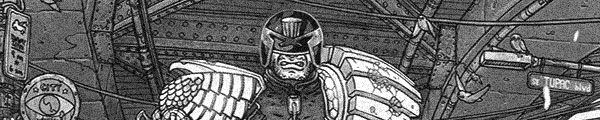
Not the strongest last issue, not at all. Though it probably does have Farinas’s most consistently decent art of the entire series. Well, in terms of detail and correct body proportions. His action composition is just terrible–Wolk tries to do way too much for the last issue, especially since he closes with a lengthy action…
-
Wolk brings in the ex-judge with the Mexican wrestling mask–it isn’t too exciting as it looks just like a regular judge’s mask, only not a helmet–and Dredd has a team-up. In the second half of the issue, anyway. The first half of the issue is an introduction to Melody Time, which mixes Disneyland and anarchy.…
-
Dredd gets a sidekick–temporarily, it’s like Wolk doesn’t want him to bond with anyone in Mega-City Two or something–and fights a giant sea monster. He also gets to see how the city turns away people back to the ocean; there’s a conspiracy going on or something. Wolk also promises a former judge who dresses like…
-
Even though Farinas art gets a little worse, Wolk isn’t spending time setting up the comic, he’s just telling a Judge Dredd goes undercover with a West Coast biker gang of the future. They’re really into found art. Dredd gets a sidekick in one of the biker gang and a lot of the issue is…
-
The back matter for this issue discusses the history of Mega-City Two, which I only briefly read. Writer Douglas Wolk has a nice structure for the issue–he drops the reader into Mega-City Two, with Judge Dredd as the anchor, and goes crazy. It’s a strange, Hollywood-influenced, happy place. Think the future in Wall-E, only a…
-

Dredd: Underbelly is the comic book sequel to Dredd, the movie, which is based on Judge Dredd, the comic book. So why make a big deal out of a comic book, in this case Underbelly? Well, Judge Dredd wears his new movie outfit and the designs are based on the movie, not the comic. Writer…
-
I guess I haven’t been paying attention but the lead of Invasion, Bill Savage, barely even registers a presence anymore. Finley-Day is more concerned with the setting of his stories than the content. Harlem Heroes, with Belardinelli art and Tully apparently wrapping up, is far more pleasant. Home stretch hopefully. It’s still incomprehensible nonsense. The…
-
It’s another all right issue. There’s some really interesting art, which helps things along. Invasion is fine. Dorey doesn’t get many amazing visuals, but it’s amusing enough. It takes place in an abandoned city; could be better, but when couldn’t Invasion be better. Harlem Heroes–without Gibbons, which I didn’t even notice–is really lame. Again it…
-
A not bad issue. Invasion doesn’t have the best script, but Carlos Pino’s art is really good. Finley-Day’s definitely not writing for the deep thinker–the evil Volgs have these expensive missiles for hitting one target (one human target) a piece. Dumb but fine. Heroes is mean-spirited but at least about the Aeroball game. Belardinelli does…
-
It’s an inoffensively weak issue. Finley-Day handles both Invasion and Dredd and doesn’t do well with either of them. Invasion has some really complex layouts from Dorey, which are cool, but the story’s pretty lame. Dredd is oddly not particularly busy–McMahon spends more time on little details than city designs–and Finley-Day doesn’t have a good…
 The Stop Button