The Program (2015, Stephen Frears)

The Program does not tell a particularly filmic story. It doesn’t have a rewarding dramatic arc. Telling the story of disgraced cyclist Lance Armstrong, with Ben Foster in the role–and as the film’s main character–does not offer many moments of joy. Foster’s spellbinding. He humanizes the sociopath enough to make him understandable in his cruelty. The Program is not a mystery, it starts with Foster figuring out how to cheat. At no moment is he playing the hero, not even when he does something heroic. It’s nearly a biopic, albeit an inspiring one, but it’s also a condemnation of character.

Rightly so too. But it does mean having an “anti-hero” in the lead position of the film and that situation holds The Program back. There’s a lot of historical footage used for the bike racing. While director Frears and cinematographer Danny Cohen do shoot some excellent cycling sequences, this film isn’t about the sport. It’s not about the thrill of it. It’s not even about the cost of fraud, if only because the subject isn’t capable of feeling guilt. Foster’s performance is phenomenal in the third act, when things come crashing down, because he’s got to collapse silently. It’s a tour de force performance (no pun) without a great defining scene. He never faces off with the people he’s tried to ruin. He’s a snake. He has a lawyer do it. And Foster’s perfect at it.

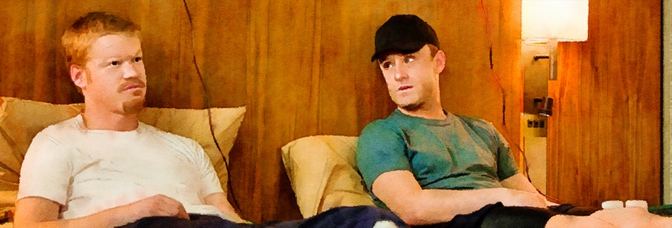
In the antagonist positions are Chris O’Dowd as the reporter who tries to figure out why Armstrong has to brake while going uphill. For a while, O’Dowd has a lot to do. Then he disappears. He’s excellent, but the film just doesn’t have enough for him to do. The same goes for Jesse Plemons as one of Foster’s teammates. He’s great, he has a complex arc (sort of), but he doesn’t have a lot to do. Again, history fails to provide the necessary melodrama.

Once things get legal, Cohen and Frears employ some odd spherical lenses to create claustrophobia in the Panavision frame. It’s not successful, but Frears is more about his actors, more about the way the film conveys its narrative than its visual sense. In many ways, The Program is just watching to see what Foster is going to do next, just like the viewer.

Good support from Guillaume Canet and Denis Ménochet. Cohen’s photography, spherical choices aside, is strong. The same goes for Valerio Bonelli’s editing. Except the historical footage. It might have made sense if it were a metaphor for O’Dowd waxing poetic about cycling turned into a fraud, but it isn’t. It’s mostly an expository shortcut, a budget requirement.

The film starts strong, but it’s obviously relying on its actors and on John Hodge’s sturdy, methodical, somewhat thankless script. Frears takes the time to set up expectations, then lets Foster surpass them all. The Program doesn’t want to answer all the questions its raises, it’s happy to just come up with some good questions. It might limit the film’s overall potential, but Foster, O’Dowd, Plemons, Cohen and Frears all do excellent work here.

The Route V50 (2004, Stephen Frears)

It’s clearly an extended Volvo commercial starring Robert Downey Jr. and directed by Stephen Frears, but I also think The Route V50 is based on an essay someone wrote to accompany a book of photographs (photographed by someone else). A French someone and a French someone else. If that assumption is correct, it should be a lot better… but wait, it appears the French persons are actually just Volvo advertising guys.

As it stands, it’s a terrible remake of a “Twilight Zone” episode where Downey runs into himself over and over at different points in a timeline. It’s interesting to see how these different temporal characterizations interact… but it’s Downey mugging for the camera and doing a TV commercial.

Regardless of source material, screenwriter Ed Roe’s apparently unable to write anything but that TV commercial so the partially engaging plot device is the only thing it’s got going for it.

1/3Not Recommended

CREDITS

Directed by Stephen Frears; screenplay by Ed Roe, based on a story by Lorenzo De Rita and Bertrand Fleuret; director of photography, Remi Adefersin; edited by John Smith; music by Nathan Larson; produced by Frances Silor; released by Volvo.

Starring Robert Downey Jr.


RELATED

The Queen (2006, Stephen Frears)

Glibly, I can say the most amazing thing The Queen does is humanize Tony Blair, seeing as he’s been decency’s biggest quisling in recent memory. But seeing a sympathetic portrayal of politician–one still in power when a film is released–is uncommon. Michael Sheen really creates a Tony Blair, certainly a Tony Blair one wishes the real person measured up to. And royalty is often sympathetically portrayed, just not modern royalty, which is where The Queen becomes rare. I had assumed the screenwriter adapted a book, something with some non-reporter-like confirmation (apparently, the screenwriter got independent confirmations of specific facts)… because The Queen then becomes a fictionalization of a real person, but a fiction striving for truth… is a truly exceptional attempt for a work.

I watched this film with tears in my eyes for much of it, because it made me privy to something private. An autobiography isn’t private, it’s published. I don’t like considering the impetus behind a film’s creation–it’s money, almost always, unless the film’s really cheap (and then it’s usually the desire for future money)–but this film mustn’t have easy to make in that regard and–I’m losing my train of thought. My film review vocabulary isn’t geared for admiring people’s intentions. Anyway.

Superficially glibly… James Cromwell. Cromwell’s been a ham for a good ten years or so. The Queen really rescues him from it. The role lends itself to ham and he doesn’t do it. Alex Jennings is also excellent as Charles. Some of The Queen‘s easy effectiveness comes from the majority of the characters being privately conflicted, unable to release it. Sheen acts as a bit of a release valve, getting to vocalize frustration, which the other main characters cannot do.

As for Mirren–being disinterested in the history of the Windsors, my fiancée proved invaluable in explaining certain details to me (the film would work just fine without the knowledge, of course)–but I did find it odd, back when I heard about the film, the quintessential British female actor (from the American perspective anyway) playing the quintessential British female. I assumed it would be an easy fit, but Mirren–a little differently from Sheen’s Blair, since Blair isn’t a world figure in the same way–creates the Queen. Through her interactions with her staff, from assistant to groundskeeper, Mirren gradually establishes more than a visible humanity, but really makes the audience understand more her feelings than the response to her actions.

In terms of handling–storytelling handling–if The Queen were an absolutely fictional piece, it’d be good but not revolutionary. It’s a somewhat standard structure, two main threads, one secondary one, but, again, the subject matter and the handling of it–I love the scenes Frears cuts a little short, in the middle of dialogue, when the Queen ceases listening and then so too must the audience–makes the film a particular achievement. Oddly, the only other thing I can think of to even compare this film to is… Bubba Ho-Tep, but whereas that film brought deep feeling to the fictionalized life of a real person, The Queen brings it to the real life of a real person. It’s really something.

4/4★★★★

CREDITS

Directed by Stephen Frears; written by Peter Morgan; director of photography, Affonso Beato; edited by Lucia Zucchetti; music by Alexandre Desplat; production designer, Alan Macdonald; produced by Christine Langan, Tracey Seaward and Andy Harries; released by Miramax Films.

Starring Helen Mirren (The Queen), Michael Sheen (Tony Blair), James Cromwell (Prince Philip), Sylvia Syms (the Queen Mother), Alex Jennings (Prince Charles), Helen McCrory (Cherie Blair), Roger Allam (Sir Robin Janvrin) and Tim McMullan (Stephen Lamport).


RELATED

Dirty Pretty Things (2002, Stephen Frears)

At some point during Dirty Pretty Things, maybe the half-way point, I didn’t check, I realized the film’s non-traditional approach was holding it back. It’s ironic (or maybe not, I’m sure I’m using the word wrong) since the third act is the most predictable thing I’ve seen in recent memory. I sat and waited for my predictions to come true and all of them did… even the last few moments, which were straight from a Hollywood playbook. Being straight from that playbook isn’t even a bad thing, necessarily–yes, I realize I just said not playing from it was holding Pretty Things back–but changing… modes of transport (I was going to go metaphor, but got too self-conscious) handicaps the thing. What starts as a good, solid different film becomes everything it wasn’t at the beginning. It preaches, which is one of the great things the first two acts do not do.

I thought, when the film got going, it was going to be an interesting, hotel-set mystery. It isn’t. It’s half traditional thriller, half character study. The character study eventually loses. Very little happens in the first twenty or thirty minutes and, once it does, a lot of the film’s charm disappears. Chiwetel Ejiofor’s performance is astounding. The poster I remember is the one with Audrey Tautou’s name above the title and the definite suggestion of a thriller. Obviously, American (especially Miramax) marketing of foreign product tends to be bullshit, but in this case, it’s an incredible slight against the film. But I’m glad, since I went into it knowing Ejiofor was good in other stuff and getting to see him–unexpectedly–in the lead. Tautou’s supporting, nothing more. She’s in it more than most of the other characters, since she’s the McGuffin in many ways. Any time something happens, it’s somehow because of Tautou (and occasionally because of Ejiofor’s concern for her). Sophie Okonedo is in it a lot less, but she has a lot more of an impact, just because of how her character shows up in the film. She tends to be in scenes where Ejiofor is defined through his actions, rather than his reactions to Tautou. Not to say Tautou’s performance isn’t good. It’s fine. It just doesn’t resonate very well… she doesn’t embody her character enough to make the character’s sometimes unlikely story fly.

As the villain, Sergi Lopez is excellent.

Frears does a good job throughout, maintaining an off-putting atmosphere to the film. He only really slips a couple times. Once with the Jaws dolly zoom and again in the film’s last few shots, when he inexplicably loses the distinctive color palette. At that point, however, the film had turned into the inspirational tale of an illegal immigrant instead of a story about a human being.

A few more words about Ejiofor. In many ways, since he is in most scenes, Dirty Pretty Things is a fantastic showcase for his ability. He gets to display a wide range–even though the script does him the disservice of trying to make him ominous, which is an absolutely ludicrous device (maybe the worst in the film), and even then he works through it. The only downside is how infuriating it is when the script makes him have to do (or say, especially say) something stupid.

2.5/4★★½

CREDITS

Directed by Stephen Frears; written by Steven Knight; director of photography, Chris Menges; edited by Mick Audsley; music by Nathan Larson; production designer, Hugo Luczyc-Wyhowski; produced by Tracey Seaward and Robert Jones; released by Miramax Films and BBC Films.

Starring Chiwetel Ejiofor (Okwe), Audrey Tautou (Senay), Sergi Lopez (Sneaky), Sophie Okonedo (Juliette) and Benedict Wong (Guo Yi).


RELATED