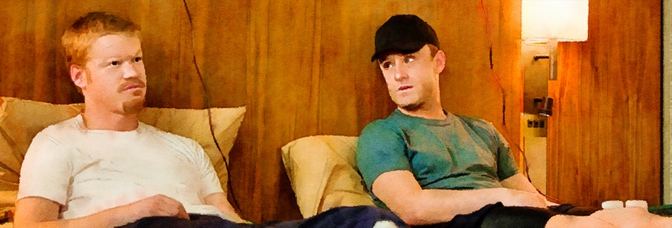
Judas and the Black Messiah (2021, Shaka King)

Judas and the Black Messiah has some third act problems. They end up drawing too much attention to LaKeith Stanfield’s character—the Judas—not having enough, well, character. Especially since director King uses footage of the real guy (it’s a true story) in the denouement, after opening the film with Stanfield in old age makeup playing the guy in the footage.

The film’s about Fred Hampton (The Black Messiah, played by Daniel Kaluuya) and Bill O’Neal (Stanfield). Hampton was the chairman of the Chicago chapter of the Black Panther Party. O’Neal is the FBI informant who aided in his murder. In 1989, O’Neal gave an interview for Eyes on the Prize 2 where he explained his informant status and complicity in the murder. The entire transcript is available online, with King using some of the unaired footage, which suggests he had access to the whole thing. Only O’Neal—in the interview—utterly copped out on accepting any responsibility for being a Judas. And the film doesn’t empathize with him about it, severely knocking down the effectiveness of Stanfield’s performance and even story arc. Particularly since—after an action beat—instead of seeing Stanfield’s reaction, the film uses Jesse Plemons’s white FBI guy as the scene protagonist. Basically once we get a scene of Martin Sheen in J. Edgar Hoover makeup being a scumbag and Plemons deciding he’s going to go along to get along, that plot line starts going downhill.

It unfortunately coincides with Hampton’s temporary release from jail, which has King shifting the perspective on his storyline from Kaluuya to Dominique Fishback, as Kaluuya’s conflicted girlfriend. So. Third act problems. The film’s able to do a last minute save thanks to the historical facts, which it presents on title cards (though, given Stanfield’s narrating from go and then the title of the film, it might’ve been better with the cards at the beginning versus the end); King does that ever precarious move in the biopic of bringing in the real people. It works thanks to Fishback’s person’s future, but also—and more complicated—Fred Hampton footage. The title cards draw attention to Hampton’s age at the time of his assassination—twenty-one—though Kaluuya’s not twenty-one. And Stanfield’s not twenty-one either. So there’s this biopic-y feel all of a sudden; it doesn’t have long enough to be problematic (would it have been better with age appropriate leads, et cetera) because of the real Hampton footage.

It’s impossible to have someone—anyone—play Fred Hampton. Even with the magic Kaluuya makes in his performance, it’s nothing like the actual Fred Hampton. Even in a thirty second clip, it’s clear he’s singular and the tragedy of the story punctures the soul. So King manages to all of a sudden go unsteady with the real O’Neal footage—basically using it to cop out to not giving Stanfield a fuller character—then to immediately ratchet it tight with the rest of the title cards and the Hampton close. Even if the Hampton close does Kaluuya no favors. Between the actors and the truth, King chooses the latter.

Otherwise, Judas and the Black Messiah is spectacular.

Until the second Sheen scene—Sheen opens the film lecturing to an auditorium of FBI agents about the dangers of Black people getting rights (generally getting rights; he gets specific in the scene opposite Plemons later) and it’s unclear he’s J. Edgar Hoover, unless the makeup was supposed to be a giveaway—but until that second Sheen scene, it’s Kaluuya’s film. Stanfield and his occasional narration and his meeting up with Plemons is just the narrative angle on introducing Kaluuya and the Black Panther chapter.

Kaluuya transfixes. He starts quiet in a speech to a college—where he meets Fishback and she plants the seeds to their romance, which is fantastic throughout—getting louder and louder until he sort of projects out of the screen. It’s one of the great performances from go, with Kaluuya capably handling his reduced presence and King’s revised narrative distances. But he’s the film. Even when he’s no longer the film, he’s the film. Right up until reality crashes in.

Stanfield’s good but it’s a bland part. Everyone else in the Panther party is better, starting with Fishback, but also supporting players Ashton Sanders and—especially—Albee Smith. Smith ends up with the most consistently tracked arc (versus Stanfield’s arc really being Plemons’s, Kaluuya’s transferring to Fishback) and it’s phenomenal. Darrell Britt-Gibson gets to play the sturdy sidekick guy throughout and is ever reliable. Great cast, great performances. King does really well with his actors.

Technically, it’s always outstanding. Sean Bobbitt’s photography is great, Craig Harris and Mark Isham’s score, Kristan Sprague’s editing, Sam Lisenco’s production design is excellent. Judas always looks, sounds, and moves great.

Okay, minus the Sheen and FBI stuff. King doesn’t know how to do the bad guys winning.

Judas is a big, gut-wrenching success for Kaluuya, Fishback, and King.

I’m Thinking of Ending Things (2020, Charlie Kaufman)

Once I’m Thinking of Ending Things makes it painfully, obviously clear what’s actually going on with nondescript Oklahoma intellectual artsy girl Jessie Buckley, her pseudo-intellectual, experience matters more but wait is actually smart or is he boyfriend Jesse Plemons, his weird parents—Toni Collette (who somehow manages to be the only person in the not-untalented cast to give a consistently good performance—hashtag, it’s the script’s fault) and David Thewlis (who, along with Plemons, seems to be doing an advertisement for “Fargo: The TV Show”)—and possibly creepy high school custodian Guy Boyd for the third or fourth time, the film becomes something of a waiting game. Waiting to see if director and screenwriter Kaufman can actually make anything out of it or not.

He does not.

It’s a big hill to climb, considering the script is all about presenting caricatures and his direction of his actors isn’t any better. Though it’s not like you really want Kaufman to put more effort into lionizing flyover country; he clearly wouldn’t do a good job of it.

The film actually seems structured to resist criticism, like Kaufman’s laughably bad 4:3 composition. Things is a Netflix streaming exclusive, Netflix streams in 16:9, Kaufman is a rebel who shoots in 4:3. Shame he doesn’t showcase his actors in their tight close-ups as much as have them showcase his pat dialogue; though I guess quoting Pauline Kael en masse is a flex for certain people. Stars Buckley and Plemons do get better eventually, but not permanently and it’s so obvious why they’re better the improvement just ends up annoying.

The film opens with Buckley narrating about her six week relationship with Plemons, who she either met at a trivia night or somewhere she saw in a Robert Zemeckis movie (Kaufman throwing poop at Robert Zemeckis is as good as the film gets so you can stop if it doesn’t connect, or if you don’t get the reference because then you’re not going to get the seventy-five other conversations when Kaufman tries to appeal to a “New Yorker” audience like it’s 2002 and the David Foster Wallace thing is a lot)….

Anyway.

The film opens with Buckley and Plemons driving to his parents. It’s like twenty minutes of them in the car in one shots talking to each other but not because Buckley’s interior monologue is running the whole time about how much she wants to dump Plemons. Then the parents, where Thewlis opens with a variation of his “Fargo” performance (which is just a mainstream Thewlis anyway) and does some refinements. He at least shows the capacity for range. Collette does wonders with a superficial role, showing the range but also the ability. Plemons and Buckley don’t have exhibit any range, which is kind of fine. At some point you’re glad it’s not better actors being wasted in the film.

Then there’s a second car ride where Kaufman decides to do some two shots so the actors get to… act together (he doesn’t do much actors acting together with the parents either; if anything, Ending is two hours and fifteen minutes of a director not actually knowing how to direct a movie). Plemons and Buckley get immediately better and then even better as the script gets weird for a moment and it seems like the obvious reveal isn’t coming.

The obvious reveal, of course, does arrive, albeit with some solid cushioning. Kaufman doesn’t do a great job with the reveal sequence but it shows more imagination than anything else in the film has to that point. The two hour mark or so.

Good photography from Lukasz Zal—not his fault Kaufman can’t compose a 4:3 shot—not good editing from Robert Frazen—but not his fault Kaufman can’t shoot scenes—not good production design from Molly Hughes, especially not for 4:3. Jay Wadley’s music is… fine.

Outside Collette being great just because, there’s no reason for Ending Things. Other than seeing what proud pseudo-elitist hipster streaming cinema looks like in 2020.

The Program (2015, Stephen Frears)

The Program does not tell a particularly filmic story. It doesn’t have a rewarding dramatic arc. Telling the story of disgraced cyclist Lance Armstrong, with Ben Foster in the role–and as the film’s main character–does not offer many moments of joy. Foster’s spellbinding. He humanizes the sociopath enough to make him understandable in his cruelty. The Program is not a mystery, it starts with Foster figuring out how to cheat. At no moment is he playing the hero, not even when he does something heroic. It’s nearly a biopic, albeit an inspiring one, but it’s also a condemnation of character.

Rightly so too. But it does mean having an “anti-hero” in the lead position of the film and that situation holds The Program back. There’s a lot of historical footage used for the bike racing. While director Frears and cinematographer Danny Cohen do shoot some excellent cycling sequences, this film isn’t about the sport. It’s not about the thrill of it. It’s not even about the cost of fraud, if only because the subject isn’t capable of feeling guilt. Foster’s performance is phenomenal in the third act, when things come crashing down, because he’s got to collapse silently. It’s a tour de force performance (no pun) without a great defining scene. He never faces off with the people he’s tried to ruin. He’s a snake. He has a lawyer do it. And Foster’s perfect at it.

In the antagonist positions are Chris O’Dowd as the reporter who tries to figure out why Armstrong has to brake while going uphill. For a while, O’Dowd has a lot to do. Then he disappears. He’s excellent, but the film just doesn’t have enough for him to do. The same goes for Jesse Plemons as one of Foster’s teammates. He’s great, he has a complex arc (sort of), but he doesn’t have a lot to do. Again, history fails to provide the necessary melodrama.

Once things get legal, Cohen and Frears employ some odd spherical lenses to create claustrophobia in the Panavision frame. It’s not successful, but Frears is more about his actors, more about the way the film conveys its narrative than its visual sense. In many ways, The Program is just watching to see what Foster is going to do next, just like the viewer.

Good support from Guillaume Canet and Denis Ménochet. Cohen’s photography, spherical choices aside, is strong. The same goes for Valerio Bonelli’s editing. Except the historical footage. It might have made sense if it were a metaphor for O’Dowd waxing poetic about cycling turned into a fraud, but it isn’t. It’s mostly an expository shortcut, a budget requirement.

The film starts strong, but it’s obviously relying on its actors and on John Hodge’s sturdy, methodical, somewhat thankless script. Frears takes the time to set up expectations, then lets Foster surpass them all. The Program doesn’t want to answer all the questions its raises, it’s happy to just come up with some good questions. It might limit the film’s overall potential, but Foster, O’Dowd, Plemons, Cohen and Frears all do excellent work here.

The Master (2012, Paul Thomas Anderson)

It would be wrong to call The Master a self-indulgent masterpiece, as it’s not a masterpiece (except maybe for Mihai Malaimare Jr.’s photography and Mark Bridges’s costumes… oh, and the sound design) but it’s also not self-indulgent. Anderson shows no personality until the end credits, when he sends shouts out to family members. Well, I guess that inclusion does qualify as self-indulgent (or worse).

The Master actually isn’t easy to talk about. There’s a purple elephant in the room as far as a twist and I don’t want to give it away. Not to say I want anyone else to suffer through the film–and especially not the end credits–but it’d just be mean. I will say Anderson does blatantly rip off a rather famous line from Midnight Run. It’s for one of Joaquin Phoenix and Philip Seymour Hoffman’s scenes. Their scenes are usually pretty good. Hoffman’s absolutely wonderful in the film. His performance doesn’t make up for the rest of it, but he does distract from it.

As for Phoenix, it’s hard to say. Anderson’s got him limping, got him walking around with a distinctive hands-on-his-hips look, got him talking with a jaw injury… And I haven’t even mentioned Phoenix looking forty-five but playing a guy in his mid-to-late twenties.

Amy Adams has the next biggest part. She’s so affected, Phoenix looks like he’s giving a natural performance.

The Master‘s a bloated mess of self-important, faux profundity.

0/4ⓏⒺⓇⓄ

CREDITS

Written and directed by Paul Thomas Anderson; director of photography, Mihai Malaimare Jr.; edited by Leslie Jones and Peter McNulty; music by Jonny Greenwood; production designers, David Crank and Jack Fisk; produced by Anderson, Megan Ellison, Daniel Lupi and JoAnne Sellar; released by The Weinstein Company.

Starring Joaquin Phoenix (Freddie Quell), Philip Seymour Hoffman (Lancaster Dodd), Amy Adams (Peggy Dodd), Laura Dern (Helen Sullivan), Ambyr Childers (Elizabeth Dodd), Jesse Plemons (Val Dodd), Rami Malek (Clark), Lena Endre (Mrs. Solstad), Madisen Beaty (Doris Solstad) and Kevin J. O’Connor (Bill William).


RELATED