Swamp Thing 127 (January 1993)

16097Whether intentional or not, the mad scientist lab and experiment in this issue remind a lot of The Return of Swamp Thing. Collins has embraced a–pardon the expression–comic book goofiness in her villain, General Sunderland’s daughter. It often plays like a parody of a good Swamp Thing comic as opposed to a real one.

For example, Alec promises Abby he won’t leave the swamp early in the issue (their first scene, actually). Of course he does by the finish. Collins doesn’t trust the reader to remember. It’s shockingly contrived.

Ditto for Chester, who is again announcing he’s leaving the comic. I find it hard to believe he and Abby hang out at diners when they need to gab. All of Collins’s inventiveness is gone at this point.

Maybe it’s because Eaton’s so weak. His art is terrible this issue, either awkward or static or both.

It’s very lame.

CREDITS

Project Proteus; writer, Nancy A. Collins; penciller, Scot Eaton; inker, Greg Baker; colorist, Tatjana Wood; letterer, John Costanza; editor, Stuart Moore; publisher, DC Comics.

Swamp Thing 126 (December 1992)

16096Dick Foreman coming in to do a guest writing spot gives Swamp Thing the break it needs. Even Eaton does a little better, since he’s not drawing people as much as grandiose cosmic events. Though he does take the chance to mess up Linda Holland.

Alec stalks a cartoonist he used to read–or Alec Holland used to read–and gets him stoned in hopes of inspiring him. That Swamp Thing would take the time to do such a thing is out of character for what Collins is doing, but who cares. A book needs something different occasionally and Foreman provides it.

The only time he loses track is when he has Alec explain the cartoonist’s place in the universe. It’s a real “show, don’t tell” moment; Foreman botches it. Can’t rightly blame Eaton.

Still, the rest is good–and the finish is great. It’s a rather successful fill-in.

CREDITS

The Big Picture; writer, Dick Foreman; penciller, Scot Eaton; inker, Kim DeMulder; colorist, Tatjana Wood; letterer, John Costanza; editor, Stuart Moore; publisher, DC Comics.

Swamp Thing 125 (November 1992)

16095 1It’s an anniversary issue and Collins brings back Arcane. She makes him somewhat comical, as he possesses baby Tefé and has her running around resurrecting his “evil dead.” I couldn’t believe they used that phrase. Clearly Sam Raimi doesn’t trademark well.

Abby and Alec freak out, the dead jazz guy shows up to help them, it goes on and on. There’s more of the Alec narration–not a lot, thank goodness. Collins doesn’t seem to understand the place of Arcane in the series. In Alec’s narration, he blames his battle with Arcane for not discovering his true elemental nature.

Maybe I read a different Swamp Thing but I’m pretty sure everyone used Arcane sparingly. Until he got to Hell; then he became good comic relief.

The cliffhanger–a soft one–foreshadows Arcane’s new body to inhabit. It’s not much of a surprise.

Collins has run out of ideas. It’s unfortunate.

CREDITS

Family Reunion; writer, Nancy A. Collins; penciller, Scot Eaton; inker, Kim DeMulder; colorist, Tatjana Wood; letterer, John Costanza; editor, Stuart Moore; publisher, DC Comics.

Swamp Thing 124 (October 1992)

16094Talk about anti-climatic… Collins grows Swamp Thing to Godzilla-size for a reveal and then has him pass the buck at the end of the issue.

The story’s not bad. Presumably a former Swamp Thing made a deal with some South American natives who worshipped to the elemental (including blood sacrifices, which Alec reveals taste good in the soil) and now their descendants need help. They call their corn god and Alec arrives instead.

He helps them against the Sunderland Corporation, but it turns out not even Swamp Thing can defeat the military industrial complex. Or something.

Alec has a lot of interior monologue this issue–the most in years, I think–and it turns out he’s scared for his family. Being Swamp Thing doesn’t mean he can protect them from the bad guys.

Maybe he should dress up as a bat.

While not terrible, it’s far from good.

CREDITS

Husks; writer, Nancy A. Collins; penciller, Scot Eaton; inker, Greg Baker; colorist, Tatjana Wood; letterer, John Costanza; editor, Stuart Moore; publisher, DC Comics.

Swamp Thing 123 (September 1992)

16093I think Eaton thinks he’s doing a Steve Bissette impression. If so, it’s not producing any good art. Lots of static panels and busy line work don’t make up for some actual movement.

There’s story movement though. Collins sends Chester away this issue–after Eaton’s practically turned him into an action hero, at least physically–and the evil Sunderland corporation is moving full steam ahead against Alec.

Except Alec knows about them, so why doesn’t he jump into a fern at their corporate headquarters? Because Collins makes him very, very weak except in the elemental action scenes. She’s pretty much spent all of her good momentum from when she took over. A three parter about a doctor moonlighting as a brainwashed assassin isn’t a good Swamp Thing.

The writing on Abby is getting weak too. With the nanny around, Abby’s become completely disinterested in her kid.

It’s dreadfully tepid stuff.

CREDITS

Punctures; writer, Nancy A. Collins; penciller, Scot Eaton; inker, Kim DeMulder; colorist, Tatjana Wood; letterer, John Costanza; editor, Stuart Moore; publisher, DC Comics.

Swamp Thing 122 (August 1992)

16092Collins doesn’t improve here. Eaton might a little, even though his pencils become incredibly static. He finally puts noses on the cast, which outweighs his other inabilities at a talking heads issue.

But Collins. She splits the Sunderland threat apart–one from the maniacally evil Sunderland daughter herself and another, tangentially related one from the gubernatorial candidate Alec embarrassed–but both threats are idiotic. Even if Alec can’t sense when people are plotting against him–all he does this issue is bond a little with Lady Jane–they still don’t need to use goofy plans.

Swamp Thing hasn’t felt so contrived in a long time. Collins is mostly just using keywords and catchphrases. I hope so she recovers soon, because when she turns pacifist hippie Chester into Rocky Balboa, the issue just collapses. It becomes a spoof of itself.

Even cliffhanger’s absent any tension. Collins is spreading everything too thin.

CREDITS

The Eye of the Needle; writer, Nancy A. Collins; penciller, Scot Eaton; inker, Kim DeMulder; colorist, Tatjana Wood; letterer, John Costanza; editor, Stuart Moore; publisher, DC Comics.

Swamp Thing 121 (July 1992)

16091Oh, good grief. All those nice things I said about Collins and this issue’s how she repays me.

Lady Jane has moved in. She apparently knows to read Tefé storybooks; there’s an implication Abby never did. Collins seems to have forgotten how she wrote Abby just a few issues ago (you know, as a protagonist and not a jerk).

Collins brings back Sunderland in the form of a previously undisclosed daughter to the late general. She’s out to get Alec, except she hasn’t been keeping tabs on him over the years. It’s all a coincidence she discovers he’s still around. Instead of, I don’t know, performing in Las Vegas. It’s idiotic.

Then, to make matters even worse, Collins brings in a goofy-named villain. It’s maybe Swamp Thing’s first goofy-named villain. It shouldn’t have any.

Eaton’s art is terrible. He’s painfully flat.

Just like the rest of the comic.

CREDITS

Laissez les Bon Temps Rulers; writer, Nancy A. Collins; penciller, Scot Eaton; inker, Kim DeMulder; colorist, Tatjana Wood; letterer, John Costanza; editor, Stuart Moore; publisher, DC Comics.

Swamp Thing 120 (June 1992)

16090Bad news, good news. Eaton’s the regular penciller. In addition to Tefé’s undocumented nanny, Lady Jane, not having a nose, none of the other female characters seem to have much of one either. Certainly not enough to make their faces three dimensional.

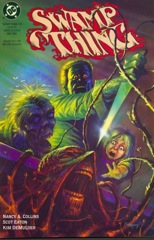
Good news is Collins can write, which I already knew, but she choses to do so here. She tells Lady Jane’s origin story and she does it a lot better than the rest of the issue. It’s an unhappy story of early industrial age England, told from a woman’s perspective; it’s excellent.

The stuff with Alec being unsympathetic to Abby? Not excellent. Collins skips establishing Alec approving of Lady Jane as a nanny so his position on the matter makes no sense.

It’s only a few pages in the issue, but enough to show–juxtaposed against the Lady Jane origin–where Collins’s storytelling interests lie.

It’s mostly great.

CREDITS

Lady Jane; writer, Nancy A. Collins; penciller, Scot Eaton; inker, Kim DeMulder; colorist, Tatjana Wood; letterer, John Costanza; editor, Stuart Moore; publisher, DC Comics.

Swamp Thing (1985) #119

Swamp Thing  119

For the entire issue–which is incredibly fast paced as Alec and Abby try to find a kidnapped Tefé–Scot Eaton’s pencils are fine. There aren’t any amazing panels, but it all flows rather nicely. Until the final reveal, where Eaton goes entirely flat. It’s a full page too. It ends the issue poorly.

Otherwise, the issue’s pretty. Alec acting as a tracking dog for the cops is unlikely; I don’t believe he can’t sense Tefé’s location–can’t he talk to the trees or grass around her–but it’s dramatically successful. Collins hasn’t found a good balance for his power.

She also has a lot of exposition, which is again about the purple vengeance monster. It’s nothing she didn’t cover in the previous issue and now it’s just text to slow the reader. It doesn’t offer anything.

Collins tries to do too much this issue. She should’ve taken her time.

Swamp Thing 119 (May 1992)

16089For the entire issue–which is incredibly fast paced as Alec and Abby try to find a kidnapped Tefé–Scot Eaton’s pencils are fine. There aren’t any amazing panels, but it all flows rather nicely. Until the final reveal, where Eaton goes entirely flat. It’s a full page too. It ends the issue poorly.

Otherwise, the issue’s pretty. Alec acting as a tracking dog for the cops is unlikely; I don’t believe he can’t sense Tefé’s location–can’t he talk to the trees or grass around her–but it’s dramatically successful. Collins hasn’t found a good balance for his power.

She also has a lot of exposition, which is again about the purple vengeance monster. It’s nothing she didn’t cover in the previous issue and now it’s just text to slow the reader. It doesn’t offer anything.

Collins tries to do too much this issue. She should’ve taken her time.

CREDITS

The Bad Man; writer, Nancy A. Collins; penciller, Scot Eaton; inker, Kim DeMulder; colorist, Tatjana Wood; letterer, John Costanza; editor, Stuart Moore; publisher, DC Comics.