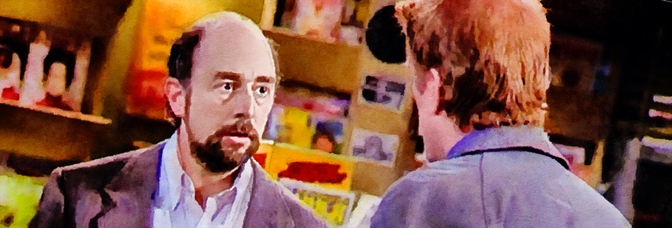
Becker (1998) s01e19 – Truth and Consequences

Marsha Myers wrote this episode and Myers has been one of the only reliable writers this season. So high hopes for it. And strange disappointment because Truth and Consequences does succeed but it doesn’t have much to do with Myers’s script. It succeeds because it’s got Richard Schiff in a sitcom guest spot. He’s Ted Danson’s accountant cousin who ends up crashing with Becker (Danson) and visiting with the regular cast. It’s great, but because it’s Schiff. Schiff doing sitcom comedy like he does here would be insufferable weekly, but for a guest spot? It’s glorious.

Not to mention the other guest with the most to do is Marvin Kaplan. He’s an old man patient of Danson’s who wants to get busy with the ladies. He’s got a younger woman; she’s sixty-five. There’s a great moment where Danson—mind you, the episode’s from 1999—tells Kaplan a woman’s pleasure is important too now. Kaplan says, “The rules have changed.” Danson replies, “The rules haven’t changed; they’re just enforcing them now.” So that moment does stand out in Myers’s script. It’s not a spectacular moment for the show itself—Danson’s character on the show avoids female characters for romance presumably because it’s too inconvenient to respect them—but it’s a good moment in the script and episode. Kaplan—who is a very familiar TV character actor guest starrer—is right in the scene and Danson’s good enough in the moment.

There’s also a great one-liner from Danson (and Myers) later about how alcohol kills pain and cigarettes relieve stress. So some good moments, but the episode’s all about Schiff’s guest spot. He’s very funny and very good.

Linda (Shawnee Smith) and Margaret (Hattie Winston) get a subplot involving a buff stud medical waste inspector (Matt Battaglia). It doesn’t go for long—it’s like the episode flips between its regular guest cast, Smith and Winston in the first half, then Terry Farrell and Alex Désert in the second—but it’s a good showcase for Smith.

The episode probably just needed a better director. There are lots of solid pieces for the regular cast and then Schiff flawless with whatever he’s got. It’s a very good sitcom but not a great showcase for “Becker,” the show itself. Better direction would’ve made the difference.

Walk and Talk the Vote (2012, Michael Mayers)

Walk and Talk the Vote reunites the “West Wing” cast–including Martin Sheen as President Bartlet, which I wasn’t expecting, but a lot of it feels like it could have just been impersonators.

The only time the commercial–for Mary McCormack’s sister, Bridget Mary McCormack–gets any energy is when characters are actually talking to each other and the actors are visibly getting in rhythm with each other. It happens especially with Allison Janney and Bradley Whitford and a little with Sheen and Lily Tomlin. Poor Richard Schiff, who doesn’t talk with anyone so much as at them, looks a little lost.

Also lost are Joshua Malina and Janel Moloney. They literally disappear after their initial appearance.

It’s a neat idea and not a bad commercial to encourage people to vote the non-partisan portion of the ballot, but John Cockrell’s script is really forced.

Whitford and Janney save it.

1/3Not Recommended

CREDITS

Directed by Michael Mayers; screenplay by John Cockrell, inspired by a television show created by Aaron Sorkin; director of photography, Mayers; edited by Greg Arata; music by Kyle Newmaster; produced by Mary McCormack and Michael Morris.

Starring Allison Janney (C.J. Cregg), Janel Moloney (Donna Moss), Richard Schiff (Toby Ziegler), Bradley Whitford (Josh Lyman), Mary McCormack (Kate Harper), Joshua Malina (Will Bailey), Melissa Fitzgerald (Carol Fitzpatrick), Lily Tomlin (Deborah Fiderer) and Martin Sheen as the President.


RELATED

Rough Magic (1995, Clare Peploe)

Rough Magic isn’t a bad idea, it’s just poorly plotted. Most of the movie takes place in Mexico, where it’s mildly engaging and generally amusing (except when Paul Rodriguez shows up to annoy and he is incredibly annoying). Notice all the qualifiers? The movie starts strong and even gives the impression of ending strong (it doesn’t). For example, D.W. Moffett’s excellent in period pieces and most of his work is in the first fifteen minutes and the last fifteen minutes. Clare Peploe’s direction is good overall, but during the first act, it’s much better than the rest of the film.

I had assumed, given how disjointed the narrative gets–it becomes about Russell Crowe (who’s mediocre with a shifty accent and is actually better when he’s the protagonist) instead of Bridget Fonda–the novel was something obscure and maybe good, a thought I rarely have when watching an adaptation. However, the novel’s some pulp from the early 1940s, so I doubt it’s a literary masterwork and I’m wondering how much of the script is new. I’m assuming most, given how particular the setting is to the story, but I suppose it’s possible the big disconnect (from Mexico back to Los Angeles) did come from the novel. Because anyone working on the script should have seen right away it was off.

Bridget Fonda’s great, though she and Crowe don’t have much chemistry for much of the film, and she has some great scenes. Richard Schiff, Andy Romano, Kenneth Mars, Jim Broadbent–very strong supporting cast.

It’s too bad it doesn’t work out, but it becomes clear once the story moves to Mexico it isn’t going to… and then it alternates between amusing and trying, with the Rodriguez scenes something terrible.

1/4

CREDITS

Directed by Clare Peploe; screenplay by Robert Mundi, William Brookfield and Peploe, based on a novel by James Hadley Chase; director of photography, John J. Campbell; edited by Suzanne Fenn; music by Richard Hartley; production designer, Waldemar Kalinowski; produced by Declan Baldwin and Laurie Parker; released by Goldwyn Films Inc.

Starring Bridget Fonda (Myra), Russell Crowe (Alex Ross), Jim Broadbent (Doc Ansell), D.W. Moffett (Cliff Wyatt), Kenneth Mars (Ivan the Terrific), Paul Rodriguez (Diego), Andy Romano (Clayton), Richard Schiff (Wiggins) and Euva Anderson (Tojola).


RELATED