Howard the Duck 5 (September 1976)

Howard the Duck #5If you’re a duck stuck in the Marvel Universe, how are you going to earn some quick cash? Wrestling, of course. Everyone knows fighting crime doesn’t pay and you’ve got to look out for number one!

Howard and Beverly are having money troubles–I love how Gerber gets around to discussing the obvious logic problems in Howard (I can only hope there’s the sleeping situation issue)–and Howard tries finding a job of his own.

Beverly’s modeling gig isn’t going to make them millionaires, after all.

His misadventures get him on TV–fighting a clown (the clown did hit him with a cream pie)–and then working as a collection agent. Not any kind of work for a respectable duck, hence the wrestling for ten grand.

There’s a lot humor, but Colan’s pencils really show the humanity of it all. Gerber works some considerable magic with Howard the Duck’s thoughtfulness.

CREDITS

I Want Mo-o-oney!; writers, Martin Pasko and Steve Gerber; penciller, Gene Colan; inker, Steve Leialoha; colorist, Michele Wolfman; letterers, Gaspar Saladino and Irving Watanabe; editor, Marv Wolfman; publisher, Marvel Comics.

Star Trek 13 (April 1981)

Star Trek #13It's another high concept issue from Pasko. He's got McCoy meeting his estranged daughter for the first time in years–she's marrying a Vulcan (a much, much older one), he's got the Enterprise landing on The Planet of the Apes and how it plays out when the Klingons get there. Pasko plays a lot with the Apes thing, working in all sorts of genre stuff from outside. For a few pages, it all feels like a mystery, and for the last few pages, Pasko goes for difficult character work.
In the meantime, there are also Klingons around causing trouble. These are post-The Motion Picture Klingons having a very television series encounter with the Enterprise crew. Pasko hits all the right notes.

Unfortunately, Joe Brozowski, Tom Palmer and Marie Severin don't exactly knock it out of the park on the art. There's some detail, but it's more consistently messy than anything else.

B+ 

CREDITS

All the Infinite Ways; writer, Martin Pasko; pencillers, Joe Brozowski, Tom Palmer and Diverse Hands; inkers, Palmer and Marie Severin; colorist, Carl Gafford; letterer, Joe Rosen; editor, Louise Jones; publisher, Marvel Comics.

Star Trek 12 (March 1981)

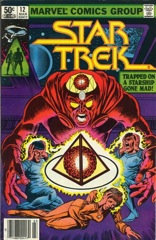
Star Trek #12Penciller Luke McDonnell–along with Tom Palmer on inks–does a lot of photo referencing this issue. But he’s only partially successful. Kirk looks spot-on, but Spock doesn’t. And Janice Rand returns this issue; she’s not spot on either. At least she’s not problematic. The work on Spock is downright bad.

The issue references the first episode of the television show, the disappearance of Rand in the first season and then a lot from the movie. There are a few visual cues straight from The Motion Picture.

Pasko’s script moves fast and doesn’t stop for the absurdity speed bumps. There’s a big crisis and the entire thing should have been avoided. Pasko seems to realize it and skips even trying.

He also does a feeble characterization of Rand. She’s an entirely new character from her time on the show; Pasko can’t connect to her.

It’s a well-intentioned misfire.

C 

CREDITS

Eclipse of Reason; writers, Alan Brennert and Martin Pasko; pencillers, Luke McDonnell and Tom Palmer; inker, Palmer; colorist, Carl Gafford; letterer, Joe Rosen; editor, Louise Jones; publisher, Marvel Comics.

Star Trek 11 (February 1981)

Star Trek #11This issue’s art, from Joe Brozowski and Tom Palmer, is better than the usual for the comic. A lot of emphasis on the faces, lots of photo reference, but also a decent level of general competency. If a little static.

Pasko’s script regurgitates some of the old “Star Trek” episodes without offering anything new. He relies on bringing in a guest star from a character’s past, which hurries along the setup because Pasko can use expository conversation. It’s just not very useful in terms of furthering the characters. Everyone is stuck; it’s unfortunate the series doesn’t take the time to develop any character subplots. Maybe the license forbids it.

It’s a perfectly fine licensed property comic. Pasko’s clearly a “Trek” enthusiast and he does fine remixing a bunch of old episodes into this story. It’s a shame Marvel isn’t doing anything more with the comic, but it’s to be expected.

C 

CREDITS

“…Like a Woman Scorned!”; writer, Martin Pasko; pencillers, Joe Brozowski and Tom Palmer; inker, Palmer; colorist, Carl Gafford; letterers, Joe Rosen and Rick Parker; editor, Louise Jones; publisher, Marvel Comics.

Star Trek 9 (December 1980)

Star Trek #9Dave Cockrum must have refused to draw faces and made the inker do it. It might explain why the features on the characters this issue appear to slide around their faces, Frank Springer had to get them all filled in.

Bad art aside, it’s not a bad issue. It’s nearly decent, but Pasko throws in a subplot about Kirk and some ex-girlfriend and then some other big coincidence. The ex-girlfriend is a weak character and Kirk doesn’t look anything like himself anyway, so it’s almost entirely out of place. When Pasko resolves it, he relies in the female character only he never did anything to build her up.

The rest of the issue has a somewhat predictable finish but also has a boring way of unfolding. Pasko can’t make it compelling, maybe because he mocks the danger. He shows one extreme, then a nearly comical one.

Very mixed bag.

C+ 

CREDITS

Experiment in Vengeance!; writer, Martin Pasko; pencillers, Dave Cockrum and Frank Springer; inker, Springer; colorist, Carl Gafford; letterer, John Costanza; editor, Louise Jones; publisher, Marvel Comics.

Star Trek 8 (November 1980)

Star Trek #8Martin Pasko writes the heck out of this comic book. He’s got a really complicated plot and it makes for a fantastic, lengthy read. Pasko doesn’t just come up with a great reveal for the aliens, he’s also got the really cool subplots going. He runs two subplots through the comic, resolving one and then introducing the next. And those run under this intriguing main plot.
It shows why, for once, a licensed property comic can excel. The comic only works because it’s a Star Trek comic yet Pasko so profoundly transcends the norm in plotting ability, it becomes something singular.

Unfortunately, Ricardo Villamonte is the apparently worst possible inker for Dave Cockrum in the world. Forget the characters looking too photo-referenced, they don’t even look the same between panels. And there’s no depth. Villamonte didn’t put in any shadows. None.

But that Pasko script is a wonderful thing.

A- 

CREDITS

The Expansionist Syndrome; writer, Martin Pasko; pencillers, Dave Cockrum and Ricardo Villamonte; inker, Villamonte; colorist, Carl Gafford; letterer, Ray Burzon; editor, Louise Jones; publisher, Marvel Comics.

The Saga of the Swamp Thing 19 (December 1983)

12368.jpg
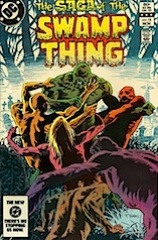
It’s Pasko’s final issue and he goes out on a high note. The opening quickly resolves the now protracted cliffhanger, then brings Arcane almost immediately into the story.

While I’m still underwhelmed with a reprint for the previous issue, it did establish the precedent for Arcane appearances, which Pasko continues here. When old Anton shows up, it’s a very special issue.

Bissette comes up with some disgusting Un-Men (the insect thing is creepy) and Alec and Abby have to escape them. Even though old home week continues, Pasko gives the cast members he created farewells. Dennis and Liz finally get close and the evil German doctor who wasn’t always evil tries for a redemption.

This issue, with Arcane, is so strong it overshadows some of Pasko’s good work on the series. It’s as though all it needed to excel was Bissette and old characters, but Pasko was also essential.

CREDITS

…And the Meek Shall Inherit…; writers, Stephen R. Bissette and Martin Pasko; penciller, Bissette; inker, John Totleben; colorist, Tatjana Wood; letterer, John Costanza; editor, Len Wein; publisher, DC Comics.

The Saga of the Swamp Thing 18 (November 1983)

810268.jpg
Hey, wait a second, I’ve already read this story….

This issue reprints the tenth issue of the original Swamp Thing series, when Arcane swims across the ocean and attacks Swamp Thing only to be defeated by the spirits of dead slaves. Wrightson art, one of Wein’s last good unsettling issues, it’s a good comic book. Wish whoever had been in charge had at least changed the editor’s notes so it didn’t refer to the second issue of the original series here in a Saga of the Swamp Thing book.

There are bookends, of course, and I guess they’re were the issue has problems. The flashback isn’t particularly important, at least not as a full reprint. Pasko, Bissette and Totleben could have retold it in a page or two. It’s an awkward fill, since it doesn’t do anything to resolve the previous issue’s cliffhanger.

They should’ve just taken a month off.

CREDITS

The Man Who Would Not Die!; writers, Martin Pasko and Len Wein; pencillers, Stephen R. Bissette and Bernie Wrightson; inkers, John Totleben and Wrightson; colorist, Tatjana Wood; letterer, Ben Oda; editor, Len Wein; publisher, DC Comics.

The Saga of the Swamp Thing 17 (October 1983)

12366.jpg
Wow, what an unpleasant issue. Pasko brings back Abby and Matt—with yet another retelling of the first series, but this time from their perspective, which reveals how they just disappeared from it at some point.

Keeping with the old home week feel to the issue, Arcane shows up at the end. Bissette and Totleben really know how to make him disgusting, maybe more than anyone else so far. It’s a glorified cameo, but gives the feel things are changing in the series.

What’s most striking about the issue is how Pasko ties Matt’s alcoholism to the horrors Alec and the supporting cast face. Interestingly, the second Abby calls him Alec, he ceases to be Swamp Thing to me. Bissette and Totleben’s artwork is absolutely fantastic, whether its the flashback, the monsters or just the page layout.

It’s a great issue, though Pasko takes a few pages to get rolling.

CREDITS

…And Things That Go Bump in the Night; writer, Martin Pasko; penciller, Stephen R. Bissette; inker, John Totleben; colorist, Tatjana Wood; letterer, John Costanza; editor, Len Wein; publisher, DC Comics.

The Saga of the Swamp Thing 16 (August 1983)

12365.jpg
For Bissette and Totleben’s first issue, Pasko does something of a refresh. The issue opens with a quick origin retelling, then reintroduces the supporting cast. It’s amusing the previous evil German guy is now a good guy. Apparently, being a Holocaust survivor means you get to later torture and murder people and it’s okay.

Most of the issue is spent with Swamp Thing in a small town where everyone accepts him. It’s the kind of thing Wein did in the seventies series (and did do in the seventies series, as I think about it). Obviously, there’s a reason why they all accept him. It’s an introduction issue, maybe even for readers who liked the original but missed the relaunch.

Seeing as how Abby shows up, for the first time, in a non-speaking cameo.

Bissette and Totleben are off to a fine start; they mix the horror and action well.

CREDITS

Stopover in a Place of Secret Truths; writer, Martin Pasko; penciller, Stephen R. Bissette; inker, John Totleben; colorist, Tatjana Wood; letterer, John Costanza; editor, Len Wein; publisher, DC Comics.