The Untold Legend of the Batman 2 (August 1980)

16900.jpg
With Byrne gone–and Aparo taking all the art duties–Untold Legend actually becomes visually distinctive. While Aparo’s faces aren’t compelling, he does a lot of nice work this issue. Wein’s script covers a lot of events and Aparo has a particularly nice time with Alfred’s flashback. The war panels are excellent.

This issue, Wein covers Robin and Alfred’s origins and also Two-Face and the Joker. The most interesting historical continuity details? Wein’s Joker isn’t insane, he just thinks being funny looking will scare people. Also Alfred… he wasn’t always the Wayne butler. Wein should have told the whole series from Alfred’s perspective.

Somehow having the comic less from Batman’s perspective works better. Wein’s Batman is obnoxious.

Like I said, the series is worth a look just for historical interest with the mashed together origin events, but Wein’s framing story is just plain lame.

It’s not even a mystery.

C 

CREDITS

With Friends Like These…; writer, Len Wein; artist and letterer, Jim Aparo; colorist, Glynis Wein; editor, Paul Levitz; publisher, DC Comics.

The Untold Legend of the Batman 1 (July 1980)

16899.jpg
The Untold Legend of the Batman might have good art… but it’s hard to tell. Each page is packed with panels–except one pin-up page, which is pretty good–and it’s hard to get a handle of John Byrne’s pencils (with Jim Aparo inking).

Some of the pages are pretty good though, but it’s certainly not a comic to read for the art. Sadly, it’s also not a comic to read for the writing.

Untold Legend is a streamlined retelling of Batman’s original, adding in all the Earth-One origin developments. It’s excellent as a curiosity (I’d forgotten teenage Bruce Wayne was Robin to some police detective) but Len Wein’s writing is atrocious.

Most of the comic is Bruce retelling his history to Alfred. One would assume Alfred would know some of these events, if not all.

The issue’s painful at times, a shopping list of contrived origin events.

Swamp Thing 33 (February 1985)

12382.jpg
So while Swamp Thing has his adventure in “Pog,” Abby has her own one here. Except she’s mostly just in a framing sequence, not quite an adventure.

For whatever reason, Moore brought the original appearance of Swamp Thing into continuity with this issue. So there’s a few pages of Abby with Cain and Abel–Moore’s starting to explore the nature of storytelling a little, something he’d later expand on in Promethea–and then a reprint of the Len Wein and Bernie Wrightson House of Secrets Swamp Thing.

The end ties it all together, but the story isn’t consequential at all. It’s Moore mixing playfulness and good humor. He ends it on a joke. Moore’s often his most startling when he’s doing light comedy. It’s nice.

Ron Randall does the Abby bookend art. It’s the best work I’ve seen from him.

But he’s nowhere near Wrightson.

And Wein’s nowhere near Moore.

The Saga of the Swamp Thing 18 (November 1983)

810268.jpg
Hey, wait a second, I’ve already read this story….

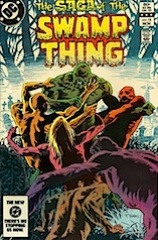
This issue reprints the tenth issue of the original Swamp Thing series, when Arcane swims across the ocean and attacks Swamp Thing only to be defeated by the spirits of dead slaves. Wrightson art, one of Wein’s last good unsettling issues, it’s a good comic book. Wish whoever had been in charge had at least changed the editor’s notes so it didn’t refer to the second issue of the original series here in a Saga of the Swamp Thing book.

There are bookends, of course, and I guess they’re were the issue has problems. The flashback isn’t particularly important, at least not as a full reprint. Pasko, Bissette and Totleben could have retold it in a page or two. It’s an awkward fill, since it doesn’t do anything to resolve the previous issue’s cliffhanger.

They should’ve just taken a month off.

CREDITS

The Man Who Would Not Die!; writers, Martin Pasko and Len Wein; pencillers, Stephen R. Bissette and Bernie Wrightson; inkers, John Totleben and Wrightson; colorist, Tatjana Wood; letterer, Ben Oda; editor, Len Wein; publisher, DC Comics.

DC Retroactive: Batman – The ’70s 1 (September 2011)

231252_20110720234036_large.jpg

Once one gets past Len Wein’s expository narration—and his way too self-aware Batman thought balloons—Retroactive is a good bit of fun.

The story’s got two possibilities for predictable revelations and Wein plays with it. He fulfills one of them but then completely ignores the second. Instead, he does something utterly goofy in the context of a one shot but perfect if it were a “missing” adventure.

However, having Tom Mandrake do the art for a seventies Batman book is a little odd. Mandrake’s artwork is utterly fantastic. His Batman is big and scary and his Bruce Wayne is urbane. He’s got some amazing panels of people and I wish he’d do a talking heads series; it’d be beautiful.

But it’s not seventies Batman style. He’s way too good for the absurdities Wein sometimes lobs at him (and the reader).

It’s a surprisingly okay issue… with fantastic art.

CREDITS

Terror Times Three!; writer, Len Wein; artist, Tom Mandrake; colorist, Wes Hartman; letterer, Dezi Sienty; editors, Chynna Clugston Flores and Jim Chadwick; publisher, DC Comics.

DC Special Series (1977) #27

Dc special 27The issue opens with Len Wein’s nearly incomprehensible expository narration. While the comic is written almost more as a tie-in to the “Hulk” TV show and an introduction to Batman, one almost needs an English degree to figure out what Wein’s trying to say.

But his plotting isn’t much better; in fact, it’s worse. At one point, Batman teams up with the Joker. You know, instead of arresting him for the mass murders and so on. Not to mention the big Marvel villain (the Joker’s partner) is this stupid space alien who looks like a jack in the box.

Actually, it’s too bad—the Hulk and Batman go together because they’re so different. The Hulk’s all about lack of control, Batman’s the opposite. A better writer would have found a good story.

However, the Jose Luis Garcia-Lopez art makes the comic worthwhile. It makes up for the writing.

The Phantom Stranger (1969) #14

Ps14

I don’t think I’ve ever seen pre-eighties Jim Aparo before. It’s absolutely stunning. The tight faces are present, but there’s also a bunch of energy. I never would have thought he’d be a great Phantom Stranger—or any supernatural story—artist, but he excels.

Len Wein comes up with two good stories for the issue, though the Stranger one is better. This villain figures out a way to capture the Stranger and then takes out his heart, figuring transplanting it into his body will give him immortality. Of course, it doesn’t work out as planned (does the Phantom Stranger actually need a physical heart?). Wein has some purple narration, but the plot moves fast and Aparo makes it damned creepy.

The Doctor Thirteen backup is a little silly (Wein opens with a swamp monster and ends with a sci-fi thing), but Tony DeZuniga’s art makes it simply wonderful.

Swamp Thing (1972) #13

Sw13

Even though the issue ends with a teaser of the next one, it reads a little like Wein was preparing for it to be Swamp Thing’s finale. Swamp Thing reveals his identity to Matt Cable and then, instead of setting off with Matt to adventure, heads back to the swamp. It takes Swamp Thing a night to walk from Washington D.C. to Louisiana. Wein’s not so great at geography apparently.

This issue features Redondo’s best work so far. Besides integrating horrific into his tragic renderings of Swamp Thing, he also gets to do a lot of regular action. Matt and Abby put on SHIELD uniforms to break Swamp Thing out, for example.

Wein starts off stronger than he finishes, opening with Swamp Thing discovering his serum, in the swamp water, has been mutating the wildlife. It’s interesting, but Wein moves on immediately.

It’s goofy and pointless, but never too bad.

Swamp Thing (1972) #12

Sw12

I’ve decided what Redondo does so differently from Wrightson (and how it effects the book). He draws Swamp Thing not as a muscle-bound, ideal specimen… but rather a lumpy, awkward creature. No wonder he looks forlorn all the time. It changes how the book plays. One wouldn’t think Arcane would be after Swamp Thing’s body if he’d seen it as Redondo conceives it.

The issue is a depressing affair, with Swamp Thing tied to an unfortunate man who’s cursed to live forever… starting at the dawn of time. It apparently gets lonely when one’s alive billions of years. Wein plots it a little like a mystery, which works, but Swamp Thing’s inglorious departures from various time periods leaves something to be desired. Oddly, the internal thoughts start poor and get better, like Wein’s getting back into the groove.

Speaking of upping the grooviness… Wein gives Cable a black sidekick.

Swamp Thing (1972) #11

Sw11

Nestor Redondo has the somewhat impossible task of following Bernie Wrightson. He does pretty well, though he could have gotten more help from Wein. Redondo recasts Swamp Thing as more of a lumbering superhero (Redondo’s expressions of Swamp Thing’s frequent dismay are startling, given the character is genetically predisposed to stoicism). But he does fine. The cliffhanger’s fantastic and his people are good.

But Wein’s plot and his details (the dialogue, Swamp Thing’s thoughts) are all questionable. The issue’s a sequel to a Phantom Stranger issue Wein wrote three years earlier… it ties Swamp Thing to the greater supernatural DC universe, but it’s an odd fit. There’s only so much one might believe could happen in Swamp Thing’s particular swamp.

There’s a lot of cruelty; Wein explains why it’s okay later, but it’s a cheap excuse. He also objectifies Abby here (for the first time).

It’s all right, just… off.