Has Black Hammer not had a big issue lately? Because this issue gives me the “momentous reveal” chills I got reading the first trade. Lemire works the whole thing on multiple levels–you get big moment on a character level for Barbalien, but there’s also a whole “what’s the mystery of Black Hammer” thing going on. And Lemire juxtaposes those subplots against Abraham Slam’s story and flashback. It’s really good.
Wonderful Ormston art this issue too. The flashback is awesome, but the modern stuff is so melancholic and disheartening. Real upper, this comic.
CREDITS
Writer, Jeff Lemire; artist, Dean Ormston; colorist, Dave Stewart; letterer, Todd Klein; editors, Cardner Clark and Daniel Chabon; publisher, Dark Horse Comics.
The strangest thing about Black Hammer, which I can’t believe I hadn’t noticed before–or did and didn’t comment on (or worse, did and did comment on)–is how both Lemire and Ormston excel at the tragedy. The comic is at its best when the characters are suffering their worst. This issue has a little bit of passive suffering–Gail has no happy memories–but also the active, confounded suffering of new addition Lucy Weber. Lemire has her the catalyst for possible change, giving the reader foolishly renewed hope for the characters. It’s a depressing issue, but gloriously so (Ormston has a great time with it); the cliffhanger is an evil shocker too.
The strangest thing about Black Hammer, which I can’t believe I hadn’t noticed before–or did and didn’t comment on (or worse, did and did comment on)–is how both Lemire and Ormston excel at the tragedy. The comic is at its best when the characters are suffering their worst. This issue has a little bit of passive suffering–Gail has no happy memories–but also the active, confounded suffering of new addition Lucy Weber. Lemire has her the catalyst for possible change, giving the reader foolishly renewed hope for the characters. It’s a depressing issue, but gloriously so (Ormston has a great time with it); the cliffhanger is an evil shocker too.
CREDITS
Writer, Jeff Lemire; artist, Dean Ormston; colorist, Dave Stewart; letterer, Todd Klein; editors, Cardner Clark and Daniel Chabon; publisher, Dark Horse Comics.
Lemire gets Hammer’s second storyline–with Black Hammer’s (the dead hero, not the comic itself) daughter showing up in the farm. There’s a lot of comedy, there’s a lot of tenderness (which Lemire and Ormston handle quite well), there’s a lot of flashback on Black Hammer. It’s a great issue with a way too effective soft cliffhanger. It’s like you’ve got an all-new series to read.
Lemire gets Hammer’s second storyline–with Black Hammer’s (the dead hero, not the comic itself) daughter showing up in the farm. There’s a lot of comedy, there’s a lot of tenderness (which Lemire and Ormston handle quite well), there’s a lot of flashback on Black Hammer. It’s a great issue with a way too effective soft cliffhanger. It’s like you’ve got an all-new series to read.
CREDITS
Writer, Jeff Lemire; artist, Dean Ormston; colorist, Dave Stewart; letterer, Todd Klein; editors, Cardner Clark, Brendan Wright, and Daniel Chabon; publisher, Dark Horse Comics.
Black Hammer looks like a horror comic. Dean Ormston’s art always suggests there’s something darker going on, even if writer Jeff Lemire didn’t hint at it all the time. There’s something creepy about the comic’s world; the cast of characters doesn’t know what’s going on, the reader doesn’t know what’s going on, Lemire doesn’t really hint at the details, just implies details exist. It makes for a disquieting reading experience, even though there’s nothing too dark going on.
More so, Lemire hints there isn’t anything much darker to be revealed, just sadder. Black Hammer is all about sadness. Sadness and secrets.
It’s also about a bunch of superheroes who find themselves transported to a farm in a rural town after they defeat a great enemy. Lemire bakes in the sadness–the superheroes weren’t happy before they left, so when the comic opens ten years after the event, it’s unlikely anything else is going to make them happy.
Except maybe Abe Slam, who’s pretty much the protagonist. He’s Captain America without the powers, only he didn’t leave his home dimension in the forties, he left it in the seventies or eighties when he was an old man and felt like he didn’t have a place anymore. Much to the chagrin of his fellow captives, he does find a place, being an old white guy farmer who romances the woman who runs the local diner. Her ex-husband’s the sheriff, which Lemire hints will come into play later, but not yet. Mostly Abe’s just contentedly getting by, mostly because he’s the only one of the captives who can.
The rest are either aliens, robots, mystically de-aged, supernaturally winged, or just plain unstuck dimensionally.
The alien is the Martian Manhunter stand-in–Lemire borrows from both Marvel and DC to fill out his cast, who weren’t a super-team so much as an assortment of superheroes. Barbalien. Turns out his not just hiding his true form, he’s also hiding he’s gay, which leads to some trouble. Because he’s keeping it a secret. Ten years stuck together on a farm and none of the characters seems to be upfront with any of the other. Some of it is the baked in sadness Lemire does, some of it is the sauce for the gander. Black Hammer is a heavy read. There’s not a bright sky in Lemire’s writing or in Ormston’s art. When the comic’s really going for it, it’s impossible to say who’s more effective, Lemire or Ormston. It’s impossible to imagine the comic without the two of them.
The robot is Talky-Walky, who is probably female–she doesn’t get her own issue in this collection–because she’s the sidekick of the unstuck fellow, Colonel Weird. He’s the Adam Strange stand-in who knows more about what’s going on than he can explain but in learning it, he’s gone mad. There’s the implication of unrequited love on her side. Back in the day, they used to travel to other planets and eradicate life because what else were they going to do to aliens in the Golden or Silver Age. Lemire makes a lot of subtle comments on old comics matter-of-factly. Again, he bakes it in.
Colonel Weird’s issue has some foreshadowing, but mostly it’s a dejected look at how these previously powerful characters can’t have any more power. Even though they do still retain a lot of their powers, if not all of them.
The de-aged person is Golden Gail. She’s a female Captain Marvel (Shazam Captain Marvel). Only she became Captain Marvel in the forties and whenever she changed into the hero, she became a nine year-old. So now she’s a middle-aged woman stuck in a nine year-old’s body. She’s probably the closest thing to comic relief, only it’s all so tragic and all so heavy, it’s never funny. Worse is when it turns out she’s got a crush she shouldn’t have. Lemire’s not happy unless Black Hammer is making someone unhappy; he’s also willing to take on that burden. He’s asking the reader for a lot of emotional investment and is doing so responsibly. There’s not a single time he asks for too much without it being necessary.
Then there’s Madame Dragonfly. She’s got the wings. She’s a witch consigned to a cabin who went out to save the world because just because she’s a cursed witch doesn’t mean she’s a bad guy. She’s the coolest character in the book. Lemire plays with tropes and standards, but Madame Dragonfly is something entirely her own. What if the narrator of a horror comic, gross with dragonfly wings and eye of newt and zombie dolls, wasn’t a bad guy. Her story finishes the collection; it’s where Lemire hints at things too terrible for even Black Hammer to reveal. Not too terrible in terms of horrific reveals, but too terrible in terms of human reveals. He takes his characters very, very seriously.
While most of the issues–except the first–have a single character emphasized, Lemire’s careful to continue his B plots and C plots. It’s a tightly constructed comic, both in Lemire’s plotting and how Ormston visualizes it. The series is upfront about its despondence, upfront in its deconstruction. It’s never overly ambitious. Lemire and Ormston are ambitious with it, but they always hit their marks.
It ends on a cliffhanger of sorts, both for the reader and the characters, which is sort of annoying. Not because it’s not well-executed, but because it means I need to wait for more Black Hammer.
Black Hammer looks like a horror comic. Dean Ormston’s art always suggests there’s something darker going on, even if writer Jeff Lemire didn’t hint at it all the time. There’s something creepy about the comic’s world; the cast of characters doesn’t know what’s going on, the reader doesn’t know what’s going on, Lemire doesn’t really hint at the details, just implies details exist. It makes for a disquieting reading experience, even though there’s nothing too dark going on.
More so, Lemire hints there isn’t anything much darker to be revealed, just sadder. Black Hammer is all about sadness. Sadness and secrets.
It’s also about a bunch of superheroes who find themselves transported to a farm in a rural town after they defeat a great enemy. Lemire bakes in the sadness–the superheroes weren’t happy before they left, so when the comic opens ten years after the event, it’s unlikely anything else is going to make them happy.
Abraham Slam in his younger days.Except maybe Abe Slam, who’s pretty much the protagonist. He’s Captain America without the powers, only he didn’t leave his home dimension in the forties, he left it in the seventies or eighties when he was an old man and felt like he didn’t have a place anymore. Much to the chagrin of his fellow captives, he does find a place, being an old white guy farmer who romances the woman who runs the local diner. Her ex-husband’s the sheriff, which Lemire hints will come into play later, but not yet. Mostly Abe’s just contentedly getting by, mostly because he’s the only one of the captives who can.
The rest are either aliens, robots, mystically de-aged, supernaturally winged, or just plain unstuck dimensionally.
J’onn J’onzz–sorry, Mark Markz–arrives on Earth.The alien is the Martian Manhunter stand-in–Lemire borrows from both Marvel and DC to fill out his cast, who weren’t a super-team so much as an assortment of superheroes. Barbalien. Turns out his not just hiding his true form, he’s also hiding he’s gay, which leads to some trouble. Because he’s keeping it a secret. Ten years stuck together on a farm and none of the characters seems to be upfront with any of the other. Some of it is the baked in sadness Lemire does, some of it is the sauce for the gander. Black Hammer is a heavy read. There’s not a bright sky in Lemire’s writing or in Ormston’s art. When the comic’s really going for it, it’s impossible to say who’s more effective, Lemire or Ormston. It’s impossible to imagine the comic without the two of them.
The robot is Talky-Walky, who is probably female–she doesn’t get her own issue in this collection–because she’s the sidekick of the unstuck fellow, Colonel Weird. He’s the Adam Strange stand-in who knows more about what’s going on than he can explain but in learning it, he’s gone mad. There’s the implication of unrequited love on her side. Back in the day, they used to travel to other planets and eradicate life because what else were they going to do to aliens in the Golden or Silver Age. Lemire makes a lot of subtle comments on old comics matter-of-factly. Again, he bakes it in.
Captain Weird explores… the weird.Colonel Weird’s issue has some foreshadowing, but mostly it’s a dejected look at how these previously powerful characters can’t have any more power. Even though they do still retain a lot of their powers, if not all of them.
The de-aged person is Golden Gail. She’s a female Captain Marvel (Shazam Captain Marvel). Only she became Captain Marvel in the forties and whenever she changed into the hero, she became a nine year-old. So now she’s a middle-aged woman stuck in a nine year-old’s body. She’s probably the closest thing to comic relief, only it’s all so tragic and all so heavy, it’s never funny. Worse is when it turns out she’s got a crush she shouldn’t have. Lemire’s not happy unless Black Hammer is making someone unhappy; he’s also willing to take on that burden. He’s asking the reader for a lot of emotional investment and is doing so responsibly. There’s not a single time he asks for too much without it being necessary.
Shazam! Oh, you know what they mean.Then there’s Madame Dragonfly. She’s got the wings. She’s a witch consigned to a cabin who went out to save the world because just because she’s a cursed witch doesn’t mean she’s a bad guy. She’s the coolest character in the book. Lemire plays with tropes and standards, but Madame Dragonfly is something entirely her own. What if the narrator of a horror comic, gross with dragonfly wings and eye of newt and zombie dolls, wasn’t a bad guy. Her story finishes the collection; it’s where Lemire hints at things too terrible for even Black Hammer to reveal. Not too terrible in terms of horrific reveals, but too terrible in terms of human reveals. He takes his characters very, very seriously.
Madame Dragonfly helps save the world.While most of the issues–except the first–have a single character emphasized, Lemire’s careful to continue his B plots and C plots. It’s a tightly constructed comic, both in Lemire’s plotting and how Ormston visualizes it. The series is upfront about its despondence, upfront in its deconstruction. It’s never overly ambitious. Lemire and Ormston are ambitious with it, but they always hit their marks.
It ends on a cliffhanger of sorts, both for the reader and the characters, which is sort of annoying. Not because it’s not well-executed, but because it means I need to wait for more Black Hammer.
CREDITS
Writer, Jeff Lemire; artist, Dean Ormston; colorist, Dave Stewart; letterer, Todd Klein; editors, Ian Tucker, Cardner Clark, Brendan Wright, and Daniel Chabon; publisher, Dark Horse Comics.
Some time during the first part–of four–of Bodies, I realized it didn’t have much media exploitation potential. The gimmick is simple–a similarly mutilated body is found in London at different times in history (and the future) and the police investigate. Writer Si Spencer shows his hand as far as interest–with the present and the nineteenth century getting the most emphasis. Both these periods drive the narrative, with the future and the WWII eras sort of garnish.
There are different artists for each period. Meghan Hetrick for the present, Dean Ormston for the 1800s, Tula Lotay for the future, Phil Winslade for the World War II. All the art is decent and appropriate for its period; Lotay is the least successful.
Spencer tries to establish his characters quickly, but through flash not substance.
It’s a competent comic, but there’s nothing compelling about the mystery or the characters.
C
CREDITS
Writer, Si Spencer; artists, Meghan Hetrick, Dean Ormston, Tula Lotay and Phil Winslade; colorist, Lee Loughridge; letterers, Dezi Sienty and Taylor Esposito; editors, Sara Miller and Shelly Bond; publisher, Vertigo.
It’s more from the adventures of young Pullman. I was wondering if it would turn out to be him and it does. Not sure if it’s supposed to be a surprise–Dean Ormston, who “finishes” (which looks like all the art), doesn’t draw the traditional Pullman. He’s a lot dirtier here.
Given the story takes place around 2500 BCE, the dirt is no surprise.
Carey looses Pullman on poor Gilgamesh, who goes monster hunting on the villain’s suggestion. The issue makes certain aspects of the Unwritten mythology quite literal, which is neat. Ormston does a great job with monsters.
Gilgamesh narrates the issue, giving Carey the opportunity to show off writer chops, but it also gives the reader a new perspective. Even with the time period, the reader knows more than Gilgamesh about what he’s encountering. Or some of it, anyway.
It’s yet another excellent issue. Thoughtful, action-packed goodness.
CREDITS
Set in Stone; writers, Peter Gross and Mike Carey; pencillers, Gross and Dean Ormston; inker, Ormston; colorist, Fiona Stephenson; letterer, Todd Klein; editors, Joe Hughes and Karen Berger; publisher, Vertigo.
 Has Black Hammer not had a big issue lately? Because this issue gives me the “momentous reveal” chills I got reading the first trade. Lemire works the whole thing on multiple levels–you get big moment on a character level for Barbalien, but there’s also a whole “what’s the mystery of Black Hammer” thing going on. And Lemire juxtaposes those subplots against Abraham Slam’s story and flashback. It’s really good.
 The strangest thing about Black Hammer, which I can’t believe I hadn’t noticed before–or did and didn’t comment on (or worse, did and did comment on)–is how both Lemire and Ormston excel at the tragedy. The comic is at its best when the characters are suffering their worst. This issue has a little bit of passive suffering–Gail has no happy memories–but also the active, confounded suffering of new addition Lucy Weber. Lemire has her the catalyst for possible change, giving the reader foolishly renewed hope for the characters. It’s a depressing issue, but gloriously so (Ormston has a great time with it); the cliffhanger is an evil shocker too.
 Lemire gets Hammer’s second storyline–with Black Hammer’s (the dead hero, not the comic itself) daughter showing up in the farm. There’s a lot of comedy, there’s a lot of tenderness (which Lemire and Ormston handle quite well), there’s a lot of flashback on Black Hammer. It’s a great issue with a way too effective soft cliffhanger. It’s like you’ve got an all-new series to read.
 Black Hammer looks like a horror comic. Dean Ormston’s art always suggests there’s something darker going on, even if writer Jeff Lemire didn’t hint at it all the time. There’s something creepy about the comic’s world; the cast of characters doesn’t know what’s going on, the reader doesn’t know what’s going on, Lemire doesn’t really hint at the details, just implies details exist. It makes for a disquieting reading experience, even though there’s nothing too dark going on.
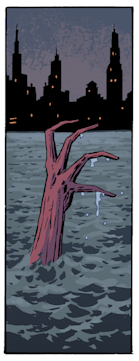


 Some time during the first part–of four–of Bodies, I realized it didn’t have much media exploitation potential. The gimmick is simple–a similarly mutilated body is found in London at different times in history (and the future) and the police investigate. Writer Si Spencer shows his hand as far as interest–with the present and the nineteenth century getting the most emphasis. Both these periods drive the narrative, with the future and the WWII eras sort of garnish.
 It’s more from the adventures of young Pullman. I was wondering if it would turn out to be him and it does. Not sure if it’s supposed to be a surprise–Dean Ormston, who “finishes” (which looks like all the art), doesn’t draw the traditional Pullman. He’s a lot dirtier here.