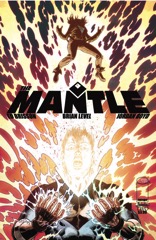
The Mantle 2 (June 2015)

The Mantle #2Okay, Brisson takes the route I guess I was hoping he’d take and he immediately goes unexpected places with it. Maybe not entirely unexpected–the idea of the new Mantle meeting up with the old Mantles, if possible, for inspiration, isn’t unexpected. But how Brisson gets there is a complicated and crazy. And it’s what gives the comic some energy.

Because the villain? The Plague guy whose very touch makes people’s arms fall off? He’s an awful villain. Brisson gives him a bit of personality, which doesn’t help because it gets the reader curious about answers to questions Brisson isn’t even raising yet.

There aren’t a lot of questions in The Mantle. Brisson does a good job staying on track, so when he loses control of a scene, it stands out.

The art is, once again, decent. Level has personality if not the detail (or time) for all of it.

CREDITS

Writer and letterer, Ed Brisson; artist, Brian Level; colorist, Jordan Boyd; editor, Laura Tavishati; publisher, Image Comics.

The Mantle 1 (May 2015)

The Mantle #1I want to know where The Mantle is going more than I want to read where it’s going. The way writer Ed Brisson sets up the end of this first issue, it could either go in two paths. One where the series is very episodic, one where it isn’t. Would I not continue reading depending on the former or the latter… No.

But I want to know. I want to know how to digest the material.

Simple setup. Superheroes are real. They just hide and fight their enemies in the middle of nowhere. It’s unclear how long they’ve been around, but at least a decade because the titular Mantle is like the Green Lantern rings.

Only the villain is hunting down the Mantle holder before they can get comfortable.

Brian Level’s composition is better than his detail, which gives it all a certain distinct personality.

Mantle’s okay. I think.

CREDITS

Writer and letterer, Ed Brisson; artist, Brian Level; colorist, Jordan Boyd; editor, Laura Tavishati; publisher, Image Comics.

Lazarus (2013) #10

Lazarus  10

It's a torture issue. Sure, it's a torture issue where the guy getting tortured is an odious previous villain in Lazarus, but it's still a torture issue.

What's most surprising about it is Lark sticking on the art for what's essentially a done-in-one fill-in type issue. The rogue son of the main family goes off to another family–who are based in New York City, which gives Lark a chance to do something like Escape from New York for a bit and it's awesome–and it's his bad time trying to defect.

Rucka uses the issue to establish how the world works outside the family he's used to dealing with and to setup either the next story arc or the next few story arcs.

The issue moves a little too fast, but the Lark New York scenes make up for it in art, and the resolution is a decent surprise.

It's fine.

Lazarus (2013) #9

Lazarus  9

You know, I can’t remember the last time I’ve liked a comic plot–along with how things turn out for the characters–but not liked the comic itself. Until today.

Rucka has been making leaps and bounds improvements with Lazarus and they sort of culminate here… at least in terms of character development. The lousy narrative structure of this issue? It’s a regression. It’s practically an all action issue, but not really. Rucka opens with a sword duel flashback and it’s pretty art from Lark but it’s not worth the pages. Those pages would have been better spent towards the end in the present action, making the action scenes there resonate better.

There’s also the missed opportunity to better bring together the arc’s various characters.

Again, it’s a fulfilling issue for a reader in terms of narrative progression, it’s just a mess of a comic. Very awkward to talk about.

Lazarus (2013) #8

Lazarus  8

Rucka shows all the subplots coming together at the end of the issue for the soft cliffhanger. It’s not particularly dramatic stuff; the connection is contrived, which is okay because Lazarus is kind of a big soap opera. The kids hating their rich father is enough to make it a soap opera. Through in an “adopted” genetically engineered sibling and it’s even bigger.

There are some problems with how long this arc is going. Hopefully it’s only another issue. A lot has happened but most of the events just rearranged things. Rucka’s still coasting on some of the more effective events, kind of zooming downhill on that momentum to get him to the finale.

Nothing much happens. It’s filler, except the linking of the story lines. But it’s still good enough. Even with Lark’s art falling off a bit, especially on faces. They look way too hurried.

But steady on.

Lazarus 8 (April 2014)

Lazarus #8Rucka shows all the subplots coming together at the end of the issue for the soft cliffhanger. It’s not particularly dramatic stuff; the connection is contrived, which is okay because Lazarus is kind of a big soap opera. The kids hating their rich father is enough to make it a soap opera. Through in an “adopted” genetically engineered sibling and it’s even bigger.

There are some problems with how long this arc is going. Hopefully it’s only another issue. A lot has happened but most of the events just rearranged things. Rucka’s still coasting on some of the more effective events, kind of zooming downhill on that momentum to get him to the finale.

Nothing much happens. It’s filler, except the linking of the story lines. But it’s still good enough. Even with Lark’s art falling off a bit, especially on faces. They look way too hurried.

But steady on.

B 

CREDITS

Lift, Part Four; writer, Greg Rucka; artists and letterers, Michael Lark and Brian Level; colorist, Santiago Arcas; editor, David Brothers; publisher, Image Comics

Lazarus (2013) #7

Lazarus  7

Even though there’s a rather emotional turn of events this issue–Rucka and Lark pace the sequence perfectly–there’s almost a genial quality to this issue of Lazarus. As genial as a comic where the opening scene is a flashback to Forever getting caned as a child.

But that genial quality, along with an odd sense of wonderment in the soft cliffhanger, are worrisome for the arc. Not terribly worrisome, just a bit. Rucka can either reward the reader or be honest to the story. While reading the issue, these concerns don’t come up. Only afterwards.

The stuff with the peasant family trying to make it to the opportunity to better themselves is good. Maybe a little too much tugging on the heartstrings but no worse than any number of Westerns.

Forever, in the modern day, is investigating a terror cell. It’s practically the B plot, but engaging.

Lazarus’s stride is continuing.

Lazarus 7 (March 2014)

Lazarus #7Even though there’s a rather emotional turn of events this issue–Rucka and Lark pace the sequence perfectly–there’s almost a genial quality to this issue of Lazarus. As genial as a comic where the opening scene is a flashback to Forever getting caned as a child.

But that genial quality, along with an odd sense of wonderment in the soft cliffhanger, are worrisome for the arc. Not terribly worrisome, just a bit. Rucka can either reward the reader or be honest to the story. While reading the issue, these concerns don’t come up. Only afterwards.

The stuff with the peasant family trying to make it to the opportunity to better themselves is good. Maybe a little too much tugging on the heartstrings but no worse than any number of Westerns.

Forever, in the modern day, is investigating a terror cell. It’s practically the B plot, but engaging.

Lazarus’s stride is continuing.

B 

CREDITS

Lift, Part Three; writer, Greg Rucka; artists and letterers, Michael Lark and Brian Level; colorist, Santiago Arcas; editor, David Brothers; publisher, Image Comics.

Lazarus (2013) #6

Lazarus  6

Reading this issue of Lazarus, I was having a hard time reconciling it with the way the comic used to read. It’s become one I look forward to reading (not just seeing the Lark art) and I think I figured out what Rucka’s doing differently.

First, he’s turned Forever into a somewhat unreliable protagonist. The reader gets to see her reactions to certain things and assume her emotions, but Rucka is deftly suggesting not. The reader doesn’t know what Forever’s doing because she’s not that kind of protagonist.

Second, he’s splitting the story between the big power people and the little people. Even if the little people are scummy security guards. Rucka’s mixed the pot a little–there’s a cast of interesting people.

Maybe third, maybe more part two point one, is how Rucka’s opening up the space. He’s giving Lark much more to draw.

It’s becoming a solid read.

Lazarus 6 (February 2014)

295094 20140205115050 largeReading this issue of Lazarus, I was having a hard time reconciling it with the way the comic used to read. It’s become one I look forward to reading (not just seeing the Lark art) and I think I figured out what Rucka’s doing differently.

First, he’s turned Forever into a somewhat unreliable protagonist. The reader gets to see her reactions to certain things and assume her emotions, but Rucka is deftly suggesting not. The reader doesn’t know what Forever’s doing because she’s not that kind of protagonist.

Second, he’s splitting the story between the big power people and the little people. Even if the little people are scummy security guards. Rucka’s mixed the pot a little–there’s a cast of interesting people.

Maybe third, maybe more part two point one, is how Rucka’s opening up the space. He’s giving Lark much more to draw.

It’s becoming a solid read.

B+ 

CREDITS

Lift, Part Two; writer, Greg Rucka; artists and letterers, Michael Lark and Brian Level; colorist, Santiago Arcas; editor, David Brothers; publisher, Image Comics.